
Quick answer: Where is Billionaires’ Row in San Francisco?
For sightseeing purposes, Billionaires’ Row in San Francisco is the roughly three-block stretch of Broadway between Divisadero Street and Lyon Street in Pacific Heights. Divisadero marks the eastern end of the commonly described segment; Lyon marks the western end, beside the top of the Lyon Street Steps. This is the boundary used by several supplied travel and architecture sources, including a published Pacific Heights walking itinerary.
The Lyon Street Steps are a natural extension because they begin beside the western end of the Row. The Palace of Fine Arts is another popular addition farther downhill. Neither needs to be included: you can walk the commonly described Broadway segment and stop before descending the staircase.
Billionaires’ Row SF at a glance
Detail Practical answer Neighborhood Pacific Heights Commonly described segment Broadway between Divisadero and Lyon streets Eastern end Broadway and Divisadero Western end Broadway and Lyon Primary activity Viewing architecture and streetscapes from public sidewalks Terrain Hilly approaches; substantial stairs on routes descending at Lyon, as reflected in published tour mobility information Admission No admission charge to walk the public streets and sidewalks Reduced-stair turnaround Stop at the top of the Lyon Street Steps and return without descending Nearby extensions Alta Plaza Park, Lyon Street Steps and Palace of Fine Arts
The simplest plan is to walk west along Broadway from Divisadero to Lyon, pause near the overlook and decide whether to turn back or continue downhill. That decision matters more than the short Broadway segment itself. Descending the stairs changes the outing from a compact residential walk into a longer, one-direction route ending at a much lower elevation.
What visitors can actually see from the public street
Billionaires’ Row is an active residential area, not a museum district or attraction complex. The houses are private. Visitors should not expect to tour interiors, enter gardens or pass through gates unless a property is clearly operating as a public venue.
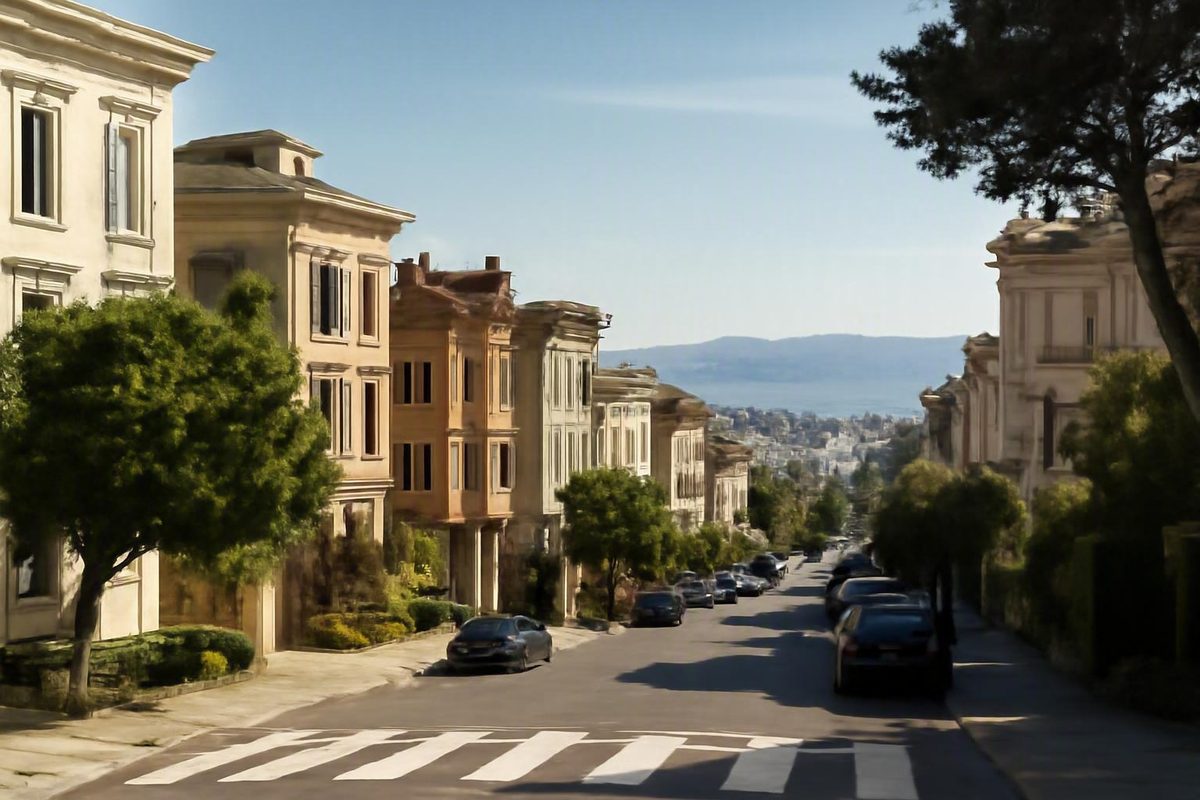
The appeal lies in what faces the public realm: façades, rooflines, entrances, walls, mature landscaping and the arrangement of large homes along the hill. Trees, hedges, retaining walls and sloping driveways also show how residential architecture responds to Pacific Heights’ terrain.
Architectural variety is one of the segment’s most noticeable features. The supplied sources describe Victorian, Edwardian, revivalist, Tudor, château-inspired, contemporary and modern designs rather than one uniform house type. An architecture firm’s overview of the Broadway segment likewise emphasizes the mixture of historic-looking and contemporary residential styles.
That variety makes the walk more interesting when you look beyond scale. Compare:
- Symmetrical and asymmetrical façades
- Steep roofs with flat or concealed rooflines
- Restrained exteriors with elaborate revivalist details
- Masonry compositions with broad areas of modern glass
- Houses set close to the sidewalk with those behind walls or deep landscaping
- Formal entrances with designs organized around garages and sloping driveways
You do not need to identify an owner or occupant to understand how differently neighboring houses present themselves to the street. In fact, concentrating on design usually produces a more rewarding visit than trying to connect each address with a public figure.
Near the upper Lyon Street Steps, openings in the landscape may provide views toward San Francisco Bay and the Palace of Fine Arts. Broader sightlines can extend across the Bay, but fog, low cloud, vegetation and ordinary changes in visibility may obscure part of the panorama. Treat the view as a possible highlight rather than a guarantee.
This is also a residential segment rather than a visitor-services corridor. Do not build a plan around finding a ticket booth, interpretive center, public mansion tour or continuous series of historical plaques on Broadway. Current restroom, water and other service locations should be checked separately rather than assumed.
Visitors should likewise not expect:
- Access to private homes, gardens or entrance paths
- Guaranteed celebrity sightings
- Public confirmation of who currently occupies a residence
- A flat, attraction-style promenade
- A complete architectural history displayed on the street
Photographs of full façades, rooflines and the wider streetscape will generally tell a better story than attempts to inspect windows or identify residents. The buildings, landscaping and shape of the hill are the durable public-facing subjects.
The history behind Pacific Heights’ wealth—without turning lore into fact
A widely repeated explanation connects Pacific Heights’ development as a wealthy residential area with the aftermath of the 1906 earthquake and fire. In this account, affluent San Franciscans affected by destruction in earlier enclaves such as Nob Hill moved or rebuilt toward Pacific Heights, where prominent sites offered Bay-facing views and space for large homes.
The same broad narrative associates the neighborhood with fortunes derived from gold, timber, oil and transportation, followed in more recent tourism coverage by technology wealth. These themes appear in architecture and tour sources, but they should be understood as neighborhood-level context rather than a verified history of every Broadway property.
Early-20th-century mansion development helps explain the character of the surrounding streetscape. It does not mean that every building on the Row comes from the same period or architectural movement. The visible mixture of traditional and contemporary designs instead shows that the area has continued to change.
“Gold Coast” and “Millionaires’ Row” are also names associated with Pacific Heights in tourism coverage. The supplied evidence does not document exactly when each phrase arose or demonstrate a neat historical progression from Gold Coast to Millionaires’ Row and then Billionaires’ Row.
Geological explanations deserve similar caution. Some commercial accounts claim that Pacific Heights experienced less destruction in 1906 specifically because it sits on bedrock. The evidence pack does not contain authoritative geological and historical research sufficient to present that explanation as established fact.
The useful distinction is between neighborhood history and promotional storytelling. Repeated accounts can show how guides and tour operators interpret an area, but repetition alone does not verify every detail. The supported, appropriately qualified conclusion is that supplied architecture and tour sources commonly connect Pacific Heights’ affluent residential development with the period around the early 20th century and post-1906 rebuilding. More specific claims about individual buildings require preservation files, archival documents or other institutional records.
Choose a route that matches your time and tolerance for hills
There is no required route. The best option depends on whether your priority is the Broadway segment itself, a deeper architecture walk or a downhill connection to the Palace of Fine Arts.
Option 1: The focused Broadway visit
Start at Broadway and Divisadero, then walk west along Broadway to Lyon Street. View the houses from public sidewalks, cross carefully and finish near the top of the Lyon Street Steps.
This is the clearest way to cover the commonly described Row without committing to the staircase. At Lyon, pause for the view and assess your energy, the weather and your onward transportation. If you do not want a substantial descent, turn around or leave by another nearby street.
There is no need to assign a rigid completion time. The segment is short, but the route used to reach it may be hilly, and stops for architecture, landscaping and views will affect your pace.
Option 2: An architecture-oriented Pacific Heights outing
Use Broadway and Lyon as the anchor, then add neighboring streets to place the Row in a wider residential context. This lets you compare Broadway’s large properties with different lot patterns, narrower streets and other architectural forms nearby.
For a guided structure, SF City Guides lists a walk titled “Billionaires’ Row: Outer Broadway Architecture.” The organized route meets at Broadway and Lyon, includes hills and stairs, lasts approximately 1.5 to 2 hours, and ends at Washington and Lyon near the Swedenborgian Church at 3200 Washington Street. Those details apply to the listed tour, not to an independent walk, and should be verified through the current SF City Guides tour page before your visit.
If you are walking independently, Broadway and Lyon remains the logical no-stair turnaround. You can add nearby streets before or after reaching that point without descending toward Cow Hollow.
Option 3: The scenic downhill extension
A longer route can connect Alta Plaza Park, the Broadway segment, the Lyon Street Steps and the Palace of Fine Arts. Commercial walking itineraries use this sequence because it moves from a neighborhood park to hilltop architecture and then toward Bay-facing scenery.
It is not merely a longer version of the Row. Once you descend the Lyon Street Steps, you have left the compact Broadway visit and committed to a lower endpoint. One published itinerary begins at Alta Plaza Park, continues through Billionaires’ Row and descends approximately 350 steps before ending at the Palace of Fine Arts, illustrating why the stair-heavy extension requires a separate return plan.
Before descending, decide how you will leave the lower area. Transit, a pickup or another one-direction itinerary may make more sense than retracing the staircase. If your return plan is uncertain, stop at the top.
Option 4: A broader Pacific Heights walk
Visitors who want a neighborhood-scale outing can combine Billionaires’ Row with parks, historic houses, Fillmore Street and surrounding residential blocks. One published self-guided route begins near Van Ness Avenue and Jackson Street, covers four miles, and gives an author-estimated duration of two to three-and-a-half hours.
Those figures apply to that complete itinerary, not to Broadway between Divisadero and Lyon. The longer option makes sense when Pacific Heights is a major part of the day rather than a brief stop between other attractions.
Even on a broad route, Lyon remains the key decision point. Do not descend simply because the stairs look like the next obvious attraction. Confirm that the lower endpoint and return logistics suit the rest of your day.
Hills, stairs, and a reduced-stair alternative
Pacific Heights has steep grades, and the approach to Broadway may be more demanding than the three-block segment itself. Streets that appear close together on a map can involve significant climbing, so the most convenient starting point depends on your origin and tolerance for hills.
The Lyon Street Steps add a separate physical challenge. Sources disagree about the exact count: one guide reports competing totals of 288 and 332 steps, while a commercial itinerary describes the descent as about 350 steps. The evidence therefore supports describing the staircase as substantial, not choosing a definitive number. The conflicting figures are reported in the Lyon Street Steps guide and the commercial itinerary linked above.
For a reduced-stair visit:
- Arrive near either end of the Broadway segment.
- Walk between Divisadero and Lyon on public sidewalks.
- Pause near the top of the Lyon Street Steps.
- Enjoy whatever view the conditions allow.
- Return along Broadway or leave by another street without descending.
This avoids the main staircase, but it should not be described as wheelchair accessible, fully step-free or suitable for every mobility level. The supplied evidence does not include an accessibility audit of grades, curb ramps, crossings, pavement or temporary construction conditions.
Warnings on tour pages should be interpreted narrowly. One commercial route says its stair-heavy itinerary is unsuitable for travelers using walkers or strollers; another says its route is not wheelchair accessible. Those statements concern the operators’ particular routes, including the Lyon Street Steps. They do not establish the accessibility of every public sidewalk in Pacific Heights.
Comfortable walking shoes, water and a manageable pace are sensible for any version of the outing. Stop where you will not block driveways, entrances or the sidewalk. If you descend toward the Palace of Fine Arts, treat the return as a separate transportation decision rather than assuming you will want to climb back.
Visitors with mobility limitations should check current sidewalk, construction and transit conditions on the day of the visit. Compare arrival points instead of assuming the geographically nearest stop offers the easiest approach. Do not rely on unverified availability of benches, restrooms, drinking water, smooth pavement or accessible crossings.
Self-guided walk, free architecture tour, or paid tour?
No tour is required.
A self-guided visit works well when you want:
- Flexible timing
- No admission cost for using public sidewalks
- Control over how much hill climbing you do
- An easy turnaround before the Lyon Street Steps
- A quiet focus on architecture rather than personalities
- Freedom to combine the Row with another part of your day
The tradeoff is that the street itself does not provide a complete interpretive framework. Without preparation, you may see intriguing façades without knowing the broader neighborhood story. That need not diminish the experience: close observation can be the purpose of the walk.
An SF City Guides walk is the clearest supplied option for structured, architecture-oriented narration. Its current listing says “Billionaires’ Row: Outer Broadway Architecture” meets at Broadway and Lyon, lasts approximately 1.5 to 2 hours, includes hills and stairs, and ends at the Swedenborgian Church at 3200 Washington Street.
A third-party tourism guide describes this as a free tour, but the official listing supplied here does not establish a permanent no-cost policy. Verify the current calendar, reservation rules, group policies, cost or donation arrangements, and Muni information on the official City Guides listing before building your day around it.
A paid walking tour may add historical narration, photography help or a planned continuation to the Palace of Fine Arts. That can be useful if you want someone else to manage the route or if the Palace already fits your itinerary.
Treat booking-platform details as temporary. Prices, schedules, suppliers, group sizes, cancellation terms and exact routes can change. Ratings also require context: a perfect score based on only a few reviews reflects a small, self-selected sample and does not establish consistent quality or historical accuracy.
A practical decision rule is:
- Choose self-guided for flexibility and a simple no-stair turnaround.
- Choose City Guides for architecture-focused context, after verifying current terms.
- Choose a paid tour only when its current endpoint, terrain and mobility requirements match your needs.
Whichever format you choose, a guide does not create access to private homes. Tours operate from public space and should follow the same privacy standards as independent visitors.
Getting there and deciding whether to drive
The best arrival point depends on your walking direction and what you plan to do at Lyon Street.
For the focused Row, begin near Broadway and Divisadero or Broadway and Lyon. Starting at Divisadero produces a straightforward westbound finish near the overlook. Starting at Lyon lets you assess the view and staircase first, then walk east away from the descent.
If you intend to continue to the Palace of Fine Arts, a one-direction plan is usually easier to manage. Arrange the lower endpoint before beginning rather than discovering after the descent that your vehicle, transit connection or next reservation is back uphill.
Transit routes and service patterns can change. Check current official Muni schedules, service information and a live trip planner on the day of your visit rather than relying on an older blog’s route number or frequency. Compare the final walking approach as well as travel time: a nearby stop may still leave you with a steep climb.
Driving is possible, but it does not eliminate the need to plan around hills. Parking availability cannot be guaranteed, and an apparently open curb is not necessarily a legal space. Read all relevant signs and check curb markings, permit limits, street-sweeping restrictions and tow-away hours. Make sure the vehicle does not obstruct a driveway, sidewalk or crossing.
SFMTA states that cones, trash cans and similar objects cannot be used to claim public on-street parking. Legitimate temporary no-parking or no-stopping zones require authorization through the city’s Temporary Signage Program. The agency’s official parking guidance also directs drivers to follow posted restrictions and use 311 for deficient or missing signs and related maintenance concerns.
If an object appears to be reserving public curb space without authorized signage, avoid a confrontation. Note the location, document the condition from public space if it is safe to do so and use official reporting channels.
Published allegations about neighborhood parking disputes do not change the governing rules. Nor do allegations of cones, confrontations or vehicle damage establish who was responsible for damage without an investigation or official finding. For visitors, the relevant guidance is simple: follow posted restrictions, avoid disputes and report problems through the proper channels.
Residential etiquette and the claims this guide will not make
Remain on public sidewalks and obey signs. Do not step into driveways, entrance paths or landscaping to improve a photograph. Keep vehicle entrances clear, leave room for other pedestrians and move away when residents or service workers need access.
Photographing broad façades and streetscapes is less intrusive than aiming through windows or concentrating on people entering and leaving. Avoid long lenses or other equipment used to inspect private interiors. Do not hold cameras over walls, fly equipment over private grounds or linger at a doorway while trying to establish who lives there.
This guide does not provide a sightseeing list of current residents or precise celebrity addresses. Occupancy claims are frequently uncited, privacy-sensitive and subject to change. Even a verified property record would not necessarily establish who currently lives in a house, and ownership through a company would not by itself identify a beneficial owner.
Property-price claims are also poor visitor guidance. The supplied commercial sources conflict over whether one widely discussed Broadway property sold for $70 million or $71 million, and the evidence does not independently resolve the discrepancy. Omitting a definitive figure is more accurate than choosing one for effect.
Asking prices must also be distinguished from completed transactions. A listing records what a seller sought at a particular time; it does not prove that a sale occurred at that amount. Promotional valuations and claims about neighborhood rankings require the same caution.
The durable reason to visit is already in public view: architectural variety, landscaping, the shape of Pacific Heights and the transition from mansion-lined Broadway to the Lyon Street Steps and Bay-facing scenery.
A successful outing can be simple. Walk Broadway between Divisadero and Lyon, study the architecture and stop at Lyon for the view. Descend only if the terrain and return plan make sense. Billionaires’ Row works best as one part of a Pacific Heights visit—not as a hunt for private residents.
Frequently asked questions
Where exactly is Billionaire Row in SF?
The most commonly used sightseeing boundary is Broadway between Divisadero Street and Lyon Street in Pacific Heights, a stretch of roughly three blocks. Divisadero is the eastern end; Lyon is the western end beside the top of the Lyon Street Steps.
The supplied sources use the name as a nickname and do not establish a formal city boundary. Nearby mansions may appear in broader descriptions, but Broadway between those two cross streets is the clearest planning definition.
Can you walk Billionaires’ Row for free without taking a tour?
Yes. No tour or admission payment is required to walk the public streets and sidewalks. The residences remain private, so this access does not extend to homes, gardens, gates, driveways or entrance paths.
A guided walk is optional. It may provide architectural or historical narration, while self-guided exploration gives you more control over pace and makes it easy to stop before the Lyon Street Steps.
How difficult are the hills and Lyon Street Steps?
Difficulty depends heavily on your approach. Pacific Heights has steep grades, and reaching Broadway may involve more climbing than the mansion-lined segment itself.
The Lyon Street Steps are a substantial staircase. Supplied sources report conflicting totals ranging from 288 to roughly 350, so visitors should plan for significant stair use rather than rely on one definitive count. A listed commercial route involving the staircase also says it is not wheelchair accessible and requires a moderate fitness level, as detailed in its mobility information.
Is there a way to visit without descending the Lyon Street Steps?
Yes. Walk Broadway between Divisadero and Lyon, stop near the upper end of the steps for the view and return without descending. That covers the commonly described Row.
Do not assume this makes the entire visit step-free or wheelchair accessible. The evidence does not audit approach grades, curb ramps, crossings, sidewalk surfaces or temporary construction conditions.
Can traffic cones legally reserve street parking in San Francisco?
No. SFMTA says ordinary cones, trash cans and similar objects cannot be used to claim public on-street parking. Authorized temporary no-parking or no-stopping restrictions require city approval and official signage, according to SFMTA’s parking rules.
Drivers must still follow posted signs, curb markings, permit rules, street-sweeping restrictions and tow-away hours. Problems involving parking obstructions or deficient signs can be reported through 311, and visitors should avoid confrontations over curb space.