
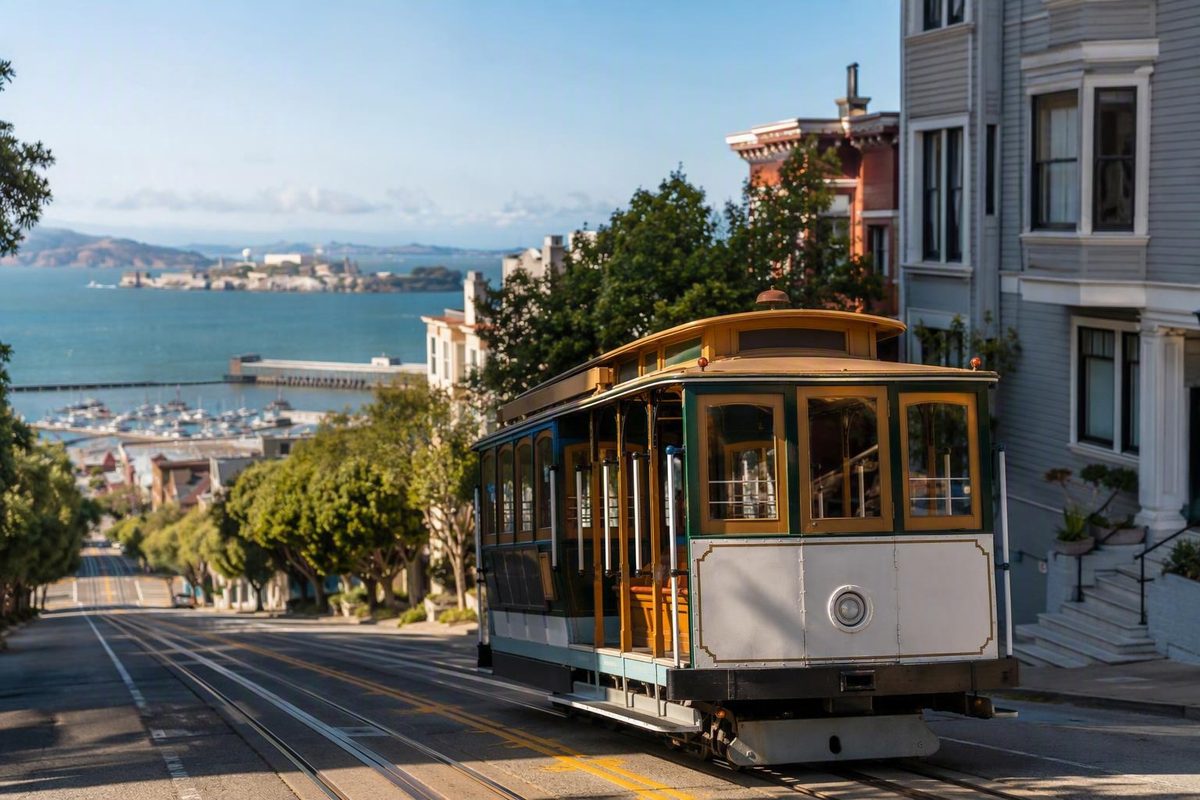
Andrew Smith Hallidie developed San Francisco’s first successful street cable railway by adapting wire-rope and mining-conveyance technology. Regular service began on Clay Street in 1873, and cable routes eventually formed a roughly 53-mile urban network. Electric streetcars, earthquake damage, aging infrastructure, route closures, and buses later made most of that network obsolete.
Cable cars survived because San Francisco’s steepest streets preserved a practical role for cable traction—and because residents repeatedly chose to retain a reduced system. Today, the operating network consists of the Powell–Mason, Powell–Hyde, and California Street lines, not the full Victorian system described in SFMTA’s cable-car history.
San Francisco cable-car history at a glance
The history follows a clear arc: invention, rapid expansion, technological decline, civic preservation, consolidation, and reconstruction. Preservation did not save every original line. It retained and reconfigured selected routes into the working three-line system operating today.
| Date | Milestone |
|---|---|
| 1869 | Hallidie conceived a cable-powered street railway suited to San Francisco’s hills. |
| August 1–2, 1873 | Historical accounts differ over the first Clay Street test or trip. FoundSF places a successful test on August 1, while SFMTA and other histories use August 2. |
| September 1, 1873 | The Clay Street Hill Railroad began regular public service. These early milestones are documented in SFMTA’s history. |
| 1892 | The network reached its reported greatest route extent. Cable companies eventually laid about 53 miles of track and operated more than a dozen lines. |
| April 18, 1906 | The earthquake and fires damaged cable infrastructure. Cable service on Market Street ended with the disaster. The expansion and 1906 milestones are summarized in the 150 Years of Cable Cars history. |
| 1947 | Voter action required the city to retain the Powell Street cable-car lines after officials proposed replacing them with buses. |
| 1949 | A separate vote supported municipal acquisition of the privately operated California Street Cable Railroad. These two voter decisions are detailed in SFMTA’s preservation history. |
| 1952 | San Francisco completed its acquisition of the California Street company. |
| 1954 | Consolidation substantially reduced cable-car trackage. |
| 1957 | Powell–Hyde was assembled from portions of earlier routes, establishing the surviving three-line pattern. These consolidation milestones appear in Market Street Railway’s historical overview. |
| 1964–1966 | The system received National Historic Landmark designation in 1964 and was added to the National Register of Historic Places in 1966. The two federal milestones are recorded in the historic-property summary. |
| 1971 | Voters added city-charter protection for continued cable-car operation and minimum service. |
| 1982–1984 | The system, car barn, and operating infrastructure underwent comprehensive reconstruction. Market Street Railway recounts the charter protection and rebuilding. |
| Today | The operating routes are Powell–Mason, Powell–Hyde, and California Street. |
Two kinds of survival appear in this timeline. The 1947 vote stopped the immediate elimination of the Powell lines. The later acquisition, consolidation, charter protection, and reconstruction determined the smaller system’s long-term form.
1873: Hallidie brings cable traction to Clay Street
Andrew Smith Hallidie was a Scots-born engineer and an experienced maker of wire rope. He had used cable in mining conveyance, where machinery could move heavy loads without relying on traction from a vehicle’s wheels. His achievement was to adapt that broader technology into San Francisco’s first successful street cable railway—not to invent every form of cable haulage from nothing.
Hallidie entered a partnership to construct the Clay Street Hill Railroad over Nob Hill. The line demonstrated that a continuously moving cable beneath the street could pull passenger cars over terrain that created serious problems for horse-drawn service.
The exact date of the first demonstration is less certain than the familiar anniversary suggests. FoundSF reports a successful test descent and return on August 1, 1873. SFMTA and other preservation histories place the first test or trip in the early hours of August 2. These accounts may be describing a test and a launch differently, but the available summaries do not resolve the discrepancy conclusively.
The firmer public milestone came one month later. Regular service on the Clay Street Hill Railroad began on September 1, 1873. That date marks the change from experimental demonstration to scheduled urban transportation.
Hallidie said his purpose was to overcome hills too steep for horse-drawn streetcars. A more dramatic story holds that he was inspired after seeing horses struggle or suffer while pulling a car on a wet San Francisco grade. That version remains part of cable-car folklore, but it should be treated as legend or attributed recollection rather than established fact.
The underlying problem is clear without relying on the legend. San Francisco needed a practical way to carry passengers over severe grades without asking horses to haul loaded railcars uphill. Clay Street showed that an underground cable could supply the necessary pulling force.
Why cable cars worked on San Francisco’s hills
A cable car does not propel itself with an onboard motor. Instead, the wooden vehicle is pulled by a continuously moving underground cable. That basic distinction explains both the system’s advantage on steep terrain and the infrastructure burden that eventually made it obsolete across most of the city.
On a severe grade, the cable supplies the pulling force. Horses do not have to drag the car uphill, and the vehicle does not depend entirely on powered steel wheels maintaining adhesion against steel rails. Conventional electric streetcars worked well across most city streets, but their wheels could slip on grades where cable traction remained useful.
Cable operation required an interconnected physical system beneath and beside the street: a power source, moving cables, specialized track construction, and supporting machinery. Cable traction therefore made the most sense where its hill-climbing advantage justified its complexity.
| Transit type | Main advantage | Main limitation |
|---|---|---|
| Horse-drawn cars | Used established rail technology without a cable plant | Horses struggled on steep grades and required continual care |
| Cable cars | Could pull cars over severe grades | Required substantial specialized infrastructure |
| Electric streetcars | Generally faster, cheaper, and easier to extend | Steel-wheel traction was less suitable for the steepest cable routes |
This is why cable cars could become obsolete without becoming entirely useless. Electric traction was the stronger general-purpose urban technology. Cable traction retained a narrower advantage on unusually steep streets, and San Francisco had enough of those streets to keep survival possible.
From rapid expansion to a 53-mile network
Clay Street was only the beginning. Other private companies adopted cable traction during the 1870s and 1880s, and more than a dozen lines eventually operated under multiple owners. At the network’s reported peak, cable routes formed part of the city’s ordinary transportation system rather than a service created for sightseeing.
Cable-car companies ultimately laid about 53 miles of track. Historic routes reached toward the Presidio and Golden Gate Park, crossed the Castro area, and extended into the Mission and other districts far beyond the three routes that remain. Cable lines also operated along Market Street, then the city’s central transit corridor.
The network reached its reported greatest route extent in 1892. That same year, electric streetcars began operating in San Francisco. The peak of the cable system therefore coincided with the arrival of the technology that would displace it across most of the city.
The appeal of cable traction was practical. It enabled regular rail service over grades that challenged horses, helping transit companies carry ordinary passengers through a rapidly growing and unusually hilly city. In its own era, this was mainstream transportation technology rather than a nostalgic novelty.
Its geographic reach also changes how the surviving lines should be understood. The Powell–Mason, Powell–Hyde, and California Street routes preserve only a limited portion of the former network. Their importance does not come from representing every historic route; it comes from keeping the underlying transportation technology in active use on streets where its distinctive advantage is still visible.
Electric streetcars, the 1906 disaster, and the long decline
Cable traction’s period of technological dominance was comparatively brief. Frank Sprague inaugurated a practical electric streetcar system in Richmond, Virginia, in 1888, and San Francisco had electric streetcar service by 1892.
Electric streetcars were generally faster, cheaper to construct and operate, and easier to extend into additional areas. Where streets were not exceptionally steep, transit companies had little reason to maintain the underground machinery required by cable operation. Cities converted flatter cable routes to electric traction, and San Francisco followed the same pattern.
The earthquake and fires of April 18, 1906 delivered another major blow. The disaster damaged cable infrastructure across San Francisco, and cable service on Market Street ended. Reconstruction decisions had to be made alongside the rebuilding of streets, utilities, buildings, and the wider transit network. On routes where cable traction no longer offered a compelling terrain advantage, electric conversion became more attractive.
The earthquake did not cause the cable network’s disappearance by itself. Decline was cumulative: electric streetcars had already challenged cable operation, the disaster damaged infrastructure, machinery aged, routes closed or changed, and buses later offered service without the same fixed mechanical system beneath the street.
That longer sequence is more accurate than a simple before-and-after account. San Francisco did not abandon most cable routes on a single day. It repeatedly selected newer technology where cost, flexibility, and geographic reach mattered more than cable traction’s ability to handle severe grades.
The 1947 fight that saved a smaller system
By the mid-1940s, San Francisco’s transit system was in poor condition after World War II. Mayor Roger Lapham and other officials supported replacing worn rail services with buses. They argued that cable cars were costly to repair and operate and could not provide adequate modern service.
The Powell Street lines were scheduled for bus replacement in 1947. Friedel Klussmann responded by founding the Citizens’ Committee to Save the Cable Cars and organizing a public campaign around their value to San Francisco. Voters sided with preservation and required the city to retain the Powell lines, as recounted in SFMTA’s account of the campaign.
That decision prevented immediate elimination, but it did not preserve every remaining cable route unchanged. A separate vote in 1949 supported municipal acquisition of the privately operated California Street Cable Railroad. San Francisco completed the acquisition in 1952.
The inherited network was then consolidated. Trackage was substantially reduced in 1954, and Powell–Hyde was created from portions of earlier routes in 1957. Preservation consequently involved both survival and loss.
| Proposal or condition | Decision or action | Result |
|---|---|---|
| Replace Powell cable cars with buses | 1947 voter action | City required to retain the Powell lines |
| Continue private California Street operation | 1949 acquisition vote; purchase completed in 1952 | California Street company entered municipal ownership |
| Maintain the broader inherited network | 1954 consolidation | Cable-car trackage was substantially reduced |
| Reconfigure remaining route segments | Powell–Hyde formed in 1957 | The surviving three-line pattern took shape |
The distinction between the 1949 and 1952 events matters. Voters supported acquisition in 1949; the city completed the transaction three years later. Likewise, the 1954 consolidation reduced the system, while the creation of Powell–Hyde in 1957 completed a later part of the reconfiguration.
The preservation campaign succeeded through compromise. It blocked complete replacement, helped bring the remaining private operation into city ownership, and kept cable traction in regular service. But it did not restore the 53-mile network or preserve every inherited route.
From working transit to protected industrial heritage
The surviving cable-car system gradually acquired formal legal and historic protection. It received National Historic Landmark designation in 1964, followed by listing on the National Register of Historic Places in 1966. These were distinct federal milestones rather than interchangeable names for the same action.
In 1971, San Francisco voters added city-charter protection for continued cable-car operation and minimum service. That changed the system’s political position: continued operation became more than an ordinary policy preference that city officials could readily reverse.
Historic protection did not mean leaving worn machinery untouched. From 1982 to 1984, San Francisco undertook a comprehensive reconstruction of the system, including the car barn and operating infrastructure. The cable cars operating today are therefore historic transportation sustained through maintenance, replacement, and rebuilding—not vehicles and machinery composed entirely of original 19th-century parts.
Three routes remain:
- Powell–Mason
- Powell–Hyde
- California Street
The cars are not all configured alike. California Street uses double-ended cars that can reverse direction through trackwork. The Powell lines use single-ended cars that must be physically turned on turntables at their terminals. For visitors, watching that manual turn provides an immediate view of how specialized this railway remains.
The Cable Car Museum offers a clearer look beneath the familiar street scene. It occupies part of the historic Cable Car Barn and Powerhouse, where operating winding machinery shows the industrial system that pulls the cars through the city. The museum also displays historic cable cars and other material from the system’s development.
That combination is what makes San Francisco’s cable cars unusual. They are a visitor attraction, but they are not merely decorative vehicles or replicas. They remain municipal transit supported by live machinery, specialized operating practices, legal protection, and a reconstructed historic infrastructure.
San Francisco’s hills gave cable traction a lasting practical niche, but civic action determined whether that niche would survive. The three lines moving through the city today are not an intact Victorian network. They are a deliberately preserved, consolidated, and rebuilt fragment—one that keeps the city’s transit history visible in motion.