
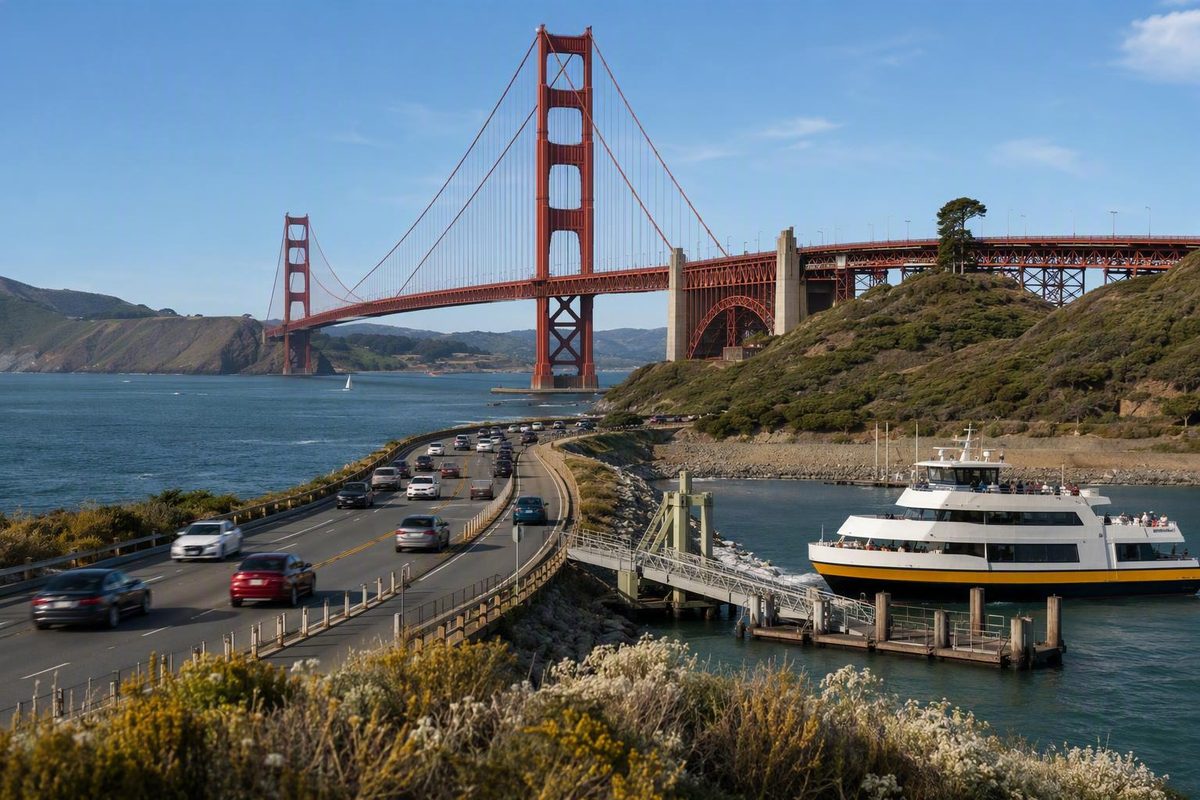
Since July 1, 2026, a standard southbound Golden Gate Bridge crossing costs $10.25 with FasTrak, $10.50 with plate-based payment, or $11.25 by mailed Toll Invoice. Taking Golden Gate Transit or Golden Gate Ferry did not avoid the day’s increase: both regional transit fares also rose on July 1 under the district’s five-year fare program, although the supplied fare notice does not provide enough figures to compare their exact dollar costs with driving.
Every Standard Driving Rate Rose By 50 Cents
The July increase added $0.50 to every standard two-axle payment category and to the conditional eligible-carpool rate. The official toll schedule lists the rates now in effect.
| Payment Category | Before July 1 | From July 1 | Increase |
|---|---|---|---|
| FasTrak | $9.75 | $10.25 | $0.50 |
| Plate account or one-time payment | $10.00 | $10.50 | $0.50 |
| Toll Invoice | $10.75 | $11.25 | $0.50 |
| Eligible carpool, FasTrak only | $7.75 | $8.25 | $0.50 |
Motorcycles use the standard two-axle rates. The $8.25 carpool figure is conditional rather than an automatic discount for carrying several people.
The Golden Gate Bridge, Highway and Transportation District separately announced that Golden Gate Transit bus and Golden Gate Ferry regional fares increased on the same date. Its transit and ferry fare notice identifies July 1, 2026, as part of a five-year fare program.
The source material supplied here does not include the individual bus and ferry route fares before and after the change. Their exact amounts therefore cannot be placed honestly beside the driving prices. What the official notice does establish is that neither service held its regional fares steady on July 1.
Why The Skip-Driving Advice Sounds Reasonable
The usual money-saving advice has a fair foundation. FasTrak now costs $10.25 for one tolled car crossing, and a mailed invoice costs $11.25. A visitor may also face rental-company processing charges that are separate from the bridge’s underlying toll. A bus or ferry avoids parking, driving, and responsibility for paying a vehicle toll.
Transit can still be the better choice for convenience, a waterfront approach, or avoiding a car in San Francisco. The July toll increase alone, however, does not prove that transit escaped the price change. The district’s news index records both the bridge and regional transit changes, and the bus and ferry increases took effect on the same day.
That distinction scopes the verdict. Bus or ferry may cost less for a particular passenger and route, but the figures supplied in the official notice here do not establish that comparison. They establish only that switching modes did not sidestep the July 1 increase itself.
Choose a mode, date and number of crossings; the comparator shows whether that option escaped the July 1 increase.
The default view compares all four requested crossing options after July 1. Select one to calculate known driving costs or inspect the documented transit change.
| Mode | Before July 1, 2026 | July 1 or later | Change |
|---|---|---|---|
| Drive: FasTrak Southbound toll only | $9.75 | $10.25 | +$0.50 |
| Drive: mailed invoice Southbound toll only | $10.75 | $11.25 | +$0.50 |
| Golden Gate Transit bus Regional passenger fare | — route fare not supplied | — route fare not supplied | Increased |
| Golden Gate Ferry Regional passenger fare | — route fare not supplied | — route fare not supplied | Increased |
Default verdict: all four displayed crossing options increased on July 1, 2026; none held steady.
Sources: Golden Gate Bridge official July 2026 toll schedule; Golden Gate Transit and Golden Gate Ferry regional fare-change notice. A dash means the exact figure was not supplied.
A Round Trip Usually Produces One Bridge Toll
Golden Gate Bridge vehicle tolls are collected only southbound into San Francisco. Driving north from San Francisco toward Marin does not produce a Golden Gate Bridge toll; returning south produces one.
A San Francisco-to-Marin-and-back itinerary therefore crosses the bridge twice but normally incurs one bridge toll. The same count applies in reverse: a trip beginning in Marin pays on the southbound leg into San Francisco, not on the later northbound return.
Budget by counting southbound vehicle crossings rather than doubling the posted rate for every round trip. Five out-and-back driving days with one southbound crossing each mean five tolls, not ten. Any other tolled bridge on a longer route has its own schedule and collection rules.
Bus and ferry fares work differently because they are passenger fares rather than vehicle tolls. The one-direction bridge toll rule should not be applied to transit pricing.
FasTrak Remains The Cheapest Standard Payment Method
For a standard two-axle vehicle or motorcycle, FasTrak is $0.25 cheaper than either plate-based option and $1 less than a Toll Invoice. The district’s July 2026 bridge announcement separates the payment categories.
| Payment Method | Southbound Toll | More Than FasTrak |
|---|---|---|
| FasTrak | $10.25 | — |
| License Plate Account | $10.50 | $0.25 |
| One-Time Payment | $10.50 | $0.25 |
| Toll Invoice | $11.25 | $1.00 |
A License Plate Account and One-Time Payment share the same rate, but they are different arrangements. One-Time Payment should not be confused with a Toll Invoice: the former costs $10.50 and the latter $11.25, a difference of $0.75.
For one crossing, the difference among standard methods is limited to $1. For 20 southbound crossings, FasTrak totals $205, plate-based payment totals $210, and Toll Invoice totals $225. FasTrak is therefore $5 less than the plate rate and $20 less than invoices over those 20 crossings.
The July increase itself adds $10 across 20 comparable crossings because 20 crossings multiplied by the $0.50 increase equals $10.
These totals cover bridge tolls only. They do not include rental-company toll-processing fees, account charges, penalties or other amounts outside the bridge schedule. Rental drivers should check their agreements before crossing because the official rates do not determine what a rental company may charge.
The $8.25 Carpool Rate Requires Confirmed Eligibility
The eligible-carpool toll rose from $7.75 to $8.25. It appears only under FasTrak, not under License Plate Account, One-Time Payment or Toll Invoice.
Having multiple occupants does not by itself prove eligibility. Occupancy, toll-tag settings, lane, direction, day, time and vehicle-class conditions may affect whether the discount applies. The rate table alone does not establish all of those operational rules.
The discounted rate is $2 below the standard $10.25 FasTrak toll, but that arithmetic does not entitle every group to the lower charge. Use the standard FasTrak figure for planning unless the vehicle and trip satisfy the district’s current carpool and DMV decal rules.
Multi-Axle Vehicles Use A Different Schedule
Trucks and some RV, trailer or towing combinations may not belong in the two-axle category. The current district schedule increases with the number of axles.
| Axles | FasTrak | Plate Payment | Toll Invoice |
|---|---|---|---|
| 2 or motorcycle | $10.25 | $10.50 | $11.25 |
| 3 | $30.75 | $31.50 | $33.75 |
| 4 | $41.00 | $42.00 | $45.00 |
| 5 | $51.25 | $52.50 | $56.25 |
| 6 | $61.50 | $63.00 | $67.50 |
| 7 or more | $71.75 | $73.50 | $78.75 |
The available old-versus-new comparison establishes a $0.50 increase for standard two-axle vehicles, motorcycles and eligible carpools. It does not supply every previous multi-axle amount, so the current schedule cannot be used to claim that each larger category also rose by exactly $0.50.
Axle count, rather than body style alone, determines the category. An RV towing a vehicle or a truck pulling a trailer may have more chargeable axles than the powered vehicle by itself. The southbound-only collection rule still applies.
Electronic Tolling Means No Cash Booth At The Bridge
The Golden Gate Bridge uses all-electronic tolling. Drivers do not stop at a staffed booth, and cash tolls are not collected at the bridge.
That does not mean cash is unavailable through every authorized off-bridge channel. The district identifies credit card, cash, check and money order as possible payment instruments across its payment arrangements, but not every instrument necessarily works through every channel. Current setup instructions and deadlines should be checked for the selected method.
Drivers should continue through the electronic tolling area rather than slowing down to search for a cash lane. The crossing is recorded electronically, and the driver remains responsible for having the toll handled through an appropriate account, payment or invoice arrangement.
FasTrak also warns that it will never request payment by text. A text message asking for a FasTrak payment should be treated as suspicious; do not follow its link, and navigate independently to an official payment site.
The Bridge And Transit Changes Remain Separate Charges
The bridge increase was one step in a five-year incremental toll program adopted by the district’s board in March 2024, according to the official FasTrak rate notice. The source establishes the program and adoption date but does not assign the July 2026 increase to one construction project, maintenance job or fixed revenue target.
Golden Gate Transit and Golden Gate Ferry regional fares also rose under a five-year fare program. The matching July 1 date explains why changing among district-operated crossing modes did not avoid that day’s increase, but it does not make the charges interchangeable.
A bridge toll applies to a vehicle’s southbound crossing. A bus fare applies to a passenger trip on Golden Gate Transit, and a ferry fare applies to a passenger trip on Golden Gate Ferry. Each service has its own prices and rules.
The Golden Gate Bridge schedule is also separate from the schedules for the seven state-owned Bay Area toll bridges. An announcement concerning the Bay Bridge, Richmond–San Rafael Bridge or another state-owned crossing should not be assumed to change Golden Gate Bridge rates.
Future figures under either five-year program should be checked against the schedule then in effect. For travel now, the defensible choice among driving, bus and ferry depends on route convenience, passenger count, parking and the current fare for the specific transit trip—not on an assumption that bus or ferry stayed unchanged on July 1.