
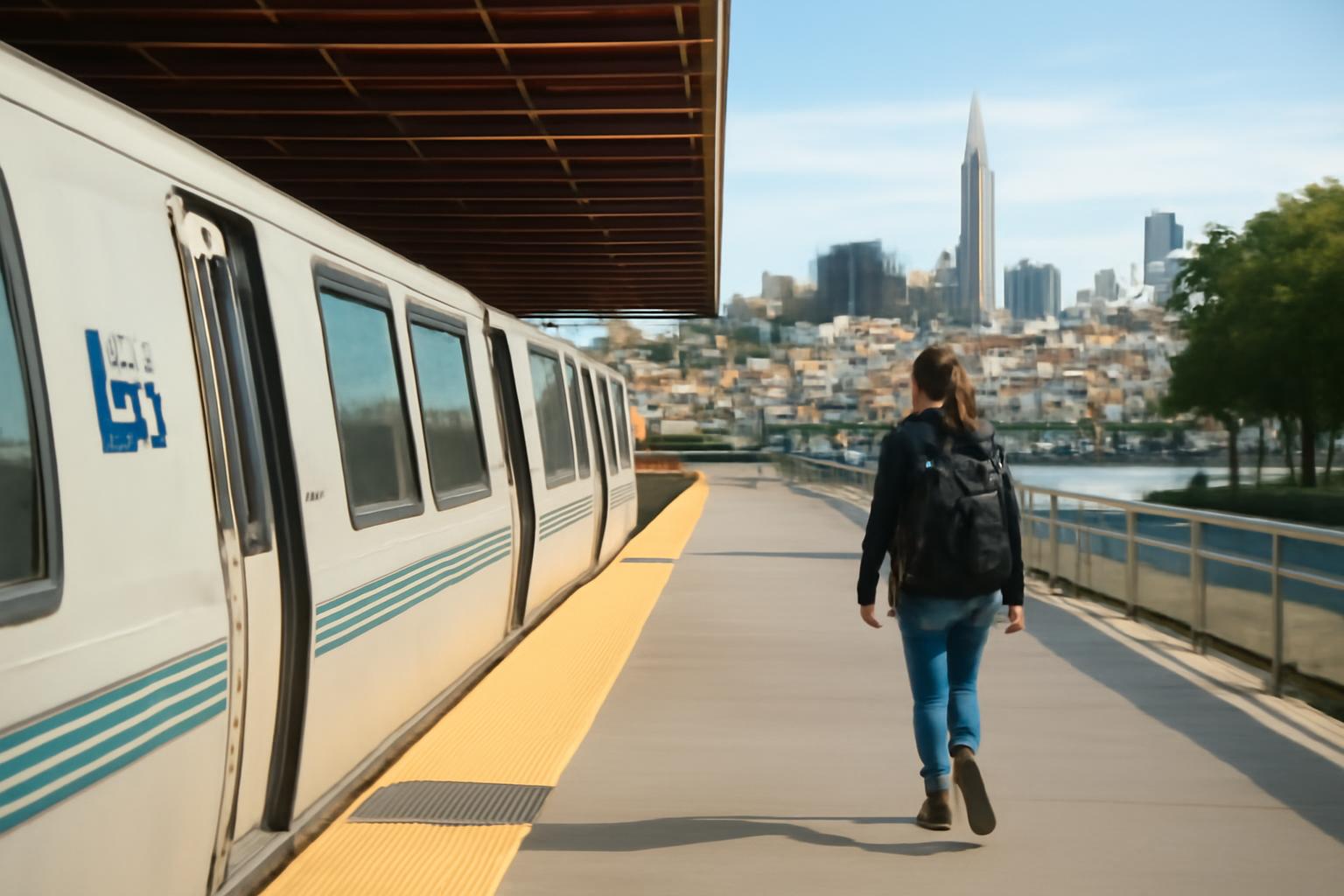
If your actual destination is San Francisco rather than the Bay Area in general, the airport choice is usually less about a dramatic speed gap and more about transfer shape, schedule fit, and how much friction you are willing to tolerate after landing.
The strongest direct comparison in the evidence is not a systemwide average. It is a single July 2024 head-to-head test. But it is still useful because it shows how close these trips can be when your target is a downtown BART stop rather than a curbside pickup or a far-flung neighborhood. Official airport and BART guidance also helps explain why: both airports can hand you to the rail network efficiently, but each does it a little differently.
The practical takeaway for most visitors is this: if you plan to take rail into San Francisco’s core, search both airports. Then decide based on fare, arrival time, airline schedule, luggage, and whether you prefer SFO’s slightly simpler handoff or are fine with OAK’s extra connector step.
SFO vs. Oakland: Real Transit Times to San Francisco Downtown
The clearest head-to-head evidence is a real-world comparison to Embarcadero, and it found near-parity rather than a blowout. In that July 2024 test, Cranky Flier timed the trip from exiting SFO security at 1:52 p.m. to arriving at Embarcadero at 2:39 p.m. for a total of 47 minutes via AirTrain and BART. On the reverse comparison, leaving Embarcadero at 9:57 a.m. and reaching OAK security took 44 minutes via BART and the airport connector, even after missing one connector departure. The same piece notes SFO sits about 7 miles south of San Francisco’s border while OAK is about 7 miles east in straight-line terms, yet the transit result still came out essentially even for downtown access in that test (Cranky Flier’s comparison).
That does not prove the airports are always equal. It does show that once you add airport circulation, platform waits, and transfer timing, small map-based advantages can disappear. A missed connector at OAK or a longer BART wait at SFO can erase what looks like a neat geographic edge on paper.
It also matters that the comparison stopped at Embarcadero, not at a specific hotel. That is an important distinction. Reaching a central BART station efficiently is one problem; getting from that station to Nob Hill, Fisherman’s Wharf, the Marina, or the western side of the city is another. A visitor staying near Powell Street may feel the trip differently from someone heading to a hilltop boutique hotel that still requires a taxi or a steep walk.
So the right conclusion is modest, not sweeping. The best direct test available suggests that either airport can be competitive for a downtown-bound rail trip, and that flight quality may matter more than airport branding if BART is your plan. Think of “near-equal” here as a practical rule of thumb for downtown rail users, not a guaranteed average in all conditions.
Where the choice starts to separate is outside that narrow scenario. If you have heavy luggage, a stroller, or simply want the least segmented trip, SFO tends to feel cleaner because the airport handoff is more straightforward. If OAK saves you meaningful money or gives you a much better schedule, the extra transfer is often still a reasonable trade.
BART from SFO to San Francisco: Step-by-Step Guide
SFO is the easier airport to explain because the path into rail is simple. From any terminal, follow signs to AirTrain, ride it free to Garage G/BART Station, and enter the SFO BART station in the International Terminal on the Departures/Ticketing Level near the G Gates. SFO says riders can pay with Clipper or with BART’s contactless Tap and Ride using a bank card or mobile wallet; it also notes that a Millbrae transfer can connect you to Caltrain if that corridor fits your plans better (SFO’s official transit page).
A practical arrival flow looks like this:
- Leave your terminal and follow AirTrain/BART signs.
- Board AirTrain; there is no fare for this segment.
- Get off at Garage G/BART Station.
- Tap in at the fare gates with Clipper or a contactless card or phone.
- Board the next train shown as serving San Francisco and confirm the destination on the platform display before you get on.
For most visitors, the useful San Francisco BART stops are the familiar downtown spine: Embarcadero, Montgomery Street, Powell Street, and Civic Center/UN Plaza. In practice, Powell is usually best for Union Square, Embarcadero for the waterfront and lower Financial District, and Montgomery for much of the core business district.
One thing first-time riders often overthink is line color. At SFO, platform displays matter more than memorized screenshots. Service patterns can change, and the most reliable habit is to look for the train that is actually running through the San Francisco stops you need.
If your plans line up better with the Peninsula rail corridor, SFO’s Caltrain option is worth remembering. You can take BART to Millbrae and transfer there. That is not the default move for most downtown visitors, but it can make sense if your hotel or next stop fits the Caltrain side better than BART.
The bigger advantage of SFO is not that it is magically faster in all cases. It is that the airport-side logic is easy: terminal to AirTrain, AirTrain to BART, BART to city.
BART from Oakland Airport to San Francisco: Step-by-Step Guide
OAK adds one more link in the chain, but the process is still straightforward once you know the sequence. UC Berkeley’s transit guide says the Oakland Airport Connector runs every 9 minutes all day, which helps keep the extra transfer from becoming intimidating in normal conditions (UC Berkeley transit guide).
OAK’s own airport page says the BART connection is just across the street from the terminals and that the train ride to Coliseum is a quick 8 minutes. It also says trains depart every 6 minutes during most hours, with less frequent late-night service (OAK’s official public transportation page).
Here is the practical version:
- Leave the terminal and follow signs to BART.
- Walk to the airport connector platform across from the terminals.
- Ride the connector to Coliseum.
- At Coliseum, transfer to the train that continues through San Francisco.
- Tap in and out with your chosen payment method and stay on for your downtown stop.
For most visitors, the useful San Francisco stops are the same ones that matter from SFO: Embarcadero, Montgomery Street, Powell Street, and Civic Center/UN Plaza. The difference is not really where BART drops you off. The difference is the extra handoff at Coliseum.
That extra step is usually easy for solo travelers and light packers. It feels less elegant if you are managing children, oversize bags, or a late arrival where one missed departure matters more. That is the real trade: not a fundamentally different transit system, just a more segmented path into it.
If OAK sounds complicated, it usually is not. It just rewards a little more momentum. Follow the signs, make the connector transfer, and use the destination displays at Coliseum instead of trying to rely on memory.
BART Schedules, Fares & Service Alerts for Airport Trips
BART is a strong airport rail option by U.S. standards, but it is not 24/7. UC Berkeley summarizes the general operating window as 5 a.m. to midnight on weekdays, 6 a.m. to midnight on Saturdays, and 8 a.m. to midnight on Sundays (BART hours summary).
For OAK specifically, the airport says trains run every 6 minutes during most hours and every 20 minutes from 11 p.m. to midnight, depending on day of week. That makes OAK perfectly workable for many normal arrivals, but it also means edge-of-day flights need more care than casual trip-planning often suggests. Before you lock in a flight, check the live trip in BART.gov or 511.org rather than relying on a static article or old screenshot.
If you are using SFO, current disruption planning matters as much as the schedule itself. BART’s airport page warns riders to expect 30-minute delays starting at 9 p.m. Sunday through Thursday between Millbrae, SFO, and Daly City because of planned train-control modernization work (BART service alert).
Fares are distance-based, so the right planning move is not to memorize a published airport fare snapshot. It is to check the live amount for your exact station pair when you travel. That matters more now that schedules, alerts, and payment options can all shift over time.
A smart pre-booking checklist is simple:
- check the first train you could realistically catch after landing
- check the last train that still gives you comfortable margin before departure
- check whether there is an active alert affecting the SFO branch or your transfer timing
- check the trip again on the day of travel
This is also why the “which airport is faster?” question can be too narrow. On a perfect midday run, the difference may be trivial. On a late-night arrival with maintenance delays or an awkward missed transfer, it may feel much larger.
Rideshare, Shuttles & Other Alternatives to BART
If you skip BART, the symmetry between the airports weakens.
At OAK, you still have straightforward non-rail options. San Francisco Travel notes that rideshares are available outside baggage claim, taxis and limousines serve the airport, and BART remains the main public-transit path into downtown San Francisco.
At SFO, the official menu is broader. The airport says SamTrans Route 292 serves the terminals, EPX and 142 serve the Rental Car Center, and SamTrans operates 24/7, with thinner late-night coverage on ECROwl and 397. SFO also lists airporter services to places such as Marin, Sonoma, Napa, and Monterey.
It can make excellent sense if your hotel is awkward from BART, your arrival is outside rail hours, or your group size makes a car feel worth the premium.
That does not mean a car is wrong. It means you should compare the whole trip rather than the airport leg alone. A short car ride that still leaves you stuck in bridge traffic can lose its appeal fast. So can a cheap rail trip that ends with a steep ten-minute uphill luggage drag.
Choosing SFO or OAK Based on Your San Francisco Plans
If your base is downtown, around Union Square, near the Embarcadero, or close to a BART-connected hotel, the airport difference is often small enough that your flight schedule matters more than the airport label.
That is especially true if you are planning San Francisco intelligently. A good city base reduces backtracking, avoids unnecessary climbs, and lets you start major walking days from flatter, better-connected places. In that kind of trip, the value of your airport is not just “How fast do I reach the city?” but “How cleanly do I reach the part of the city that sets up the rest of my stay?”
For many travelers, that points toward the same downtown BART stops from either airport. Powell works well for a Union Square stay. Embarcadero works well for a waterfront-first arrival day. Montgomery is useful for a Financial District or Moscone-oriented trip. If your first afternoon is meant to be light and readable rather than ambitious, either airport can feed that plan reasonably well.
SFO still has an intuitive edge for many San Francisco-first trips. It offers the simpler airport-to-rail handoff, and it generally gives travelers the broader set of flight options overall.
OAK becomes more attractive when the fare difference is meaningful, when you prefer a smaller-airport feel, or when San Francisco is only one part of the trip. If you also expect East Bay time, or simply dislike busier large-airport routines, OAK can be a perfectly rational choice.
So the cleanest decision rule looks like this:
- Choose SFO first if you want the simplest rail path and the widest flight schedule.
- Choose OAK first if the fare or timing is clearly better and you do not mind one extra transfer.
- Treat them as close competitors if your real target is a downtown BART stop.
That last point is the one many visitors underestimate. For downtown-focused transit users, these airports are much closer substitutes than their names suggest.
Rush Hour, Events & Tips for Smooth Airport Transit
If you are driving from OAK rather than taking rail, Bay Bridge conditions are the obvious variable. If you are taking BART, you remove much of that uncertainty from the comparison.
SFO carries a different risk profile. General airport guides commonly frame it as the airport more exposed to fog-related delays, while OAK car trips are more exposed to bridge traffic variability when your destination is San Francisco (Bay Area airport guide). That is not a reason to fear either airport; it is just a reminder that “faster” depends on what kind of disruption you are trying to avoid.
Events can also distort the final leg more than the airport leg. The July 2024 SFO-vs.-OAK comparison was conducted during San Francisco Pride, when movement inside the city was messy, yet the airport-to-Embarcadero rail results still came out close. That is a useful lesson: a clean airport ride does not guarantee an effortless last mile.
A few habits make airport transit smoother from either side:
- keep one warm layer easy to reach
- use the lightest bag you can manage
- set up Clipper or contactless payment before you land if possible
- think about your final neighborhood, not just your first BART station
- do not confuse “downtown arrival” with “door-to-door arrival”
Families and heavier packers should weigh friction more heavily than stopwatch time. OAK’s smaller scale may appeal, but it adds the connector handoff. SFO removes that extra transfer but can feel busier. The better airport is often the one whose annoyances you mind less.
Late-Night or Early Flights: Backup Options Beyond BART
This is where airport choice becomes more consequential.
Once your flight pushes toward the edge of BART service, you should stop thinking only about nominal rail time and start thinking about fallback quality. BART’s daytime usefulness is strong. Its overnight usefulness is zero.
At OAK, the official airport page lists AC Transit Line 73 between OAK and Coliseum/OAK BART from about 4:56 a.m. to 12:06 a.m., plus Line 805 as the late-night service between about 12:35 a.m. and 4:30 a.m.. The same page also points travelers to Amtrak from Oakland Jack London Square for wider regional connections (OAK overnight transit options).
At SFO, the airport says SamTrans operates 24/7, with the thinner overnight network centered on ECROwl and 397; it also lists 292 as a key airport-serving route and notes the additional airporter network for some regional destinations (SFO official transit options).
That does not mean either airport becomes painless outside BART hours. It means you still have public-transit backup if you do not want to pay for a car. In practice, though, the best strategy for very early or very late flights is not heroics. It is margin.
Build extra time if your plan depends on:
- the first train of the day
- a connector or branch transfer
- a late-night bus connection
- a rideshare pickup during an event or surge
If your flight sits well inside BART hours, SFO and OAK can be close-run choices for downtown-bound visitors. If your flight sits near the system’s edges, the comparison changes. Then the better airport is the one whose backup plan you actually trust yourself to execute.
Is BART from SFO or Oakland faster to San Francisco Embarcadero?
In the strongest direct comparison available, the difference was tiny. Cranky Flier timed SFO security to Embarcadero at 47 minutes via AirTrain and BART, and Embarcadero to OAK security at 44 minutes via BART and the airport connector. That supports treating the two airports as practical near-rivals for downtown rail access, while still remembering that it was a single observed test, not a universal average (Cranky Flier’s July 2024 test).
How long is the Oakland Airport Connector to BART?
OAK describes the airport-to-Coliseum segment as a quick connector ride to the main BART network. In practical terms, think of it as a short airport transfer rather than the part of the trip that determines your whole journey.
What SF BART stops serve downtown from both airports?
From either airport, the core downtown stops most visitors care about are Embarcadero, Montgomery Street, Powell Street, and Civic Center/UN Plaza.
Does fog or Bay Bridge traffic make one airport better?
Sometimes, yes, but in different ways. If you are traveling by car, OAK is more exposed to Bay Bridge variability when heading into San Francisco. SFO is more commonly discussed as the airport with fog-related operational risk.
Clipper card needed for SFO/OAK BART?
No. A physical Clipper card is optional for many adult riders because BART now supports contactless payment at the fare gates in addition to Clipper. Clipper is still useful if you want one payment method across multiple Bay Area systems, but it is not the only workable airport-rail option now (payment summary).