
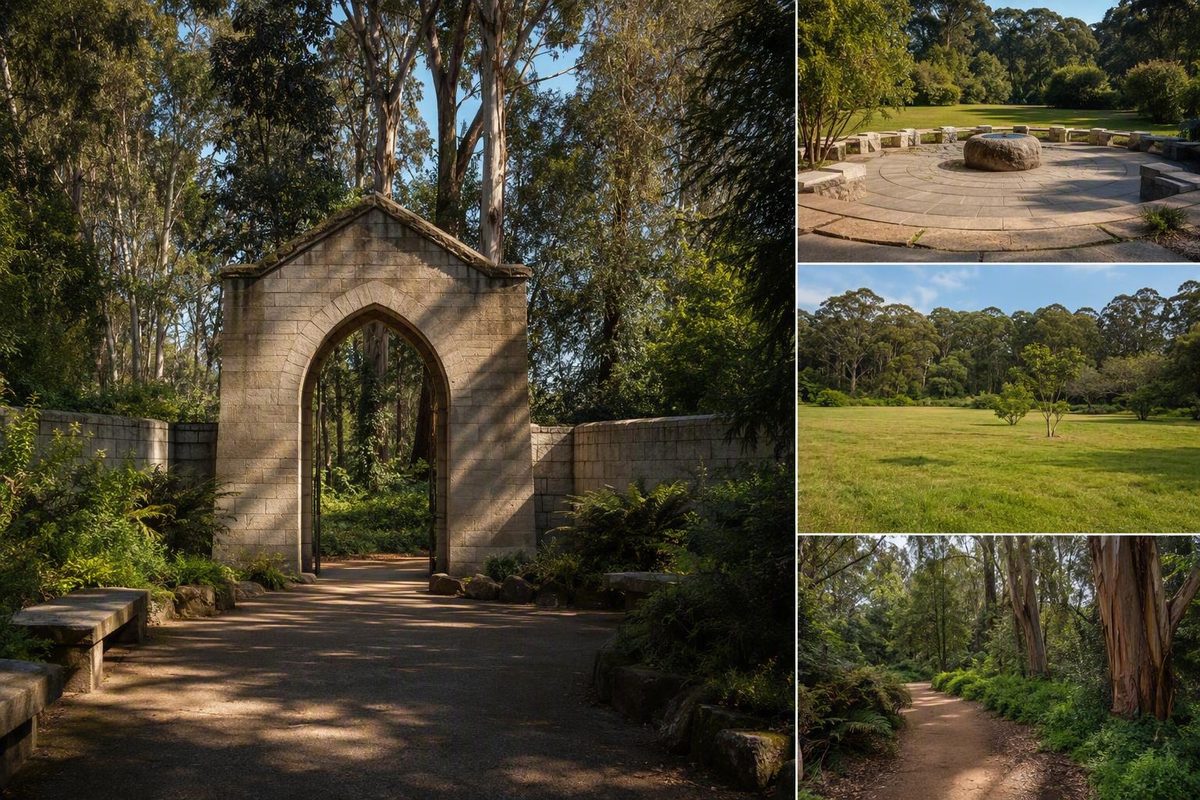
The National AIDS Memorial Grove is a public landscape memorial in Golden Gate Park dedicated to people lost to AIDS and to preserving the wider history of the epidemic. Set within de Laveaga Dell, it brings together engraved names, historical markers, meadow, trees, paths and water in a place for remembrance, healing, reflection and HIV/AIDS education.
It is best approached as an active memorial rather than a conventional sightseeing stop. Visitors can follow a simple self-guided route, but should confirm current hours, entrance conditions, tours and accessibility before traveling.
Related: How to Plan a Golden Gate Park Half-Day Itinerary.
Quick orientation: what and where the Grove is
The Grove occupies de Laveaga Dell in the eastern or southeastern part of Golden Gate Park. It is a cultivated landscape where visitors can walk, pause and encounter both individual memorials and the broader history of HIV/AIDS.
For navigation, use the National AIDS Memorial Grove in Golden Gate Park, at Bowling Green and Middle Drive East, across from the tennis courts. The city’s facility page provides the location and lists park hours of 5 a.m. to midnight. Check for temporary closures before your visit; daytime is the more practical choice for reading inscriptions and exploring the paths.
The city describes much of the Grove as wheelchair-accessible. If you need a particular step-free route, confirm the entrance, surfaces and slopes for that route rather than assuming every path is accessible.
What to see: a simple feature-by-feature route
A self-guided visit does not require a fixed itinerary or a predetermined duration. The following sequence provides a practical framework while leaving room for ceremonies, private mourning and unhurried reflection.
-
Enter through a designated portal. Pause after entering instead of treating the Grove as a shortcut through the park. Consulting a current official map before arrival can make it easier to understand your position relative to the central landscape.
-
Orient around the central meadow. The meadow creates an open visual center between more enclosed and wooded spaces. Its relationship to the surrounding trees and planted areas is part of the memorial experience, not merely landscaping around a monument.
-
Find the Circle of Friends. This memorial feature contains names engraved in stone. Move slowly enough to experience it as a record of individual lives rather than only as a design element. Because inscriptions may be added over time, a fixed name count can quickly become outdated.
-
Continue through the wooded areas. Paths extend into planted and forested sections toward features that include the Fern Grotto and stream. The movement between meadow, trees and water gives the Grove a rhythm of openness, enclosure and quiet discovery.
-
Look for overlooks and historical plaques. These elements broaden the experience beyond the engraved names, connecting personal remembrance with the history of the AIDS epidemic.
Traveler reviews commonly describe the Grove as peaceful, poignant and contemplative. Those descriptions are subjective rather than promises about what any visit will feel like. Weather, maintenance, other visitors, ceremonies and private gatherings can all affect the atmosphere.
Allow the visit to unfold without relying on a standard completion time. Before traveling, seek current information if you need to know about slopes, path surfaces, seating, restrooms or step-free access; general maps and individual traveler reports are not sufficient for assessing the entire site.
Why it is called a living memorial
The Grove is “living” in both a physical and communal sense. Trees, meadow, water and changing plant life surround engraved names and historical markers, allowing remembrance to take place through a cultivated landscape rather than around a single statue or building.
That setting supports different forms of memory. Someone may come to mourn one person, reflect on the experiences of a generation, learn about the epidemic or consider the lives of people living with HIV today. Personal grief and public history occupy the same space.
Community care is central to the Grove’s identity. Volunteer labor helped restore and create the landscape, and recurring workdays continue that stewardship. Gardening, cleanup and restoration do more than maintain its appearance: they renew a memorial shaped through collective effort.
The Grove honors people who died of AIDS while preserving stories involving survivors, caregivers and advocates. The National AIDS Memorial describes it as a place of remembrance and education, intended to resist the fear, silence, discrimination and stigma associated with HIV/AIDS.
This continuing purpose distinguishes the Grove from a memorial that treats its subject as a closed historical episode. The landscape changes, volunteers return, visitors encounter the names anew, and HIV remains part of the present rather than only the past.
From community vision to national memorial
The Grove emerged through several stages rather than on a single founding date:
- Conception and organization: San Franciscans conceived the idea in 1988, and a steering committee formed in 1989 to move the project forward. A documented history of the Grove records both stages and the early planning process.
- Physical creation and national recognition: Major restoration and construction began with a community workday in September 1991. The site later received federal recognition as the National AIDS Memorial Grove in 1996, marking its transition from a community-created place of mourning to a nationally designated memorial. These milestones are described in an architectural history of the Grove.
- Planning and municipal agreement: The San Francisco Park Commission approved the master plan in 1992, and the Grove entered a 99-year lease with San Francisco in 1993. The planning effort involved 22 designers and park personnel, guided by landscape architect Garrett Eckbo rather than created by him alone, according to the Grove’s documented chronology.
These distinctions matter when discussing anniversaries. An anniversary tied to 1988 marks the original vision; one tied to 1991 marks the beginning of substantial work on the landscape; and one tied to 1996 marks national recognition.
Community workdays connect that history to the present. The same basic act that helped establish the Grove—people gathering to care for the land—remains part of how the memorial is preserved.
Plan a respectful visit—and verify the changing details
Use this pre-visit checklist shortly before setting out:
- Confirm current Golden Gate Park and Grove hours.
- Check the current admission policy.
- Identify which designated portals are open.
- Look for temporary closures, restoration work or access restrictions.
- Verify whether tours are being offered and whether reservations are required.
- Check for ceremonies or private events that could affect access.
- Consult current city or park information for transit, parking and bicycle arrangements.
If you require step-free access, ask for specific and current information rather than relying on a general statement that the Grove is “accessible.” Confirm which portal to use and request details about slopes, path surfaces, seating and nearby accessible restrooms. A traveler’s report of a ramp at one location does not establish accessibility throughout the landscape.
Avoid building a tight schedule around an assumed visit duration. The Grove contains several distinct areas, and the appropriate pace depends on how long you choose to pause, read or reflect.
Inside the memorial, keep conversation quiet, give mourners and ceremonies ample space, and treat engraved names and commemorative features carefully. These are principles of respectful conduct, not a replacement for any current posted rules.
When taking photographs, give mourners privacy and avoid interrupting gatherings or blocking paths.
Ways to participate beyond a visit
The National AIDS Memorial organizes Community Volunteer Workdays at the Grove. Participants may contribute to gardening, cleanup and restoration, continuing the community labor that helped shape the site.
Current dates and practical requirements can change. Ask the organization directly about registration, eligibility for individuals or groups, age requirements and what participants should bring.
People may also inquire about permanently memorializing someone within the Grove. Groups interested in holding a commemorative or other specific event can seek permission to reserve the site. Neither option should be treated as automatic: confirm eligibility, application steps, costs, deadlines and permit requirements before making commitments.
The Grove is one part of the wider National AIDS Memorial organization. That organization also stewards the AIDS Memorial Quilt and operates educational, scholarship and observance programs. The landscape and Quilt are distinct memorial forms, but both preserve individual lives within the larger history of HIV/AIDS.
Participation can therefore take several forms: tending the landscape, learning from community histories, asking about memorialization or arranging an approved gathering.
Is the AIDS Memorial Grove the same as the AIDS Memorial Quilt?
No. The Grove is a physical landscape memorial in Golden Gate Park, while the AIDS Memorial Quilt is a textile memorial composed of panels. Both are stewarded by the National AIDS Memorial organization, but they are separate projects and offer different forms of remembrance.
When did the Grove become a national memorial?
The Grove received federal recognition as a national memorial in 1996. That differs from its conception in 1988 and the beginning of substantial volunteer restoration and construction in September 1991, as reflected in the Grove’s historical account.
The Grove is both a landscape visitors can explore and a continuing act of community remembrance. Verify operational and accessibility details before traveling, then arrive with enough flexibility and quiet attention to engage respectfully with its names, history and living landscape.