
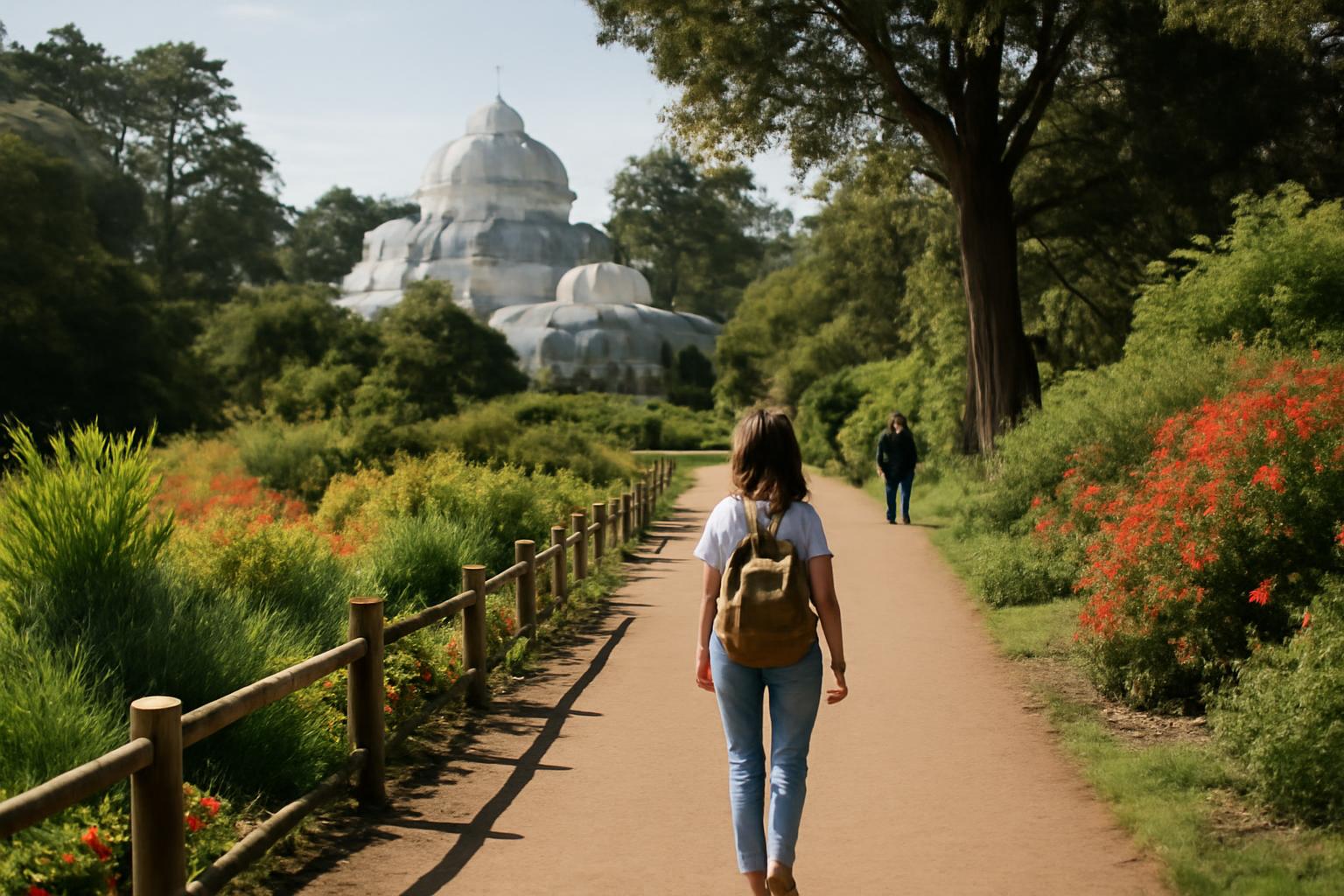
A good golden gate park half day itinerary starts with one honest decision: you are not trying to “do the park.” You are trying to do one part of it well.
That matters because Golden Gate Park rewards focus more than ambition. In four to six hours, the best visit is usually not a heroic cross-park push from museums to windmills to Ocean Beach. It is a compact eastern-cluster route built around the Music Concourse, where major attractions, calmer garden paths, and practical arrival points line up unusually well.
It also helps to be clear about what this article is and is not. This is a planning framework synthesized from cited visitor guides, not a live operations page. Shuttle service, museum hours, transit patterns, ticket prices, and free-entry rules can change. So the durable part is the route logic: stay in the east, keep the transitions short, and let one strong anchor carry the morning.
If you arrive with that mindset, a half day here feels generous rather than rushed. You can combine one major museum, one or two classic gardens, a viewpoint, and a pleasant walk without turning the outing into a logistics puzzle. The real trick is sequencing, not speed.
Why Focus on a Half-Day Eastern Cluster
Golden Gate Park is simply too large to “cover” on a short visit. Visitor guides consistently describe it as a park of about 1,017 acres, roughly three miles long and half a mile wide, with many of its best-known attractions concentrated on the eastern side rather than spread evenly from one end to the other (SF Tourism Tips).
That concentration is what makes a half day realistic. One visitor guide places the de Young Museum, California Academy of Sciences, Japanese Tea Garden, Shakespeare Garden, and Conservatory of Flowers within about a 15-minute walk of one another, and the same guide lists shuttle stops at the Conservatory of Flowers, de Young Museum, Rose Garden, and Stow Lake (A Passion and a Passport).
The useful takeaway is not “I can see everything.” It is “I can see enough if I stop pretending the west side belongs in the same outing.” The Dutch windmills, Ocean Beach edge, and farther-west scenery are worthwhile, but they work better on a longer day, a bike outing, or a return visit. Try to bolt them onto a museum-and-garden morning and the whole plan starts to feel like commuting inside a park.
In other words, it delivers the feeling of Golden Gate Park without asking you to master all of Golden Gate Park.
A second benefit is mental, not just geographic. A focused route lets you experience the park as a landscape instead of as a checklist. When the stops are close, you notice the transitions: the shift from museum plaza to trees, from formal garden structure to looser paths, from crowd energy to bench-and-breathing-room calm. That is exactly what gets lost when people turn a half day into a park-long scavenger hunt.
Getting to Golden Gate Park Efficiently
If you are still deciding where to stay in the city, a smarter San Francisco neighborhood base can reduce the kind of cross-town backtracking that makes a short park visit harder than it needs to be.
For visitors coming from Caltrain at 4th and King, the cleanest route logic in the evidence pack is older Tripadvisor forum advice: take the N Judah Muni Metro west, get off at 9th Avenue and Irving, and walk north into the museum cluster. The same thread gives a backup option of BART toward Daly City and then the 28 bus up 19th Avenue, with Fulton and Park Presidio as the more useful stop for the de Young side (Tripadvisor forum thread).
Because that transit advice comes from an older forum thread, use it as route logic rather than as live service information. The important planning point is still sound: enter near the eastern museum cluster, not at some random park edge that leaves you solving a second transportation problem on foot.
If you are driving, the most practical target for a short visit is the Music Concourse parking garage at 10th Avenue and Fulton Street (San Francisco Travel). Older visitor guidance also describes street parking on JFK and MLK Drives as time-limited, generally around two to four hours, which is another reason a centered arrival point matters on a half-day visit.
For rideshare or taxi, the simplest move is even more straightforward: get dropped near the Music Concourse and start there. You save time, reduce uncertainty, and begin within easy reach of the Academy, de Young, Japanese Tea Garden, and nearby paths.
Bikes are the middle-ground option. For a pure eastern-cluster half day, though, walking is usually still the calmer choice. A bike adds range, but it also adds locking, re-orienting, and small decision friction at exactly the moment when a short itinerary benefits from simplicity.
My default arrival recommendations look like this:
- From Caltrain or downtown: transit toward 9th Avenue and Irving or the Music Concourse side.
- From elsewhere in the city: rideshare/taxi to the Music Concourse area if convenience matters most.
- If driving: use the garage and keep the whole visit centered nearby.
- Only rent bikes if you already know your route extends beyond the core eastern cluster.
The big strategic rule is simple: one clean arrival, one coherent zone, one clean exit.
Sample 4-Hour Morning Itinerary: 9 AM to 1 PM
For most first-time visitors, the best default version of a half day is one major paid anchor plus lighter surrounding stops. That means the itinerary below is not a “fully do four attractions” plan. It is a focused Academy-centered route that uses the de Young area mainly for the Hamon Observation Tower unless art is the main reason you came.
In half-day form, the value comes from keeping the interiors selective rather than trying to finish every building you enter (Bucket List Journey).
Here is the clearest 9 AM to 1 PM version.
-
9:00 AM — Arrive near the Music Concourse. If you came by transit, walk in from the 9th Avenue/Irving side or another eastern entry. If you drove, come up from the garage. Start at the California Academy of Sciences and give it about an hour. That is enough for a purposeful visit built around its biggest draws rather than a room-by-room completion attempt.
-
10:15 AM — Head to the Conservatory of Flowers. Keep expectations realistic here. This stop works well because the building itself is part of the payoff. If plants are not your main interest, a short visit or even an exterior-first look can still feel worthwhile.
-
11:15 AM — Move toward the de Young area. If art is your top priority, this is where you can spend your second paid hour. For everyone else, make the Hamon Observation Tower your anchor. Older guide material specifically notes that the tower is free, which makes it the smartest way to get a rewarding viewpoint without sacrificing the rest of the morning to a second major interior (Two Blue Passports).
-
12:00 PM — Walk to the Japanese Tea Garden. This is the decompression stop. Forty to forty-five minutes is usually enough for a relaxed loop if you are not sitting down for a long tea break.
-
12:45 PM to 1:00 PM — Exit deliberately. Walk back toward your entry point, take an available shuttle only if it clearly helps, or continue out toward the Inner Sunset for lunch.
The important part of that schedule is not the exact minute marks. It is the structure. You start with the highest-demand indoor stop while your energy is fresh, then shift toward visual and atmospheric stops that still feel rewarding on shorter dwell times.
If you prefer art to science, you can invert the paid emphasis: make the de Young your main stop and treat the Academy as a future visit. What you usually should not do, in only four hours, is try to fully experience both major museums and two ticketed gardens. The geography allows it. The clock usually does not.
A few practical notes make this route work better:
-
Buy only the ticket you actually plan to use well. People often confuse physical proximity with good value. Just because four attractions fit geographically does not mean four tickets make sense.
-
Treat the Conservatory as flexible. It is the easiest stop to shorten without ruining the day.
-
Use the Tea Garden as your pressure-release valve. If the morning is running late, it is still a satisfying last stop in a compact window.
-
Keep the de Young decision open until you are there. If museum fatigue has already kicked in, the tower is the right answer.
Older guide material placed Academy admission in the mid-$30s, de Young admission around $15, and some garden admissions in the low teens, but those figures are best used only as historical planning context and not as current booking information. The half-day lesson matters more than the exact number anyway: time is usually the scarcer resource here.
If you want the most efficient possible version, think of the morning this way:
- One immersive interior
- One architecture-and-garden stop
- One free viewpoint or selective second stop
- One calm finish
That formula gives you variety without turning the visit into a sprint.
Key Attractions in the Eastern Cluster
The eastern cluster works because the attractions feel genuinely different from one another. The California Academy of Sciences combines aquarium, planetarium, rainforest, and living-roof experiences; the institution opened in 1923 and its current building followed a major 2008 renovation. The de Young Museum dates to 1895, the Conservatory of Flowers to 1879, and the Japanese Tea Garden to the 1894 exposition era (SF Tourism Tips).
Those dates are more than trivia. They explain why the area feels layered rather than interchangeable. In a short span, you move between Victorian-era horticultural history, long-running civic museum culture, and newer architectural statements. That is a strong recipe for a half day because each stop changes the mood of the visit without requiring a long transfer.
The California Academy of Sciences is the strongest all-ages anchor. If you are traveling with kids, mixed-age family groups, or adults who want the highest concentration of activity in one building, this is usually the safest headline choice. It bundles multiple kinds of experience into one ticket, which matters when time is tight.
The de Young Museum is the better anchor for adults who would rather have art and a view than a science-heavy blockbuster. The Hamon Tower is the key half-day feature here because it gives you a 360-degree outlook without committing the entire visit to galleries. On a clear day, older guide material notes that you may even get a bridge sightline from the tower, though the bridge itself is not part of the park outing.
The Conservatory of Flowers is ideal when you want a high visual return on a short stop. Its value is not just botanical depth; it is the instant sense of place.
The Japanese Tea Garden is the emotional counterweight to the museums. That makes it unusually well-suited to the last part of a half-day route, when you want something memorable but not demanding.
If you want a fifth stop, make it free and make it light. That could mean a shorter garden detour, a bench pause near the concourse, or a little extra path time instead of another ticket line. Older visitor roundups also highlight extras such as the bison paddock, tulip, magnolia, and succulent garden areas, a hidden waterfall, and Claude the albino alligator. Those are fun texture points, but most of them make more sense as optional add-ons for a longer day or a bike-enhanced visit rather than as essential stops in a strict four-hour plan.
As an editorial synthesis of the cited guides, the most useful attraction ranking for a half day looks like this:
- Best single paid stop for families: California Academy of Sciences
- Best single paid stop for adults who prefer views and culture: de Young plus Hamon Tower
- Best short scenic stop: Japanese Tea Garden
- Best architecture-and-plants stop on limited time: Conservatory of Flowers
- Best extra add-on when time is slipping: simple wandering rather than one more interior
That last point is easy to underestimate. Golden Gate Park often gets better, not worse, when you leave one thing undone.
Budget Tips and Free Entry Windows
Budget planning in Golden Gate Park is less about making the whole outing cheap than about avoiding waste. A 2021 visitor guide listed approximate admission in these ranges: $34.95 for the California Academy of Sciences, $15 for the de Young, $10–$12 for the Conservatory of Flowers, $10–$12 for the Japanese Tea Garden, and $9–$12 for the Botanical Garden. The same guide also listed free-entry windows including the Conservatory on the first Tuesday of the month, de Young on Friday evenings and the first Tuesday of the month, the Botanical Garden early daily and on the second Tuesday monthly, and the Japanese Tea Garden on Monday, Wednesday, and Friday from 9 to 10 AM. Because those figures and windows are time-sensitive, treat them as older planning context only and verify them before you build your day around them (A Passion and a Passport).
The cheapest strong half-day versions are usually one of three shapes:
- One-ticket plan: pay for either the Academy or the de Young, then add free walking and lighter outdoor stops.
- Garden-skewed plan: use a verified free morning window if it happens to match your day, then add one paid garden or the Hamon Tower.
- Mostly free plan: skip the biggest interiors, use the tower if open, and enjoy the eastern cluster as a landscape rather than a ticket stack.
San Francisco Travel also notes that a Gardens of Golden Gate Park multi-pass exists. If you know in advance that your day is really a garden day rather than a museum day, that kind of bundled approach may make more sense than buying one-off admissions at the gate.
The best money-saving rule is also the best pacing rule: do not buy two major museum tickets just because the buildings are close together. In a four-hour visit, buying both the Academy and the de Young often means paying for more than you can comfortably absorb.
This is also where the free Hamon Tower matters. Even if you skip the full de Young galleries, the tower can still give you a high-value stop in the cluster without turning the budget into a bigger commitment.
If you are trying to keep costs down, spend on the stop that most closely matches your interests and let the park itself supply the rest. Golden Gate Park is unusually good at making selective spending feel intelligent rather than deprived.
Intra-Park Navigation: Shuttle, Walk, or Bike
For the eastern cluster itself, walking should be your default. The whole point of this itinerary is that the core stops are close enough together to keep transitions readable and pleasant. If you are bouncing among the Academy, de Young area, Tea Garden, and Conservatory, walking is usually simpler than waiting for another mode between each stop.
The shuttle is best treated as a bonus, not as the spine of the plan. The evidence pack is conflicting: one guide describes a free weekend-and-holiday shuttle with stops including the Conservatory, de Young, Rose Garden, and Stow Lake, while another describes a more frequent year-round service through the eastern attractions area. When sources disagree at that level, the practical answer is easy: do not make your half day depend on the shuttle showing up exactly when you need it.
That does not mean the shuttle is useless. It just means it should be opportunistic. If you finish a stop and a shuttle happens to solve a longer internal hop, great. If not, your route should still work perfectly well on foot.
Bikes become more valuable as soon as your ambitions expand. If Stow Lake, the bison paddock, JFK Promenade, or west-end scenery becomes part of the plan, a bike can make the park feel much more manageable. But for a first half day, biking can also introduce unnecessary friction: where to leave it, whether to backtrack to it, and how much time you are losing every time you switch from riding to lingering.
Segway tours also show up in older visitor guidance as a way to cover ground quickly, but they solve a different problem than this article is trying to solve. They are about overview. This itinerary is about staying selective enough that you do not need an overview.
A good decision framework looks like this:
- Walk between the closest core stops
- Use a shuttle only if current service and timing help you
- Choose a bike only if your route clearly expands beyond the eastern core
There is also a quieter reason to stay on foot: Golden Gate Park is one of those places where the in-between moments matter. The route feels better when you notice trees, benches, changing light, and the small reset between one attraction and the next. A bike is efficient. Walking is often more satisfying.
If mobility or stamina is a concern, keep the plan even tighter. Start as close as possible to the Music Concourse, choose one major indoor attraction, and add just one adjacent outdoor stop. In that version, the “success” of the day comes from conserving energy, not from covering distance.
Practical Tips for Success
A short Golden Gate Park outing goes better when your practical choices are slightly boring. Older guide material specifically recommends layers, advance ticket planning, and—if your timing is flexible—September or October as especially good months to visit.
So the simple packing list remains the right one:
- comfortable walking shoes
- one wind-ready layer
- water
- a light bag
- any prebooked tickets you actually intend to use
Food strategy matters more than people expect. If you stop for a full sit-down lunch in the middle of your prime park window, you can easily lose the relaxed rhythm that makes the eastern cluster work. A quicker café or snack approach is usually smarter during the visit, with a fuller meal before or after. Longer-day park itineraries often pair the area with Inner Sunset food stops such as Tartine before the park or Hook Fish Co. after it, which gives you a clean park block rather than a stop-start day.
Advance planning is also worth it for emotional reasons, not just logistical ones. The more time-sensitive your visit is, the less you want to spend it debating admissions, lines, or whether you should squeeze in one more paid stop.
The park’s history is part of why even a short visit can feel substantial. San Francisco Travel says the park took shape in 1871, when field engineer William Hammond Hill and master gardener John McLaren began turning what had been difficult Outside Lands terrain into an urban park (San Francisco Travel). Older visitor guidance also frames the park as a landscape made from sand dunes and notes its later role as a refuge after the 1906 earthquake and as one of the city spaces associated with the Summer of Love.
That history is useful because it changes how you read the outing. You are not just walking between ticketed attractions. You are moving through a deliberately built civic landscape that has accumulated meaning over generations. Even in a half day, it helps to leave a little room for that feeling instead of turning the morning into pure entry-exit efficiency.
A final practical note: Golden Gate Park is not the same trip as the Golden Gate Bridge. Older guide material is explicit about that. If bridge views or waterfront walking are another major goal, treat them as a separate block of the day with their own transport plan rather than assuming they naturally combine.
Adapting for Interests or Constraints
The eastern-cluster plan is flexible, but only if you do not confuse “customized” with “everything at once.”
For families or kid-focused groups, the safest pattern is the Academy plus one lower-structure follow-up. The Academy does a lot of work for you because it gathers multiple experiences in one building. After that, the Tea Garden, Conservatory, or even just a path-and-snack reset is usually a better second act than another full museum.
For garden-first visitors, reverse the emphasis. Start with the Conservatory, move through the de Young area for the Hamon Tower if you want a view, and finish in the Japanese Tea Garden. This version is quieter, usually feels more spacious, and avoids the “big museum first” energy of the Academy-centered route.
For budget travelers, decide in advance which expensive stop you are skipping. Golden Gate Park rewards selective spending better than many urban attractions do. One paid anchor plus free wandering often feels fuller than two rushed interiors.
For foggy or cold mornings, go indoors first. Start with the Academy or de Young, then decide how much garden time the weather deserves afterward. For clearer days, you can flip that instinct and cash in the outdoor spaces earlier.
For mobility-limited or low-energy visitors, simplify ruthlessly. Arrive as close as possible to the Music Concourse, choose either the Academy or the de Young area, and add only one nearby outdoor stop. In this version, the best itinerary is the one that still feels good at the end.
For people tempted to combine the park with the bridge, resist unless you already know your transportation plan. Golden Gate Park and the bridge are not adjacent attractions. The park works better when paired with nearby neighborhoods or with a clean transit move afterward, not with a vague hope that the bridge is “basically right there.”
And if you find yourself wanting to add Stow Lake, the Rose Garden, the bison paddock, and the west end all at once, that is usually your sign that you are planning a different day than a half day. The good news is that Golden Gate Park rewards return visits extremely well. Leaving something for next time is not failure here. It is good editing.
Does the free Golden Gate Park shuttle run every day?
Treat the answer as uncertain until you confirm it for your date.
The evidence pack is inconsistent. One visitor guide describes a free shuttle on weekends and holidays with stops including the Conservatory, de Young, Rose Garden, and Stow Lake. Another describes a more frequent year-round service through the eastern attractions area. Because that conflict affects real planning, the safest approach is to treat the shuttle as a possible convenience rather than as a promise.
In practice, that means your core half-day route should be fully walkable without any shuttle help. If a shuttle happens to be operating and useful, it is a bonus.
What’s the best public transit from downtown or Caltrain to the museums?
From Caltrain at 4th and King, the strongest route logic in the evidence pack is the older recommendation to take the N Judah to 9th Avenue and Irving and then walk north into the museum cluster. The same older forum thread offers BART to Daly City plus the 28 bus as a backup, with Fulton and Park Presidio as the more useful stop for the de Young side (Tripadvisor forum thread).
For most half-day visitors, the N Judah logic is cleaner because it gets you close to the eastern cluster without creating another major transfer problem once you arrive.
Just keep the source quality in mind: that advice is old. Use it as orientation, then confirm current service before you go.
Are there current free entry days for major attractions?
There often are, but you should verify them directly before your visit.
Older visitor guides list free or discounted windows for the Conservatory of Flowers, de Young, Botanical Garden, and Japanese Tea Garden, and some of those windows appear tied to specific weekdays, early hours, residency, or ID requirements. That makes them useful for planning ideas, but not reliable enough to assume without checking current attraction information.
The best money-saving strategy is to choose one attraction you would still feel good about paying for, then let any confirmed free-entry window improve the day rather than determine whether the day works at all.
Can families do this half-day itinerary?
Yes, absolutely—if they choose the simplified version.
The family mistake is not visiting Golden Gate Park for half a day. The family mistake is trying to force four headline attractions into that half day. A much stronger family template is:
- one big indoor anchor, usually the Academy
- one outdoor follow-up, such as the Tea Garden or Conservatory
- built-in snack or bench time
- a clean exit before everyone melts down
That version uses the park well instead of using up the group.
Is parking reliable for a half day?
Parking is workable, but not something to treat casually.
The best option is the Music Concourse garage because it puts you near the right cluster from the start. Older visitor guidance also describes street parking on JFK and MLK Drives as time-limited, often around two to four hours, which can be awkward if your timing slips or you arrive stressed.
So if you are driving, the smartest move is not “hope street parking works out.” It is “choose the arrival method that protects the short time you actually have.” For many half-day visitors, that means the garage, rideshare, or transit rather than a parking hunt.