
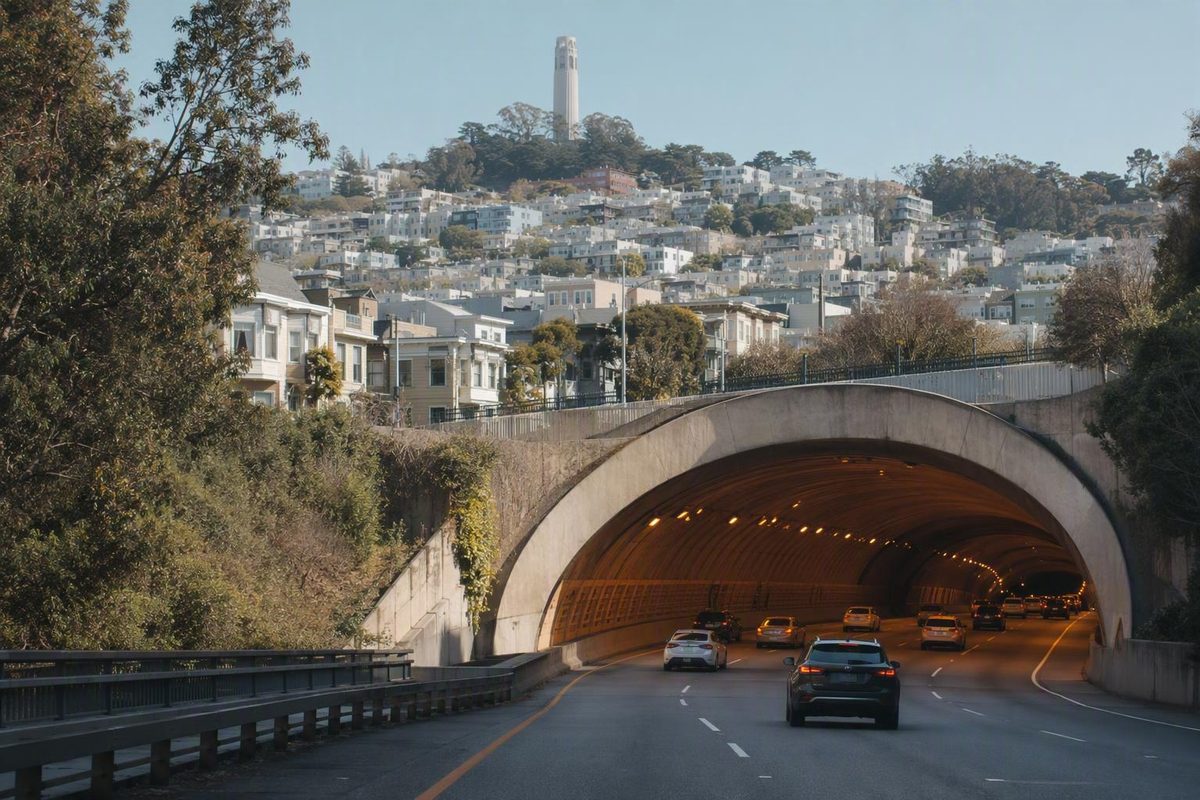
The Broadway Tunnel is not planned to remain completely closed for 14 months. The published construction plan calls for one bore to close at a time while the other carries one lane in each direction. To avoid the reduced-capacity section eastbound, follow the official Broadway–Larkin–Pacific–Powell detour. For a car-free alternative, consider the 30 Stockton or 45 Union/Stockton. SFMTA publishes the lane plan, detour and transit alternatives.
Latest available published plan — reviewed September 17, 2026; not a live traffic confirmation: The supplied agency plan covers Broadway between Larkin and Powell streets and provides for phased, one-bore-at-a-time closures. No timestamped first-party notice was available here to confirm conditions on September 17, so verify the active bore and any temporary restrictions immediately before traveling.
The short answer: the tunnel has partial access
A brief full closure from Sunday into Monday preceded the longer reduced-capacity arrangement. Reports differed on its planned and final duration, ranging from an earlier 46-hour plan to later accounts of approximately 22 to 24 hours. The useful distinction for travelers is that this initial complete shutdown preceded the phased partial closure. ABC7 reported a Sunday-to-Monday closure before the reduced-lane phase.
Under the continuing published plan, one of the tunnel’s two bores closes at a time. The remaining bore is reconfigured to carry one eastbound lane and one westbound lane through the affected section of Broadway between Larkin and Powell streets.
The restrictions began in mid-August 2026 and were expected to continue for approximately 14 months. That estimate applies to the phased lane restrictions, not a continuous complete closure.
Separately, the overall project was reported as targeting completion in October 2027. Both the approximately 14-month restriction period and the October 2027 completion target are estimates, and they do not align precisely enough to promise a firm end date. Local News Matters reported the partial-access arrangement, peak-period delay warning and October 2027 target.
Do not assume which bore is closed now based only on the original sequence. The evidence establishes the planned order, but not a verified current configuration for September 17, 2026.
Broadway Tunnel closure timeline by phase
The published sequence closes the south, or eastbound, bore first and then shifts work to the north, or westbound, bore. Sources vary between geographic and directional terminology, but the planned order is consistent.
| Phase | Approximate duration | Bore status | Traffic pattern |
|---|---|---|---|
| Initial setup | Brief, Sunday into Monday | Both bores temporarily closed | Full closure before partial access |
| Phase 1 | Roughly 7 to 7.5 months | South/eastbound closed; north/westbound open | One lane in each direction |
| Phase 2 | About 7 months | North/westbound closed; south/eastbound open | One lane in each direction |
The durations come from SFMTA’s published traffic-impact plan and are approximate. A firm phase-switch date should not be calculated simply by adding seven or 7.5 months to the August 2026 start. Construction schedules and traffic-management arrangements may change.
The published “approximately 14 months” description also sits alongside an October 2027 target for overall project completion. The lane-restriction period and the full construction schedule therefore should not be treated as having one guaranteed end date.
Detours and transit alternatives
For an eastbound driver avoiding the work zone, the official detour is:
- Follow Broadway to Larkin Street.
- Turn south on Larkin Street.
- Turn east on Pacific Avenue.
- Turn north on Powell Street.
- Rejoin Broadway.
Pacific Avenue to the south and Union Street to the north have also been reported as broader alternatives. They are not interchangeable with the detailed official route: Union Street is a general northern alternative, while Larkin–Pacific–Powell is the published turn-by-turn eastbound detour.
Do not create a westbound route by reversing those instructions. The supplied information does not establish a detailed official westbound detour. Follow current signs or navigation guidance that accounts for active restrictions.
If your trip is flexible, consider Muni rather than driving through or around the tunnel:
- 30 Stockton
- 45 Union/Stockton
SFMTA recommends those lines as alternatives, but that does not mean their routes, stops or schedules have changed. Check current Muni arrival information separately.
Allow additional time during peak periods, even if you remain on Broadway. SFMTA also said digital message signs would alert drivers to changing traffic conditions and alternate routes, so follow posted instructions rather than relying on an old screenshot or saved route.
Choose a plan by how you are traveling
The simplest choice depends on whether you need the tunnel itself, can approach from another street or can leave the car behind.
| Traveler situation | Recommended approach | Limitation |
|---|---|---|
| Eastbound driver avoiding the work zone | Use Broadway, south on Larkin, east on Pacific, north on Powell, then return to Broadway | Nearby streets may also carry diverted traffic |
| Driver staying on Broadway | Continue through the open bore, planned to carry one lane each way | Reduced capacity can cause peak-period delays |
| Flexible Chinatown or North Beach visitor | Consider the 30 Stockton or 45 Union/Stockton | Check current arrivals; no service change is implied |
| Chinatown visitor arriving by car | Keep the visit, but add time for the approach | Parking, loading and delivery conditions are not established here |
| School family or staff member | Leave earlier and review school or transportation notices | Drop-off and pickup travel may be affected |
| Pedestrian, cyclist or traveler needing an accessible route | Seek current official or on-site instructions before entering the area | Present passage arrangements are not confirmed |
Chinatown businesses remain open during construction. The project is a reason to adjust your route, not necessarily to cancel a neighborhood visit. If you are arriving for a meal, shopping or an appointment, allow more time for the approach and consider completing the final part of the trip without relying on the tunnel.
SFUSD warned that reduced capacity could affect morning drop-off, afternoon pickup and travel around Chinatown and North Beach. It advised families and staff to allow additional time, consider alternate routes and stay alert for changing traffic patterns. See the district’s Broadway Tunnel school traffic advisory.
For pedestrians, cyclists and people who need a wheelchair-accessible or otherwise step-free route, the supplied evidence does not confirm the current passage arrangement. Do not assume that every mode can use the open bore during every phase. Follow on-site instructions; if the available agency notice does not answer your access question, seek current city guidance before setting out.
Why work above the tunnel affects traffic below
The restrictions are tied to the seismic renovation of the Chinatown Public Health Center, which sits above the tunnel’s eastern entrance. The renovation was reported at approximately $76 million. Local News Matters reported the city’s characterization of the center as the most seismically vulnerable facility in San Francisco’s public health network.
The traffic changes are not simply a response to construction somewhere nearby. Public Works said the health center’s location above the tunnel requires temporary lane reconfiguration to accommodate extensive seismic shoring. That work reduces the space available for normal traffic below.
The project also includes work inside the tunnel:
- roadway repaving or reconstruction;
- walkway and sidewalk repairs or reconstruction;
- wall and ceiling tile work;
- installation of LED lighting; and
- reconstruction of the concrete center island.
In practical terms, the phased arrangement creates working room for the health-center shoring and tunnel improvements while preserving some cross-town vehicle access. One bore remains available for two-way traffic under the published plan rather than both bores being removed from service throughout construction.
What to verify before you leave
Treat the published plan as a framework, not a live lane map. Before driving, riding or walking toward the tunnel:
- Confirm the active bore. Do not infer it solely from the original phase sequence.
- Check for a phase switch or temporary full closure. Short-term restrictions may differ from the basic long-term pattern.
- Review posted detours. Use current signs for any direction not covered by the official eastbound route.
- Check access for your mode. Current pedestrian, bicycle and accessible-passage arrangements are not established by the supplied evidence.
- Allow extra time. Reduced capacity is expected to matter most during peak travel periods.
Use the cited SFMTA construction page as the primary published traffic-planning source. Because no timestamped first-party update was available here for September 17, check that page and on-site signage immediately before departure. A finished service article should display the exact date, clock time and time zone of any subsequent verification.
Firm phase-change dates, a detailed official westbound detour, future intermittent closures, and current pedestrian, bicycle and accessible-passage arrangements are not established here. Predictions of severe congestion or business losses are community concerns rather than demonstrated outcomes, and one isolated test drive should not be treated as a typical delay estimate.
The usable choice is simple: the Broadway Tunnel, also known as the Robert C. Levy Tunnel, is subject to a reduced-capacity phased plan rather than a continuous 14-month shutdown. Drive through with extra time, use Larkin–Pacific–Powell to detour eastbound, or consider the 30 Stockton or 45 Union/Stockton. Verify the active phase immediately before leaving because the bore configuration and schedule can change.