
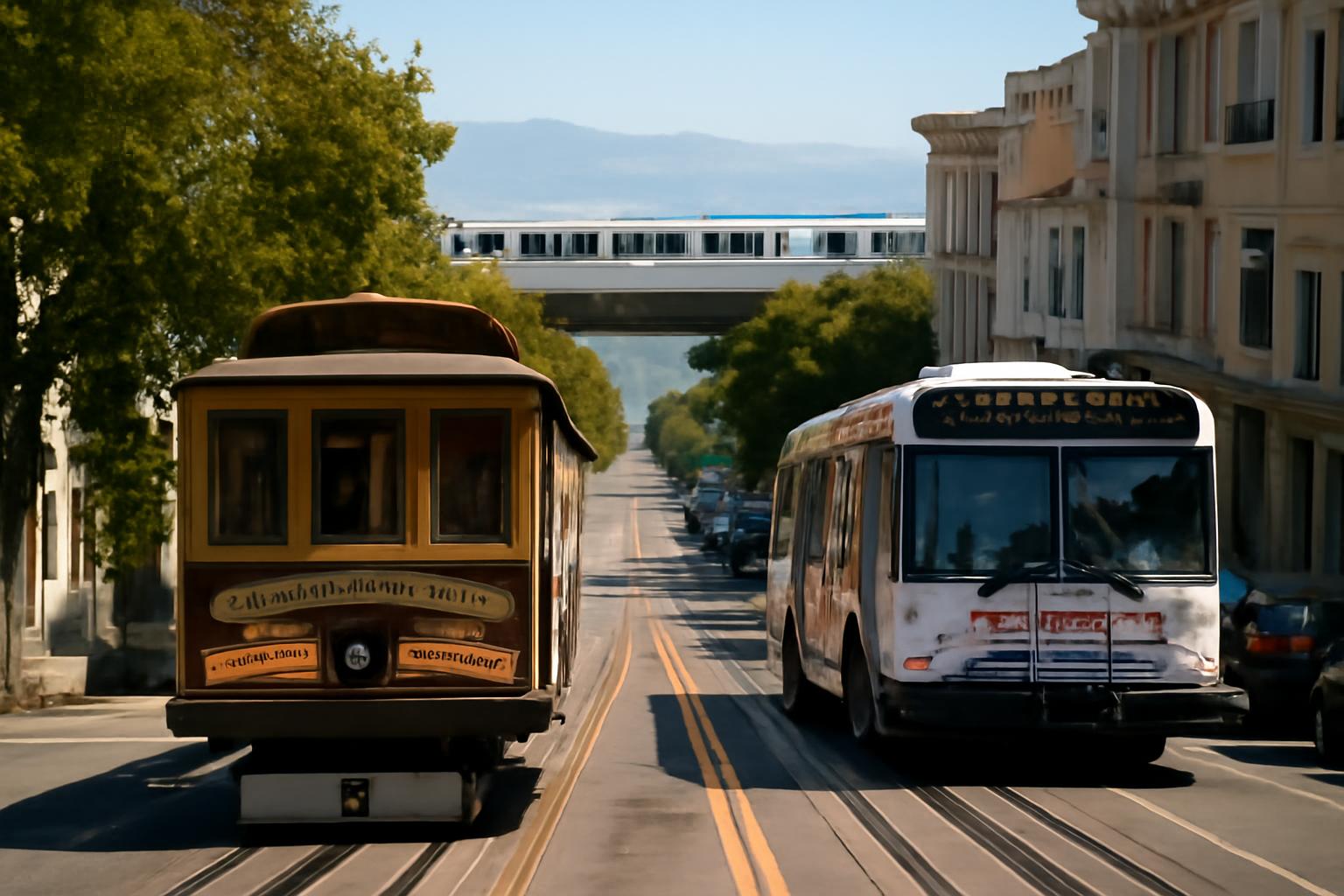
If San Francisco transit feels confusing at first, it’s usually because three different ideas get blurred together.
Cable cars are the iconic ride. Muni is the city’s everyday network. BART is the separate regional rail system that handles bigger jumps fast.
For most visitors, the cleanest mental model is this:
- BART handles the big moves: airport trips, East Bay trips, and a few fast north-south jumps through San Francisco.
- Muni handles the city itself: neighborhoods, museums, parks, the waterfront, and most day-to-day moving around.
- Cable cars are a special Muni service you use selectively: for the experience, for certain steep corridors, and for adding some San Francisco character to an otherwise practical day.
That means the smartest plan usually is not choosing one system and ignoring the others. It is layering them. Arrive by BART, circulate by Muni, and add one cable car ride when the route, hills, and mood all line up.
Before the deeper comparison, here is the quick version:
| System | Best for | Where it shines | Weak spots | Best mindset |
|---|---|---|---|---|
| Cable cars | Scenic hill rides, classic tourist experience | Powell lines, Nob Hill, Russian Hill, Wharf-adjacent corridors | Narrow coverage, lines, separate fare logic, weak accessibility | Treat it as a premium heritage ride that can also save your legs |
| Muni | Everyday city travel | Neighborhoods, parks, museums, Castro, Mission, Golden Gate Park, waterfront | Slower than BART for long regional jumps | Use it as your default inside San Francisco |
| BART | Airport and regional access | SFO, East Bay, downtown spine | Not a neighborhood explorer, fewer San Francisco stops | Use it for speed, then switch to Muni |
If you keep that table in your head, most transit decisions in San Francisco become much easier.
Understanding San Francisco’s Transit Layers
Cable cars are not a separate transit agency. They are a historic service operated by Muni, and SFMTA says today’s San Francisco cable cars were named a National Historic Landmark in 1964. They work by gripping moving cables beneath the street rather than using onboard motors, which is why they feel less like ordinary transit and more like moving city heritage, according to SFMTA’s cable car overview.
That said, visitors are not wrong to experience cable cars as their own category. Institutionally they sit inside Muni. In real life, they feel more premium. They run on only three lines, attract the longest tourist queues, and follow different fare rules from regular buses, Metro trains, and historic streetcars. So the easiest way to think about them is: cable cars are part of Muni, but not interchangeable with the rest of Muni.
Muni is the broader city network. In practical terms, it is what you use for most in-city trips: buses, Muni Metro light rail, the F-line historic streetcars, and cable cars all sit under that umbrella.
BART is different. It is not “the subway part of Muni.” It is a separate regional rail system with its own fare logic and a different job. Within San Francisco, it serves a limited spine through stations such as Embarcadero, Montgomery, Powell, Civic Center, 16th Street Mission, 24th Street Mission, and Balboa Park. That makes it excellent for certain long jumps and for getting into and out of the city, but not a substitute for Muni’s neighborhood coverage.
The key place where visitors feel all of this at once is Powell Street. Around Powell, the downtown BART station, central Muni connections, and the Powell cable car turnaround sit close enough together that switching is easy. But physical closeness does not mean fare or system unity. You can move between them conveniently, while still dealing with three different transit roles:
- Cable cars: heritage ride, hill assist, selective use
- Muni: local transportation inside San Francisco
- BART: regional connector, especially for SFO and the East Bay
That framing clears up most visitor confusion right away. It also helps prevent the most common mistake: trying to make one system do a job another one does better.
Routes and Coverage: Where Each System Shines
Cable cars are a tiny network with very specific strengths. The three lines are the Powell-Hyde, Powell-Mason, and California Street lines. For most visitors, the route personality matters more than the formal name. Powell-Hyde is the line most associated with steep hills and classic views on the way toward the Wharf area. Powell-Mason serves much of the same tourist demand with a slightly different path.
That narrowness is both the cable car’s charm and its limitation. Because the system is so small, it can feel magical when your route happens to match it. But if your day includes the Mission in the morning, Golden Gate Park in the afternoon, and dinner in Hayes Valley, cable cars are not your main transportation tool. They are a moment, not a mesh.
Muni is the opposite. It wins by coverage. One current guide describes a bus network of 73 routes, plus Metro service and historic streetcars, which is why Muni is the system that actually stitches neighborhoods together across the city in a way cable cars and BART do not, according to the same transit overview. If your plan includes the Mission, Castro, Haight, Richmond, Sunset, Golden Gate Park, Japantown, or the waterfront, you are thinking in Muni territory.
It is not flashy. It is simply the system that lets you make normal visitor moves without constantly bending your day around a rail spine or a tourist corridor. The more your trip looks like “real places in different neighborhoods,” the more Muni becomes the answer.
BART, by contrast, is strongest when the distance is large enough to matter. Inside San Francisco it functions like a fast trunk line through limited stations. That makes it very useful if your start and finish both sit near that spine. It makes it much less useful if your goal is to wander block by block through neighborhoods. BART helps you cross a gap. Muni helps you live inside the city once the gap is crossed.
So the practical distinction looks like this:
- Cable cars serve a few steep, scenic, visitor-heavy corridors very well.
- Muni serves almost everything else inside San Francisco.
This is why cable cars are rarely the right answer to “How do I get around San Francisco all day?” They are too narrow. But they can be exactly right for “How do I avoid one brutal uphill stretch and make it memorable?” That is the cable car sweet spot.
It is also why BART can mislead first-time visitors. On a map, it can look like the city’s main subway. In use, it is more like a regional backbone. If you are going from SFO to downtown, or downtown to the Mission, or across the Bay, that is powerful. If you are trying to reach scattered sights across the city, it quickly runs out of usefulness and Muni takes over.
A good way to decide is to ask one question: Are you trying to reach a corridor, a neighborhood, or an experience?
- If it is a corridor, BART may help.
- If it is a neighborhood, Muni is usually the answer.
- If it is an experience on a steep, scenic route, cable cars deserve a look.
That question alone will save a lot of bad transit choices.
Fares, Passes, and Value for Visitors
Fares are where the systems feel least alike.
According to the official SFMTA fares page, regular Muni service uses a time-limited fare window, while cable cars are priced separately and do not include transfers. The same page says youth ages 18 and under ride free on regular Muni service, while cable cars are excluded except for children 4 and under. SFMTA also lists 1-day, 3-day, and 7-day Visitor Passports that include unlimited Muni rides, including cable cars.
That creates three different value models for visitors.
First, there is the single cable car ride. This is the right play if you want the experience once and do not need it to carry the logic of your whole day. You are paying for a specific memorable segment, not building your transportation strategy around it.
Second, there is regular Muni use. If most of your moving around will happen on buses, Metro, or streetcars, ordinary Muni fare logic is usually the best value. That is especially true if your trip is neighborhood-heavy and only lightly tourist-corridor-heavy.
Third, there is the Visitor Passport. This starts to make sense when you expect multiple Muni rides and also want one or more cable car trips without thinking about each ride separately. Market Street Railway’s rider guidance notes that the passport covers unlimited Muni, including cable cars, but does not include BART, which is why it works best for city days rather than airport-or-regional days, per Market Street Railway’s rider information.
BART sits outside all of that. Its fares are distance-based, which is why airport or cross-bay trips belong in a separate budget bucket from ordinary local sightseeing rides, as San Francisco Travel explains on its transportation page. The important visitor takeaway is not the exact fare on a given day. It is the pricing logic: BART is a regional rail product, not part of an unlimited city-transit visitor bundle.
That is why treating every transit ride as interchangeable leads to bad budgeting. A neighborhood bus ride, a cable car climb, and an airport rail trip solve different problems and are priced as different products. When visitors get frustrated by San Francisco transit costs, it is often because they expected one flat system and got three overlapping ones instead.
A simple way to think about value:
- Mostly neighborhoods and attractions spread around the city? Use regular Muni as your baseline.
- One cable car ride for fun? Buy that ride and use Muni for the rest.
- Several Muni rides plus cable cars in the same day or trip? Look at a Visitor Passport.
- Airport or East Bay included? Budget BART separately.
There is also a psychological value point worth remembering: a cable car is rarely the best transport bargain, but it can still be the right trip bargain if it replaces a long uphill walk and becomes one of the day’s memorable moments. Visitors sometimes overcorrect toward pure efficiency and strip all the character out of a San Francisco day. The goal is not to ride the cheapest vehicle every time. The goal is to spend intelligently on the segments that actually improve the day.
Because fares do change, the best habit is simple: use current Muni and BART information shortly before you travel, but keep the logic above in mind so you know what you are checking and why.
Payments: Clipper, Apps, and Cash Rules
For most visitors, Clipper is the least stressful answer because it works across systems instead of locking you into just one. SFMTA says Clipper works on Bay Area transit systems including Muni, and the same fares page says Muni fares can also be purchased through MuniMobile, cash can still be used on vehicles with exact change required, and SFMTA lists tap-to-pay support for a single Muni ride with a chip-enabled credit or debit card on the same official fares page.
That creates a practical visitor hierarchy:
- Clipper if you want one payment method across Muni and BART
- MuniMobile if you mainly want Muni tickets or a Visitor Passport on your phone
- Cash only as a backup, because exact-fare rules are inconvenient when you are moving fast
Clipper is especially useful when your trip includes an airport run, a regional hop, or any situation where BART enters the picture. It lets you stop thinking in separate payment silos. You still pay different fares on different systems, but the experience becomes much smoother because one stored-value tool works across them.
MuniMobile is strongest when your trip is mostly San Francisco-based and you want easy access to Muni fares or a Visitor Passport without handling a physical card. It is less universal than Clipper, but it can be very convenient for city-focused visitors whose trip pattern is mostly buses, Metro, streetcars, and maybe one cable car ride.
Cash remains the least elegant method. It is still workable, but San Francisco transit is much easier when you are not counting bills and coins at the curb while a vehicle is boarding.
Cable cars add one extra wrinkle: SFMTA says the major turnarounds at Powell & Market, Bay & Taylor, and Hyde & Beach require fares to be purchased in advance from 8 a.m. to 8 p.m. daily, rather than sorted out at the last second on the spot (SFMTA cable car page).
That matters because many visitors assume payment can always be improvised once they reach the most famous queue. At the busiest cable car boarding points, that assumption can slow you down.
So the cleanest recommendation is:
- If your trip includes BART at all, start with Clipper.
- If you are staying mostly inside San Francisco and want a Visitor Passport, MuniMobile can be very convenient.
- If you insist on cash, keep small bills and expect a clunkier experience.
The more complex your itinerary, the more Clipper tends to win. The more Muni-only your itinerary becomes, the more MuniMobile starts to look attractive.
Use Cases: Airport Runs, Wharf Trips, Neighborhood Hops
The easiest way to choose between cable car, Muni, and BART is to stop asking which system is “best” in the abstract and ask which trip you are actually taking.
SFO to downtown or Union Square: this is classic BART territory. San Francisco Travel describes BART as the fast, dependable rail connection from SFO into the city, with downtown stations such as Powell making the handoff to local transit straightforward on its transportation guide. Once you arrive downtown, you walk or switch to Muni for the last local stretch.
This is also where visitors sometimes try too hard to make the iconic option happen too early. A cable car after a flight may sound romantic, but if you are carrying bags or just want the easiest arrival, BART plus a short local finish is usually the calmer choice. Save the scenic mode for the part of the day when you can actually enjoy it.
If your goal is having the famous San Francisco cable car moment on the way to the Wharf, then the cable car can be worth it. Those are different trips even when the destination is the same.
A lot of transit frustration comes from pretending those goals are identical. They are not. One is transportation. One is transportation plus theater. If you want theater, pay for theater happily. If you want efficiency, choose efficiency and do not resent it.
Nob Hill, Russian Hill, and other steep visitor corridors: this is where cable cars justify themselves best. On the right route, they are not just picturesque. They are a legitimate hill-management tool. San Francisco looks compact on a map, but a short distance can become a punishing climb. When a cable car neatly erases that climb while giving you the full city experience, it is doing something more useful than just entertaining you.
Neighborhood exploration days: if your plan includes the Mission, Castro, Haight, Golden Gate Park, Japantown, Hayes Valley, the Richmond, or the Sunset, think Muni first. Those are Muni days, not BART days and not cable car days. This is where buses and Metro lines quietly outperform the famous options by actually getting you where you want to go.
Then switch to Muni only for the last local leg.
Mixed sightseeing days: if your day includes ordinary Muni rides plus one or more cable car trips, the best-value answer is often a Visitor Passport rather than a pile of separate purchases. This is especially true if you want to keep decisions light and not keep recalculating whether each scenic segment is “worth it.”
There is a broader planning lesson underneath all of these examples: do not force one system to solve every problem.
- BART is not a sightseeing circulator.
- Cable cars are not a citywide network.
- Muni is not a regional airport rail service.
Once you accept that, San Francisco becomes easier to navigate because you stop searching for a single winner and start matching the tool to the trip.
It also helps to think about energy, not just geography. Visitors often overfocus on whether two places are technically connected and underfocus on what the day will feel like. A cable car may be slower than another route but still improve the day if it avoids a hard climb. A bus may be less glamorous than a cable car but still be the better choice if it keeps the day moving. BART may feel less “San Francisco” than a streetcar, but it may save enough time at the start or end of the day to make everything else smoother.
A few common smart pairings look like this:
- BART in, Muni out: airport arrival followed by neighborhood hotel transfer
- Muni out, cable car back: walk downhill through a district, then use the scenic uphill return
- Cable car one way, F-line the other: get the iconic ride once, use the easier historic streetcar on the opposite leg
- BART to downtown, all-Muni after that: a common pattern for short stays centered on San Francisco proper
The best visitor itineraries in San Francisco are usually layered, not pure. That is the real answer to the cable car vs. Muni vs. BART question.
Transfers, Hubs, and Hill-Smart Planning
If there is one transit area worth understanding well, it is Powell Street. This is where many visitor itineraries naturally converge because BART, central Muni connections, and the Powell cable car turnaround all sit within easy reach of one another. That physical closeness is a major convenience, especially for first-time visitors.
But “they connect at Powell” does not mean they behave like one merged system. Physically, they meet. Financially and operationally, they remain separate. BART still follows BART logic. Regular Muni still follows Muni logic. Cable cars still follow cable car logic.
That is why Powell works best as a decision point, not an autopilot point. When you surface there, ask:
- Need speed? Stay with BART as long as it helps.
- Need broader city coverage? Switch to Muni.
- Want scenery and a hill assist? Take a cable car.
- Only going a short, flat distance? Walk and save the ride.
This is also where transfer expectations matter. Regular Muni is the transfer-friendly part of the system. Cable cars are not. And Clipper, useful as it is, does not turn separate systems into one unlimited bundle. It smooths payment. It does not erase the distinctions between local Muni travel, premium cable car rides, and regional BART trips.
For visitors, the smartest planning is often less about “connections” and more about terrain management. San Francisco punishes casual uphill mistakes. A route that looks efficient on a flat map can feel wasteful if it burns your energy on a steep climb you could have skipped.
A better approach is to build your day around neighborhoods and elevation:
- cluster nearby stops together
- use transit for the steep lift
- keep flat or downhill walking for the scenic wandering part
- avoid turning every transfer into an accidental hill workout
For mixed-mode days, real-time tools matter. A route that looks ideal at breakfast may not be ideal three hours later. Google Maps, Muni planning tools, and similar apps help you answer the practical question that matters most in the moment: Is the next best move a BART hop, a local Muni line, a cable car, or just staying in this neighborhood a bit longer?
That last option is underrated. Visitors sometimes over-transfer because a map makes constant movement feel productive. But San Francisco often rewards slower neighborhood blocks more than hyperactive mode-switching. The point of understanding hubs like Powell is not to transfer endlessly. It is to know your options well enough to move only when it actually improves the day.
Practical Tips: Crowds, Accessibility, Safety
The biggest cable car mistake is assuming the famous turnaround line is the only way to ride. It isn’t. SFMTA says you can board at the turntables or at the brown-and-white cable car sign posts along the route, which is the official basis for the simple line-avoidance strategy of boarding farther along instead of at the busiest origin points, according to SFMTA’s cable car page.
That one shift can completely change the experience. Instead of treating the turnaround queue as mandatory, think of it as one boarding option among many. If you are flexible, walking a few blocks to an intermediate stop can be much smarter than standing in the most photographed line in the city.
Local rider guidance also consistently points visitors toward the California Street line as a calmer option than the Powell queues and suggests riding early or later in the day for a less crowded experience (local cable car rider guidance). That is not a guarantee, just a useful pattern.
SFMTA says cable cars are not accessible, do not allow full-size bikes, and instruct riders to hold on, watch for traffic, and keep service animals on a rider’s lap when riding on the exterior portions of the car (SFMTA cable car page).
So the practical safety and comfort rules are straightforward:
- hold on seriously, especially on hills and curves
- watch traffic when boarding or stepping off
- do not choose cable cars if you need the easiest boarding experience
Families should think about the same tradeoff. Because regular Muni has more generous youth fare rules than cable cars, and because ordinary buses and streetcars are simpler to board, a mixed strategy is often the sweet spot: use regular Muni for most movement, then pick one cable car ride because you want it, not because you accidentally made it the backbone of a family transit day.
The biggest practical win is to separate the cable car experience from the pressure to use cable cars constantly. Once you do that, the city gets easier, cheaper, and calmer.
F-Line Alternative and Waterfront Ties
Market Street Railway describes the F-Market & Wharves line as a Muni-operated historic streetcar route running from Castro to Fisherman’s Wharf, and it uses the same fare structure as regular Muni buses and light rail rather than cable-car pricing, according to Market Street Railway’s rider guide.
For visitors, that makes the F-line one of the best best-of-both-worlds transit options in San Francisco:
- it still feels historic and distinctly local
- it serves the waterfront well
- it avoids premium cable car fare logic
It fits especially well into waterfront days. If you are walking one direction along the northern waterfront or heading toward the bridge, it often makes more sense to keep the walk as the outward experience and treat transit as the return plan rather than forcing the day into a loop. If that is the kind of day you are building, this Golden Gate waterfront walk guide pairs naturally with an F-line or other Muni return.
That gets to the real answer behind the whole cable car vs. Muni vs. BART question:
- Use BART to enter or leave the city efficiently.
- Use Muni to actually move through San Francisco.
- Use a cable car when the route, hills, and experience line up.
- Use the F-line when you want historic transit flavor without making your day revolve around cable car logistics.
That combination is how you get a San Francisco day that feels iconic without becoming inefficient.
Does one pass cover cable cars, Muni, and BART?
Not in the simple “one unlimited visitor pass for everything” sense. A Visitor Passport covers Muni and cable cars, but not BART (Market Street Railway rider guide). Clipper works across Muni and BART as a payment method, which is useful, but that is not the same thing as an all-inclusive unlimited pass.
Best from SFO to Fisherman’s Wharf?
If the route fits your day, the F-line is often the simplest historic-feeling option for that final city leg. Choose a cable car only if you specifically want the experience and are not trying to make luggage part of the fun.
How to skip cable car queues?
Do not assume the turnaround is your only boarding choice. SFMTA says you can board at turntables or at brown-and-white sign posts along the route, so riding from an intermediate stop is often smarter than joining the most famous line (SFMTA cable car page). Local guidance also often points to the California Street line and to earlier or later rides as calmer options.
Are kids free on these systems?
On regular Muni, youth 18 and under ride free. On cable cars, that free-youth rule does not apply; only children 4 and under ride free, according to the SFMTA fares page. BART has its own separate fare rules, so do not assume Muni’s youth policy carries over.
Clipper vs MuniMobile for visitors?
Pick Clipper if you expect to use BART plus Muni and want one broadly accepted payment method. Pick MuniMobile if you are staying mostly inside San Francisco and want to buy Muni fares or a Visitor Passport on your phone. Many visitors end up using Clipper for regional travel and either Clipper or MuniMobile for local rides, depending on which is more convenient for the trip they actually planned.