
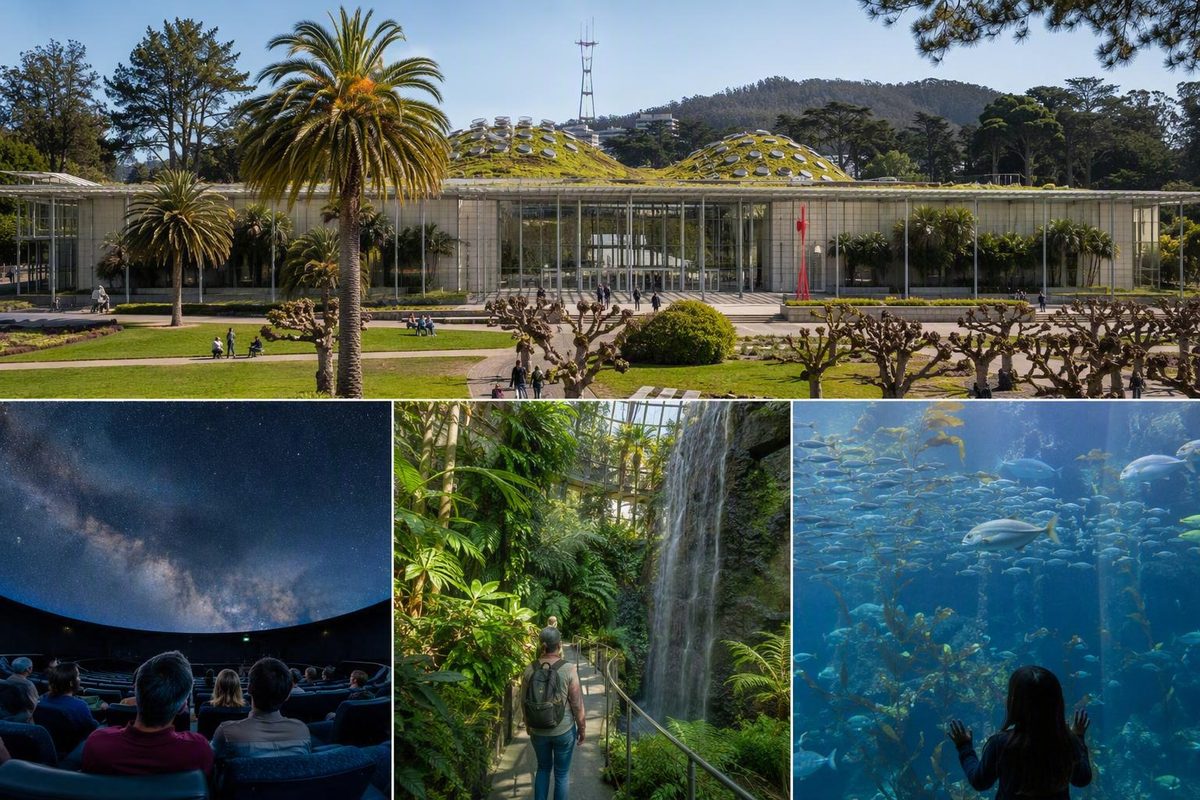
The California Academy of Sciences in Golden Gate Park is easier to plan when you think of it as several substantial attractions sharing one building—not as a conventional museum that can be covered gallery by gallery. A first visit may include an aquarium, indoor rainforest, scheduled planetarium presentation, natural-history galleries, and the Living Roof.
Before arriving, make three decisions:
- Decide whether the planetarium is a priority.
- Choose how much time you want for the aquarium and rainforest.
- Protect at least three to four hours before adding another major Golden Gate Park attraction.
Once inside, address the planetarium reservation first. Then use that fixed presentation time to organize the flexible parts of your visit. Pairing the rainforest with the aquarium can reduce backtracking, while the natural-history galleries and Living Roof can fill shorter openings before or after the show.
Hours, admission products, reservations, programs, and closures can change. Treat this as a routing guide and verify operational details with the Academy before departure.
What the California Academy of Sciences Is—and Where to Find It
The California Academy of Sciences is both a natural-history museum and an active scientific institution. Public exhibits are only part of its work; research, natural-history collections, biodiversity studies, and animal care also take place behind the scenes.
The current Golden Gate Park building was designed by Renzo Piano and reopened in 2008. Its planted roof, glass rainforest dome, skylights, and open central spaces make the architecture part of the visit rather than merely a container for the exhibits, as this overview of the Academy building explains.
The address is 55 Music Concourse Drive, San Francisco, CA 94118. The Academy stands in Golden Gate Park’s Music Concourse area, across from the de Young Museum. It is well inside the park, so reaching the park’s eastern edge does not mean you have reached the museum. San Francisco Travel confirms the address and summarizes transportation options.
Four principal venues define most first visits:
- Steinhart Aquarium, with marine and freshwater habitats
- Osher Rainforest, a multilevel tropical environment inside a glass dome
- Morrison Planetarium, an immersive theater with scheduled presentations
- Kimball Natural History Museum, with specimens, fossils, biodiversity, geology, and related subjects
The Academy’s official overview identifies these four principal visitor venues. The Living Roof adds another signature stop, although it is best understood as part of the building and landscape experience rather than a separate museum.
Each area has a different pace. Aquarium visitors may linger at individual habitats. The rainforest follows a more directed route. Planetarium access depends on a scheduled presentation and limited capacity. Natural-history galleries are flexible but easy to underestimate. The roof can be a short look or a longer architecture stop.
Before arriving, decide which two or three experiences would make the visit feel complete. Many first-time visitors prioritize the rainforest, aquarium, and planetarium. Families with young children may prefer animals and short programs. Architecture enthusiasts may rank the Living Roof more highly, while natural-history visitors should reserve real time for Kimball rather than treating it as a passage between larger attractions.
What to See: The Four Core Experiences and Signature Stops
The main challenge is not finding something to see. It is deciding where to spend limited attention.
Start with Steinhart Aquarium if animals are your priority
Steinhart Aquarium includes marine and freshwater environments, a living coral reef, tide-pool habitats, African penguins, and other aquatic life. Those totals are less useful for planning than the practical point: the aquarium can absorb a substantial share of a visit.
This is the easiest area in which to lose track of time. Visitors who stop at every habitat may spend hours here, while a highlights route can focus on the reef, penguins, tide-pool environments, local ecosystems, and whichever other habitats most interest the group.
If a feeding or reef dive matters to you, treat it as a schedule anchor. Do not assume that a program mentioned in an older review will operate on your date.
Treat Osher Rainforest as an experience, not a shortcut
Osher Rainforest is a four-story tropical environment enclosed by a glass dome. Its route passes tropical plants and habitats containing free-flying birds and butterflies, reptiles, amphibians, insects, and fish. The visual emphasis changes as you climb through the dome and return toward the aquarium level.
The climate is an important planning factor. The rainforest is intentionally warm and humid, which can feel especially pronounced after a cool or foggy San Francisco morning. Wear a removable layer rather than a heavy outfit that is difficult to carry. Visitors who do not tolerate heat or humidity comfortably may prefer a shorter pass through the dome. A family travel account of the rainforest and aquarium route also describes the four-story dome and its tropical conditions.
The rainforest and aquarium form a logical pair. Complete the rainforest, then continue toward the aquatic displays rather than crossing the main floor again without a reason. Exact elevator access and circulation patterns can change, so follow current signs and staff instructions rather than relying on an old floor-by-floor route.
Plan Morrison Planetarium around a fixed time
Morrison Planetarium is an immersive theater, not an open gallery. Presentations operate at scheduled times and have limited capacity, so the planetarium should shape the rest of the visit if it is one of your priorities.
Building admission and access to a particular presentation are separate questions:
- Does your admission product make you eligible for a planetarium show?
- Have you secured a reservation for a specific presentation?
Do not assume that admission guarantees entry to the show you want. The Academy currently says planetarium reservations are required, but the booking method has changed over time. Confirm the procedure for your date and deal with the reservation as soon as you enter.
The darkness, large-scale projection, immersive sound, and apparent movement are central to the experience. They may not suit every young child or motion-sensitive visitor. Read the current program description before promising a particular presentation.
Use Kimball Natural History Museum as the flexible part of the route
Kimball Natural History Museum is the part of the Academy that most closely resembles a traditional natural-history museum. Its displays cover subjects such as specimens, fossils, biodiversity, geology, paleontology, adaptation, and relationships between people and the natural world.
If you have a short opening before a presentation, choose one nearby gallery rather than beginning an attraction that cannot be comfortably interrupted. After the show, return to the subjects that best match your interests.
Kimball also provides context for the Academy’s scientific identity. Its specimens and biodiversity displays connect the public museum with research collections, fieldwork, and conservation questions.
Include the Living Roof, but keep it flexible
The Living Roof is both an architectural feature and an ecological stop. Its planted contours connect the building visually with Golden Gate Park and offer a welcome change after several indoor exhibits.
The roof is especially relevant for visitors interested in architecture, landscape design, native planting, and environmental systems. Allow time for it, but do not organize a tightly timed day around guaranteed access. Confirm current availability, particularly if the roof is a major reason for your visit.
If time becomes short, protect the aquarium and any reserved planetarium presentation first. The roof works well as a final stop when access and conditions cooperate.
Consider the earthquake simulator a bonus priority
The earthquake simulator can be another first-visit highlight, particularly for travelers interested in San Francisco history or Earth science.
Its operating status can change. Check current exhibit information rather than assuming that its appearance in an older itinerary means it will be running on your date.
Finally, use the current daily schedule instead of relying on a permanent “must-see” list. Feedings, reef dives, talks, sensory activities, family programs, and temporary exhibitions may deserve more attention than an exhibit prioritized in an older review.
Check These Details Before You Leave
The Academy’s permanent structure is straightforward. Its daily operations are not. Hours, ticket availability, discounts, program times, maintenance notices, dining, and reservation procedures can vary by date.
Start with the Academy’s official plan-your-visit page. Confirm:
- Opening and closing hours for your date
- Date-specific admission availability
- Whether advance purchase is recommended for your ticket product
- Current discounts and eligibility requirements
- Exhibit, elevator, or roof maintenance notices
- Special-event effects on normal access
- Current dining information
- Planetarium rules and reservation instructions
Buying admission in advance is prudent when your schedule is inflexible, but do not assume it is mandatory for every date or product. Avoid using a price from an older article as your budget figure. Admission prices, peak-date products, discounts, and eligibility requirements can change.
The planetarium deserves a separate check. Current Academy guidance says reservations are required. It also states that children under four are not permitted and that presentations may not be suitable for children under seven; families should verify those policies before departure in case the rules or show formats change. These details appear in the Academy’s current visitor guidance.
If the planetarium matters to your group, answer these questions before leaving:
- Is planetarium access included with your intended admission product?
- Can you reserve before arrival, or only after entering?
- What booking process is currently in use?
- What age restrictions apply?
- How early must you arrive at the theater?
- Are any presentations separately ticketed?
- What will you do if the preferred show reaches capacity?
Then inspect the daily calendar for feedings, dives, demonstrations, talks, family activities, tours, and temporary exhibitions. If two scheduled priorities conflict, choose before arrival rather than spending the first part of the visit debating.
A compact pre-visit checklist:
- Admission: Confirm the correct date and ticket product.
- Hours: Check the schedule for the actual day, including holiday or event changes.
- Planetarium: Verify eligibility, age rules, showtimes, and the current reservation process.
- Closures: Look for notices affecting exhibits, elevators, dining, or the roof.
- Daily programs: Select one or two priorities instead of trying to attend everything.
- Transportation: Check live transit routing or garage information.
- Dining: Verify which venues are operating and when.
- Weather: Dress for outdoor park conditions and the humid rainforest interior.
Save accessible copies of essential tickets and instructions if you are managing several admissions. More importantly, keep the schedule simple. One planetarium presentation and one animal program will usually create a smoother visit than a day built around every timed activity.
Choose a Two-Hour, Half-Day, or Extended Visit
A useful itinerary begins with an honest time limit. Two hours can produce a worthwhile highlights visit, but it is not enough to explore the Academy comprehensively. A three-to-four-hour block is a more realistic starting point for many first-time visitors, while a slow family visit, meal, temporary exhibition, and multiple programs can occupy most of a day. Tripadvisor’s visitor listing places a typical visit beyond three hours, although individual pace varies considerably.
A two-hour highlights visit
Use two hours only if you are comfortable leaving substantial areas unseen. A dated but still useful compressed-visit example follows the same basic logic: settle the planetarium first, move through the rainforest into the aquarium, attend the fixed show, and add the roof only if time remains.
A flexible sequence is:
- Enter and address the planetarium reservation. Seek a presentation that fits your limited window. If none is available, decide promptly whether to substitute more aquarium or natural-history time.
- Visit Osher Rainforest. Follow the route through the dome without trying to stop at every viewpoint.
- Continue toward Steinhart Aquarium. Choose a few priorities rather than attempting every habitat.
- Attend the reserved planetarium presentation. Leave transition time to reach the theater and meet current arrival requirements.
- Add the Living Roof or one Kimball gallery. Choose whichever is practical before departure.
This route is vulnerable to delays. An unavailable show, slower entry, altered circulation, or an especially engaging aquarium display can change it immediately. Treat the sequence as a decision framework, not a promise that everything will fit.
A three-to-four-hour first visit
For many visitors, three to four hours creates enough flexibility to experience the major venues without turning each one into a race. This is an editorial planning range rather than a guarantee; the Academy’s size and the number of scheduled activities mean personal pace matters substantially.
A practical sequence is:
- Enter and address the planetarium reservation.
- Check the day’s schedule for one feeding, dive, talk, or family program worth protecting.
- Visit Osher Rainforest.
- Continue into Steinhart Aquarium and give it the largest flexible block.
- Take a seated or meal break.
- Attend the planetarium presentation.
- Explore selected Kimball galleries.
- Finish at the Living Roof if it is accessible and conditions are suitable.
The exact order should follow the available showtime. If the only useful planetarium presentation occurs shortly after arrival, attend it first. If a priority feeding is imminent, see that before entering the rainforest. Fixed times govern the day; galleries fill the spaces around them.
When to allow most of a day
Consider an extended visit if you want several of the following:
- An unhurried aquarium exploration
- A planetarium presentation
- A feeding, reef dive, talk, or demonstration
- A temporary exhibition
- A full meal
- Detailed natural-history galleries
- Time to discuss exhibits with children
- A slower mobility pace
- A tour or special activity
- Repeated rest breaks
Families should plan a meal or seated pause before fatigue becomes obvious. The rainforest, aquarium, theater, and galleries provide different kinds of stimulation, and children may tire at a different rate from adults. Older visitors and anyone continuing elsewhere in Golden Gate Park may also benefit from preserving energy rather than maximizing exhibit count.
Do not cross the building repeatedly just to follow an itinerary written before you saw the day’s schedule. If you are already near a priority exhibit and have enough time before the planetarium, see it. A good route minimizes unnecessary movement while remaining flexible enough for closures, crowds, and unexpected interests.
Getting There: Muni, Parking, and Golden Gate Park Orientation
The Academy is at 55 Music Concourse Drive, beside the central Music Concourse and near the de Young Museum. Travel time depends on where you begin, which side of the park you approach, and whether you use transit or the underground garage.
Taking Muni
Muni is a practical option because it avoids parking demand and lets you finish the day somewhere other than where you began. Available transportation guidance lists the N Judah and routes 44, 5, and 7 among the services used to reach the Academy area, but stops, transfers, and service patterns should be checked live. San Francisco Travel provides a visitor-oriented transit and parking summary.
There is no universal “downtown to Academy” route. A traveler leaving Union Square may receive different directions from someone starting at Fisherman’s Wharf, the Mission, or a western neighborhood. Walking tolerance and accessibility needs can also change which connection is most practical.
Use a live trip planner shortly before departure and compare:
- Total travel time
- Number of transfers
- Walking distance from the stop
- Current service alerts
- Step-free or other accessibility needs
- The return route after the museum closes
The best outbound route may not be the best return route. If you add another park stop, you may finish closer to a different bus or rail connection.
Driving and parking
The nearby facility is the underground Music Concourse Garage, serving the Academy and de Young area. It may fill early on busy weekends and holidays, so treat parking as a variable rather than a guarantee.
Before leaving, confirm:
- Current opening hours
- Hourly or event rates
- Vehicle entrances
- Height or access restrictions
- Accessible-parking arrangements
- Payment procedures
- Effects of road closures or special events
Do not rely on a parking price quoted in an old blog or review. Rates and operating arrangements can change, and waiting for a convenient garage may add more time than its map location suggests.
Driving may be practical for groups carrying children’s supplies or for some visitors with mobility needs. Muni may be simpler when traffic or garage demand is high. Compare live travel time and current garage information before choosing.
If you drive, avoid moving the car between nearby Golden Gate Park attractions. The Academy, de Young, Music Concourse, and surrounding outdoor areas are close enough that relocating the vehicle may create more trouble than it solves. Park once and keep the day geographically concentrated.
Families by Day, Adults at Night
The Academy serves both families and adults, but the best format depends on the group and the kind of visit it wants.
Daytime programming can include penguin feedings, coral-reef dives, storytime, sensory activities, talks, and other family offerings. Programs vary by date, and some may require separate tickets, so check the Academy’s official daily calendar before promising a particular activity.
Age-aware priorities can help:
- Younger children: Penguins, fish, butterflies, tide-pool environments, and short programs may be easier to absorb than long gallery sequences.
- School-age children: The rainforest, aquarium habitats, fossils, interactive science, and earthquake themes can create a varied route.
- Teenagers: Planetarium presentations, biodiversity, architecture, climate, and research context may add depth.
- Adults: The planetarium, aquarium, natural-history collections, coral work, and Renzo Piano building can support a slower, more interpretive visit.
These are starting points, not rules. A preschooler may be fascinated by fossils, while an adult may want to spend most of the visit watching reef life.
Caregivers should verify current restrictions before promising a planetarium presentation, tour, or special activity. Ask about the exact experience rather than assuming every program is suitable for every age or mobility level.
How NightLife differs
NightLife is a separate program restricted to guests 21 and older. The Academy describes it as an adults-only event, and its programming, hours, ticket products, atmosphere, and exhibit access may differ from normal daytime admission. Check the specific event listing on the Academy’s official website.
Daytime is the appropriate default for families with children.
Do not assume NightLife occurs on every Thursday without exception. Confirm the date and distinguish among:
- Regular daytime admission
- NightLife admission
- A tour
- A separately ticketed activity
- A special event
A ticket for one product should not be assumed to include the others. If your goal is a complete first look at the aquarium, rainforest, natural-history museum, roof, and planetarium, compare the specific NightLife description with normal daytime access before purchasing.
Comfort, Accessibility, Food, and Sensory Planning
A comfortable visit depends on more than available time. Climate, immersive projection, physical simulations, seating, dining, and accessible routes may all affect how much the group can reasonably enjoy.
Dress for two environments
Golden Gate Park can feel cool, breezy, or damp, while Osher Rainforest is intentionally warm and humid. Removable layers handle this contrast better than one heavy garment. If you bring a coat, choose something easy to carry through the galleries.
Visitors who are especially sensitive to heat or humidity can place the rainforest earlier in the visit, shorten the route, or skip it. There is no advantage in forcing a long stay merely because it appears on a highlights list.
Consider motion and immersive effects
Planetarium presentations use darkness, large-scale projection, sound, and apparent movement. These effects may not suit every young child or motion-sensitive visitor. Review the description of the current show and skip it if the format sounds uncomfortable.
The earthquake simulator is also optional. Visitors who dislike shaking or enclosed simulations can focus on the surrounding Earth-science material instead. Confirm that the simulator is operating before treating it as a promised part of the day.
Confirm accessibility directly
Third-party editorial reporting describes the Academy and rainforest as wheelchair accessible, with ramp or elevator access and some manual wheelchairs. The same reporting notes that seating can feel limited during busy periods. Because routes, elevators, equipment, and temporary closures can change, use the published accessibility overview as background rather than a guarantee.
Contact the Academy directly before visiting if anyone needs accommodations involving:
- Step-free routes
- Wheelchair or mobility-equipment availability
- Accessible parking
- Elevator access
- Hearing or vision support
- Sensory accommodations
- Companion or caregiver policies
- Medical equipment
- Seating or rest needs
- Access to a tour or the Living Roof
A general statement that a museum is wheelchair accessible does not establish that every exhibit, temporary route, tour, or roof area will be usable on a particular date. Ask about the specific experiences you intend to visit.
Plan food and a real break
The Academy Café and Terrace Restaurant are identified as on-site dining options. Verify which venue is open, along with current hours, menus, prices, and allergy procedures, before depending on either for a particular meal.
Do not wait until everyone is tired to decide where to pause. Build a seated break into a half-day visit, ideally between the rainforest-aquarium block and the planetarium or natural-history galleries. A pause also gives the group a chance to decide what still matters.
Check current rules directly if you need information about outside food, storage, stroller parking, re-entry, quiet spaces, or water access. Available evidence is not current enough to state those policies definitively.
Should You Add the de Young—or Spend More Time at the Academy?
The de Young Museum’s location across the Music Concourse makes a two-museum day geographically convenient. That does not automatically make it comfortable.
The Academy should usually remain the main anchor for:
- Families with children
- Visitors committed to a planetarium presentation
- Anyone who wants unhurried aquarium time
- Visitors especially interested in the rainforest
- Groups needing meal and rest breaks
- Science or architecture enthusiasts
A conservative pairing plan is to give the Academy three to four hours, take a meal or outdoor pause, and then make a selective de Young visit only if the group still has adequate time and energy. Do not plan two exhaustive museum visits back to back.
A practical combined day might look like this:
- Arrive at the Academy near opening or at your planned entry time.
- Resolve the planetarium reservation.
- Visit the rainforest and aquarium.
- Attend the planetarium presentation.
- Choose one or two natural-history areas.
- Take a meal or seated break.
- Check your energy and the remaining museum hours.
- Visit the de Young for a specific exhibition or focused collection.
Choose one museum rather than both when traveling with young children, moving slowly, prioritizing several Academy programs, or visiting on a shortened day. The same advice applies when the de Young exhibition you want deserves several hours of its own.
The Academy can be a useful rainy-day anchor because its aquarium, rainforest, planetarium, and natural-history galleries are primarily indoors. The Living Roof and additional park walks remain dependent on conditions.
Science and architecture enthusiasts have good reasons to stay longer. The public exhibits connect with active biodiversity research, specimen collections, animal care, and coral work. A local news feature documented scientists recreating specific marine conditions for coral reproduction behind the public areas, illustrating the relationship between the museum floor and the Academy’s scientific and animal-care work.
The Renzo Piano building adds another layer that a rushed checklist can obscure. Notice how the Living Roof, glass rainforest dome, skylights, and surrounding park relate to one another rather than treating the roof only as a final photograph.
Use one decision rule: add another attraction only after protecting the Academy experiences that require fixed times or limited capacity.
Frequently Asked Questions
How many hours do you need at the California Academy of Sciences?
Allow three to four hours as a practical starting point for a first visit. That usually creates room for the rainforest, selected aquarium habitats, a planetarium presentation, some natural-history exhibits, and the Living Roof, although pace and availability vary. Published visitor guidance commonly suggests a range of roughly two to four hours, with more time needed for shows or special events.
Two hours can work for a compressed highlights route, but it will be rushed and incomplete. Visitors who want a meal, temporary exhibitions, animal programs, extensive aquarium time, or a slower family pace may need most of a day.
Is a Morrison Planetarium show included, and how do reservations work?
Even when planetarium access is included, a place in the preferred show should not be assumed.
Current guidance says reservations are required. Because older sources describe different kiosk and QR-based systems, verify the latest procedure and address the reservation immediately after entering. Families should also confirm current age restrictions and show suitability; a recent independent visitor guide summarizes the reservation requirement, but official instructions should control.
Is it better to take Muni or park at the California Academy of Sciences?
Muni is often simpler because it avoids parking demand and works well for a day concentrated in Golden Gate Park. Available transportation information lists the N Judah and routes 44, 5, and 7 among the relevant services, but the best trip depends on your origin, current service, walking tolerance, and accessibility needs.
Driving may be preferable for some families or visitors with mobility needs. The underground Music Concourse Garage is nearby but may fill on busy weekends and holidays. Compare live transit time with current garage hours, rates, entrances, and availability before leaving.
Is the California Academy of Sciences a good rainy-day activity?
Yes. The aquarium, rainforest, planetarium, and natural-history exhibits are primarily indoors, so the Academy can occupy several hours without relying on outdoor park conditions.
Treat the Living Roof and additional Golden Gate Park walks as optional. Bring a rain layer for the trip between transit or parking and the entrance, while remembering that the rainforest itself will remain warm and humid.
Can you visit the California Academy of Sciences and de Young Museum in one day?
Yes, but plan it as a full-day combination and keep at least one museum selective. A sensible approach is three to four hours at the Academy, followed by a meal or rest, then a focused de Young visit if time and energy remain.
Choose only the Academy when traveling with young children, moving at a slower pace, or prioritizing several scheduled programs. The museums are easy to combine geographically, but that does not mean every visitor will enjoy trying to cover both comprehensively.
For the smoothest first visit, confirm live details on the Academy’s official site, handle the planetarium reservation first, group the rainforest and aquarium together, and protect at least three to four hours before adding another Golden Gate Park attraction. A focused route will usually feel more complete than an attempt to cover every gallery, program, and neighboring museum in one day.