
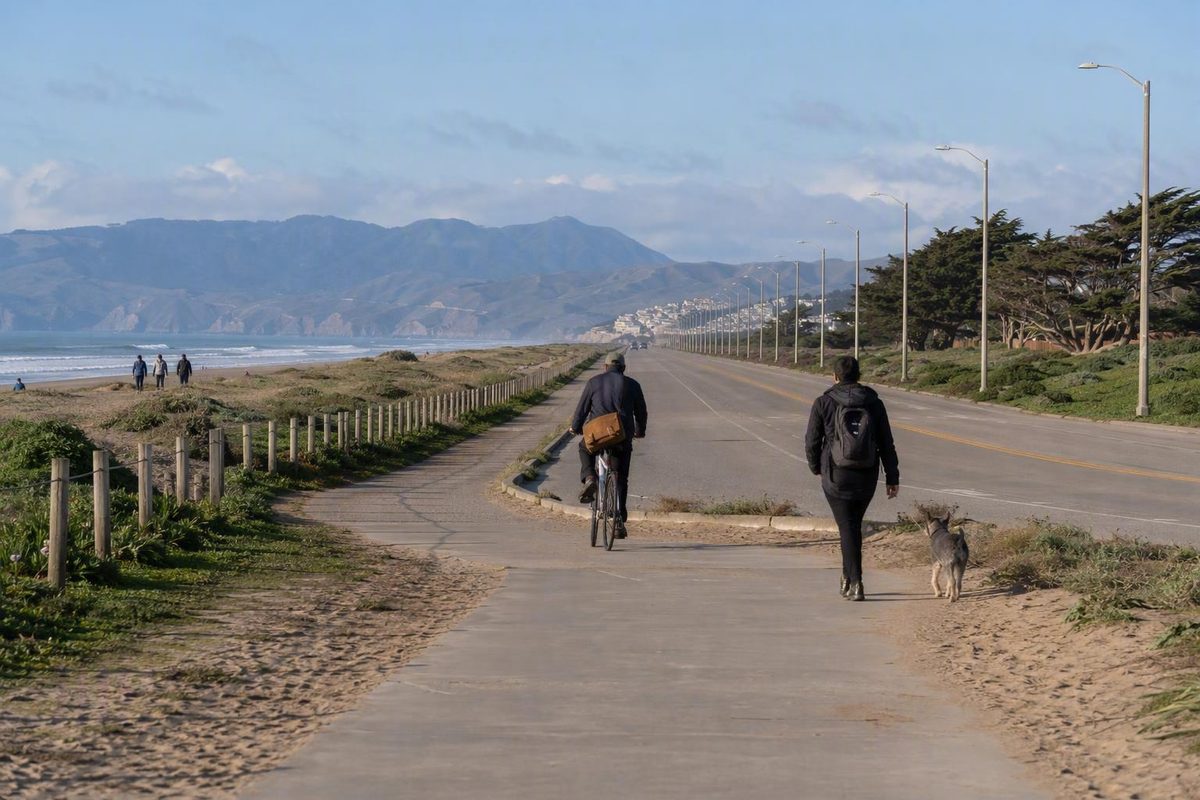
The November 3, 2026 measure is not a countdown to Sunset Dunes disappearing. Even if Proposition G wins a simple citywide majority, San Francisco would still have to fund, permit, design and build the reopening project. SFMTA and Recreation and Parks put the preliminary bill at $13.95 million, money that has not been appropriated, while the seven-day closure adopted through Proposition K won 55% citywide support in 2024. A later Controller estimate lowered the projected upfront cost to about $9.8 million, but it did not supply the money or an opening date. KQED reviewed the preliminary city records, and Mission Local reported the revised departmental estimate.
Choose a ballot result and cost scenario; the explorer shows whether visitors should plan for a park or a reopened road.
Test the ballot result separately from the money and construction needed to put weekday cars back on the Upper Great Highway.
The staffing reduction is only a possible offset; published reporting does not conclusively establish its accounting treatment.
- 1Citywide VoteAssumed passed
A simple majority authorizes weekday private-vehicle access.
- 2Mayor and Supervisors Fund the WorkNot appropriated
The ballot measure does not itself supply the estimated implementation money.
- 3Coastal and Other ApprovalsStill required
The coastal-permit cost, studies and possible conditions are not quantified.
- 4Final Design and ProcurementSchedule —
No final intersection scope, contracts or procurement calendar are supplied.
- 5Signals and Roadway WorkTimeline —
Eight intersections dominate the later estimate; construction must precede ordinary weekday traffic.
| Scenario | Upfront | Annual | Five-Year Total |
|---|---|---|---|
| Later estimate, lower annual case | ~$9.8M | ~$500K | ~$12.3M gross |
| Later estimate, higher annual case | ~$9.8M | ~$1.9M | ~$19.3M gross |
| Lower case with possible staffing offset | ~$9.8M | ~$500K less ~$300K | ~$10.8M illustrative |
| Higher case with possible staffing offset | ~$9.8M | ~$1.9M less ~$300K | ~$17.8M illustrative |
| Preliminary SFMTA/Rec & Parks estimate | ~$13.95M | — | — |
| Measure fails | Reopening work not triggered | — | Sunset Dunes stays |
Sources: reported SFMTA, Recreation and Parks and Controller estimates cited in the article. Amounts marked ~ are estimates; — means the supplied evidence gives no figure or timeline.
The Coin-Flip Interpretation Gets One Part Right
Visitor coverage often frames Proposition G as a clean park-versus-traffic choice: yes means cars return, no means Sunset Dunes remains. That is a fair description of the policy question on the ballot.
A yes vote would authorize private vehicles on the Upper Great Highway from Monday at 4:00 a.m. through Friday at 6:00 p.m., except when a government holiday falls on a weekday. The approximately two-mile road between Lincoln Way and Sloat Boulevard would remain closed to ordinary private vehicles on weekends and government holidays. A no vote would preserve the seven-day closure.
Emergency vehicles, official government vehicles, authorized intra-park shuttles and similar authorized vehicles are excepted. The measure concerns the Upper Great Highway inside Sunset Dunes, not the separate Great Highway Extension south of Sloat Boulevard. The Proposition G election overview provides the threshold, proposed schedule and exceptions.
The coin-flip framing fails on timing. A majority vote changes city policy; it does not appropriate construction money, issue a coastal development permit or restore eight intersections. No published evidence in the supplied reporting establishes a definite reopening date.
That makes “see Sunset Dunes before it is gone” poor trip-planning advice. The practical assumption is that the park remains available through at least the following summer, even under a yes-vote scenario. That is a planning judgment based on the unfinished funding, approval and construction gates—not an official guarantee of a summer 2027 operating schedule.
A Yes Vote Would Clear Only the First Gate
Proposition G qualified for the ballot after organizers gathered enough signatures in July 2026. It requires a simple majority on November 3. If it passes, the implementation sequence would still include:
- A city funding decision. The mayor and Board of Supervisors would have to identify and appropriate money.
- Regulatory approval. Reopening requires a coastal development permit and may require other government approvals.
- Final engineering. Agencies would have to settle the scope for signals, signs, striping and roadway preparation.
- Procurement and construction. The city would need contracts and a construction schedule, then complete the work before ordinary weekday traffic could return safely and legally.
Ballot qualification is not voter approval. Voter approval is not an appropriation. An appropriation does not replace a coastal permit, and a permit does not restore traffic signals.
The permit cost is not quantified in the available reporting. Neither are the costs of associated studies or conditions that regulators might impose. The evidence also supports no prediction about whether the California Coastal Commission would approve, reject or modify the project.
The same uncertainty applies to timing. No final intersection-by-intersection scope, procurement calendar or signal-construction schedule has been published in the supplied evidence. A measure can authorize weekday traffic without making the road ready for it.
The Cost Record Contains Two Different Upfront Estimates
The $13.95 million figure came from the preliminary SFMTA and Recreation and Parks estimate. Approximately $13.2 million was associated with signal restoration or replacement, with another $750,000 for removing park amenities and making the corridor suitable for private vehicles.
Earlier July reporting had identified at least $10.75 million: roughly $10 million connected to signals and $750,000 in Recreation and Parks work. The measure had not yet qualified when that report appeared, and the Controller’s analysis was still pending.
The later Controller estimate, reported in August, put one-time implementation at approximately $9.8 million. Mission Local’s report on the Controller estimate supplies the principal breakdown:
| Upfront Work | Later Estimate | Role |
|---|---|---|
| Eight intersections | ~$8.8M | Signals |
| Road and park conversion | ~$750K | Preparation |
| Striping and signs | ~$200K–$250K | Traffic control |
| Rounded total | ~$9.8M | One-time estimate |
Signals account for roughly 90% of the later upfront estimate. The work may involve restoration or replacement rather than simply switching existing lights back on.
Mission Local reported approximately $200,000 for temporary and permanent striping and signage, while CBS San Francisco reported $250,000. The $50,000 difference is small beside the signal budget and illustrates that these are rounded projections, not a final bid schedule. CBS San Francisco reported the later cost components.
The available work papers do not explain precisely why estimated signal costs fell from approximately $13.2 million to $8.8 million. A changed engineering scope, replacement assumptions, schedule or accounting treatment could explain the difference, but selecting one without the underlying analysis would be speculation.
The figures should not be averaged. The $13.95 million amount is a preliminary departmental estimate; $9.8 million is the later reported Controller estimate. Neither is a final contract or approved appropriation.
Five Years Could Cost $12.3 Million to $19.3 Million
The Controller reporting added an estimated $500,000 to $1.9 million in annual expenses for roadway and signal maintenance, sand removal and dune reshaping.
Using the later $9.8 million upfront estimate, the gross five-year arithmetic is straightforward:
| Five-Year Case | Calculation | Gross Total |
|---|---|---|
| Lower annual cost | $9.8M + 5 × $500K | $12.3M |
| Higher annual cost | $9.8M + 5 × $1.9M | $19.3M |
This is why some coverage describes a potential bill approaching $20 million. The $19.3 million result is a five-year scenario, not an upfront charge or approved spending plan. The San Francisco Standard’s five-year analysis also notes that actual spending depends on later city funding decisions.
The annual range is broad because coastal maintenance varies. Reported sand-removal and dune-management spending was approximately $860,000 in FY2022–23, $420,000 in FY2023–24, $290,000 in FY2024–25 and $330,000 in FY2025–26. CBS reported that annual sand removal and dune reshaping could range from approximately $100,000 to $1.5 million, depending on weather, service level and available funding.
Those historical amounts provide context, not a forecast for a particular year. They also remain distinct from the one-time signal, striping and conversion work.
A Possible Staffing Offset Does Not Resolve the Budget Gap
The reporting identifies a potential reduction of approximately $300,000 a year in park staffing if weekday vehicle access returns. It is not established as a guaranteed cash saving, and the supplied material does not conclusively show whether that reduction is already reflected in every version of the annual estimate.
Automatically subtracting it could double-count the offset. If it were separate, fully realized and sustained for five years, it would reduce the illustrative totals as follows:
| Scenario | Gross Total | With $1.5M Offset |
|---|---|---|
| Lower five-year case | $12.3M | $10.8M |
| Higher five-year case | $19.3M | $17.8M |
These are illustrative calculations, not Controller-approved net estimates. Staffing assignments and future service levels would remain budget decisions.
The signal bill also requires careful interpretation. An SFMTA spokesperson said comparable restoration or replacement costs would have arisen if the road had remained open because the signals were past their useful life. That means some spending may represent deferred or eventual infrastructure replacement rather than a cost caused exclusively by Proposition G.
It does not establish that the entire signal estimate is unrelated to reopening. The available evidence does not divide the eight intersections into work needed only for returning cars, work accelerated by the measure and work that would eventually be required under another configuration.
The Citywide Vote and District Backlash Point in Different Directions
Proposition K closed the Upper Great Highway to private vehicles seven days a week after receiving 55% support citywide in 2024. The closure took effect in March 2025, and Sunset Dunes opened the following month. SFMTA’s project history records the voter-approved policy and distinguishes this two-mile segment from the rest of the corridor.
That citywide result has not been reversed or replaced by a newer citywide poll in the supplied evidence. It therefore remains the strongest completed electoral test of the underlying policy.
The backlash was much stronger near the road. In the Sunset District, 64% of voters opposed Proposition K, and anger over the closure contributed to the recall of the district supervisor. That is meaningful evidence of concentrated neighborhood resistance, not proof that the citywide electorate has changed sides.
Both facts can be true: the city approved the park, while voters closest to the corridor rejected the closure by a substantial margin. Proposition G’s organizers gathered enough signatures to force another citywide decision, but qualifying a measure demonstrates organizational support rather than majority support at the polls.
The 2026 proposal is also narrower than a return to the old seven-day road. It would restore most weekday traffic while retaining car-free weekends and government holidays. That compromise may attract voters who disliked either full-time configuration, but the supplied evidence contains no reliable polling figure with which to measure that effect.
Visitors Should Plan Around the Existing Park
For a visit before the election, nothing about the ballot process changes current access: Sunset Dunes remains the car-free Upper Great Highway between Lincoln Way and Sloat Boulevard.
A no vote would preserve that arrangement. A yes vote would begin an implementation process whose largest known obstacle is not wording on the ballot but unfunded physical work. The city would still face the upfront estimate, recurring maintenance, an unpriced coastal-permit process and a construction timeline that has not been published.
The cleanest visitor assumption is therefore that Sunset Dunes is staying for the foreseeable trip-planning horizon. Do not treat November 3 as the day the park disappears, and do not assume cars could return immediately after ballots are counted.
If weekday access eventually returns, weekends and government holidays would remain car-free under Proposition G. Visitors would still have recreational access during those periods, although movable or permanent park amenities could change to accommodate weekday traffic.
The evidence supports a scoped verdict: Proposition G could legally reverse part of Proposition K, and voters could approve it. What it cannot do by itself is produce $9.8 million to $13.95 million, secure a coastal permit or complete signal construction. That gap between authorization and implementation is why Sunset Dunes remains the sound planning assumption even if the reopening measure passes.