
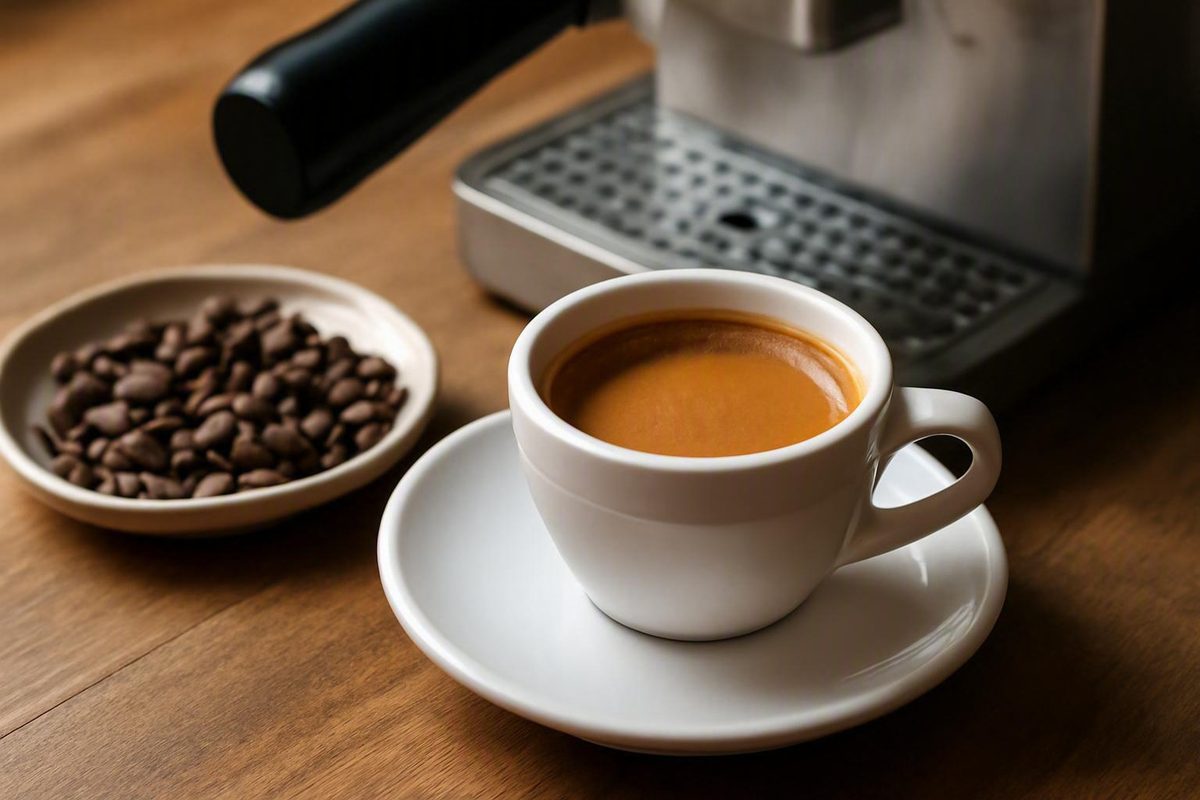
Medium roast espresso can occupy a useful middle ground: enough roast development to support sweetness and body, yet often enough origin character to preserve fruit, spice, florals, or other distinctive flavors. That versatility can suit straight shots, Americanos, and milk drinks—but “medium roast” is not a complete recipe.
A dependable approach begins with measured inputs and outputs. Start with a dose appropriate for your basket, target a 1:2 brew ratio, observe how quickly the espresso reaches that yield, and then taste it. Correct large flow problems with grind size before refining flavor through smaller changes to grind or beverage yield.
The goal is not to force every coffee into the same time or ratio. It is to create a controlled first shot and learn what the particular coffee, grinder, basket, and machine require.
What “medium roast espresso” actually means
Espresso is a brewing method rather than a formal roast level or a separate species of coffee bean. Medium-roast coffee can be brewed as espresso, as can light- and dark-roast coffee when the grind, dose, yield, and other brewing variables are adjusted appropriately. Beans do not need an “espresso roast” label to work in an espresso machine.
An “espresso roast” label generally communicates that a roaster selected or developed the coffee with pressurized espresso brewing in mind. It may also signal a traditional rich or dark flavor direction, but it does not identify a standardized roast category. Peet’s guide to espresso and roast level similarly distinguishes espresso as a method and says different roast levels can be used when the recipe is dialed in properly.
That distinction matters when shopping. One company might apply “espresso roast” to a medium blend, another to a dark roast, and a third to any coffee it believes will provide suitable sweetness and body under espresso extraction.
“Medium roast” is not standardized either. One roaster’s medium may resemble another roaster’s medium-dark, while a specialty roaster’s medium may look relatively light beside a conventional supermarket blend. The label narrows the field, but it cannot predict exactly how the coffee will taste or flow through your basket.
Medium roast is therefore best treated as a starting category rather than a guarantee. It commonly offers a combination of sweetness, texture, and recognizable coffee character, but it is not objectively better than light or dark roast. The right choice depends on the flavors you enjoy and the drinks you prepare.
Roast level is also only one influence on the result. Coffees carrying the same medium-roast label can differ because of:
- Origin and growing conditions
- Bean variety and density
- Processing method
- Single-origin or blend composition
- Roast development
- Coffee age and ambient conditions
- Grinder design and burr condition
- Basket size and geometry
- Dose and puck preparation
- Machine temperature, pressure, and preinfusion behavior
These variables can contribute to very different flow and flavor from one bag to the next. A grinder setting that produces a sweet, full shot with one medium roast may produce a fast, sharp shot—or a slow, harsh one—with another.
How medium-roast espresso tends to taste
Medium roast is commonly described as a bridge between lighter, origin-focused coffee and darker, roast-driven coffee. In broad terms, it may retain more perceived acidity and origin character than a dark roast while offering more roast-developed sweetness and body than many light roasts. These are tendencies, not fixed properties.
Sensory language becomes more useful when translated into familiar experiences:
- Acidity is a bright, lively, or fruit-like impression that might resemble citrus, apple, berries, grapes, or other tart foods. Acidity does not automatically mean the espresso is unpleasantly sour.
- Sweetness is a balancing impression that may suggest caramel, brown sugar, chocolate, honey, or ripe fruit. These descriptors refer to perceived flavor and aroma rather than added sugar.
- Bitterness may be pleasant and cocoa-like or aggressive and burnt. Some bitterness can provide structure, while a harsh or lingering finish may overwhelm the coffee.
- Body is the perceived weight and texture of the espresso. A shot might feel thin and tea-like, smooth and silky, or dense and syrupy.
- Dryness or astringency is a mouth-drying tactile sensation, comparable to the finish of oversteeped tea. It is related to, but not identical with, bitterness.
Balanced espresso does not have to eliminate acidity or bitterness. A fruit-oriented coffee may be intentionally bright, while a chocolate-oriented blend may contain pleasant cocoa bitterness. Balance means that one quality does not overwhelm the sweetness, texture, and intended character of the coffee.
Medium roast is not one flavor category. Coffee Bean Direct, for example, describes its own medium-roast espresso as earthy and spicy, with moderate acidity and heavy body. The company says the blend contains coffee from South America, Central America, and India. Those are manufacturer-provided blend and tasting descriptions, not independently verified sensory findings.
Coffeeness markets another medium-roast espresso around chocolate, hazelnut, caramel-like sweetness, and full body. That seller-provided description illustrates a comforting, nut-oriented interpretation of medium roast rather than a notably bright one.
Fruit-forward examples broaden the category further. Better Brew Coffee documented a home experiment with a medium roast carrying stated notes of red grape, plum, and cherry. The brewer found the espresso lively and fruit-centered even after adjustment. That single experience cannot predict how another coffee will perform, but it demonstrates why the roast label alone cannot tell you whether a cup will taste earthy, nutty, floral, or wine-like.
Compared cautiously with dark roast, medium roast often leaves more room for origin character and complexity. Darker coffee is commonly described as heavier and more roast-driven, with smoky, caramelized, or bittersweet qualities. Medium coffee may seem brighter or more layered. Bean selection, processing, roast development, and brewing recipe can blur those boundaries, and neither roast level is inherently superior.
Use these general differences to choose a direction, not to prejudge the cup. The coffee in front of you still needs to be brewed and tasted on its own terms.
A measured starting recipe for a double espresso
For a conventional double basket that comfortably accepts the dose, begin with this controlled recipe:
| Variable | Starting point |
|---|---|
| Dry coffee dose | 18 g |
| Espresso yield | 36 g |
| Brew ratio | 1:2 |
| Initial diagnostic time | Approximately 25–35 seconds |
An 18-gram dose yielding 36 grams is a commonly presented 1:2 starting recipe, while published timing guidance varies from approximately 25–30 seconds to about 30–35 seconds. These figures form an initial diagnostic range, not a universal standard. See the Coffee Bros. 1:2 dialing example and Peet’s extraction overview linked earlier.
A 1:2 ratio means that the beverage weighs twice as much as the dry coffee. Published recipes may use different doses—such as 20 grams in and 40 grams out—while preserving the same relationship. The principle is the measured ratio, not one compulsory basket dose.
Follow the practical capacity of your basket. CoffeeGeek’s equipment examples show why basket dimensions and capacity can require different doses and recipes. If your basket is intended for a dose near 16 grams, a 1:2 test would target approximately 32 grams in the cup; if it is intended for 20 grams, the corresponding target would be approximately 40 grams.
Weigh both the dry coffee and the beverage yield. A scale accurate to 0.1 gram is useful for repeatability because it helps you determine whether a grind adjustment—not an unintentionally changing dose or yield—altered the shot. CoffeeGeek specifically recommends 0.1-gram measurement when dialing in espresso.
Stop the extraction at the target beverage mass, record the time, and taste the espresso after it cools enough to evaluate comfortably. Keep the same timing convention for every attempt.
CoffeeGeek’s numerical equipment example, for instance, explicitly includes preinfusion in its reported time. If a published recipe does not explain its convention, compare its dose, yield, visible flow, and flavor rather than trying to reproduce the time exactly.
Treat the approximate 25–35-second range as evidence about flow, not a pass-or-fail test. A balanced shot can fall outside it, and a poor-tasting shot can land inside it. Time tells you how long a known dose took to produce a known yield.
Avoid starting with a universal grinder number. Grinder markings do not transfer reliably among brands, models, burr sets, or individual units. Begin near the manufacturer’s espresso range, a setting that worked for a similar coffee, or a broad roaster recommendation. Then judge the measured result from your equipment.
The same restraint applies to temperature. Start with your machine’s stable baseline or a reasonable coffee-specific recommendation if one is supplied. Establish a workable grind and ratio before introducing another variable. Changing grind, yield, dose, and temperature together makes the result difficult to interpret.
The baseline is not meant to prove that a 1:2 shot is correct. It creates a controlled first result from which you can learn what the coffee needs.
Dial in the coffee without changing everything at once
A repeatable process is more useful than a collection of isolated recipes. Use the same sequence for each attempt:
- Weigh the dry dose. Confirm how much coffee reaches the basket.
- Prepare the puck consistently. Distribute the coffee and tamp level using the same routine.
- Stop at the target yield. For the baseline, that is 36 grams from an 18-gram dose.
- Record the shot time. Use the same start point each time.
- Taste after slight cooling. Evaluate acidity, sweetness, bitterness, body, and finish.
- Change one variable. Record the change before pulling another shot.
Changing one variable at a time does not guarantee improvement, but it makes the result easier to interpret.
Correct major flow errors with grind
If the target yield arrives much too quickly, grind finer. Keep the dose, target yield, and preparation routine stable while testing the new setting.
If the target yield arrives much too slowly—or the machine barely produces espresso—grind coarser. Again, hold the dose and target yield steady.
This separates flow adjustment from recipe adjustment. When the other major variables remain stable, the effect of the grind change becomes clearer.
There are practical exceptions. A grinder with large adjustment steps may jump directly from too fast to too slow. CoffeeGeek notes that a small dose change can sometimes compensate for coarse adjustment steps, provided the basket can accept that dose appropriately. Basket capacity also takes priority over trying to preserve an arbitrary published number.
Refine flavor with yield once flow is workable
Once the espresso reaches the target yield at a plausible rate, let taste guide the next adjustment.
For a bright medium roast that remains sharply sour after the major flow problem has been corrected, test a modestly longer yield. From an 18-gram dose, moving from 36 grams to 40 or 45 grams is a smaller and more interpretable experiment than immediately jumping to 54 grams. Longer ratios such as 1:2.5 or 1:3 are options to test, not standard prescriptions for medium roast.
One firsthand experiment illustrates the tradeoff. A Better Brew Coffee writer tested a fruit-forward medium roast over three shots and preferred the third attempt at 18 grams in, 54 grams out—a 1:3 ratio—with a 29-second extraction. The documented three-shot experiment involved one coffee, machine, grinder, and palate, so its exact settings are illustrative rather than transferable.
Experienced brewers may sometimes reach a satisfactory recipe in three shots: establish a baseline, correct the largest flow error, and then refine the flavor. CoffeeGeek presents this as an efficiency goal and explicitly notes that it does not happen every time. An unfamiliar grinder, an unsuitable starting point, or a demanding coffee can require more attempts.
Troubleshoot flow and flavor as separate problems
A fast shot and a sour shot often occur together, but they are not the same observation. Flow tells you how quickly the beverage reached the target mass. Flavor tells you whether the extraction and concentration suited the coffee.
Ask two separate questions:
- Did the espresso reach the target yield much too quickly or slowly?
- How did it taste after cooling enough to evaluate?
Then make the smallest reasonable adjustment.
| Observation | Likely extraction direction | First adjustment | What to hold constant |
|---|---|---|---|
| Target yield arrives much too quickly | Often too little resistance and extraction | Grind finer | Dose, target yield, preparation |
| Target yield arrives much too slowly | Excessive resistance is possible | Grind coarser | Dose, target yield, preparation |
| Sour and thin, with fast flow | Insufficient extraction is a common possibility | Grind finer | Dose and target yield |
| Sour or sharp, with reasonable flow | The coffee may benefit from more extraction | Extend yield modestly or test a slightly finer grind | Change only one variable |
| Harsh, bitter, or drying, with slow flow | Excessive extraction is one possibility | Grind coarser | Dose and target yield |
| Bitter or drying, with reasonable flow | The yield may be too long for the coffee | Shorten yield modestly | Dose and grind |
| Heavy but dull | The shot may be too concentrated or uneven | Test a slightly longer yield; repeat preparation carefully | Dose and preparation routine |
| Watery despite a plausible time | The yield may be too long, or flow may be uneven | Shorten yield modestly; repeat preparation carefully | Dose and grind initially |
| Results change unpredictably | Dose or preparation may be inconsistent | Verify weights and repeat the same routine | Recipe and machine routine |
Sour or thin espresso can indicate insufficient extraction, particularly when the shot also reaches its target much too quickly. Grinding finer is the logical first test because it addresses the visible flow problem while preserving the recipe. Peet’s extraction guidance likewise describes sour, thin espresso as a common sign of under-extraction and bitter, harsh espresso as a possible sign of over-extraction.
If the flow is already plausible but the coffee remains sharply sour, a longer yield may be more informative. Increase the target in a small step while keeping the grind stable. If sweetness improves and the acidity becomes more fruit-like, the change may be useful. If the shot simply becomes watery, bitter, or dry, return toward the previous yield.
Harsh, bitter, or drying espresso can point toward excessive extraction, but sensory diagnosis is imperfect. A dark cocoa bitterness may belong to the intended coffee profile. Roast character can also create smoky or bitter flavors that remain even when the measured flow is reasonable.
If the shot is also very slow, grind coarser first. If flow is reasonable but the finish becomes progressively less pleasant as the shot runs, test a shorter yield.
Timing alone cannot settle these questions. A different coffee reaching the same ratio in the same time may taste bitter or dry.
If an adjustment makes the espresso worse, return to the last better-tasting recipe. Then either make a smaller change to the same variable or test a different explanation. Dialing in should be a controlled sequence, not a one-way progression toward finer grinding or longer shots.
Why every new bag needs its own settings
A grinder setting that worked yesterday is useful information, but it is not guaranteed to suit the next coffee. Espresso flow can change with the coffee, surrounding conditions, and brewing equipment.
Relevant factors include:
- Roast development
- Bean variety and density
- Origin and processing method
- Coffee age
- Ambient humidity and temperature
- Grinder design and burr geometry
- Basket diameter, shape, and capacity
- Dose and puck dimensions
- Machine behavior
- Distribution and tamping consistency
CoffeeGeek’s dialing guide specifically identifies roast, coffee age, humidity, temperature, grinder design, basket geometry, dose, and machine characteristics as variables that can alter the required recipe.
This does not mean that every variable needs active adjustment. It means the previous setting is a reference point. Start nearby when the new coffee appears similar, but verify the actual dose, yield, time, and flavor instead of forcing the new bag to match the old one.
Medium roast can serve as a practical reference between lighter and darker coffees. It does not follow that every light roast must be ground finer or every dark roast coarser. Those directions appear in some commercial dialing guidance as broad tendencies, but an individual coffee, grinder, basket, and recipe can behave differently.
Grinder numbers are machine-specific. A setting of “4” on one grinder may be unusable on another model. Copy another brewer’s adjustment logic, not the number.
Your dosing workflow also determines what should be checked:
- Single dosing: Weigh the intended dose before grinding and verify the ground output periodically.
- Grind by weight: Set the target dose, but check the delivered amount until you know how consistently the grinder reaches it.
- Grind by time: Treat the timer as a dosing aid rather than proof of mass. Check the delivered dose regularly because coffee and operating conditions can change the output.
- Manual hopper dosing: Weigh the coffee delivered to the basket rather than estimating from appearance.
Whatever the workflow, verify the actual dose by weight. A suddenly faster shot may reflect a grind change, but it may also contain a different dose than intended. Commercial dialing guidance also recommends using a digital scale and periodically checking the output of timed grinders.
Coffee can grind and flow differently as it ages. The direction and pace of change are not identical for every coffee or environment, so there is no supported universal schedule for re-dialing. Adjust when the measured flow or flavor changes enough to justify it.
A short log helps prevent random corrections:
| Item | Example |
|---|---|
| Coffee | Roaster, coffee name, roast description |
| Dose | 18.0 g |
| Yield | 36.0 g |
| Time | 29 seconds, including preinfusion |
| Grind | Your grinder’s position |
| Taste | Sweet start, bright finish, slightly thin |
| Next change | Keep grind; raise yield to 40 g |
The notes do not need to be elaborate. Their purpose is to show what changed and whether it helped. When the coffee ages—or when you later open a similar bag—the log provides a rational starting point.
Choose beans by flavor and drink style, not the roast label alone
The most useful bag is not necessarily the one with the most prominent “espresso” branding. Look for a flavor direction that suits how you drink coffee, and then treat the tasting notes as a hypothesis to test.
Three broad styles provide a practical shopping framework.
Earthy, spicy, and heavy-bodied
Consider this direction if you enjoy substantial texture, restrained fruitiness, and descriptions such as spice, earth, wood, or dark cocoa. It may also appeal to drinkers looking for a robust flavor direction in milk.
Coffee Bean Direct is an attributed commercial example. The manufacturer describes its medium-roast espresso as earthy and spicy, with moderate acidity and heavy body. That suggests a traditional-leaning profile, but it remains the seller’s description rather than an independent sensory evaluation.
Chocolate, caramel, and nuts
Chocolate, caramel, hazelnut, almond, and brown-sugar notes can be useful starting signals for shoppers seeking a familiar, rounded espresso profile. These descriptions may also appeal to people who want the espresso flavor to remain noticeable in a milk drink, although that is preference guidance rather than a predictable result.
Coffeeness provides one seller-attributed example, marketing its medium-roast espresso around chocolate and hazelnut and recommending it for both straight espresso and milk drinks. Its medium-roast product description is promotional material, so statements about perfect balance, zero bitterness, or universal machine compatibility should not be treated as objective test findings.
Fruit-forward or floral
Look for descriptions such as berry, cherry, grape, plum, citrus, stone fruit, or flowers if you want a more distinctive straight espresso or Americano.
A modestly longer yield is one experiment worth testing after the flow is workable, but do not assume that every fruit-oriented medium roast needs a 1:3 ratio.
Both blends and single-origin coffees can be brewed successfully as espresso. Blends may be assembled to pursue a particular balance of body and flavor, while single-origin coffees may offer a more focused expression. The available evidence does not establish either format as inherently superior.
Some medium-roast products are marketed for several brewing methods. Coffee Bean Direct, for example, promotes its blend for brewed coffee as well as espresso. That cross-method suitability is a seller claim, and each brewing method still requires an appropriate grind. Coffee sold in an espresso-fine format is not the same product configuration as coffee ground very coarsely for French press.
When comparing bags, read the full description:
- Do the notes emphasize chocolate and caramel or citrus and flowers?
- Is the body described as heavy, creamy, silky, or light?
- Does the roaster provide an espresso recipe?
- Is that recipe stated by mass or only by volume?
- Is the coffee positioned for straight shots, milk drinks, or several methods?
- Are the statements measurable specifications, subjective tasting notes, or customer opinions?
Bag notes indicate an intended direction, not a guaranteed result. Your equipment, recipe, and palate may produce a different impression without either the coffee or your technique necessarily being defective.
Buy the format and quantity your setup can use well
Buy whole beans if you own an espresso-capable grinder. The principal advantage is control: you can change the grind for the specific coffee, basket, and observed flow. Whole beans are not automatically fresher merely because they are whole; the evidence provided here does not establish freshness without information about roasting, packaging, storage, and handling.
Generic pre-ground “espresso” coffee is a compromise because “espresso grind” is not one universal setting.
If pre-ground coffee is necessary, select a preparation-specific format intended for the brewing method you actually use. Dose and beverage yield can still be measured, but those controls do not provide the same direct adjustment as changing the grind.
Coffee Bean Direct illustrates the format range a seller may offer. In the product-page capture reviewed for this guide, the company displayed whole bean and preparation-specific options for French press, percolator, auto drip, espresso, and Turkish brewing, in 1-, 2.5-, and 5-pound packages. Those package and grind options are volatile product-page details and should be rechecked before purchase.
When comparing bag sizes, calculate the price per pound:
Price per pound = bag price ÷ bag weight in pounds
A larger bag may have a lower unit price, but unit price is not the same as practical value. If you cannot use the coffee while its flavor remains acceptable to you, the nominal saving has not helped. A large purchase also means using the same coffee for longer and potentially adjusting the grinder as its flow changes.
Estimate consumption from your actual dose and routine. At an 18-gram dose, two drinks require 36 grams of coffee before allowing for dial-in attempts or other coffee used during preparation.
Ask:
- How many espresso drinks do I prepare each day?
- How much coffee might I use while dialing in?
- Do I want to use one coffee for an extended period?
- Am I willing to adjust the grinder as its behavior changes?
- Would a smaller bag reduce waste enough to justify a higher unit price?
Prices, package options, inventory, subscriptions, ratings, and review totals can change. If quoted in a product comparison, they should be checked near publication and accompanied by a clear as-of date.
Marketplace ratings and manufacturer-hosted ratings should not be compared as if they were controlled quality measurements. Their audiences, review systems, incentives, and verification practices may differ.
Likewise, treat claims such as “perfectly balanced,” “zero bitterness,” “works with every machine,” or “best espresso” as promotional language rather than objective testing. A more useful purchase decision combines a plausible flavor direction, a suitable format, a manageable quantity, and enough grind control for your equipment.
Frequently asked questions
Can regular medium-roast coffee be used for espresso?
Yes. Espresso is a brewing method rather than a formal roast category, so regular medium-roast beans can be used in an espresso machine. An “espresso roast” label usually indicates that the roaster intends the coffee to perform well under espresso extraction; it is not a requirement.
The coffee still needs an appropriate grind and recipe. Medium roast packaged for drip brewing may work as espresso if it is freshly ground and dialed in for the espresso setup. Pre-ground drip coffee does not provide the same grind control.
What is a good starting ratio for medium-roast espresso?
A practical starting point is a 1:2 brew ratio, such as 18 grams of dry coffee yielding 36 grams of espresso. Approximately 25–35 seconds can be used as an initial diagnostic range, with the understanding that published guidance varies and taste determines the final recipe.
If your basket is designed for another dose, preserve the ratio rather than forcing it to accept 18 grams. Once the flow is workable, adjust grind or beverage yield one variable at a time.
Should medium-roast espresso be ground finer than dark roast?
It may need a finer setting than a particular dark roast, but that is not a universal rule. Coffee age, bean characteristics, grinder design, basket geometry, dose, and machine behavior can all affect the required setting.
Use the previous setting only as a reference. If the target yield arrives much too quickly, grind finer; if it arrives much too slowly, grind coarser.
Why does my medium-roast espresso taste sour even when the shot time looks right?
Shot time does not measure flavor or guarantee an even result. A shot can reach the expected time while remaining sharply sour because the ratio is too short for that coffee, the grind needs refinement, or the flow through the puck was inconsistent.
Verify the dose, yield, preparation routine, and timing convention. If the shot reaches a 1:2 ratio at a plausible rate but remains unpleasantly sour, test either a slightly finer grind or a modestly longer yield—not both at once. The aim is not to eliminate all fruit-like acidity but to find enough sweetness and body to balance it.
Is medium-roast espresso suitable for milk drinks?
Yes. Medium roast can work well in milk drinks, particularly when its stated flavor direction emphasizes chocolate, caramel, nuts, spice, or heavier body. These descriptions are useful shopping signals, not guarantees.
Fruit-forward medium roasts can also be enjoyable with milk, but that combination depends more heavily on personal preference. Regardless of drink style, begin by dialing in the espresso itself through measured dose, yield, flow, and taste.
Choose a medium roast whose stated flavor direction matches the drinks you enjoy, begin with a weighed 1:2 recipe, and use time as a diagnostic clue rather than a verdict. Correct major flow problems with grind, refine flavor through measured changes to grind or yield, and record what works.
Medium roast is valuable not because it guarantees one ideal espresso, but because it offers room to balance sweetness, body, acidity, bitterness, and origin character according to the coffee and your taste.