
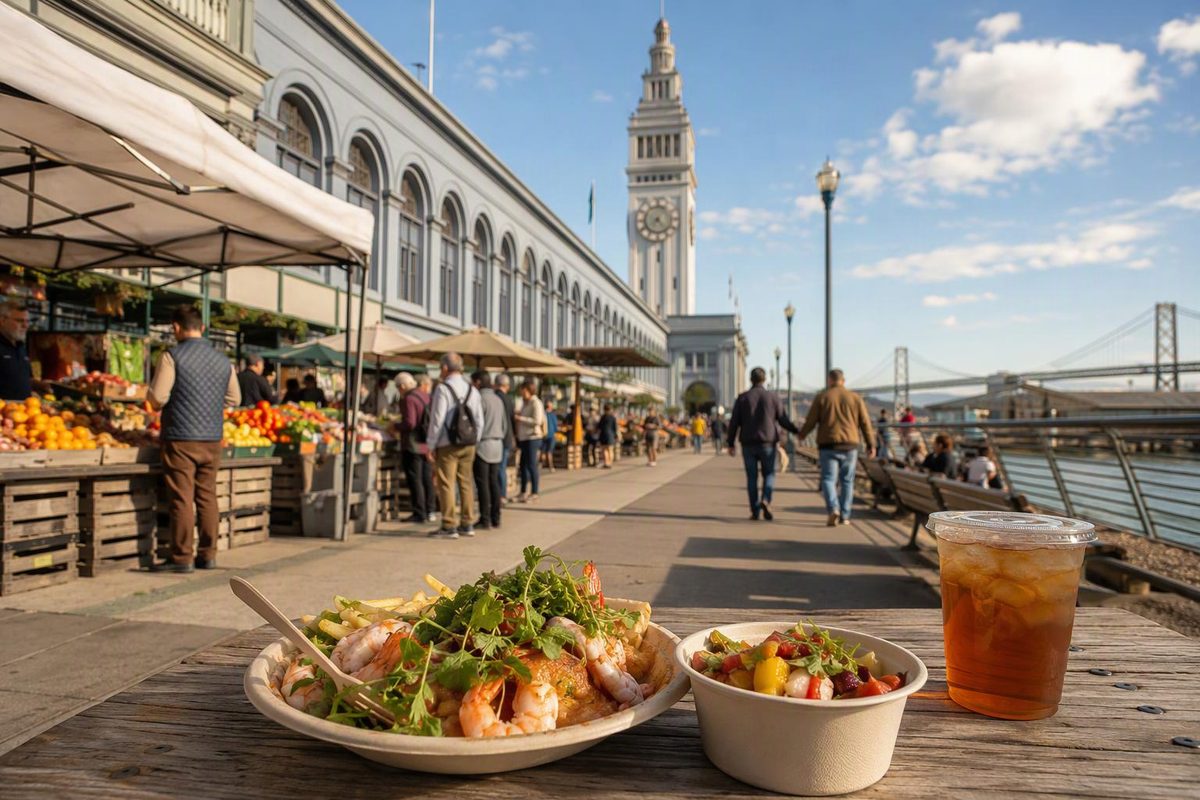
The Ferry Building works best as a focused food stop: allow 60–90 minutes for the indoor marketplace, or about two hours when the outdoor farmers market is running. Admission to the building and marketplace is free, while restaurants set their own seating and reservation policies (San Francisco Travel).
The central planning distinction is that the Ferry Building Marketplace and Ferry Plaza Farmers Market are not the same thing. The marketplace is the indoor collection of permanent food shops and restaurants. The farmers market operates outside only on Tuesday, Thursday and Saturday.
Choose your day, available time and food priority; the planner will identify the best-fit visit.
Ferry Building Visit Planner
Select the visit you can actually make. The result distinguishes the outdoor farmers market from the daily indoor marketplace.
Best Fit: Saturday Market
Market hours: 8 a.m.–2 p.m.
Two hours fits the broadest market experience. Scan the indoor hall, make one outdoor circuit, eat, then finish with later purchases.
Expect: More than 100 vendors and the most food decisions of the three market days.
| Day | Outdoor Market | Scale |
|---|---|---|
| Saturday | 8 a.m.–2 p.m. | 100+ vendors |
| Tuesday | 10 a.m.–2 p.m. | 20+ farms |
| Thursday | 10 a.m.–2 p.m. | ~10–15 vendors |
| Other days | — | Indoor marketplace |
Source: Foodwise visitor information. The indoor building is open daily, but individual merchant hours vary.
Choose The Market Day That Fits Your Visit
| Visit | Best Choice | Best For |
|---|---|---|
| Full market experience | Saturday, 8 a.m.–2 p.m. | More than 100 vendors, produce, food makers, breakfast and lunch |
| Produce-focused stop | Tuesday, 10 a.m.–2 p.m. | More than 20 farms plus prepared food |
| Compact weekday lunch | Thursday, 10 a.m.–2 p.m. | About 10–15 vendors, emphasizing street-food lunch options |
| Indoor browsing | Any day | Permanent merchants, coffee, sweets, pantry goods and restaurants |
The farmers-market hours and vendor counts come from Foodwise, the market operator. The market runs year-round, rain or shine.
Saturday is the right choice when the market itself is the attraction. It offers the broadest selection, but the scale also creates more walking, comparison and food decisions. Budget about two hours if you want to scan the stalls, choose a meal and make a final pass for produce or packaged goods.
Tuesday is the more focused choice when farms and produce matter more than sheer variety. Its more than 20 farms make it substantial enough for market shopping without requiring the same amount of time as Saturday. A 60–90 minute visit can work if you decide whether lunch or produce is the priority before arriving.
Thursday is best treated as a compact lunch market. With about 10–15 vendors and an emphasis on street-food options, it fits a weekday waterfront stop more readily than an open-ended market outing. It is not a smaller version of Saturday in every respect, so choose it for convenience and lunch rather than maximum selection.
On Monday, Wednesday, Friday and Sunday, plan around the indoor marketplace. That is not necessarily a lesser visit if the goal is coffee, a prepared meal, sweets or edible gifts. It is simply a different experience from the outdoor market.
The building is open daily from 6 a.m. to 10 p.m., but that does not mean every counter serves throughout that window. Each business keeps its own schedule. Check the current merchant directory before making a special trip for one vendor. The marketplace closes on Thanksgiving and Christmas Day, according to the Ferry Building visitor information.
Follow One Compact Loop Instead Of Backtracking
A clean visit has three parts: scan the indoor hall, make one outdoor circuit when the farmers market is operating, and finish on the bay side. This prevents the common pattern of buying immediately, carrying food while browsing and then returning to stalls already passed.
Scan The Indoor Hall Before Ordering
Spend the first five or ten minutes walking the central hall without buying anything. The purpose is not to inspect every product. It is to see which of four visit types fits your appetite and available time:
- Quick meal: pizza, sandwiches, tacos, empanadas or Japanese deli food
- Bay seafood: a seated oyster or fish lunch
- Edible gifts: chocolate, olive oil, pantry goods or baked items
- Market tasting: two small prepared-food portions outside instead of a full restaurant meal
Once you have chosen one purpose, ignore options that belong to the others. A traveler seeking a quick meal does not need to compare every seated restaurant, while someone planning a seafood lunch should avoid filling up during the initial walk.
The official Ferry Building map identifies merchants and the north and south passageways. Check it before arrival if one business is essential, but use the hall itself to confirm what looks practical when you get there.
Make One Outdoor Circuit Before Buying
On Saturday, the farmers market surrounds the building and is larger than it appears from the Embarcadero entrance. Walk one circuit, note two or three stalls and then return to buy. This is especially useful when choosing among prepared foods, where buying at the first stall can turn the rest of the market into a walk taken while balancing a meal.
Tuesday and Thursday have smaller footprints, so a direct browse is easier. Even then, separate the decision into a main purchase and any secondary purchase. For example, choose lunch first and packaged goods second, or produce first and coffee afterward. That keeps a short stop from becoming several disconnected passes through the same area.
If produce or packaged goods are part of the plan, shop before lunch and use Foodwise’s free Veggie Valet instead of carrying bags through the rest of the visit. Saturday service runs from 8 a.m. to 1 p.m. On Tuesday and Thursday, it is available at the Info Booth from 10 a.m. to 2 p.m.
Most market sellers accept cards or contactless payment. The Info Booth also sells market coins redeemable at any stall, with a service fee for card purchases. These services and payment details are listed by Foodwise on the visitor-information page linked above.
Eat On The Bay Side And Finish Indoors
The bayside plaza has outdoor dining areas and public benches. After choosing food, move there rather than continuing to browse with it. The waterfront setting is part of the appeal, but the practical advantage is that the meal creates a clear pause between shopping passes.
After eating, return through the indoor hall once. Use that final pass for bread, chocolate, olive oil or another item intended for later. Perishable or fragile purchases are easier to manage when they are the last part of the stop rather than the first.
For a casual meal, A16 La Pala serves Roman-style pizza, focaccia sandwiches and pastries. It lists daily hours of 9 a.m.–7 p.m. (A16). Those hours are specific to that business and should not be treated as the schedule for other marketplace merchants.
For a full seafood meal, Hog Island’s operator page lists an 11:30 a.m. opening Monday–Thursday and an 11 a.m. opening Friday–Sunday. The restaurant is dine-in and takes no reservations (Hog Island Oyster Co.). If that meal is the priority, arrive close to opening and avoid putting a fixed activity immediately after lunch. A wait would otherwise compress the rest of the waterfront plan.
Match The Route To The Time Available
A 60-minute stop works best indoors or at the smaller Tuesday and Thursday markets. Spend the opening minutes scanning, commit to one food purpose and leave any gift shopping until the final pass. A seated restaurant meal may consume most of this window, so it should be the visit rather than one element within it.
With 90 minutes, the indoor marketplace can support a meal plus a deliberate browse. On a farmers-market day, this window still calls for restraint: one outdoor circuit, one main food choice and no attempt to inspect every stall.
About two hours is the better Saturday allowance. The additional time accounts for the market surrounding the building, the larger vendor count and the need to compare before ordering. It also leaves room to eat without turning lunch into a rushed standing stop.
These time blocks are planning allowances, not promises about restaurant waits or merchant service. If a specific counter or restaurant is non-negotiable, check its current hours directly and let that business determine the sequence.
Arrive By Transit And Save Walking For The Waterfront
The Ferry Building stands at the eastern end of Market Street. Embarcadero BART is one block away, according to Foodwise and BART station information. The F Market streetcar stops at “The Embarcadero/Ferry Bldg” in both directions (SFMTA). Multiple Muni rail and bus routes also stop nearby.
The walking effort changes with direction. The Embarcadero beside the building is level, while Market Street rises gradually as you head west toward Union Square. If the rest of the day includes hillier neighborhoods, take BART or Muni to the market and reserve your walking time for the waterfront.
This also produces a cleaner sequence. Arrive by transit, complete the market loop and then decide whether to continue north. Starting with a long approach on foot can use energy without improving the market visit itself.
Pier 15 is a coherent next stop for travelers continuing north; use this three-hour Exploratorium plan to judge whether it fits the remaining day. If the market is only one part of a longer waterfront outing, compare which San Francisco waterfront stretch to choose rather than automatically walking all the way to Fisherman’s Wharf.
Use The Flat Entrances And Indoor Facilities
The outdoor farmers market occupies a flat, paved surface. Curb ramps serve the Embarcadero side. Foodwise identifies the loading zone on northbound Embarcadero just south of the clock tower as the best passenger drop-off point.
Two sets of ADA-accessible public restrooms are inside the building, in the north and south passageways. On a farmers-market day, locating the correct passageway during the initial indoor scan avoids an unnecessary circuit later.
The passenger loading zone is not the same as parking. Metered street spaces and paid parking facilities are available near the building, and designated accessible spaces are located just north and south of it. Drivers should verify current parking signs, meter rules and restrictions when they arrive rather than relying on the building’s operating hours.
Shift Indoors During Rain Or Strong Wind
The farmers market operates rain or shine, but the outdoor stalls and bayside seating have less protection than the interior hall. In rain or strong waterfront wind, shorten the outdoor circuit rather than canceling the stop. Make the permanent marketplace the main event and use the outside market only for specific purchases.
A seated meal or coffee break gives the visit a weather-resistant anchor. The indoor hall also works better for browsing pantry goods, chocolate and baked items when lingering outside is uncomfortable. Because individual merchants keep their own schedules, poor weather does not remove the need to check the business you intend to visit.
Pets are not allowed in the marketplace or certified farmers market; service animals are the exception. There are no public lockers or storage areas, making the Ferry Building an awkward stop with luggage. Travelers carrying bags should arrange storage before arriving rather than expecting to leave them at the building.