
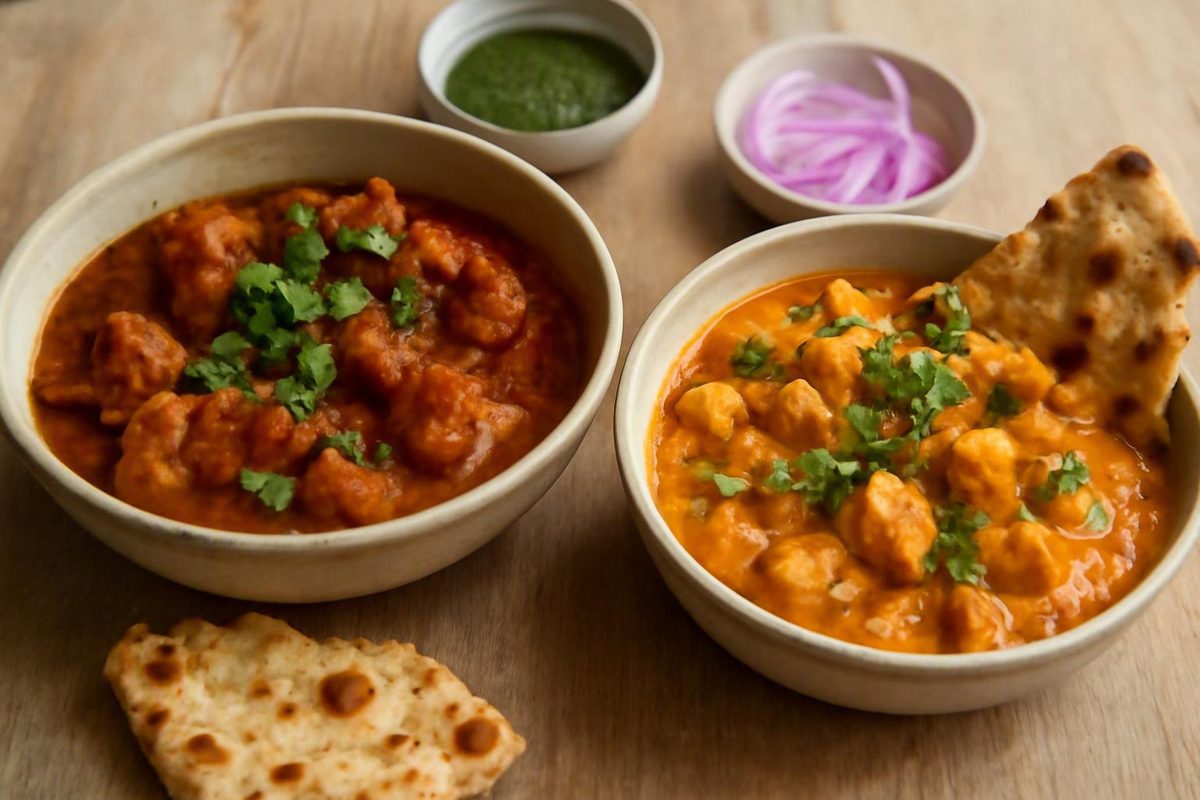
Two intertwined cuisines—and a practical way to taste the differences
The Short Answer: Similar Foundations, Distinct but Varied Traditions
Pakistani and Indian food overlap substantially, but prominent dishes, cooking methods, ingredient emphasis, and dietary customs can differ. In the two restaurant guides available for this comparison, Pakistani food is represented largely through meat dishes, while Indian food is represented through an especially broad range of vegetarian dishes. That is a limited restaurant-menu tendency—not a rule about either country.
Both guides frame the cuisines as part of intertwined South Asian traditions and emphasize Mughal-era influence on foods such as slow-cooked meats, rice dishes, breads, kebabs, and tandoori preparations. Mughal influence is only one part of a much larger culinary history, however, and these commercial introductions cannot provide a definitive historical account. Their clearest point is the extent of the overlap: basmati rice, naan, roti, paratha, biryani, kebabs, spices, and tandoor cooking appear in both traditions (Laree Adda’s comparison).
The contrast becomes visible through representative dishes. Pakistani examples in the sources include nihari, haleem, karahi, chapli kebab, seekh kebab, and paye. Indian examples include dal, paneer dishes, chana masala, dosa, chole bhature, rajma chawal, and dhokla.
But Pakistani food is not uniformly meat-based, and Indian food is not uniformly vegetarian. The available sources do not adequately cover Pakistani vegetable, lentil, greens, and seafood traditions or India’s many meat and seafood traditions. Their omissions should not be mistaken for proof that those foods are absent.
The most useful question is therefore not which cuisine is better, richer, healthier, more authentic, or spicier. It is which particular dishes and techniques are available—and what kind of meal you want.
A Side-by-Side Comparison Without the Stereotypes
This table summarizes the patterns presented in the two restaurant guides. It is an introductory menu aid, not a complete description of either national cuisine.
| Point of comparison | Pakistani food | Indian food |
|---|---|---|
| Shared staples and preparations | Rice, including basmati; naan; roti; paratha; spices; biryani; kebabs; and tandoori preparations | Rice, including basmati; naan; roti; paratha; spices; biryani; kebabs; and tandoori preparations |
| Prominent protein pattern | Often represented through substantial meat dishes, but not universally meat-based | Includes extensive vegetarian cooking as well as meat and seafood traditions |
| Vegetarian breadth | Vegetarian food exists, although the supplied sources provide little detail about it | Particularly broad documented range of lentil, bean, paneer, and vegetable dishes |
| Representative dishes | Nihari, haleem, karahi, chapli kebab, seekh kebab, and paye | Dal, palak paneer and other paneer dishes, chana masala, dosa, chole bhature, rajma chawal, and dhokla |
| Cooking methods highlighted by the sources | Slow braising, high-heat karahi cooking, grilling, tandoor cooking, and rice preparations | Tadka, dum cooking, tandoor cooking, and rice preparations |
| Chile heat | Varies by dish, cook, restaurant, and region | Varies by dish, cook, restaurant, and region |
| Dietary considerations | Halal practices are widespread in Pakistani food contexts, but individual establishments require verification | Practices vary substantially by religion, community, region, household, and establishment |
| What not to assume | Not every meal contains meat, and a Pakistani label does not prove halal status | Not every dish is vegetarian, and “vegetarian” does not necessarily mean vegan |
The dishes and broad dietary contrast above come from restaurant-produced introductions rather than a representative survey of national cooking. One guide portrays Pakistani cuisine as commonly meat-forward and lists a wide range of Indian vegetarian foods, while also acknowledging variation in spice levels within both cuisines (Indian Flavors’ overview).
National labels are useful starting points. They are not guarantees about ingredients, preparation, dietary suitability, or flavor.
What the Cuisines Share: Bread, Rice, Spices, Grilling, and More
The similarities should come before the differences. Both sources identify breads, rice dishes, spices, kebabs, biryani, and tandoor cooking as shared features.
Flatbreads as a common foundation
Naan, roti, and paratha appear in both traditions. Their presence under an Indian or Pakistani menu heading does not make them exclusive to that country.
Recipes and presentation can also differ among regions, households, cooks, and restaurants. A shared name therefore identifies a broad food category, not one fixed national version.
For a first tasting, order a bread alongside contrasting dishes. The same bread can accompany a stew, kebab, lentil dish, paneer preparation, or karahi, making it easier to notice how the surrounding food changes the meal.
Rice and biryani across borders
Rice—and particularly basmati rice—is another visible area of overlap. It may be served as an accompaniment or form the basis of a composed dish.
Biryani is the clearest reason to avoid rigid ownership claims. It appears in both culinary traditions, and versions can differ in their use of meat or vegetables, seasoning, assembly, and preparation. A restaurant may categorize its biryani as Pakistani or Indian, but that menu decision does not establish exclusive historical ownership.
The supplied evidence does not determine which country invented shared foods, which regional version came first, or how every form developed. Those questions require independent historical evidence beyond the two restaurant articles used here.
A shared spice vocabulary
The sources identify cumin, coriander, cardamom, cloves, and cinnamon in both cuisines. Their presence does not make every dish taste alike.
This is also why the number of spices in a recipe is a poor measure of an entire cuisine. Aromatic complexity and chile heat are separate qualities, and neither can be predicted from a national label alone.
Kebabs and tandoori preparations
Kebabs also cross national categories. Their ingredients, shape, seasoning, cooking, and accompaniments can vary, so the word “kebab” does not reveal one definitive Pakistani or Indian style.
Tandoor cooking is likewise presented as a shared foundation. A menu may organize tandoori dishes by national cuisine for practical reasons, but that classification cannot capture every regional, community, or household version.
| Shared food | Found in both? | What variation should you expect? |
|---|---|---|
| Biryani | Yes | Meat or vegetables, seasoning, assembly, and preparation can differ |
| Kebabs | Yes | Ingredients, shape, seasoning, cooking, and accompaniments can differ |
| Naan | Yes | Recipe, size, toppings, and texture can differ |
| Roti | Yes | Recipe, size, thickness, and cooking can differ |
| Paratha | Yes | Recipe, fillings, richness, and texture can differ |
| Rice | Yes | Variety, seasoning, preparation, and role in the meal can differ |
Restaurant categories help diners navigate menus. They do not settle historical ownership or represent every way a food is prepared.
Meat and Vegetarian Food: A Tendency, Not a Rule
Is Pakistani food more meat-focused and Indian food more vegetarian? The two available restaurant guides support that as a broad introductory tendency. They do not support it as a universal statement.
Why Pakistani menus can appear meat-forward
Several dishes highlighted by the sources help explain the pattern:
- Nihari is a slow-braised meat stew.
- Haleem is a long-cooked combination of lentils, grains, and shredded meat.
- Karahi is a high-heat preparation cooked in a wok-like vessel called a karahi; the supplied descriptions commonly pair it with meat and tomato.
- Chapli kebab is a flat minced-meat patty containing ingredients such as onions, chilies, and spices.
- Seekh kebab appears among the prominent kebab dishes.
- Paye is also listed as a representative Pakistani dish.
Together, these foods create a distinctly meat-forward picture. Haleem also shows why even that description needs care: grains and legumes can be central to a dish that contains meat.
These examples do not prove that every Pakistani meal includes meat. The source pack simply lacks enough reliable detail to describe Pakistani vegetable, lentil, greens, and seafood traditions properly.
Why Indian menus often offer extensive vegetarian choice
The Indian examples use several different foundations:
- Dal centers lentils.
- Paneer dishes, including palak paneer, provide another major vegetarian category.
- Chana masala centers chickpeas.
- Rajma chawal combines beans and rice.
- Masala dosa is described in the source as a rice crepe filled with spiced potato and served with chutney and sambar.
- Dhokla offers a format distinct from the gravies and breads that many newcomers first associate with Indian restaurant food.
- Chole bhature pairs a chickpea preparation with bread.
This range helps explain why Indian restaurant menus can provide extensive vegetarian choice. It does not imply that all Indian diners avoid meat or that every Indian region is predominantly vegetarian.
Verify dietary details dish by dish
A vegetarian diner can ask whether a dish contains meat stock or another animal-derived ingredient. A vegan diner should also ask about ghee, paneer, yogurt, cream, butter, and other dairy ingredients rather than relying on the word “vegetarian.”
The practical distinction is therefore narrower than “Pakistan equals meat and India equals vegetables.” The sources emphasize Pakistani slow-cooked meats, karahi preparations, and kebabs while presenting an especially broad Indian selection based on lentils, beans, paneer, and vegetables.
Cooking Methods That Make the Comparison Concrete
Techniques are more useful than rigid national ownership labels because they tell you how a particular dish is prepared. The available sources distinguish high-heat karahi cooking from slow-braised nihari and define tadka and dum as separate methods (Laree Adda’s cooking-method overview).
| Method | Basic process | Representative example | Bounded expectation |
|---|---|---|---|
| Karahi | Ingredients are cooked over high heat in a wok-like vessel called a karahi | A meat-and-tomato karahi preparation | High heat may create a more concentrated result than extended moist cooking |
| Slow braising | Food cooks gradually with moisture | Nihari | Extended cooking may soften the meat and bring it together with the surrounding liquid |
| Tadka | Spices or aromatics are tempered in hot oil or ghee | A tadka-finished dal | The method distributes the tempered seasoning; it does not determine chile level |
| Dum | Food cooks over low heat in a sealed pot using trapped steam | A dum-cooked rice dish, if offered | Sealed cooking retains steam while the ingredients cook |
| Tandoor | Food is cooked in a tandoor | Naan | The method differs from cooking bread on a flat pan |
Karahi versus nihari
Karahi and nihari offer a clear process contrast. Karahi is associated with high heat and a wok-like cooking vessel. Nihari is defined here by slow braising.
Those methods can produce different results even when dishes contain overlapping seasonings. They do not guarantee a specific thickness, oil level, texture, or amount of chile in every restaurant’s version.
Tadka is not a heat rating
Tadka means tempering spices or aromatics in hot oil or ghee. It is a technique, not a synonym for “very hot.”
When a menu lists tadka dal, first understand it as a lentil preparation involving tempered seasoning. If chile heat matters, ask about that separately.
Dum uses low heat and trapped steam
Dum identifies low-heat cooking in a sealed pot using retained steam. It is a method rather than proof of exclusive national ownership and may appear in connection with rice or other dishes.
Tandoor cooking is shared
The sources place tandoor cooking in both culinary traditions. “Tandoori” therefore does not by itself tell you whether a dish should be understood as exclusively Pakistani or Indian.
For a technique-led tasting, compare:
- A slow-cooked dish such as nihari or haleem.
- A high-heat karahi preparation.
- A tadka-finished dish such as dal.
- A dum-cooked item, if offered.
- A tandoor bread such as naan.
A smaller table need not order all five. The aim is to contrast methods, not to make one meal represent two countries.
Which Cuisine Is Spicier? Ask What “Spicy” Means
The supplied evidence does not support labeling either Pakistani or Indian food uniformly hotter. Chile level can vary by dish, region, restaurant, household, and cook.
The word spicy can also refer to different qualities:
- Chile heat
- Aromatic seasoning
- Richness
- Acidity or tang
- Smokiness
- Overall flavor intensity
These qualities can overlap, but they are not interchangeable. Cumin, coriander, cardamom, cloves, and cinnamon can contribute aroma without determining how much chile heat a dish contains. A rich or deeply seasoned stew is not automatically chile-hot.
That is why broad claims that one cuisine always uses “fewer but stronger” spices or that the other always layers more spices are not dependable national distinctions.
A useful restaurant question is:
“How much fresh or dried chile is used in this dish, and can it be adjusted? I enjoy aromatic seasoning but prefer low chile heat.”
The kitchen may not be able to change a dish prepared in advance, but staff may be able to suggest another option.
There is no evidence-based universal heat ranking for nihari, biryani, dal, paneer dishes, kebabs, dosa fillings, or karahi. Ask about the version being served.
Why Regional, Religious, and Household Variation Matters
Pakistani and Indian food are broad national categories containing substantial internal variation. The two sources behind this guide are commercial restaurant articles, not culinary histories, regional surveys, or scholarly authorities.
One source contrasts northern and southern Indian traditions and associates some southern cooking with coconut and tamarind. That selective example illustrates range; it does not define all southern Indian food or support claims that one region is uniformly mild and another uniformly hot.
Variation also exists within regions. Communities, households, restaurants, and individual cooks can prepare foods differently.
Religion and local custom can influence ingredient choices without determining every individual’s diet. One restaurant guide states that Muslim dietary rules exclude pork and alcohol and describes halal meat as customary in Pakistani cuisine. It also notes substantial variation in Indian dietary practices by religion, region, and establishment (Indian Flavors’ discussion of dietary practices).
That general description cannot establish the status of an individual restaurant or dish:
- Halal diners should ask the establishment about meat sourcing, ingredients, and preparation.
- Vegetarian diners should verify ingredients such as stock and sauces when relevant.
- Vegan diners should ask specifically about ghee and dairy.
- Diners avoiding a particular meat should ask what the dish contains instead of inferring it from a national label.
- Diners with allergies should identify the specific allergen and ask the restaurant directly about ingredients rather than treating any example here as automatically suitable.
Editorial note: This article summarizes introductory tendencies presented by two restaurant sources. It is not a complete culinary history and does not attempt detailed accounts of Pakistani regional cuisines, cross-border Punjabi food, Indian meat- and seafood-focused regions, migration, or recipe changes associated with Partition. Those subjects require stronger independent research.
What to Order for a Useful First Comparison
A first tasting works best when organized around food types and cooking techniques rather than a contest between countries.
For a meat-focused Pakistani introduction
Choose a few contrasting items:
- Slow-cooked: Nihari or haleem
- High-heat preparation: Karahi
- Kebab: Chapli kebab or seekh kebab
- Starch: Rice
- Bread: Naan or roti
This order introduces slow cooking, high-heat preparation, kebabs, rice, and bread. It represents the prominent dishes in the supplied sources, not the full range of Pakistani food.
For a small group, one slow-cooked item and one kebab may reveal more contrast than several similar meat dishes.
For a vegetarian Indian introduction
Build the meal around different foundations:
- Lentils: Dal
- Paneer: Palak paneer or another paneer dish
- Legumes: Chana masala
- Starch: Rice
- Bread: Roti
Depending on the menu, masala dosa, rajma chawal, dhokla, or chole bhature can add another format. These are representative choices, not a complete account of Indian food.
For a shared-foundation tasting
Compare foods found in both traditions:
- Biryani
- Kebabs
- Naan
- Roti
- Paratha
- Rice preparations
- Tandoori items
If possible, compare one category across different restaurants or menu sections. Expect ingredients, seasoning, texture, and presentation to vary. The purpose is not to identify the sole “correct” version but to see how a shared category can support different expressions.
For a technique-led tasting
Select contrasting methods:
- A slow-braised dish such as nihari.
- A high-heat karahi preparation.
- A tadka-finished lentil dish.
- A dum-cooked item, if available.
- A tandoor bread.
You do not need all five in one sitting. Nihari, karahi, dal, and naan already provide four useful points of comparison.
Questions to ask before ordering
For chile-sensitive diners:
“I prefer low chile heat but enjoy aromatic seasoning. Which dishes fit that, and can the chile be adjusted?”
For halal diners:
“Is the meat halal, and can you tell me about its sourcing and preparation?”
For vegetarian or vegan diners:
“Does this contain meat stock, ghee, dairy, or another animal-derived ingredient?”
For diners with allergies:
“I have an allergy to [specific allergen]. Can you tell me whether this dish contains it?”
Pakistani and Indian foods share breads, rice, spices, techniques, and dish categories, but the source menus also show useful introductory patterns: prominent Pakistani examples lean toward slow-cooked meats, kebabs, and karahi, while the Indian examples demonstrate extensive vegetarian variety. Neither pattern is universal, and neither cuisine is consistently hotter.
Treat a first meal as an introduction to particular dishes, methods, restaurants, and cooks—not as a verdict on an entire country’s food.
Frequently Asked Questions
Is Pakistani food spicier than Indian food?
Not uniformly. Chile heat varies by dish, region, restaurant, household, and cook in both cuisines. Ask how much fresh or dried chile a particular dish contains rather than using its national label as a heat guide.
Aromatic seasoning, richness, smokiness, and acidity can make food taste intense without making it chile-hot.
Is Pakistani food always halal?
No. Halal practices are widespread in Pakistani food contexts, but a Pakistani label does not prove that an individual restaurant, ingredient, or dish meets a diner’s requirements. Ask the establishment about sourcing, ingredients, and preparation.
Which foods are shared by Pakistan and India?
Shared foods and categories identified by the sources include basmati rice, biryani, kebabs, naan, roti, paratha, and tandoori preparations. Both cuisines also use spices such as cumin, coriander, cardamom, cloves, and cinnamon.
Shared names do not guarantee identical recipes or preparation.
Is Pakistani food mostly meat and Indian food mostly vegetarian?
That is a useful but incomplete restaurant-menu tendency. The Pakistani examples emphasized by the sources—such as nihari, haleem, karahi, chapli kebab, seekh kebab, and paye—are meat-forward. The Indian examples include a broad vegetarian range built around lentils, paneer, chickpeas, beans, rice, and vegetables.
Not every Pakistani meal contains meat, and Indian food is not uniformly vegetarian.
What should a first-time diner order from each cuisine?
For a meat-focused Pakistani introduction, try nihari or haleem, a karahi preparation, chapli kebab or seekh kebab, rice, and naan or roti.
For a vegetarian Indian introduction, try dal, palak paneer or another paneer dish, chana masala, rice, and roti. To explore the overlap, compare versions of biryani, kebabs, naan, roti, or paratha.