
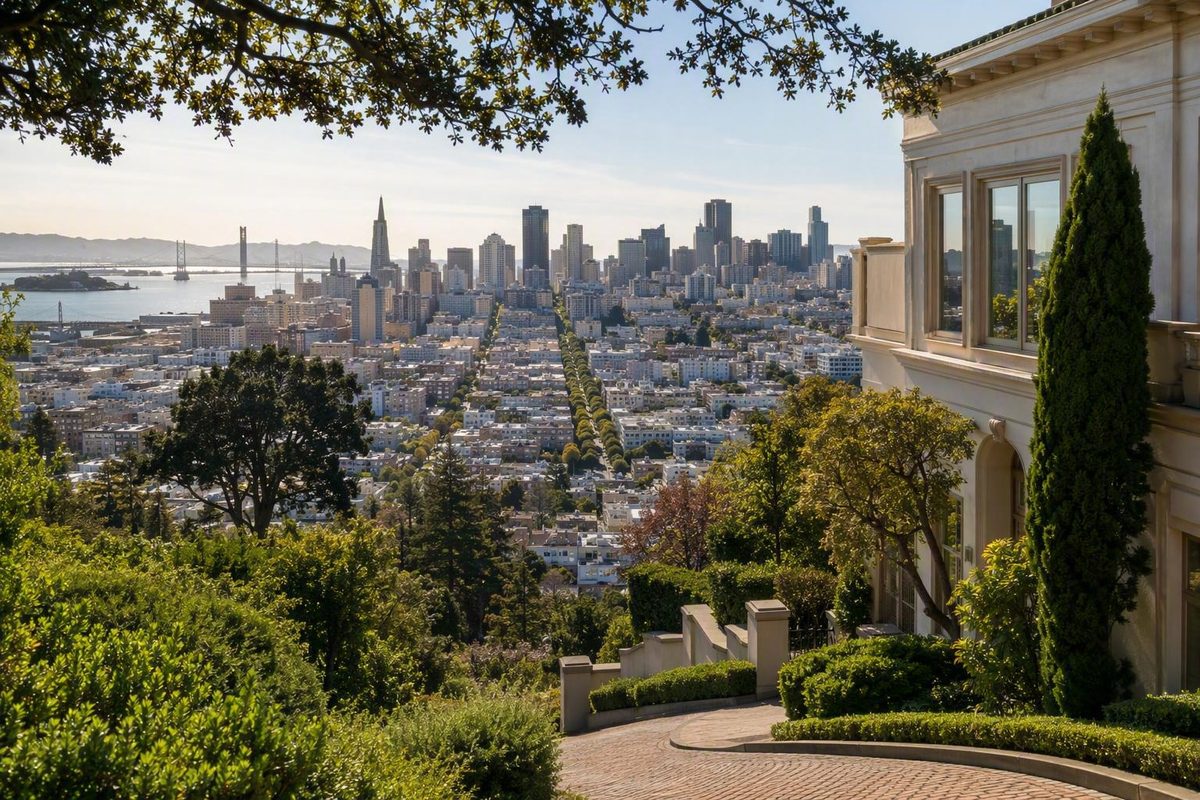
But no credible answer can name one neighborhood “richest” without first defining the term.
The available evidence tracks housing prices, property types, exceptional sales, scarcity, and luxury-market reputation. It does not establish residents’ income, assets, or net worth. Using expensive real estate as a qualified proxy, the most defensible conclusion has three parts:
- Presidio Heights has the strongest evidence reviewed here for high typical luxury-home prices.
- Pacific Heights has the clearest association with trophy properties and exceptional individual sales.
- Sea Cliff offers the most distinctive combination of coastal privacy, ocean views, and scarce estate homes.
St. Francis Wood, Noe Valley, Russian Hill, Cow Hollow, and the Marina are also credible affluent or expensive markets. They appeal for different reasons, however, and the available data cannot place them in a reliable fixed order.
What “Richest” Means—and What This Guide Can Actually Measure
This guide measures expensive housing and luxury-market prominence—not verified household wealth.
That distinction matters. A neighborhood may contain extremely valuable homes without having the highest median household income. Properties may have been owned for decades, serve as second homes, or be held as investments. Home value also reveals little about debt, business interests, financial assets, or total net worth.
Accordingly, this is a qualified guide to San Francisco’s leading luxury housing markets, not a definitive ranking of its wealthiest residents. It is based largely on agent and brokerage publications available through July 2026, rather than a normalized citywide transaction database.
Several commonly quoted real-estate measures answer different questions:
- Median sale price: The midpoint among properties sold during a stated period. Half sold for more and half for less.
- Average sale price: Total sale value divided by the number of sales. One or two extraordinary transactions can pull it upward.
- Median listing price: The midpoint of current asking prices. It reflects seller expectations, not completed deals.
- Price per square foot: Sale or listing price divided by reported interior area. It partly controls for size but not condition, views, parking, lot quality, architecture, or exact location.
- Trophy sale: An individual transaction at the extreme upper end. It shows what one buyer paid for one exceptional property, not what a typical neighborhood home costs.
Property category is equally important. An all-home figure may include houses, condominiums, cooperatives, and other property types. A single-family-only figure excludes smaller units that often sell at lower total prices. Comparing an all-property median in one neighborhood with a house-only average in another produces a ranking that looks precise but is not meaningful.
Pacific Heights illustrates the problem. A 2025 agent guide reported an overall median of approximately $2.1 million, compared with a single-family median near $7 million. The article also placed the citywide median at about $1.29 million, useful as dated context but not as a directly comparable benchmark because its categories, periods, and methods were not consistently defined (2025 San Francisco luxury-market guide).
Time periods must also match. A one-month median is not equivalent to a trailing-12-month average, and a March listing-price estimate should not be ranked against February closed sales without qualification. In thin luxury markets, a small change in which homes happen to sell can substantially alter the apparent median.
Most neighborhood comparisons reviewed for this guide come from brokerage or agent publications. They can provide useful local detail, but their publishers have a commercial interest in luxury transactions. Several do not disclose the complete dataset, neighborhood boundaries, sample, calculation method, or exact property filters behind their estimates. Their figures are best treated as dated indicators, not official valuations.
The Shortlist: San Francisco’s Leading Luxury Enclaves
There is no single winner by every measure. The top tier divides more usefully according to what each neighborhood represents:
- Presidio Heights: strongest candidate for the highest typical luxury pricing in the comparisons reviewed.
- Pacific Heights: strongest trophy-market identity, with prestige addresses and a broader range of luxury property types.
- Sea Cliff: strongest association with coastal seclusion, limited inventory, and estate-style housing.
These three recur most consistently across the luxury-market sources. St. Francis Wood, Noe Valley, Russian Hill, Cow Hollow, and the Marina broaden the field, but their reported metrics are less suitable for strict comparison.
“Sea Cliff” and “Seacliff” are alternate spellings of the same neighborhood. Cow Hollow and the Marina, by contrast, are distinct neighborhoods and should not be combined into one market.
| Neighborhood | Supported market indicator | Housing mix | Defining characteristics | Source period | Confidence note |
|---|---|---|---|---|---|
| Presidio Heights | $5.0 million median sale price and $1,510 per square foot, based on 13 sales (February comparison) | Strong single-family presence, with condos also represented | Large formal homes, quiet residential streets, direct Presidio access | February 2026 | One-month snapshot with a small sample |
| Pacific Heights | About $2.1 million overall versus nearly $7 million for single-family homes (2025 market guide) | Mansion-scale houses, condos, and cooperatives | Views, historic housing, parks, retail access, trophy addresses | 2025 | Strong illustration of property-mix effects; methodology incomplete |
| Sea Cliff | $3.1 million median sale price and $1,230 per square foot, based on three sales (February comparison) | Scarce estate-style and single-family housing | Coastal setting, ocean views, privacy, limited inventory | February 2026 | Very low transaction count makes the result directional |
| St. Francis Wood | Agent-reported median sale estimate near $4.22 million (2025 market guide) | Predominantly single-family | Larger lots, privacy, lower-density residential character | 2025 | Property category is relatively consistent; methodology is not fully disclosed |
| Noe Valley | 23 reported sales in the $4 million–$7 million single-family bracket during the prior year (April 2025 buyer guide) | Renovated single-family homes plus smaller residential properties | Central location, 24th Street, relatively sunny reputation | Article published April 2025 | Segment activity, not a neighborhood-wide median |
| Russian Hill | Approximately $2.1 million median listing estimate (agent neighborhood overview) | Historic houses, luxury residences, flats, and condos | Elevation, views, north-side location | March 2025 | Asking-price estimate, not completed-sale evidence |
| Cow Hollow | Reported figures vary substantially by property category | Houses, flats, and condos | Union Street access and active commercial streets | 2025 | Conflicting figures should not be merged without matching categories |
| Marina | Approximately $2.4 million recent median listing estimate (2025 market guide) | Houses, flats, and condos | Waterfront setting, Chestnut Street, parks, and open space | 2025 | Listing metric only; not directly comparable with sale medians |
The table is a comparison aid, not a final ranking. Confidence depends on how many homes sold, whether the property categories match, and whether the source explains its methodology.
Presidio Heights: The Strongest Candidate for Highest Typical Prices
Presidio Heights is a small, predominantly residential neighborhood adjoining the Presidio. Sources reviewed for this guide associate it with large formal houses, quieter streets, and direct access to Presidio open space. Its setting is urban and residential rather than coastal and secluded.
The clearest recent evidence comes from an agent article dated April 2, 2026. Citing Redfin data for February 2026, it reported a $5.0 million median sale price and $1,510 per square foot, based on 13 sales. The same snapshot placed Sea Cliff at $3.1 million and $1,230 per square foot, based on three sales. The author characterized the low-volume figures as directional rather than absolute.
That snapshot supports a limited conclusion: of those two neighborhoods, Presidio Heights had the higher reported median and price per square foot during that month. It cannot prove that Presidio Heights permanently leads Sea Cliff, Pacific Heights, or every other San Francisco neighborhood.
A separate agent comparison published in July 2026 reported average single-family prices of approximately $8.9 million in Presidio Heights, compared with about $6.7 million in Pacific Heights. It placed average condo prices at roughly $2.1 million in Presidio Heights and just under $2 million in Pacific Heights. The article did not disclose its data provider, transaction count, exact measurement period, or calculation method (July 2026 neighborhood comparison).
Even with that limitation, the difference between the reported $8.9 million house average and $2.1 million condo average demonstrates why property category matters. A neighborhood-wide figure will shift according to whether a given period produces more house sales or more condo sales.
Presidio Heights’ practical profile also differs from its rivals. The February comparison described it as formal, quiet, and closely connected to the Presidio, with a higher reported Walk Score than Sea Cliff. Walkability still varies by exact address, destination, and tolerance for elevation.
For a prospective resident, the tradeoff is not simply “expensive versus less expensive.” Presidio Heights may suit someone prioritizing a quieter city setting, larger formal homes, and ready access to Presidio paths. It may be less suitable for someone seeking Sea Cliff’s ocean-facing seclusion or Pacific Heights’ wider selection of luxury condos and cooperatives.
On the available pricing evidence, Presidio Heights is the leading candidate for high typical luxury-home prices. That is not the same as proving it has the wealthiest residents—or that it leads in every period, property type, and metric.
Pacific Heights: Billionaire’s Row and the Trophy-Sale Ceiling
Its reputation rests on a combination of grand historic housing, prominent views, prestige addresses, parks, nearby retail, and individual properties capable of reaching the extreme upper end of the city’s market.
Unlike more house-dominated enclaves, Pacific Heights has a varied housing stock. Its market includes major single-family residences as well as luxury condominiums and cooperatives. That creates multiple luxury price tiers, but it also pulls all-property medians below house-only measures.
The housing-mix effect is clear in one 2025 agent guide: approximately $2.1 million across all homes, compared with nearly $7 million for single-family houses. The gap does not mean one figure is wrong; the figures describe different sets of properties.
A July 2026 agent comparison offered another view, placing average single-family prices at about $6.7 million and average condo prices just below $2 million. Because the article provided no underlying dataset, sample, or calculation method, those figures should be read as agent-reported market guidance rather than independently reproducible statistics (July 2026 neighborhood comparison).
Pacific Heights’ trophy-market reputation centers on Billionaire’s Row, an informal name for a stretch of Broadway. The July 2026 comparison defined it as the three blocks between Divisadero and Lyon; other real-estate sources use the label more generally for prestigious Broadway properties.
Agent publications reviewed for this guide report individual Pacific Heights transactions of approximately $70 million to $71 million. These accounts support the neighborhood’s exceptional-sale reputation, but they are not treated here as independently verified city records. They also say nothing about what a typical Pacific Heights house costs.
That distinction separates Pacific Heights from Presidio Heights. The July comparison gave Presidio Heights the higher reported average single-family price, while Pacific Heights had the stronger association with exceptional individual transactions and a wider range of luxury housing.
Pacific Heights may therefore be relevant to someone seeking:
- A recognized prestige address
- Potential Bay or Golden Gate views
- Grand historic houses
- Access to parks and active retail streets
- A choice between single-family residences and luxury multi-unit properties
- Exposure to the city’s trophy-home market
None of those factors makes every property equivalent. Elevation, outlook, interior condition, parking, lot configuration, architectural quality, and the difference between a house and a condo can outweigh a neighborhood-level average.
Pacific Heights is best understood as the neighborhood with the clearest trophy-market identity—not automatically the place with the highest typical price or the greatest verified resident wealth.
Sea Cliff: Coastal Privacy, Estate Homes, and Thin Data
Sea Cliff occupies a coastal setting between the Presidio and Lincoln Park. Its identity is tied to privacy, ocean views, estate-style homes, and extremely limited inventory. Compared with Pacific Heights or Presidio Heights, it has a more secluded atmosphere.
Real-estate sources describe Spanish-influenced, Mediterranean, and Tudor Revival homes in the neighborhood. These are recurring architectural styles, not a claim that every Sea Cliff property follows one of them. The neighborhood’s curving and terraced streets also reflect its early residence-park planning.
The February 2026 figures require particular care. An agent article citing Redfin reported a $3.1 million median sale price and $1,230 per square foot, based on only three sales. With such a small sample, the type, location, and condition of each property can materially affect both statistics.
That result differs from a 2025 agent-reported median near $4.28 million. The discrepancy does not by itself establish that Sea Cliff’s market declined: the estimates may use different periods, property categories, boundaries, and calculations.
An agent guide published in April 2025 offered directional buyer guidance rather than a current valuation. It said direct-cliff properties may exceed $15 million, while homes farther from the water or needing renovation may fall into the $4 million to $5 million range. The article also reported nine Sea Cliff sales in the prior year’s $4 million–$7 million segment, without disclosing the full dataset or calculation method (April 2025 luxury-buyer guide).
Sea Cliff’s practical distinction from Presidio Heights is as important as the numbers. Sea Cliff is more coast-oriented and separated from active commercial corridors. Presidio Heights is more closely connected to everyday city streets and direct Presidio access.
For buyers, scarcity is both the attraction and the difficulty. A neighborhood may have a powerful luxury reputation while producing too few annual transactions for stable medians. Finding a property that matches a specific budget, architectural preference, view requirement, and condition standard can be difficult when only a small number of homes reaches the market.
Sea Cliff clearly belongs in San Francisco’s top luxury tier. Its exact position within that tier is unusually difficult to measure because its defining asset—scarcity—also makes its statistics unstable.
The Other Affluent Contenders: St. Francis Wood, Noe Valley, Russian Hill, Cow Hollow, and the Marina
The top three do not exhaust San Francisco’s high-value residential markets. Several other neighborhoods offer luxury housing, but their appeal depends more heavily on property type, lot size, commercial access, views, or a particular budget segment.
St. Francis Wood
St. Francis Wood stands apart for its lower-density, predominantly single-family character. Its larger lots, privacy, and more suburban residential atmosphere represent a different form of luxury from the northern view neighborhoods.
An April 2025 agent article reported an average lot size of approximately 6,200 square feet and 10 sales in the $4 million–$7 million bracket during the prior year. A separate 2025 agent guide estimated the neighborhood’s median sale price at approximately $4.22 million. Neither publication fully disclosed its methodology, so the figures are indicators rather than official benchmarks (April 2025 luxury-buyer guide; 2025 market guide).
For someone prioritizing land, a quieter streetscape, and a single-family setting, St. Francis Wood may be more relevant than a higher-profile neighborhood with smaller lots or a substantial condo market. It also offers a useful contrast with Sea Cliff: St. Francis Wood emphasizes lot size and lower density, while Sea Cliff adds coastal views and extremely limited supply.
Noe Valley
Noe Valley’s luxury market is associated in agent guides with a central location, renovated single-family homes, a relatively sunny reputation, and the commercial corridor along 24th Street. Its appeal is less about formal estates or oceanfront seclusion than combining expensive houses with an active neighborhood center.
The April 2025 agent guide reported 23 Noe Valley sales in the $4 million–$7 million bracket during the prior year. It separately listed nine in Eureka Valley and three in Cole Valley; those adjacent-neighborhood sales should not be added together and labeled as Noe Valley activity.
The 23 reported transactions indicate activity in that particular price segment. They do not establish Noe Valley as more expensive overall. A segment count answers “Where did homes in this price range sell?” rather than “Which neighborhood has the highest median?”
Russian Hill
Russian Hill is a high-value north-side market shaped by elevation, views, historic homes, and luxury residences. Its varied housing includes houses, flats, condominiums, and contemporary properties, so a neighborhood-wide figure can reflect a broad mix.
One real-estate group reported a March 2025 median listing estimate of approximately $2.1 million. Because that is a listing measure, it describes asking prices rather than completed transactions. The source did not disclose enough methodological detail to compare the estimate directly with closed-sale medians from Presidio Heights or Sea Cliff (agent overview of expensive San Francisco neighborhoods).
Russian Hill’s elevation is a practical factor, not merely scenery. It can support view premiums while making walking more demanding. Homes only a few blocks apart can differ materially in outlook, slope, parking access, and proximity to active streets.
Cow Hollow
Cow Hollow offers single-family houses, flats, and condominiums, together with access to shopping and dining around Union Street and nearby corridors. That housing diversity can appeal to buyers who want a high-value north-side address without restricting their search to detached houses.
It also makes simple price claims difficult. A 2025 agent guide reported an overall median near $2.1 million and a single-family median around $4.5 million, while also presenting a materially different figure elsewhere. Without matching categories and methods, those values should not be treated as measures of the same market.
Cow Hollow should remain distinct from the Marina. They are adjacent and may appear together in broad market discussions, but their topography, housing, commercial corridors, and immediate amenities are not interchangeable.
The Marina
The Marina combines a waterfront setting with Chestnut Street, the Palace of Fine Arts, Marina Green, Fort Mason, and access toward Crissy Field. Its housing includes houses, flats, and condominiums rather than a uniform estate market (Prevu neighborhood overview).
One 2025 real-estate source gave a recent median listing estimate of approximately $2.4 million. As with Russian Hill, that asking-price figure should not be ranked directly against a closed-sale median or house-only average.
For visitors and prospective residents, the Marina’s waterfront access can be as relevant as its property values. Its character differs from elevated Russian Hill and Cow Hollow’s residential-commercial mix, even though all three provide access to active north-side amenities.
These five neighborhoods are credible affluent alternatives, but the evidence does not support an exact order. St. Francis Wood becomes more prominent when the comparison emphasizes lots and single-family homes. Noe Valley stands out when counting transactions in a particular luxury bracket. Russian Hill may appeal for elevated views, while Cow Hollow and the Marina may be more compelling for retail or waterfront access. Those are different questions, not competing answers to one perfectly measurable ranking.
How to Compare the Neighborhoods Without False Precision
A decision matrix is more useful than another price ranking because buyers, prospective residents, and visitors do not all value the same features.
| Priority | Neighborhoods to examine first | Why | Main caution |
|---|---|---|---|
| High typical luxury pricing | Presidio Heights | Strongest evidence reviewed for high typical house prices; direct Presidio access | Available figures come from limited or incompletely disclosed datasets |
| Trophy-sale potential and prestige addresses | Pacific Heights | Billionaire’s Row, prominent views, grand houses, and exceptional-sale associations | Trophy transactions do not represent typical prices |
| Coastal scenery and privacy | Sea Cliff | Ocean outlooks, estate-style homes, seclusion, and scarce supply | Exceptionally few sales can make medians unstable |
| Larger lots and lower density | St. Francis Wood | Predominantly single-family setting and larger reported lots | Less directly comparable with mixed-housing neighborhoods |
| Commercial corridor with luxury-house activity | Noe Valley | 24th Street orientation and more reported $4 million–$7 million sales than several smaller enclaves | Segment activity is not the same as a high overall median |
| North-side views and elevation | Russian Hill | Historic housing, steep topography, and view potential | Hills can make everyday walking harder |
| Retail access and varied housing | Cow Hollow | Houses, flats, condos, and nearby commercial streets | Property-mix differences complicate headline prices |
| Waterfront amenities | Marina | Chestnut Street and access to Marina Green, Fort Mason, the Palace of Fine Arts, and Crissy Field | Listing-price estimates do not show completed-sale values |
For direct Presidio access and the strongest available evidence of high typical luxury pricing, begin with Presidio Heights. For prestige, views, trophy-sale potential, and a choice between houses and luxury condos, start with Pacific Heights. For coastal scenery and privacy, Sea Cliff is the clearest match, provided that extremely limited inventory is acceptable.
St. Francis Wood is the natural comparison for someone who values land and a lower-density single-family environment more than northern waterfront access. Noe Valley is worth examining when a neighborhood commercial corridor and activity in the $4 million–$7 million house segment matter.
Russian Hill, Cow Hollow, and the Marina form another useful comparison set, but not a single interchangeable market. Russian Hill emphasizes elevation and view potential. Cow Hollow combines varied housing with nearby retail. The Marina places waterfront open space and Chestnut Street closer to daily life.
Topography deserves explicit attention. Elevation can create valuable views while making routine walking harder, and the practical experience can change block by block. A route that appears short on a map may involve a substantial climb; a waterfront route may be flatter but more exposed to wind.
These descriptions should not be converted into claims that one neighborhood is objectively best, safest, or ideal for every household. The right comparison depends on the property and the reader’s priorities: privacy, views, lot size, housing type, retail access, open space, or tolerance for hills.
A Better Way to Read Luxury-Neighborhood Price Claims
Conflicting rankings are not always the result of bad data. Often, different measurements are being compressed into the same word: “price.”
Before accepting a neighborhood ranking, check six things:
- Period: Are both figures from the same month, quarter, year, or trailing-12-month window?
- Boundary: Are both sources using the same neighborhood limits?
- Property type: Are houses being compared with houses, or is one number an all-property median?
- Metric: Are both figures medians, averages, listings, closed sales, or price-per-square-foot measures?
- Transaction status: Do the numbers represent active listings or completed deals?
- Count: How many properties support each statistic?
Whenever a source provides a transaction count beside a short-period median, keep the two together. “$3.1 million based on three sales” conveys substantially more information than “$3.1 million” alone.
Averages and medians have different weaknesses. An average can be pulled upward by one extraordinary estate. A median is less sensitive to a single outlier, but it can still swing sharply when only a few homes sell. Neither becomes reliable merely because it is presented with apparent precision.
Housing mix creates another distortion. If a neighborhood has many condo sales during a period, its all-home median may fall even while single-family houses continue to sell for much more. That is why Pacific Heights can support an overall figure near $2.1 million and a house-only figure near $7 million without contradiction.
Price per square foot is useful but incomplete. It partly controls for size, allowing a large estate and a smaller luxury unit to be compared on a common basis. It does not fully account for unobstructed views, renovation quality, parking, outdoor space, lot usability, permitted area, architectural significance, or exact block.
Short-term changes deserve similar restraint. A sharp year-over-year rise or decline in a thin market may reflect which homes sold rather than a durable change in neighborhood value. It should not be treated as proof of future appreciation, investment performance, or market resilience.
For an actual property, neighborhood statistics are only the beginning. A luxury-buyer guide recommends checking permits through the San Francisco Department of Building Inspection, reviewing zoning and historic status through the Planning Department’s Property Information Map, verifying current school-assignment rules through official enrollment resources, and obtaining structural, seismic, soil, or flood review where relevant (San Francisco luxury-neighborhood buyer comparison).
Those checks address questions a neighborhood median cannot answer. A renovated interior does not establish that work was permitted. A view does not reveal structural condition. A prestigious address does not determine expansion rights, environmental exposure, or current school assignment.
This article is a comparison framework, not a valuation of any particular home.
The most supportable conclusion remains three-part: Presidio Heights has the strongest evidence reviewed here for high typical luxury pricing; Pacific Heights has the clearest trophy-market identity; and Sea Cliff offers the most distinctive combination of coastal privacy and scarce estates. St. Francis Wood, Noe Valley, Russian Hill, Cow Hollow, and the Marina remain meaningful alternatives defined by different tradeoffs.
Expensive housing is not the same as verified resident wealth. Any current comparison should normalize the date, neighborhood boundary, property type, metric, transaction status, and sales count before drawing a conclusion.
What is the richest neighborhood in San Francisco?
There is no proven answer based on resident income or net worth in the evidence reviewed here. Using luxury housing as a proxy, Presidio Heights is the strongest candidate for high typical prices, Pacific Heights is the leading trophy-sale market, and Sea Cliff stands out for scarce coastal estates. The answer changes depending on whether “richest” means median house price, all-home median, price per square foot, or exceptional-sale ceiling.
Is Presidio Heights more expensive than Pacific Heights?
It can be, depending on the measure. A July 2026 agent comparison reported average single-family prices of approximately $8.9 million in Presidio Heights and $6.7 million in Pacific Heights, but it did not disclose its dataset, sample, or calculation method. Pacific Heights had the stronger exceptional-sale profile, and its larger condo and cooperative market can lower its all-property figure relative to its house-only pricing.
Why is Pacific Heights called Billionaire’s Row?
Billionaire’s Row is the informal name for a prestigious stretch of Broadway containing some of Pacific Heights’ most prominent homes. One July 2026 agent source defined it as the three blocks between Divisadero and Lyon. The label reflects the scale, location, and trophy-market reputation of properties along that stretch; it is not a statistical designation or proof that every resident is a billionaire.
Are Sea Cliff home-price figures reliable when so few homes sell?
They are useful as snapshots but should not be treated as stable long-term rankings. The February 2026 median of $3.1 million was based on only three sales, so the mix of ocean-facing, inland, renovated, or renovation-needing properties could move the result substantially. A longer-period dataset with matched property types would offer a better comparison, although Sea Cliff’s low volume would remain a limitation.
Why are single-family prices so different from overall neighborhood medians?
Overall medians may include condos, cooperatives, flats, and houses. Smaller units often sell for lower total prices than large detached homes, so a period with many condo transactions can pull the all-property median downward. Pacific Heights illustrates the effect: one 2025 agent guide reported an overall median near $2.1 million and a single-family median near $7 million. A house-only figure answers what detached homes sold for; an overall median describes the broader property mix.