
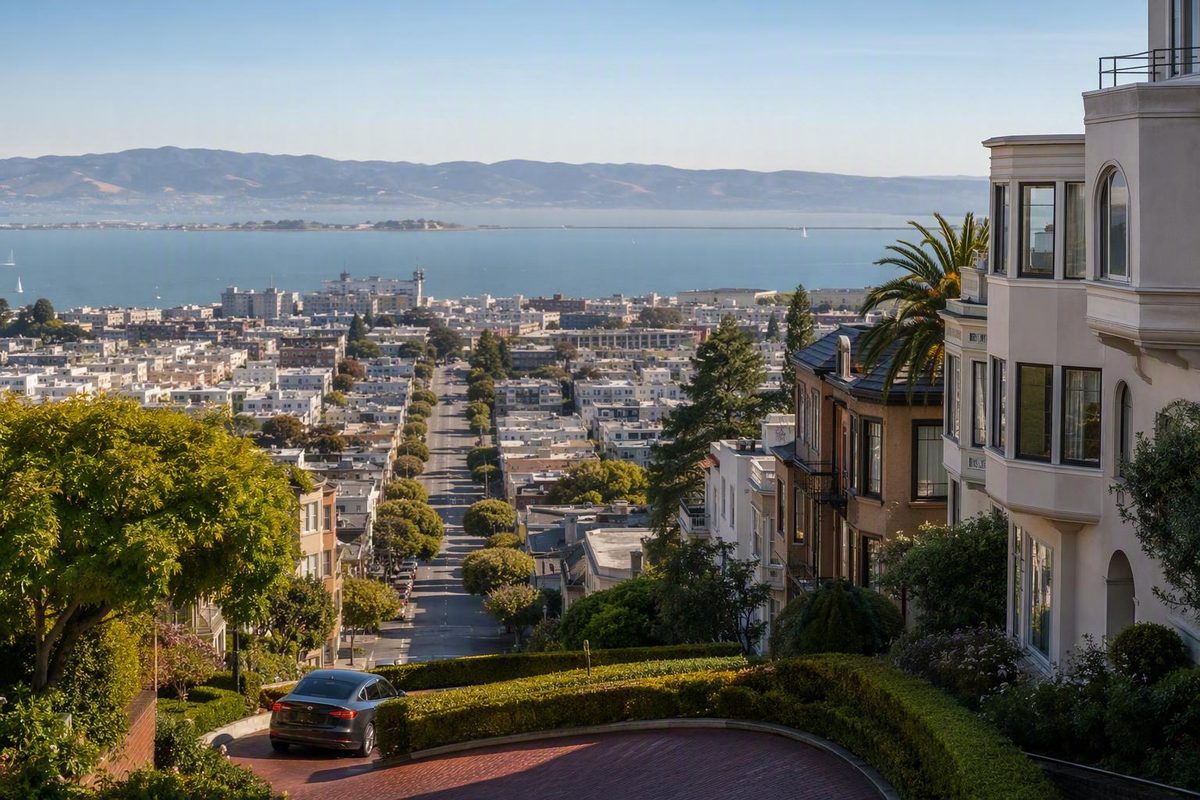
The short answer: San Francisco’s strongest affluent-neighborhood shortlist
Pacific Heights, Presidio Heights, and Sea Cliff form the strongest evidence-backed shortlist of San Francisco neighborhoods associated with concentrated luxury and exceptionally expensive housing.
That is not the same as a definitive ranking of residents by income or net worth. Reliable, consistently defined neighborhood-level net-worth data are not available in the evidence reviewed here. Home prices also cannot reveal how much income, debt, cash, investments, business equity, or other wealth individual residents hold.
Instead, the shortlist reflects observable housing-market and neighborhood characteristics: typical housing costs in limited recent snapshots, concentrations of estate-scale properties, scarce inventory, architectural character, privacy, views, and exceptional luxury sales.
Each leading neighborhood represents a different expression of wealth:
- Pacific Heights is San Francisco’s clearest symbol of historic and trophy-home wealth. Grand residences, prominent parks, Bay views, and Outer Broadway’s Billionaires’ Row give it the city’s most recognizable luxury identity. Exceptional sales strengthen that reputation, although they do not describe the typical home.
- Presidio Heights has the strongest case for the highest typical housing costs among the limited neighborhoods and recent figures compared here. A same-month comparison with Sea Cliff and a separate agent-reported comparison with Pacific Heights both place it higher, but neither establishes a permanent citywide hierarchy.
- Sea Cliff is the secluded coastal alternative. Its appeal is tied to marine views, privacy, large residences, a distinctive residence-park layout, and very limited inventory.
Russian Hill also appears repeatedly in expensive-neighborhood coverage. Its cited housing figures are below those reported for the leading estate enclaves. Russian Hill represents dense urban luxury—views, historic architecture, apartments and condominiums, and a landmark setting—rather than the same low-density estate pattern.
The broader affluent set often includes Noe Valley, Nob Hill, the Marina District, Potrero Hill, Cow Hollow, and Haight-Ashbury. Those neighborhoods cannot be placed in a defensible citywide order from the available evidence. Some appear in unranked brokerage selections without a consistent metric; others are associated with older income or housing figures that cannot be compared directly with recent closed sales.
The most useful answer therefore depends on the question:
- For historic prestige and extraordinary estate sales, start with Pacific Heights.
- For the highest typical-cost indicators in the limited recent comparisons supplied, Presidio Heights has the strongest case.
- For scarce coastal property and seclusion, Sea Cliff stands apart.
- For dense urban luxury with views and landmark access, Russian Hill belongs in the conversation.
The apparent disagreement among rankings is not necessarily an error. Most lists are measuring different things.
What does “wealthiest” mean?
“Wealthiest neighborhood” sounds like a single statistical category, but it can describe at least four distinct concepts.
- Household income measures money received during a defined period. It does not capture the full value of property, investments, businesses, retirement accounts, or other assets.
- Household net worth generally means assets minus liabilities. It is closer to what people usually mean by total wealth, but reliable neighborhood-level net-worth evidence is not supplied here.
- Typical housing cost may be represented by a median sale price, median listing price, average sale price, or price per square foot. Each measure answers a different market question.
- Exceptional luxury transactions show that a neighborhood supports unusually expensive properties. A few such sales can shape its reputation without describing its typical home or household.
These categories are not substitutes. A neighborhood can have high-income residents but less expensive housing than another area. A property may also be extremely valuable even when its owner’s current annual income is modest relative to that value. Conversely, a high household income reveals nothing by itself about debt or accumulated assets.
Housing measures create further complications:
- A median sale price is the midpoint among completed sales during a defined period.
- An average sale price adds the sale prices and divides by the number of transactions, making it more sensitive to extreme values.
- A median listing price describes asking prices, not completed transactions.
- Price per square foot adjusts for reported interior size but does not fully capture land, views, condition, architecture, parking, or expansion potential.
- A record sale identifies an exceptional transaction, not a typical neighborhood value.
Property scope matters just as much. A statistic combining condominiums, cooperatives, and detached houses may be substantially lower than a single-family-only figure for the same neighborhood. Pacific Heights contains grand detached homes but also more condominium and cooperative buildings than Presidio Heights, which is less dense and more oriented toward single-family housing. That difference can pull down a broad Pacific Heights figure without contradicting the existence of extraordinarily expensive estates.
Neighborhood boundaries introduce another uncertainty. Census geographies, city-planning districts, brokerage search areas, and residents’ everyday definitions do not always align. Shifting a boundary by a few blocks can change the balance of apartments, detached houses, renters, owners, and household types included in a calculation.
This guide therefore follows a restrained method:
- Figures retain the source’s stated metric and timing.
- Listing prices and completed sales remain separate.
- Condominiums and single-family homes are distinguished when the source does so.
- Sample sizes are disclosed when available.
- Commercially reported figures are attributed rather than treated as official city findings.
- Neighborhoods are presented as evidence-based archetypes rather than combined into a synthetic “wealth score.”
That method cannot produce a credible one-through-ten ranking. It can explain where expensive property is concentrated, what the available numbers show, and why different lists reach different conclusions.
At-a-glance comparison: what the available numbers actually show
The table collects the principal figures without treating them as interchangeable.
| Neighborhood | Figure | Metric | Measurement period | Property scope | Sample size | Source type | Principal limitation |
|---|---|---|---|---|---|---|---|
| Presidio Heights | $5.0 million; $1,510/sq. ft.; Walk 92, Transit 68, Bike 76 | Median completed-sale price; sale price per square foot; attributed accessibility scores | February 2026 for sales; Walk Score period not stated | Sales mix not specified in the excerpt | 13 sales | Real-estate article citing Redfin and Walk Score | One-month, low-volume snapshot; property mix unclear |
| Sea Cliff | $3.1 million; $1,230/sq. ft.; Walk 81, Transit 61, Bike 82 | Median completed-sale price; sale price per square foot; attributed accessibility scores | February 2026 for sales; Walk Score period not stated | Sales mix not specified in the excerpt | 3 sales | Real-estate article citing Redfin and Walk Score | Three sales make the median especially sensitive to the properties traded |
| Presidio Heights and Pacific Heights | Presidio Heights: about $8.9 million and $1,600/sq. ft. for single-family homes; about $2.1 million for condominiums. Pacific Heights: about $6.7 million and $1,460/sq. ft. for single-family homes; just under $2 million for condominiums | Agent-reported average home price and average price per square foot; average condominium price | Measurement period not disclosed; article published July 2026 | Single-family homes and condominiums reported separately | Not disclosed | Agent comparison of Pacific Heights and Presidio Heights | No underlying dataset, sample size, analysis window, or calculation method |
| Pacific Heights, Sea Cliff, Presidio Heights, Noe Valley, and Russian Hill | Pacific Heights: about $2.1 million; Sea Cliff: about $4.2 million; Presidio Heights: about $4.7 million; Noe Valley: about $2.8 million; Russian Hill: about $2.1 million | Pacific Heights and Noe Valley: median listing price; Russian Hill: median listing home price; Sea Cliff and Presidio Heights: described more broadly as median home price | Early 2025 for Pacific Heights and Noe Valley; March 2025 for Russian Hill; unclear or unspecified for Sea Cliff and Presidio Heights | Not consistently stated | Not disclosed | Commercial five-neighborhood market snapshot | Inconsistent metrics, unclear dates, no dataset, and no stated methodology |
The Presidio Heights and Sea Cliff rows provide the cleanest direct comparison because they use the same month, the same sale metrics, and disclosed transaction counts. In that limited snapshot, Presidio Heights was higher in both median sale price and price per square foot. The low volume—especially in Sea Cliff—means the result should be treated as directional rather than as a stable hierarchy.
The agent-reported Pacific Heights and Presidio Heights averages point in the same direction: Presidio Heights is higher for both reported property categories. Yet the source does not disclose the underlying transactions, time window, sample size, or calculation method. Those figures are useful as a commercial market snapshot, not as an independently reproducible study.
The five-neighborhood commercial snapshot is less comparable still. It mixes clearly labeled listing prices with figures described only as “median home prices.” It also uses different or unclear dates. Its numbers cannot support a reliable ordinal ranking.
Why can Pacific Heights show a comparatively low broad listing figure while containing exceptionally expensive estates? A statistic covering many condominium and cooperative listings can sit far below the price of a large detached house on a premium block. One or two major estate transactions can establish a neighborhood’s trophy-market reputation without moving the midpoint of all listings anywhere close to the record price.
The table therefore does not say that one neighborhood is definitively first, another second, and another third. It contains medians, averages, listings, completed sales, different property categories, different periods, and sharply different transaction volumes. Combining them into one ranking would create precision the evidence does not contain.
Pacific Heights: San Francisco’s strongest symbol of concentrated wealth
Pacific Heights has the clearest public identity as San Francisco’s neighborhood of historic wealth. Its reputation rests on monumental houses, period architecture, elevated views, landscaped streets, major parks, and a long-running luxury market. Historic properties associated with the neighborhood include the Spreckels Mansion, Whittier Mansion, and Leale House; Alta Plaza Park and Lafayette Park are prominent public spaces, while businesses cluster along Fillmore Street and parts of California Street and other boundary corridors, according to a Pacific Heights neighborhood overview.
Its best-known enclave is Billionaires’ Row, a stretch of Outer Broadway within Pacific Heights. It is not a separate neighborhood. The name refers to a prominent group of residences and view properties near the neighborhood’s northern edge.
Exceptional sales help explain why Pacific Heights carries more symbolic weight than a broad neighborhood median might suggest. A July 2026 agent article reported an approximately $71 million sale on Billionaires’ Row, another sale above $40 million, and a highest cited Presidio Heights sale of $35 million in the prior year. These are exceptional transactions rather than typical values, and the supplied evidence does not provide a comprehensive citywide count of trophy sales. They nevertheless document the presence of an unusually high-end estate market in Pacific Heights. (Austin Klar’s Pacific Heights–Presidio Heights comparison)
That distinction reconciles two conclusions that may initially appear inconsistent:
- Pacific Heights can be San Francisco’s most recognizable residential-wealth address.
- Presidio Heights can still show higher typical or average single-family prices in the limited recent comparisons available.
Pacific Heights has a broader housing mix. Grand detached residences coexist with condominiums, cooperatives, flats, and smaller multifamily buildings. Presidio Heights is less dense and more heavily oriented toward single-family properties. A neighborhood-wide Pacific Heights listing statistic can therefore be much lower than an estate-only figure even while elite houses establish a very high upper end.
Alta Plaza and Lafayette Park provide public green space and viewpoints. Fillmore Street supplies a concentrated commercial corridor.
There are tradeoffs. Elevation contributes to the views but creates steep approaches on some streets. The neighborhood also varies substantially by block: an apartment building near a commercial corridor provides a different experience from a detached residence on Outer Broadway. A prestigious name does not make the neighborhood physically uniform.
For visitors: Focus on what can be observed respectfully from public space—architecture, parks, views, street layout, and the Outer Broadway setting. Residential streets are not an invitation to enter driveways, peer through gates, photograph through windows, or speculate about a home’s occupants.
One structured way to experience the area is the San Francisco City Guides Billionaires’ Row architecture walk. The published route meets at Broadway and Lyon, ends at Washington and Lyon by the Swedenborgian Church, and lasts approximately 1½ to 2 hours. The route includes hills or stairs, and visitors should verify the current calendar and transit schedule before setting out. (Billionaires’ Row: Outer Broadway Architecture)
The walk is useful because it frames the neighborhood through public architecture and history rather than celebrity surveillance. Every residence along the route remains private property.
Presidio Heights and Sea Cliff: two different versions of ultra-expensive housing
Presidio Heights and Sea Cliff are small, established luxury enclaves on San Francisco’s northwestern side, but their settings differ substantially.
Presidio Heights feels formal, urban, and primarily residential. Large houses and estate-style properties sit beside the Presidio, providing direct access to parkland and trails. The neighborhood remains connected to the city grid and is relatively close to shops and dining, although convenience varies by block.
Sea Cliff feels more like a coastal residence park. Curving and terraced streets, landscaped elements, marine views, and a street plan shaped by topography distinguish it from San Francisco’s regular grid. Retail is limited within the neighborhood, and scarce inventory contributes to its retreat-like character. China Beach provides public coastal access below the neighborhood.
The same-month figures in the table support one narrow conclusion: Presidio Heights was more expensive than Sea Cliff under the two reported sale metrics during that particular month. They do not prove that Presidio Heights is always more expensive. A monthly median based on only a few transactions cannot represent every combination of property type, view, lot size, condition, and location.
The attributed accessibility scores provide context rather than a verdict. They suggest stronger neighborhood-level walking and transit access in Presidio Heights and a higher bike score in Sea Cliff. But such scores cannot describe the experience of every traveler or street. Hills, physical mobility, route choice, traffic comfort, and the location of a specific home may matter more than a neighborhood-wide number.
In practical terms:
- Choose Presidio Heights as an archetype if the priorities are formal residential streets, direct Presidio access, and relatively easier access to errands, shops, and dining.
- Choose Sea Cliff as an archetype if the priorities are coastal scenery, separation from the regular city grid, limited through-activity, and access to China Beach.
- Do not assume every Presidio Heights property has an estate-scale lot or that every Sea Cliff house has an unobstructed marine view.
Larger parcels, privacy, and low inventory are repeatedly associated with both neighborhoods, particularly at the upper end. Even within these small enclaves, however, block and property characteristics can outweigh the neighborhood label.
A house with a protected view, usable outdoor space, parking, and a high-quality renovation is not equivalent to a similarly sized house with a compromised outlook, deferred structural work, or an awkward lot. In a low-volume market, one large renovated estate or one smaller property requiring extensive work can move the monthly median sharply.
Rolling data separated by property type would be more informative than a single month. Until such a dataset is available, the defensible conclusion is that Presidio Heights and Sea Cliff are both ultra-expensive but express that status differently: one through formal urban estate character and Presidio access, the other through coastal seclusion and scarcity.
Russian Hill, Noe Valley, Nob Hill, Potrero Hill, and the broader affluent set
Beyond the leading three, several neighborhoods recur in coverage of expensive or affluent San Francisco areas. Their inclusion is informative, but it does not justify a second precise ranking tier.
Russian Hill is the strongest recurring example. Commercial sources have placed its listing or home-price figures around the low-$2 million range. The neighborhood combines dense urban housing, historic architecture, steep terrain, views from selected blocks, and proximity to Lombard Street. Those features support its luxury reputation, but they do not mean every property occupies the same market segment or every resident is wealthy.
Noe Valley received an approximately $2.8 million median listing price in one early-2025 commercial snapshot, while Russian Hill received an approximately $2.1 million median listing home price for March 2025. The publisher supplied no underlying dataset, sample sizes, or calculation method, so both should be treated as attributed asking-price snapshots rather than verified city statistics. (Shalini Sadda Real Estate Group’s five-neighborhood overview)
One brokerage’s unranked selection of “some of” San Francisco’s most expensive neighborhoods included the Marina District, Russian Hill, Pacific Heights, Nob Hill, Sea Cliff, Presidio Heights, Haight-Ashbury, and Noe Valley. The list did not establish that the names appeared in descending order or that one consistent metric determined inclusion. (Prevu’s expensive-neighborhood list)
Potrero Hill illustrates how income and housing-price rankings can diverge. A moving-company article reported a $156,600 median household income and a $1.516 million home price for Potrero Hill, compared with $113,600 and $2.025 million for Russian Hill. It gave Nob Hill a $82,300 median household income and an approximately $1.2985 million home price. The article was originally published in 2022 and labeled as updated in 2025, but it does not identify the Census tables, survey years, exact geographic boundaries, or which figures were refreshed; it also uses inconsistent average-versus-median terminology. (Bekins moving-company neighborhood comparison)
Under those reported figures, Potrero Hill had the highest household income of the three while Russian Hill had the highest housing price. Nob Hill’s long-standing affluent reputation did not translate into the highest figure under either measure in that source.
This does not prove that Potrero Hill has wealthier residents than Russian Hill, or that Nob Hill is no longer affluent. It shows why different metrics produce different results:
- Income and housing cost answer different questions.
- Owners may hold valuable assets while reporting lower current income.
- Renters and owners may be distributed differently across neighborhoods.
- Housing mix changes median and average property prices.
- Geographic boundaries and data years can materially affect the results.
- Commercial articles may use “richest” without explaining how income and housing values were combined.
The wider set is better understood through urban form than through an invented league table:
- Russian Hill: dense, hilly urban luxury associated with views and historic architecture.
- Noe Valley: expensive residential housing organized around an active neighborhood retail corridor.
- Nob Hill: historic prestige, apartment and hotel density, and a central hilltop setting.
- Potrero Hill: a distinct income-and-housing profile in a more southeasterly location.
- Marina District: northern waterfront access and an active commercial environment.
- Cow Hollow: expensive housing near Union and Chestnut street activity.
- Haight-Ashbury: architecturally distinctive housing included in some expensive-neighborhood lists, but not supported here as a leading wealth district.
None of these descriptions establishes comparative safety, school quality, family suitability, investment performance, or objective desirability. Those questions require different evidence and, for prospective residents, address-specific research.
Why homes command premiums within these neighborhoods
A neighborhood name may frame the market, but individual property characteristics often determine the final price. Recurring value factors in San Francisco’s luxury market include:
- Scarce inventory: Few available houses can intensify competition in small, low-turnover enclaves.
- Privacy: Setbacks, landscaping, gated entries, and separation from busy streets may command premiums.
- Large or usable lots: Flat yards and practical outdoor space can be particularly valuable in a dense, hilly city.
- Bay or ocean views: Direction, breadth, obstruction risk, and room-by-room visibility all matter.
- Architectural distinction: Period details, provenance, coherent design, and sensitive restoration can separate one property from another.
- Parking: Garage capacity and ease of access affect everyday usability.
- Permitted living space: Legally recognized square footage may be valued differently from informal or unverified space.
- Renovation quality: Structural systems, layouts, finishes, and workmanship matter more than cosmetic staging alone.
- Expansion potential: Zoning, lot configuration, historic constraints, and review requirements affect what may be feasible.
Topography creates one of the city’s most visible tradeoffs. Elevation can provide stronger light, broader outlooks, and separation from street activity. It can also make walking steeper, garage access more awkward, and routine errands less convenient. A better view and an easier daily route do not always point to the same property.
The leading neighborhoods also have different access profiles:
- Pacific Heights combines parks, retail, transit options, housing variety, and comparatively direct access toward central areas. Some of its most scenic blocks are steep.
- Presidio Heights offers formal residential streets and immediate Presidio access, with shopping and dining near parts of Sacramento and California streets.
- Sea Cliff emphasizes coastal scenery, privacy, and a retreat-like atmosphere. Limited retail means many errands require leaving the neighborhood.
- Cow Hollow and Noe Valley are often described through their active commercial corridors and more convenient daily walking patterns.
- Russian Hill offers centrality and selected views but includes notably steep routes.
Neighborhood averages conceal substantial micro-level variation. In Pacific Heights, proximity to Fillmore Street may be convenient to one buyer and too active for another. In Sea Cliff, nearby houses may differ dramatically in outlook and exposure. In Presidio Heights, lot width, parking, condition, and exact Presidio access can outweigh a small difference in address.
Prospective buyers should therefore investigate the property rather than relying on the neighborhood’s reputation. A practical due-diligence checklist includes:
- Verify building and remodeling permits.
- Review structural work and available engineering records.
- Confirm zoning, permitted use, and any proposed expansion constraints.
- Check whether the property has historic status or related restrictions.
- Verify current school-assignment rules rather than relying on assumptions tied to an address.
- Investigate soils and site conditions.
- Review flood and other applicable hazard information through current official resources.
- Confirm whether finished areas are legally permitted and consistently included in reported square footage.
- Assess parking access, drainage, retaining structures, and renovation feasibility.
- Use current official city permitting, planning, school-assignment, and hazard resources as the starting point; obtain appropriate professional advice for property-specific legal, engineering, or safety questions.
These checks are drawn from a commercial buyer guide and should not be mistaken for official requirements or a substitute for professional review. The useful underlying principle is that prestige cannot resolve a permit, structural, zoning, soil, or property-condition problem. (Wynne + Morgensen’s luxury-neighborhood buyer comparison)
These factors help explain present price differences. They do not predict appreciation, resale performance, safety, or suitability. The highest-priced property is not automatically the one that best fits a buyer’s mobility, commute, maintenance tolerance, or daily routine.
How to use the list without being misled
Before accepting any “wealthiest neighborhoods” ranking, ask seven questions.
-
What is the metric? Is the publisher measuring household income, net worth, asking prices, completed-sale prices, price per square foot, or record transactions?
-
What is the date? A listing snapshot from one year should not be compared casually with a later completed-sale median or an average from an undisclosed period.
-
How is the neighborhood defined? Check whether the publisher uses Census geography, planning boundaries, a real-estate search area, or an informal local definition.
-
What property type is included? A detached-house average and an all-property median can differ substantially. Condominium-heavy neighborhoods should not be compared with estate-oriented areas without accounting for housing mix.
-
Are these listings or transactions? An asking price records a seller’s position in the market. A completed-sale price records an actual transaction. They are not interchangeable.
-
How many observations are involved? A median based on only a few sales is technically calculable but highly sensitive to which properties happened to trade.
-
Who published the list? Agents, brokerages, movers, and tour organizations may provide useful local observations, but they also have commercial or promotional interests. Repetition across such pages is not equivalent to a transparent citywide statistical analysis.
These checks prevent a common error: comparing a median listing price with an average completed-sale price and calling the larger figure the “winner.” The difference may result from transaction status, housing type, date, neighborhood boundary, or the sensitivity of an average to one unusually expensive property.
Trophy sales should be treated separately. An eight-figure transaction shows that a neighborhood supports a market for exceptional estates. It does not show that the typical house costs that much, that neighboring residents have comparable net worth, or that the record should determine the interpretation of a broad neighborhood median.
One-month medians also require caution. In a low-volume area, the mix of properties sold can change the result sharply. One month may include a major view estate; another may include smaller houses or properties needing substantial work.
For relocation decisions, prestige should be one input rather than the organizing principle. Assess:
- The steepness of routes you would use repeatedly
- Actual transit connections rather than theoretical citywide centrality
- Walking distance to groceries, cafés, parks, and recurring stops
- Whether a quiet residential setting or active commercial corridor better fits your routine
- Parking needs and tolerance for driving to errands
- Exposure to wind, fog, and coastal conditions
- The difference between visiting an attractive block and living there every day
Visitors should apply a parallel standard. Affluent residential neighborhoods are best understood through public architecture, parks, viewpoints, commercial streets, and organized walking routes. Speculation about who lives behind an individual door is less reliable, less informative, and potentially intrusive.
The shortlist is therefore best remembered as three archetypes:
- Pacific Heights: historic prestige, visible architecture, varied housing, and documented exceptional estate sales.
- Presidio Heights: the highest typical-cost indicators among the limited recent comparisons supplied, combined with formal estate character and direct Presidio access.
- Sea Cliff: scarce coastal luxury defined by seclusion, marine views, and limited inventory.
San Francisco does not have one evidence-backed “wealthiest neighborhood” under every definition. Choose the metric first. Then check the date, boundary, property type, transaction status, sample size, and publisher before treating any list as a statement about actual resident wealth.
Frequently asked questions
What is the wealthiest neighborhood in San Francisco?
There is no single defensible answer across income, net worth, typical home prices, and exceptional sales.
Pacific Heights is the clearest symbol of historic residential wealth and trophy-home transactions. Presidio Heights has the strongest typical-cost figures among the limited recent neighborhood comparisons reviewed here. Sea Cliff is a leading enclave for scarce, secluded coastal property. The available evidence does not support declaring any one of them the definitive wealthiest neighborhood by resident net worth.
Is Pacific Heights or Presidio Heights more expensive?
It depends on the metric and property type.
The supplied commercial comparison places Presidio Heights higher on reported average prices for both single-family homes and condominiums. Pacific Heights, however, has the larger documented exceptional transactions and a broader mix of condominiums, cooperatives, flats, and detached houses.
The careful conclusion is that Presidio Heights leads the limited evidence for typical housing costs, while Pacific Heights has stronger documented examples at the extreme upper end.
Where is Billionaires’ Row in San Francisco?
Billionaires’ Row refers to a stretch of Outer Broadway in Pacific Heights. It is not a separate San Francisco neighborhood.
Visitors can view its architecture from public streets or follow the San Francisco City Guides walking-tour framework. Because the area remains residential, visitors should respect private property and residents’ privacy.
Is Sea Cliff more expensive than Presidio Heights?
Not in the directly comparable monthly snapshot reviewed here. Presidio Heights was higher in both reported sale-price measures.
That result does not establish a permanent relationship. Both neighborhoods have limited transaction volume, and Sea Cliff’s particularly small sample means its monthly median can change substantially with the mix of properties sold.
Do expensive homes mean a neighborhood has the highest-income residents?
No. Home prices, household income, and household net worth measure different things.
A property may have appreciated over many years while its owner’s current income remains comparatively modest. A high-income household may rent, carry substantial debt, or live in a less expensive neighborhood. Housing statistics also describe the properties listed or sold during a period—not the finances of every resident.
To compare resident income, use consistently dated income data with matching geographic definitions. To compare housing costs, use the same period, transaction type, property category, and neighborhood boundaries. Neither measure alone establishes total resident wealth.