
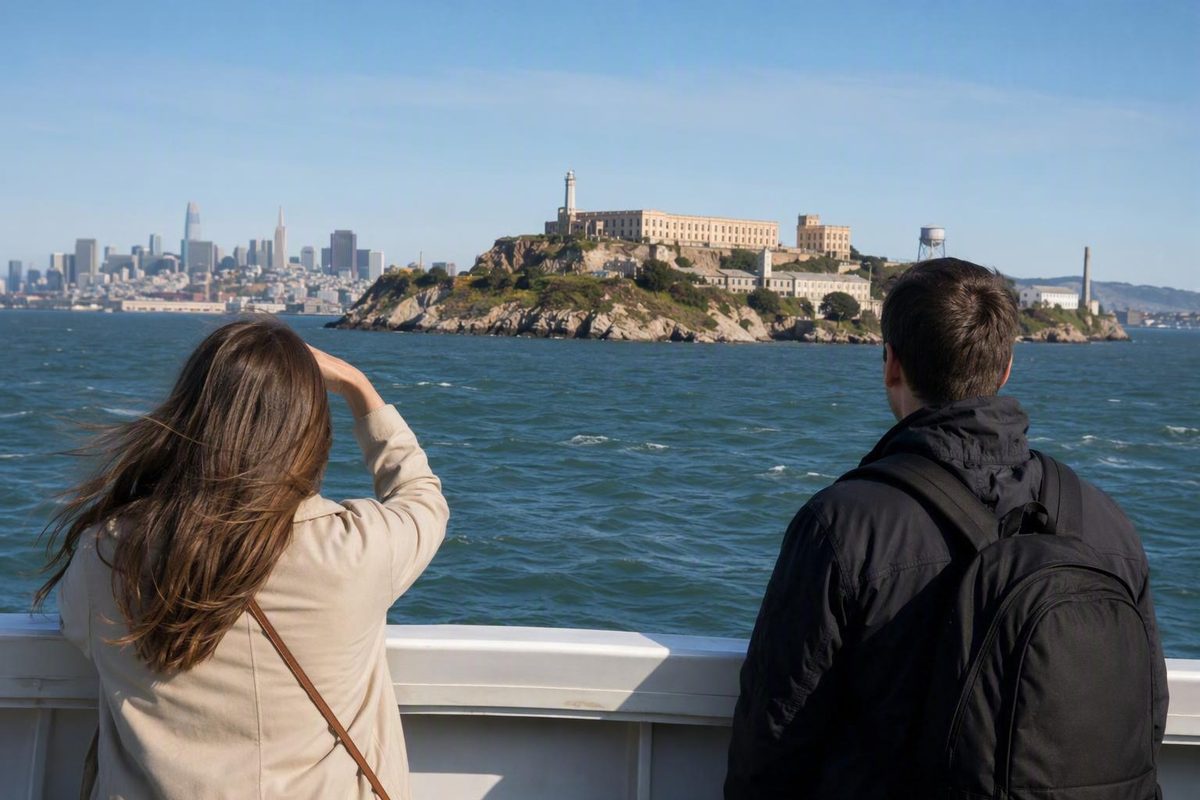
Alcatraz is easy to see from San Francisco and surprisingly easy to plan badly. The ferry ride is short, but the complete outing involves a timed departure, boarding, a steep ascent, the Cellhouse experience, optional exhibits and a return boat. Choosing the wrong cruise can also leave you looking at the island from the water when you expected to enter the prison.
The essential decisions are straightforward: buy a ticket that lands on Alcatraz, choose an experience that fits your available time, arrive at Pier 33 with a buffer and reserve enough of the day to explore without watching the clock.
Edited by San Francisco Know. Prices, schedules, access rules and open areas can change, so confirm them before departure.
The short version: how to visit Alcatraz from San Francisco
Alcatraz Island sits in San Francisco Bay and is managed by the National Park Service as part of Golden Gate National Recreation Area. Ferries authorized to land visitors on the island depart from Pier 33 Alcatraz Landing on the Embarcadero.
Alcatraz City Cruises is the only National Park Service-authorized ferry operator permitted to dock and discharge visitors there. Third-party companies can sell packages containing official ferry tickets, but an ordinary sightseeing boat cannot independently land passengers on Alcatraz. The National Park Service fee and ticket guidance identifies the authorized operator and explains that ferry transportation is required.
The critical phrase to look for when shopping is island landing. A product described as an “Alcatraz cruise,” “bay cruise” or “Alcatraz view” may only sail past the island. If you want to enter the Cellhouse, confirm that the exact product includes:
- Round-trip ferry transportation from Pier 33
- An Alcatraz Island landing
- The Cellhouse audio tour
- The correct date and departure time
Reserve ahead rather than relying on same-day availability. Plan to reach Pier 33 at least 30 minutes before departure, while following any different arrival instruction printed on your ticket. Keep roughly three to four hours open for a comfortable standard visit.
The crossing generally takes about 12–15 minutes each way, but the complete trip takes substantially longer. Visitors need time for check-in and boarding, the uphill route to the Cellhouse, the audio experience, exhibits or outdoor areas, the descent to the dock and the return boat. A standard outing needs at least 2.5–3 hours, while three to four hours creates a less hurried first visit, according to San Francisco Travel’s visitor guidance.
Do not build an itinerary around an old departure list or an undated promise about what will be open. Consult the National Park Service Alcatraz page for current conditions, accessibility information and preservation updates, and check the authorized operator for live schedules, prices and availability.
Choose the right experience: Day, Night, Behind the Scenes, Angel Island, or sail-by cruise
The right tour depends on what you want to do, not on which option sounds most dramatic. A conventional first visit, an evening program, an extended history tour and a bay sightseeing cruise solve different itinerary problems.
| Experience | Lands on Alcatraz? | Principal inclusions | Approximate time commitment | Age rules | Best fit |
|---|---|---|---|---|---|
| Day Tour | Yes | Round-trip ferry, Cellhouse audio tour, self-paced exploration, historic buildings, exhibits, gardens and available NPS programs | Allow about 2.5–4 hours overall | Children permitted; published under-five fare is free | First-time visitors, families, budget-focused travelers and people wanting daytime flexibility |
| Night Tour | Yes | Round-trip ferry, audio tour, guided introductions and evening programming | Confirm the selected departure and return schedule | Children permitted; published under-five fare is free | Visitors prioritizing evening interpretation |
| Behind the Scenes | Yes | Small-group access to areas unavailable to general visitors, expert interpretation, audio tour and Night Tour | Approximately 4–5 hours | Ages 12 and older only | History enthusiasts with most of a half-day available |
| Alcatraz–Angel Island | Yes, on both islands | Ferries, Alcatraz visit and guided Angel Island tram tour | Longer two-island outing; verify current duration | Confirm current product rules | Travelers who want a substantial bay-islands day |
| Bay Discovery Cruise | No | Sightseeing cruise with views of Alcatraz; Golden Gate passage when weather permits | 90 minutes | Confirm current operator rules | Visitors short on time who do not need to enter the Cellhouse |
| Other sail-by cruise | Usually no | Varies by operator; generally bay views rather than island admission | Varies | Varies | Travelers who only want to see Alcatraz from the water |
Tour inclusions and the 90-minute Bay Discovery Cruise are described in the authorized operator’s current ticket information. Behind the Scenes group size, age restriction and four-to-five-hour commitment are also summarized in this 2026 logistics guide. Confirm all details before purchase.
Choose the Day Tour for the conventional first visit. It offers the simplest combination of island access, the Cellhouse audio tour and self-paced exploration. Depending on current openings, that can include historic buildings, exhibits, gardens and National Park Service programs. Daytime travel is also easier to fit into many family itineraries or days containing other waterfront stops.
Choose the Night Tour for evening interpretation. It includes the Cellhouse audio experience, guided introductions and additional evening programming. Do not choose it solely because you expect darkness, empty corridors or access to a particular room. Sunset varies by season, while routes and programs can change with staffing, repairs and preservation work.
Choose Behind the Scenes for depth. Groups are limited to no more than 30 people and visit areas unavailable to general visitors. The ticket includes the Night Tour, is restricted to visitors age 12 or older and requires approximately four to five hours. It is therefore a poor fit for a tightly scheduled sightseeing day but a strong option for someone especially interested in island history.
Choose the Alcatraz–Angel Island combination for a longer bay day. The product visits both islands and includes a guided tram tour on Angel Island. The operator’s schedule page stated that the 2026 combination began on May 23, but that date does not establish current operating days, frequency, price, duration or availability. Verify each of those before organizing the rest of the day through the current ferry schedule.
Choose a sail-by cruise only when landing is unimportant. The Bay Discovery Cruise lasts 90 minutes and gives passengers views of Alcatraz without island access. Its advertised passage beneath the Golden Gate Bridge is weather-dependent. This can be sensible for travelers with limited time, but it does not substitute for the Cellhouse or island exhibits.
There is no universal winner. Day is the practical default; Night is for evening programming; Behind the Scenes is for visitors age 12 or older who want a deeper four-to-five-hour experience; the Angel Island combination is a longer two-island commitment; and a sail-by cruise is for people content to remain on the boat.
Official tickets, 2026 prices, and what the fare includes
The fee structure sounds contradictory until it is separated into two parts:
- The National Park Service does not charge a separate entrance fee for Alcatraz.
- Visitors still need paid ferry transportation to reach the island.
The ferry is not covered by an America the Beautiful pass, an annual National Park Service pass or an NPS fee-free day. Those programs also do not cover parking, special tours or special permits.
National Park Service prices published January 21, 2026
Confirm live pricing and availability before purchasing. These are dated figures, not guaranteed future fares.
Visitor category Day Tour Night Tour Behind the Scenes Children under 5 $0 $0 Restricted Children ages 5–11 $29.15 $34.85 Restricted Youth ages 12–17 $47.95 $58.35 $100.35 Adults ages 18+ $47.95 $59.65 $104.65 Seniors ages 62+ $45.15 $55.25 $97.25 Confirm live pricing and availability before purchasing.
The figures, age bands and restrictions above come from the National Park Service prices updated January 21, 2026. The same guidance says standard tickets include ferry transportation, the Cellhouse audio tour and the applicable Federal Lands Recreation Enhancement Act fee. Ranger tours are listed as free.
Behind the Scenes has a substantially higher published fare than the standard products. It also adds small-group interpretation, access beyond the general visitor route and the Night Tour. Those inclusions make it a different product rather than merely a premium departure time.
Official tickets may be purchased up to 90 days ahead, and advance reservations are strongly recommended. Day, Night and Behind the Scenes products are identified as likely to sell out, although that label does not mean every departure will be unavailable.
Book through Alcatraz City Cruises when possible. If considering a reseller package, inspect the product details rather than the headline. A legitimate bundle may contain an authorized island ticket, but “Alcatraz cruise” alone does not prove that it does. Check:
- The exact tour name
- Whether the boat lands on Alcatraz
- Whether the Cellhouse audio tour is included
- The Pier 33 departure time
- The return conditions
- The total package price
- Which portions are operated by other companies
A bundle can be useful if you genuinely want its city tour, transportation or additional attraction. It is poor value when you only need the standard Alcatraz visit and are paying extra for unwanted components. A reseller’s availability claim also does not guarantee island admission; verify that the package contains an authorized landing ticket.
A realistic Pier 33-to-island timeline
The ferry duration is the least useful number for planning the day. What matters is elapsed time from arrival at Pier 33 until you return to San Francisco.
Here is a realistic sample for a standard daytime visit:
| Stage | Approximate planning allowance | What happens |
|---|---|---|
| Arrive at Pier 33 | At least 30 minutes before ticketed departure | Locate the correct boarding area, complete current check-in procedures and join the boarding process |
| Board and depart | Variable | Boarding takes time even though the crossing is short |
| Ferry to Alcatraz | About 12–15 minutes | Cross San Francisco Bay and approach the island dock |
| Orientation and ascent | About 20–35 minutes | Hear any available arrival information, then walk uphill or use mobility assistance if eligible |
| Cellhouse experience | Allow a substantial uninterrupted block | Follow the included audio interpretation through the principal prison spaces |
| Additional exploration | About 30–90 minutes or more | Select exhibits, gardens, ruins, viewpoints or available programs |
| Descend and wait | About 20–40 minutes | Return to the dock with enough margin for boarding |
| Ferry to Pier 33 | About 12–15 minutes | Return to San Francisco |
| Disembarkation | Variable | Leave the boat and reconnect with transit, parking or the waterfront |
These are planning allowances, not an operating timetable. The 12–15-minute crossing, early-arrival recommendation and overall trip framework are supported by current visitor guidance; your ticket’s instructions take priority.
The operator describes return-boat boarding as first come, first served. Leave enough time to board your preferred eligible return, but do not assume your ticket permits every sailing. Verify the return rules for your exact product and preserve a margin before its final eligible boat.
Three workable timing templates
Compressed visit: approximately 2.5–3 hours overall
Prioritize the ascent, Cellhouse audio tour and return journey. Add one nearby exhibit only if timing permits. This is the minimum sensible template for a first visit, not an invitation to schedule a rigid event immediately afterward.
Standard visit: approximately 3–4 hours overall
Complete the Cellhouse experience, then select one or two additional priorities: perhaps the gardens and an exhibit, or military remains and a ranger program. This allows modest delays without turning the final portion into a race downhill.
Behind the Scenes: approximately 4–5 hours overall
Treat the published duration as a firm half-day commitment. Do not compare it with the ordinary ferry crossing or assume it can be shortened to fit a standard three-hour window.
Daytime exploration is generally self-paced within the operating limits and return rules attached to the ticket. Self-paced does not mean unlimited. Ferry operations, final eligible returns, building hours and temporary closures still define the visit.
Avoid placing a prepaid meal, airport transfer, theater performance or other fixed reservation immediately after your expected return. A flexible waterfront stop is safer.
Pier 33 works well as the fixed anchor for a simple Embarcadero or Fisherman’s Wharf pairing. Have breakfast nearby before an afternoon departure, take a short waterfront stroll after a morning visit or continue with a flexible one-direction Golden Gate waterfront walk. Keep the surrounding plan adjustable; the ferry reservation should control the day, not the other way around.
Getting to Pier 33 and preparing for the island
Pier 33 Alcatraz Landing is on the Embarcadero near Bay Street. The F Line streetcar and the #8 Bayshore bus stop within walking distance, while the Powell–Mason cable-car terminus is described as roughly six blocks west.
Public transit is usually easier than driving to a timed waterfront departure. Pier 33 should not be treated as having a general visitor parking lot. If driving, choose a nearby parking facility in advance, check its hours and leave extra time for traffic, finding the entrance and walking to the landing.
Do not estimate travel time from a city map alone. A transit delay, parking search or wrong-pier mistake can consume the buffer quickly. Aim to be physically at the landing—not merely arriving in the neighborhood—by the check-in time.
Expect a real uphill route
The paved route from the island dock to the Cellhouse has been described as approximately a quarter mile, with an elevation gain comparable to climbing 13 flights of stairs. The free S.E.A.T. tram transports qualifying visitors with mobility needs between the dock and the Cellhouse.
Those measurements are useful for anticipating the physical demand, but travelers should use current official guidance for access decisions. Alcatraz is a steep historic site with routes that can change, so visitors using wheelchairs, walkers or other mobility devices should confirm ferry boarding, tram eligibility and access to priority exhibits before buying a tour.
Dress for the bay, not the inland forecast
Wear comfortable, stable footwear. Even visitors using the tram may encounter sloping pavement, thresholds, hard floors and standing time.
Bring a wind-resistant layer. Layering is more adaptable than a single bulky coat because conditions can differ between Pier 33, the crossing and sheltered interior spaces.
Keep your bag light. Baggage, stroller, prohibited-item, food, water and storage policies can change, so verify the operator’s current rules rather than depending on an old measurement or assuming lockers will be available. Travelers moving between hotels should arrange luggage storage before going to the pier.
Check conditions shortly before departure, even if you booked months earlier.
Departure checklist
Before leaving your hotel, confirm:
- Ticket confirmation and exact product name
- Current Pier 33 arrival instruction
- Departure time and boarding location
- Product-specific return-ferry rules
- Transit route or selected parking facility
- Weather layer and comfortable footwear
- Mobility or other access arrangements
- Current baggage, stroller, food and water policies
- Same-day closures or preservation notices
What to see beyond the prison cells
The Cellhouse audio experience is the core interpretive feature included with standard landing tickets. Give it a focused block of time rather than trying to listen while simultaneously solving the return schedule.
The island is much larger as a historical subject than its rows of cells. Depending on current access, major features can include:
- Main Cellhouse
- Dining Hall
- Recreation Yard
- Lighthouse
- Warden’s House ruins
- Social Hall ruins
- Water Tower
- New Industries and other industries buildings
- Historic gardens
- Military fortifications and remains
- Temporary and permanent exhibits
- Outdoor viewpoints and wildlife areas
No individual space should be treated as guaranteed for a future date. Construction, preservation work, wildlife protections, staffing and temporary programs can all change what is open.
The historic gardens
The Alcatraz Historic Gardens are not simply landscaping around a prison.
Looking at the gardens as part of the historical record changes the experience. They show how people tried to create domestic space, routine and beauty within a landscape dominated by military and carceral institutions.
Wildlife and the living island
Alcatraz also supports birdlife, and visitors may see seabirds or peregrine falcons.
The Golden Gate National Parks Conservancy visitor overview presents gardens, wildlife, arts, culture and bay views as integral parts of the island visit rather than minor additions to prison history.
Incarceration beyond famous inmates
In the New Industries Building, The Big Lockup: Mass Incarceration in the United States connects the former federal penitentiary with broader questions about incarceration. Its interpretation includes perspectives from formerly incarcerated people, scholars and criminal-justice advocates.
The National Park Service has also documented a Formerly Incarcerated Speaker Series running from May through September. Individual dates and speakers should be confirmed before visiting; do not assume the program will coincide with a particular ferry reservation. Both the exhibit and the seasonal series are identified in the park’s current visitor information.
A good standard visit does not require completing every path. After the Cellhouse, choose two or three priorities:
- Gardens and island residents
- Native American occupation interpretation
- Military history and fortifications
- The Big Lockup
- Ruins and lighthouse
- Wildlife and outdoor views
- A ranger or speaker program, if available
This approach creates a more coherent visit than rushing between every open doorway.
The history that makes the island more than ‘The Rock’
Alcatraz makes more sense when its prison years are placed within a longer chronology of military power, incarceration, Indigenous activism and public interpretation.
Strategic island, lighthouse and fortress
In the 1850s, the U.S. Army began fortifying Alcatraz as part of the defense of San Francisco Bay. The island also became a lighthouse site. Its isolated, defensible position made it useful first as a military installation and later as a place of confinement.
The precise naming history and translation of “Alcatraz” remain debated. It is often associated with Spanish words referring to seabirds, but reducing that history to one definitive English translation overstates the evidence.
Military imprisonment
Military prisoners were housed on the island by the late 1850s. After the Army demolished the upper portion of its citadel, military prisoners constructed a new prison building from 1909 through 1911. That structure later became the federal Cellhouse associated with “The Rock.”
Transfer to the Department of Justice
The Army transferred Alcatraz to the Department of Justice in 1933. It then operated as a maximum-security federal penitentiary from 1934 until March 21, 1963.
The institution was intended for prisoners considered dangerous, likely to escape or unwilling to follow rules elsewhere in the federal system. Its notable prisoners included Al Capone, George “Machine Gun” Kelly, Alvin Karpis, Arthur Barker and Robert Stroud.
Celebrity stories can make the prison easier to market, but they should not dominate the history. The institution’s design, discipline, labor, racial and social context, staff community and role within the federal prison system matter more than a checklist of notorious names.
One familiar story also needs correction: Robert Stroud did not keep birds at Alcatraz. His bird studies occurred during his earlier imprisonment at Leavenworth. The Federal Bureau of Prisons history of Alcatraz documents the military construction, 1933 transfer, federal-prison period and Stroud distinction.
The penitentiary closed in 1963. Because the supplied official account is incomplete on its full reasoning, it is better not to reduce the closure to one definitive cause.
Native American occupation
Alcatraz’s history did not end when the federal prison closed. Native American activists occupied the island for more than 19 months beginning in November 1969.
This episode deserves equal narrative weight with the penitentiary. Treating it as a short postscript to escape stories misses one of the island’s most consequential chapters.
National park site
The island transferred to the Department of the Interior in 1972, entered the National Register of Historic Places in 1976 and received National Historic Landmark designation in 1986. Today the National Park Service manages it within Golden Gate National Recreation Area. This broader chronology and the occupation’s duration are summarized in the Alcatraz Island historical overview.
That management preserves more than a famous prison. It encompasses military structures, Indigenous history, gardens, ruins, wildlife habitat, exhibits and continuing interpretation of incarceration.
Escapes, cold water, and the line between fact and legend
During the federal penitentiary period, 14 escape attempts involved 36 men. No escape was officially recorded as successful.
The documented outcomes were:
- 23 participants caught
- Six shot and killed
- Two drowned
- Five officially missing and presumed drowned
The most discussed case occurred in June 1962, when Frank Morris and brothers John and Clarence Anglin disappeared. They were never found, which leaves their ultimate fate unresolved in a limited but important sense. Their official status remained missing and presumed drowned.
The Bureau of Prisons also says the bay averages approximately 50–55°F and that the mainland is at least 1.25 miles away. Cold water, strong currents, distance and limited preparation made an unplanned crossing dangerous, especially without suitable equipment or knowledge of the currents. Those conditions did not make swimming physically impossible. The official totals, outcomes, water temperature and distance come from the Federal Bureau of Prisons account.
Fact versus myth
Official finding: No Alcatraz escape was officially recorded as successful.
Unresolved element: Five participants remained missing and presumed drowned, including Morris and the Anglin brothers.
Swimming feasibility: A trained, prepared swimmer can cross cold open water under suitable conditions. That does not prove an escaping prisoner reached shore.
Main barriers: Cold water, strong currents, distance and limited preparation—not stories about man-eating sharks.
That distinction matters. It is inaccurate to declare that the three men certainly survived, but it is also stronger than the evidence allows to say their deaths were conclusively established.
The popular shark explanation is therefore a distraction. Successful crossings by trained swimmers demonstrate physical feasibility, but they provide no evidence that any particular missing prisoner survived.
Frequently asked questions
How long should I allow for Alcatraz from Pier 33 to my return?
Allow at least 2.5–3 hours for a compressed standard visit and roughly 3–4 hours for a less rushed outing. That includes arriving early, boarding, two ferry crossings, ascending to the Cellhouse, completing the audio experience, exploring selected additional areas and waiting for a return boat.
Follow the arrival instruction on your ticket and leave flexibility after the expected return. Behind the Scenes is a separate four-to-five-hour commitment.
Does an America the Beautiful pass cover the Alcatraz ferry?
No. There is no separate National Park Service entrance fee for Alcatraz, but the required ferry ticket is not covered by America the Beautiful passes, annual NPS passes or fee-free days. Pass holders should budget for the full ferry fare.
Can children visit Alcatraz, and which tour has an age restriction?
Children can visit on the Day and Night tours, and the published 2026 fare table lists children under five as free. The Behind the Scenes Tour is restricted to visitors age 12 or older.
Families should consider more than admission rules. The steep route, wind, standing time and total outing length may make the more flexible Day Tour easier with younger children.
Do all San Francisco Alcatraz cruises land on the island?
No. Some cruises only pass Alcatraz. The Bay Discovery Cruise, for example, is a 90-minute sightseeing trip that views the island without landing.
To enter the Cellhouse, verify that the product includes an Alcatraz Island landing, ferry transportation from Pier 33 and the Cellhouse audio tour. Do not rely on the word “Alcatraz” in the product title alone.
Is Alcatraz accessible for visitors who cannot manage the steep hill?
The free S.E.A.T. tram assists qualifying visitors between the island dock and the Cellhouse. However, it does not make every historic building, path or outdoor area accessible.
Review current National Park Service accessibility guidance before booking and confirm the complete journey: Pier 33 boarding, ferry access, tram arrangements, restrooms, mobility-device procedures and routes to any priority exhibits.
The simplest decision sequence is this: choose a landing experience, reserve through the authorized channel, check current prices and conditions, organize the day around Pier 33, and protect three to four hours for a standard visit. Once there, look beyond prison folklore—the island’s military history, Indigenous occupation, gardens, wildlife and continuing interpretation of incarceration are what turn a famous Cellhouse into a much fuller San Francisco experience.