
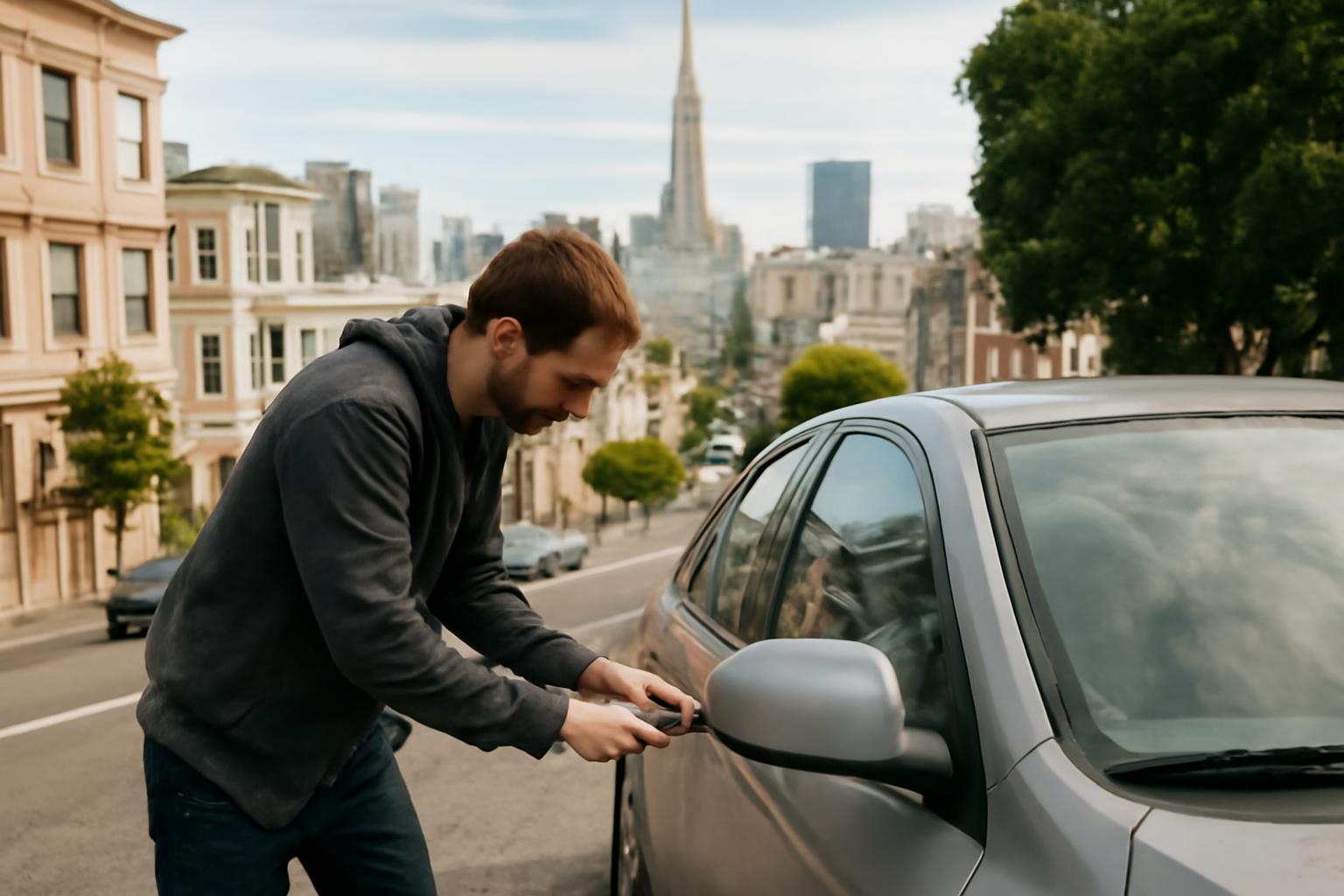
San Francisco tourist parking still deserves caution. The city’s reputation was built during years when break-ins felt constant, and even though more recent reporting suggests the broader trend has improved, official park warnings and recent visitor guidance still tell the same practical story: if you park near major sights, viewpoints, waterfronts, or recreation areas, you should plan for risk instead of assuming you will get lucky.
That does not mean every tourist lot is doomed or that every street space is a trap. It means parked-car theft in San Francisco is best understood as a probability problem. Thieves tend to look for fast, low-effort opportunities. Your job is not to make a vehicle perfectly safe. Your job is to make it look empty, ordinary, and not worth the time.
For tourists, the biggest difference usually comes before you arrive at the curb. Decide where you will park. Decide what happens to your luggage. Decide whether this stop is really a driving stop at all. Those choices matter because thieves often benefit from tourist routines: picking up a rental at the airport, driving straight to a famous view, opening the trunk, rearranging suitcases, and walking away for “just a few minutes.”
Even careful visitors can still get hit. Multiple sources say that openly. The useful goal is deterrence, not certainty. If your car looks like the least promising target nearby, your odds improve.
Why Tourist Parking in San Francisco Remains Risky
In Bay Area slang, these smash-and-grab break-ins are often called “bipping.” A 2024 Wawanesa explainer describes bipping as a relatively quiet window break historically associated with spark-plug porcelain and now sometimes done with a rescue tool, and it says the frequency of the tactic helped earn San Francisco the nickname “Bip City” (Wawanesa’s guide to San Francisco car break-ins and “bipping”).
The risk is not limited to residents or to a single neighborhood. The National Park Service says the San Francisco Bay Area has high levels of theft from vehicles and warns that criminals may watch trailheads and parking lots, especially in visitor-heavy areas. In the nearly six-year period from 2015 through September 2021, San Francisco recorded tens of thousands of larceny-from-auto cases, and NPS rangers plus U.S. Park Police responded to more than 3,969 cases across Golden Gate National Recreation Area, Muir Woods National Monument, Fort Point National Historic Site, and the Presidio of San Francisco (National Park Service vehicle burglary warning for GGNRA and nearby sites).
Tourist parking is especially vulnerable because tourist behavior is predictable. Visitors often arrive with luggage, camera bags, jackets, shopping, chargers, passports, snacks, and travel paperwork. The NPS warning specifically says to drop off luggage before a park visit when possible and, if you must store something in the trunk, do it before you arrive because criminals may be watching the lot (NPS vehicle burglary warning for GGNRA and nearby sites).
That behavior-based risk matters because most of these thefts do not require certainty. A thief does not need to know exactly what is inside. A charging cable suggests a device. A shopping bag suggests purchases. A jacket may conceal a purse. A hatchback cargo cover suggests there is something behind it. The NPS also warns that thieves may detect electronics through Bluetooth, RFID, or other wireless signals, which is why a powered-on device hidden in the car is not as good as a device removed from the car entirely (NPS vehicle burglary warning for GGNRA and nearby sites).
The important takeaway is practical, not alarmist. No routine can guarantee your car will be untouched. But a fully emptied, fully locked, low-drama-looking car is still a less appealing target than the one next to it with a backpack, cable, shopping bag, or visible luggage load. In San Francisco tourist parking, “uninteresting” is the goal.
Recent Trends: Break-Ins Down But Tourist Hotspots Lag
The broad trend appears better than the city’s worst-era reputation suggests, but the exact freshest citywide number in this evidence set comes from a weaker source than ideal. A Tripadvisor forum thread summarizing recent local reporting says San Francisco car break-ins fell to about 8,500 in 2024 from a 2022 peak of roughly 21,800—about a 61% decline and reportedly a 22-year low—and attributes the drop to tactics such as drones, bait cars, and surveillance (Tripadvisor San Francisco forum discussion summarizing recent reporting). Because that figure is presented here through a travel forum’s summary rather than a primary city dataset, it is best treated as a secondary benchmark, not the last word.
What is stronger in this evidence pack is the official warning that tourist-heavy park areas remain a live problem. The National Park Service’s current warning, last updated May 28, 2025, says Bay Area vehicle property theft remains high enough that visitors should bring only what they need, leave luggage at the hotel or rental, lock fully, take all keys and openers, and report suspicious activity. That guidance would not read the way it does if the threat had faded into trivia (National Park Service vehicle burglary warning for GGNRA and nearby sites).
Local news reporting reinforces the hotspot pattern. KQED, in an article updated May 7, 2025, says law enforcement identifies sightseeing areas such as Alamo Square, Lombard Street, and Fisherman’s Wharf as places that see many break-ins (KQED’s Bay Area car break-in prevention article). That is a useful corrective to citywide averages. A tourist does not experience “all of San Francisco.” A tourist experiences the handful of highly visible places where visitors cluster, pause, unload, and wander off.
There is also a long-running public perception that break-in totals remained very high even after the peak. One Quora response claims SFPD handled “over 17,000” car break-ins in one recent year, but it does not identify the year or provide an official underlying report, so it should be treated only as anecdotal context rather than as a statistic to rely on (Quora discussion on avoiding car break-ins in San Francisco).
So the honest reading is mixed. Recent reporting summarized by travelers suggests the city has improved materially from its peak. Official warnings and current local reporting still say tourist parking deserves real caution. Both can be true at once. A citywide decline does not erase the fact that viewpoint lots, park pullouts, and waterfront parking remain good hunting grounds for opportunistic thieves.
High-Risk Parking Spots for Tourists to Watch Out For
No source in this evidence pack provides a verified incident-rate ranking of the single “worst” lot in San Francisco, so any article that pretends to know that is overselling certainty. What the evidence does support is a reliable pattern: risk is highest where tourists predictably park with bags, cameras, electronics, or travel documents and then leave the vehicle to sightsee.
Start with the clearest categories. Official and semi-official warnings repeatedly mention airports, national park sites, and major attractions. Wawanesa’s break-in guide says airports and tourist attractions are common hotspots, while the NPS warning applies directly to Golden Gate National Recreation Area, Muir Woods, Fort Point, and the Presidio (Wawanesa’s guide to San Francisco car break-ins and “bipping”; NPS vehicle burglary warning for GGNRA and nearby sites).
For urban sightseeing areas, KQED offers the strongest location-specific reporting in this pack: according to law enforcement, Alamo Square, Lombard Street, and Fisherman’s Wharf see a lot of break-ins (KQED’s Bay Area car break-in prevention article).
Other locations in the evidence set are better treated as traveler-reported or guide-reported caution zones rather than confirmed rankings. Local-style parking guidance and rental-car blogs repeatedly flag Golden Gate Park, the Golden Gate Bridge welcome area, and waterfront parking used for Alcatraz departures as places to be especially careful. One local guide says Golden Gate Park, Lombard Street, the Painted Ladies at Alamo Square, and the 2 Bay Street area near the Alcatraz landing deserve extra caution, while describing Pier 27 only as a potentially better option in anecdotal terms, not as verified low-risk data (Inside Guide to San Francisco parking advice).
Twin Peaks belongs on the caution list too, but here the support is anecdotal rather than official. In a Rick Steves forum thread, one traveler described arriving from SFO, stopping at Twin Peaks around 2 p.m., and returning to find the back window smashed and bags stolen from a hatchback trunk while the lot was busy and other vehicles were reportedly hit at the same time (Rick Steves forum post on a Twin Peaks rental-car break-in).
It is tourist predictability. A famous stop with convenient parking is often the place where your discipline matters most.
Core Prevention: Make Your Car Look Empty and Unappealing
The best prevention advice in this evidence set is also the least glamorous: remove everything. Not only valuables. Everything that signals the possibility of value. Rental-car guidance aimed specifically at San Francisco says to clear the cabin completely—no bags, cables, jackets, coins, receipts, papers, water bottles, or shopping bags—and to think of parking as a repeatable routine rather than a last-second scramble (Hola Car Rentals’ guide to parking a hire car to deter break-ins).
That sounds excessive until you remember how low the thief’s cost is. A visible cable might mean a phone, tablet, or power bank. An empty shopping bag might suggest purchases in the trunk. A hoodie tossed in the back seat might hide a smaller item underneath. A totally empty-looking cabin removes those maybes. It will not make the car invulnerable, but it does remove many of the cues that trigger opportunistic theft.
If something must stay in the vehicle, put it away before you reach the destination. Do not arrive at the overlook, park, pop the trunk, shift luggage, and then walk to the railing. The NPS warning is explicit on this point: criminals may watch parking areas, which is why any trunk storage should happen before arrival and why dropping luggage off before sightseeing is better whenever possible (NPS vehicle burglary warning for GGNRA and nearby sites). Local rental-car guidance adds the same behavioral point more bluntly: avoid opening the trunk at tourist spots because that reveals exactly which car may be worth hitting (Hola Car Rentals’ guide to parking a hire car to deter break-ins).
Electronics deserve even stricter habits. The most defensible advice from this evidence pack is to take them with you. If you cannot, turn them fully off rather than leaving radios active. That caution is not just folklore; the NPS warning says thieves can detect electronics through Bluetooth, RFID, or other wireless signals (NPS vehicle burglary warning for GGNRA and nearby sites). The right conclusion is not that every thief is running advanced equipment, but that “hidden and powered on” is not the same as “secure.”
Secure the vehicle like it matters. Lock the doors. Fully close the windows and sunroof. Take all keys, fobs, and garage openers. Do not leave the vehicle idling while paying a meter or running into a shop, and do not treat a covered cargo area as the same thing as an empty car.
Where you park still matters, even if emptiness matters more. Staffed garages, hotel garages, monitored lots, well-lit streets, and places with regular pedestrian movement tend to offer a better risk profile than dead-end pullouts, scenic curb cutouts, or isolated spaces where someone can loiter unnoticed (Hola Car Rentals’ guide to parking a hire car to deter break-ins). Better does not mean safe. It means better.
A good test before walking away is brutally simple: if you were a thief, would your parked car look like it might contain something useful? If the answer is even “maybe,” keep adjusting.
Street vs Garage Parking: Smart Choices for Tourists
Street parking in San Francisco is not automatically reckless. It is just less forgiving of sloppy habits. Tourist advice specific to rental cars says street parking can be workable if the vehicle is truly empty, the block is well lit, there is normal foot traffic, and you follow the city’s hill-parking basics by curbing the wheels correctly and setting the parking brake firmly (Hola Car Rentals’ guide to San Francisco street parking for rental cars).
For visitors, though, the better question is not “street or garage?” in the abstract. It is “what kind of stop is this?” If you are parking for a quick errand on an ordinary commercial block with a genuinely empty car, street parking may be a reasonable call. If you are parking for hours near Fisherman’s Wharf, a waterfront departure point, a major viewpoint, or an evening restaurant plan, the balance shifts toward a garage, hotel valet, or controlled lot.
That is also where convenience can mislead you. A slightly longer walk from a more ordinary street or a staffed garage may produce a less tempting setup. Local parking guidance aimed at visitors specifically recommends using garages in tourist areas and mentions parking apps such as SpotHero as one way to find them, while still stressing that leaving no valuables in the car matters more than any app or facility name (Inside Guide to San Francisco parking advice).
That does not mean a trunk makes leaving property in the car safe. It means that if you are forced into a bad choice, some vehicle layouts are less bad than others.
Rental cues are worth treating carefully. Several traveler-oriented sources say out-of-state plates, stickers, or barcodes may draw extra attention to a rental, but that point is not established here with strong official data. The most responsible way to use it is as a plausible risk factor, not a proven rule. In contrast, “leave nothing visible” is repeatedly supported across official, editorial, and commercial sources.
A few habits help wherever you park. Photograph the car, stall number, nearby signs, and block name so you have a record if you return to damage or simply forget where you left it (Hola Car Rentals’ guide to parking a hire car to deter break-ins). And once you have parked, resist the urge to reopen the trunk for “one more thing.” The more your car looks like a tourist staging area, the worse the setup becomes.
Rental Car Specifics and Luggage Handling
Rental cars create the classic tourist break-in scenario: airport pickup, hours before hotel check-in, all luggage still onboard, then a straight drive to a famous sight. That combination shows up again and again in travel discussions because it is so common and so avoidable. In the Tripadvisor discussion that summarizes recent break-in reporting, travelers repeatedly advise solving luggage first and sightseeing second, mentioning hotel bag drop, Bounce locations, and airport-area storage as alternatives to parking near Fisherman’s Wharf with suitcases in the car (Tripadvisor forum advice on parking near Fisherman’s Wharf with luggage in a rental car).
If you arrive from SFO before your room is ready, drop bags at the hotel front desk anyway if possible. If that is not possible, use a luggage-storage option. Reorder the day. Have lunch first near your hotel. Do almost anything other than driving to a scenic stop with your whole trip in the back.
If you are traveling with someone, distribute essentials instead of concentrating everything in one bag. That will not prevent the break-in, but it can reduce the damage if it happens. The traveler who described the Twin Peaks break-in on the Rick Steves forum specifically said splitting clothing and using packing cubes would have made the aftermath easier, and partial recovery of items was easier because belongings were organized and identifiable (Rick Steves forum post on a Twin Peaks rental-car break-in).
Vehicle choice matters more than many travelers expect. In the same Tripadvisor discussion, locals and frequent visitors recommend cars with true trunks over SUVs or minivans when luggage is part of the day, and they also advise powering off electronics if a device must remain hidden in the car. That advice aligns with the NPS warning about wireless detection and with the general point that a hatchback cargo cover is not a true security barrier (Tripadvisor forum advice on parking near Fisherman’s Wharf with luggage in a rental car; NPS vehicle burglary warning for GGNRA and nearby sites).
Hatchbacks, SUVs, and minivans are not unusable in San Francisco. They just require stricter discipline. And no faith that a crowded tourist lot will protect you. The Twin Peaks anecdote is useful precisely because it happened in broad daylight, in a busy place, shortly after a rental pickup.
As for whether rental markings themselves attract thieves, the evidence here is suggestive but not definitive. Some travelers say they try to avoid obvious rental identifiers because they believe thieves read them as “tourist with luggage.” That is a reasonable concern, but the stronger, better-supported rule is still simpler: whether or not the car looks rented, an empty-looking vehicle is harder to justify hitting than one that advertises a payoff.
If Broken Into: Immediate Steps and Insurance Basics
If the worst happens, start with safety and documentation. Those steps matter because the theft itself is often only the first problem; stolen cards, identity documents, house keys, or work devices can create follow-on risks.
If the incident happened in a park area covered by the National Park Service, use the reporting numbers NPS publishes: 415-561-5656 for emergencies and 415-561-5505 for non-emergencies (National Park Service vehicle burglary reporting contacts). If it happened elsewhere in the city, contact local police and the rental company promptly.
Insurance is where many travelers discover they were using one mental bucket for several different kinds of loss. Wawanesa’s explainer says comprehensive auto coverage commonly applies to theft or vandalism damage to the vehicle, including the kind of damage that comes with a break-in, while off-premises homeowners or renters coverage may apply to stolen belongings depending on the policy (Wawanesa’s guide to what to do after a San Francisco car break-in).
Rental-car protection is often narrower than people assume. Hola Car Rentals’ guidance says rental protection typically focuses on the vehicle, related damage, and liability rather than on your personal property, which is why luggage, electronics, and other belongings may depend on separate travel, renters, or homeowners coverage instead (Hola Car Rentals’ guide to San Francisco street parking for rental cars).
The practical lesson is simple: do not assume “rental insurance” means “everything stolen from the trip is covered.” Read the policy language for the car, your personal property, and any travel or card benefit separately.
Finally, keep your paperwork organized. Save the report number, rental agreement, photos, repair invoices, and stolen-item list in one folder on your phone and in the cloud. After a break-in, the easier you make the admin, the faster you can get back to salvaging the trip.
Are SF car break-ins still a big issue for tourists in 2025?
Yes—best understood as a real ongoing tourist risk, not as proof that nothing has improved. Current 2025 guidance from the National Park Service still warns visitors to Bay Area park sites to leave luggage behind, store anything in the trunk before arrival, remove all valuables, and report suspicious activity, and KQED’s 2025-updated reporting still says law enforcement sees many break-ins around sightseeing areas such as Alamo Square, Lombard Street, and Fisherman’s Wharf (NPS vehicle burglary warning for GGNRA and nearby sites; KQED’s Bay Area car break-in prevention article).
At the same time, traveler summaries of recent local reporting describe a meaningful citywide drop from the peak, including the often-cited claim of about 8,500 incidents in 2024. The safest way to combine those two ideas is this: the overall situation may be better than the worst headlines suggested, but tourists who park at famous stops with bags in the car are still stepping into higher-risk situations than the city average.
Can I leave luggage in the trunk if hidden before parking?
Only as a fallback, not as a genuinely safe plan.
Hiding luggage before you arrive is better than opening the trunk after you park, because it avoids showing observers exactly what is inside. That point is supported both by the NPS warning and by rental-car guidance that says thieves may watch for the trunk-opening routine at scenic stops (NPS vehicle burglary warning for GGNRA and nearby sites; Hola Car Rentals’ guide to parking a hire car to deter break-ins).
But hidden luggage is still luggage in the car. A traveler’s Twin Peaks break-in report describes bags stolen from the trunk area of a hatchback even though they were under a cover, and several sources warn that some vehicles make rear cargo areas easier to inspect or reach than travelers assume (Rick Steves forum post on a Twin Peaks rental-car break-in; Tripadvisor forum advice on parking near Fisherman’s Wharf with luggage in a rental car). So yes, hiding it beforehand is better than revealing it onsite. No, it is not the same as secure.
Does rental car insurance cover stolen tourist belongings?
Usually not by default. In this evidence set, the clearest consistent guidance is that coverage is often split: comprehensive auto coverage may address damage to the vehicle, off-premises homeowners or renters coverage may address stolen property depending on the policy, and rental-car protection often focuses on the vehicle and liability rather than on your laptop, suitcase, camera, or shopping bags (Wawanesa’s guide to what to do after a San Francisco car break-in; Hola Car Rentals’ guide to San Francisco street parking for rental cars).
That is why the safest pre-trip assumption is not “I’m covered,” but “I need to check each layer separately.” Review the rental contract, your auto policy, your personal-property coverage, any travel-insurance terms, and any card benefits you plan to rely on.
What are the safest parking garages near Fisherman’s Wharf?
There is no verified garage-by-garage incident list in this evidence set, so there is no honest basis here for naming one facility as the safest.
A more useful answer is to choose by risk profile. Prefer a staffed garage, hotel valet, or heavily used facility, leave the car actually empty, and keep the parking duration as short as practical. Local guide material mentions Pier 27 as anecdotally preferable to the 2 Bay Street area near the Alcatraz landing, but it does not present verified low-risk data, so that should be treated as informal guidance rather than proof (Inside Guide to San Francisco parking advice).
Should I avoid driving altogether in San Francisco?
Not always, but for some itineraries it is the cleanest solution.
If your day involves bouncing between viewpoints, waterfront stops, and photo pullouts—especially before hotel check-in—driving creates the exact parked-car problem you are trying to avoid. That is why some public advice, including a widely circulated but anecdotal Quora discussion, effectively says the easiest way to avoid a parked-car break-in is to avoid parked-car sightseeing in San Francisco whenever you can (Quora discussion on avoiding car break-ins in San Francisco).
For many visitors, the middle path works better than an all-or-nothing answer. Use the car to arrive in the city, store the luggage, then build at least some sightseeing days around walking or transit instead of repeatedly moving the vehicle from one tourist lot to the next. A flatter waterfront day, for example, is often easier to enjoy when the car is out of the plan entirely.
San Francisco tourist parking is not hopeless, but it does reward disciplined habits. Solve luggage before sightseeing. Leave the car completely empty. Put anything unavoidable away before you arrive. Choose lit, active, or staffed parking when you can. Lock the vehicle fully every time. And remember the core principle behind all of the advice above: you are not trying to win a contest against every thief in the city. You are trying to make your car look like the least interesting option on the block.