
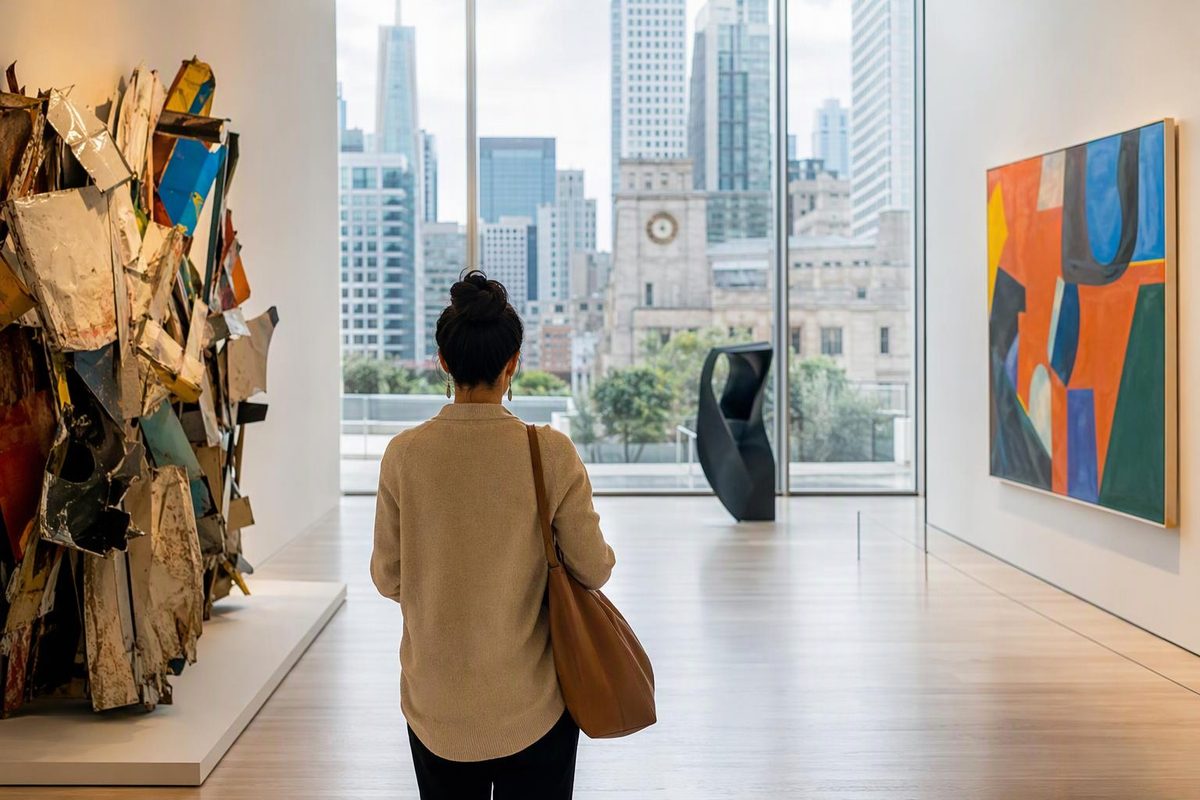
A first SFMOMA visit works better when you choose one anchor interest, add one or two contrasting floors and stop after two to three hours. Trying to cover every gallery floor usually produces more fatigue than understanding.
The museum is at 151 Third Street in SoMa, beside Yerba Buena Gardens. The short approach from Market Street along Third avoids the major hills that complicate many San Francisco sightseeing days. Most of the effort comes from moving through gallery Floors 2–7.
Check tickets and galleries before leaving
As verified September 28, 2026, standard hours are 10 a.m.–5 p.m. Monday–Tuesday and Friday–Sunday, noon–8 p.m. Thursday, and closed Wednesday. General admission is $30 for adults, $25 for ages 65 and older, $23 for full-time students with ID, and free for visitors 18 and younger. Everyone still needs a ticket, including members and visitors admitted free. Check SFMOMA’s current hours, prices and ticket link.
Gallery contents change, so check the museum’s live exhibition list on the day of your visit. For example, Matisse’s Femme au chapeau: A Modern Scandal closed September 27, 2026, although it may remain in older recommendations.
One important booking exception begins October 3, 2026: RM x SFMOMA: Between You and Me requires an “RM x SFMOMA + General Admission” timed ticket. General admission alone does not provide access. The surcharge is $10 on weekdays and $12 on weekends and holidays; members and visitors 18 and younger attend free but still need museum admission and a timed reservation. Only limited same-day tickets may be available, so book the exhibition online in advance if it is your priority.
Pick one route by interest
The exhibitions and floor locations below were current on September 28, 2026. Visit your priority floor first. After that, group the remaining stops by floor rather than repeatedly crossing the museum.
Best first overview: modern art across periods
Start on Floor 2 with 1900 to Now: SFMOMA’s Collection. Continue to Floor 4 for Ways of Seeing: Fourteen Artists, whose monographic galleries include Andy Warhol, Agnes Martin, Joan Mitchell and Richard Serra. Finish on Floor 5 with Calder, Kelly, LeWitt: Fundamentals of Form.
Budget about 35–45 minutes for each selected floor. If energy is limited, choose either Floor 4 or 5 rather than rushing through both.
Best for photography
Make Floor 3 the center of the visit. It currently holds three distinct choices:
- Graciela Iturbide: Between Two Worlds, through November 29, 2026
- Feel the Beat: Dance in Photographs, through February 28, 2027
- Table Manners, through May 9, 2027
Allow 60–75 minutes for the exhibitions that interest you and a pause at the outdoor Living Wall. Then add the photography collection on Floor 3 or one contrasting collection floor. The museum’s map identifies galleries, terraces, elevators and restrooms; use the live exhibition list to confirm what is installed.
Best for sculpture and abstraction
Begin on Floor 5 with Calder, Kelly and LeWitt, the sculpture garden and Cafe 5. If visiting by October 4, 2026, add Olafur Eliasson’s One-way colour tunnel before it closes. Continue down to Floor 4 for Agnes Martin, Joan Mitchell and Richard Serra in Ways of Seeing.
Best for memory, history and social themes
Start on Floor 6 with Memory and Matter: Personal and Collective Histories, featuring artists including Anselm Kiefer and William Kentridge. Continue to Floor 3 for the Iturbide photography survey, then finish on Floor 2 with O. Smith: Artivist or Klee Behind the Mask.
A practical 2½-hour sequence
- First 15 minutes: Enter on Third Street, open or collect your ticket, and check the day’s gallery status.
- Next 60 minutes: Go directly to the floor matching your main interest.
- Next 45 minutes: Visit one collection floor, usually Floor 4 or 5.
- Take 15 minutes: Pause at the Living Wall, a terrace or Cafe 5.
- Final 30 minutes: Finish on Floor 2 near the exit rather than adding a distant final gallery.
If you have only 90 minutes, choose one anchor floor and one nearby floor. The point is to reach the work you care about before museum fatigue sets in.
Arrival, accessibility and breaks
SFMOMA lists Montgomery Street and Powell Street stations for BART and Muni Metro, plus several bus routes stopping near Third and Mission. The T Third’s Yerba Buena/Moscone Station on Fourth Street also serves the district. Check live service before departure, then use the main entrance at 151 Third Street; SFMOMA’s arrival page also lists garage and bike-parking details.
All museum entrances and floors are accessible to visitors using wheeled mobility devices or with mobility difficulties. Elevators run from Floor 1 to ticketing on Floor 2, where a second elevator serves gallery Floors 2–7. Manual wheelchairs, portable gallery stools and adjustable canes are available free from coat check on a first-come, first-served basis in exchange for ID. An accessible drop-off is close to the Third Street entrance; see the full SFMOMA accessibility guide.
Cafe 5 on Floor 5 requires museum admission. Jane on Third, on Floor 1, and Steps Coffee, on Floor 2, are open to the public without a ticket. Check their changing hours and menus on the museum dining page.
Use the free area for a short day
If you have less than an hour—or do not want to commit to admission—SFMOMA offers 45,000 square feet of ticket-free public space on Floors 1 and 2 whenever the museum is open. Current installations include Jacob Hashimoto’s Giant Arc at the Howard Street entrance and Barbara Stauffacher Solomon’s Strips of Stripes on Floor 1. Check the current free-to-see list before going.
On a dry day, pair the museum with Yerba Buena Gardens. In rain, high wind or poor visibility, keep the plan indoors by starting in the free public areas or at Jane or Steps Coffee before entering the paid galleries. For a longer trip, place SFMOMA in a downtown or SoMa cluster rather than crossing the city for another major museum; the San Francisco itinerary guide can help keep the day coherent.