
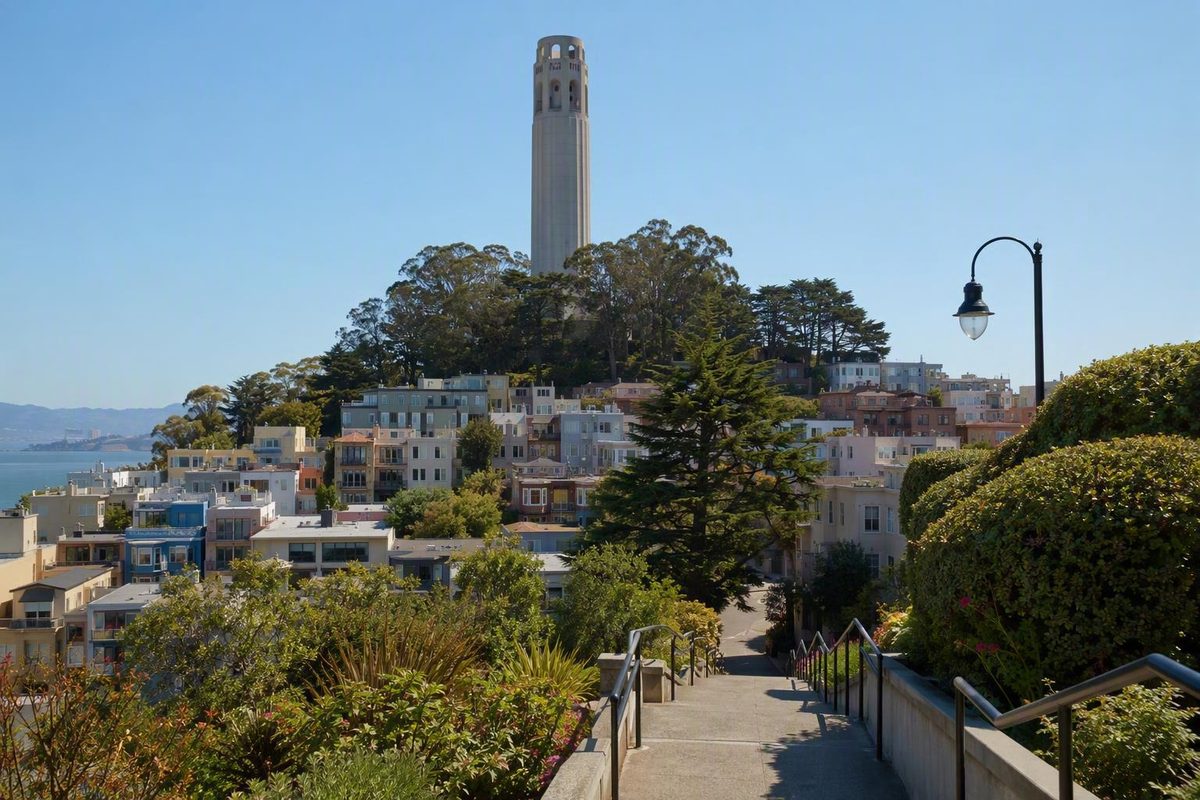
Take the 39 Coit bus up Telegraph Hill from Pier 39 or a listed Fisherman’s Wharf stop, look at the 1934 murals in the base, add the elevator ticket to the observation deck only once you know the elevator is running, then walk down once toward your next stop: the west side into North Beach for food, or the Filbert Street stairs to the waterfront. Save the stair climb for a visit where the climb is the point. Driving is the weakest option; the summit road is steep and narrow, parking is very limited, and rideshares can leave you short of the top. If steep paths are a concern, ride the bus both ways and confirm observation-level access before making the deck central to the visit.
Pick your start, stair tolerance and next stop; the route updates beside the controls.
Coit Tower Approach Planner
- Up
- Board the outbound 39 Coit at Pier 39 or a listed Fisherman’s Wharf stop and ride to the Coit Tower terminus.
- Down
- Walk down the west side of Telegraph Hill toward North Beach. Downhill stairs still need sure footing.
- Deck
- Elevator with a separate ticket; a 13-flight climb if the elevator is out. Ticket sales end one hour before closing.
Compare the four approaches
| Approach | Effort | Stairs | Side of hill |
|---|---|---|---|
| 39 Coit bus | Least | None planned | Terminus at the tower |
| Filbert Street stairs | Deliberate climb | Sustained | East, via Grace Marchant Garden |
| Greenwich, west side | Uphill walking | Includes stairs | West, North Beach side |
| Greenwich, east side | Deliberate climb | Sustained, steeper | East, waterfront side |
Estimate listed elevator tickets (non-resident)
Listed total: —
Ages 4 and under free. San Francisco residents pay lower listed rates not shown here. The listing is undated; confirm at the gift shop.
Sources: SF Recreation and Parks Coit Tower facility listing (prices, 13-flight elevator warning), SFMTA Route 39, San Francisco Travel, SF City Guides. Verify on the day.
Take Transit Up and Walk Down Once
Coit Tower stands in Pioneer Park at the top of Telegraph Hill. It looks close to the northern waterfront on a map, but that proximity does not make the final approach flat. Decide how you will reach the summit before building the rest of the day.
The practical sequence: board the outbound 39 Coit at Pier 39 or another listed Fisherman’s Wharf stop, ride to the Coit Tower terminus, visit the murals, consider the observation deck, then walk downhill once toward your next destination if your mobility and the conditions permit.
SFMTA’s live Route 39 page lists direct service from Fisherman’s Wharf and Pier 39 to Coit Tower, with real-time arrivals and temporary stop information. Check it on the day rather than relying on a remembered interval or stop location.
North Beach is the recommended continuation when food, a café or neighborhood wandering comes next; it is one of the visitor areas in San Francisco Travel’s neighborhood directory. The waterfront is the better finish when your next commitment is near Pier 33, Pier 39 or Fisherman’s Wharf.
Transit up, walk down is an editorial recommendation, not an instruction from SFMTA or the tower operator. It rests on the direct bus connection, the hilltop location and the pointlessness of climbing, descending to one district and reclimbing to reach another.
Route 39, Filbert Stairs or Greenwich Stairs: Which Approach Fits
The right approach depends on whether the climb is part of the attraction or an obstacle between you and the tower.
| Approach | Uphill effort | Stairs | Best fit |
|---|---|---|---|
| 39 Coit bus | Least of the four | No planned stair ascent | Conserving energy, limited stair tolerance, saving the walk for the descent |
| Filbert Street stairs | Deliberate climb | Sustained | The landscaped climb through Grace Marchant Garden is part of the outing |
| West-side Greenwich approach | Uphill walking | Includes stairs | Reaching the tower on foot from the North Beach side |
| East-side Greenwich steps | Deliberate climb | Sustained | Waterfront-side ascent; San Francisco Travel calls it steeper than the west side |
The Filbert Street stairs pass through Grace Marchant Garden. Treat them as a scenic climb in their own right, not a quick shortcut.
“Greenwich stairs” can mean approaches on different sides of the hill. San Francisco Travel distinguishes the eastern steps from the western approach and describes the eastern route as noticeably steeper. None of the walking approaches is easy, step-free or suitable for every visitor. Downhill stairs are still demanding; weigh balance, knees, footwear and weather before committing to a stair descent.
Why Driving to the Summit Usually Fails
Driving adds uncertainty at exactly the point where the visit should get simpler. The municipal facility information describes parking at the tower as very limited and warns that vehicle lines can become long at peak times. San Francisco Travel describes the summit road as steep and narrow.
A rideshare may suit some groups, but do not build a plan around a guaranteed summit drop-off or pickup. San Francisco Travel warns that rideshare or autonomous vehicles may leave passengers short of the top when access is constrained; its Coit Tower visitor guide summarizes the vehicle-access limits.
Transit is the stronger baseline because Route 39 has a documented stop at Coit Tower. That is a route-planning judgment, not a promise that the bus is delay-free or that every car hits a queue.
Murals, Observation Deck or Guided Tour: Three Different Visits
Choose one of three visits. A short mural stop: Pioneer Park plus whichever mural areas are open that day. A classic tower visit: add an observation-deck ticket for the elevated city and bay views. An art-focused visit: register for the longer mural tour and make the artwork the main event.
Access conditions and admission policies change, so do not assume every mural area will be open or that access will be free. The observation level requires a separate ticket under the published visitor information.
There are two guided-tour formats. The municipal facility page lists a docent tour for groups of four to six, lasting about 30 to 40 minutes. San Francisco City Guides separately offers an approximately 1.5-to-2-hour mural tour that requires advance signup; groups of seven or more must arrange a private group tour. Its Coit Tower murals tour page carries the calendar, registration details and tour-specific access notes.
What the Elevator Ticket Costs and What an Outage Means
The observation deck is reached by elevator, and tickets are sold in the gift shop, according to the municipal Coit Tower facility page. That undated listing gives non-resident elevator admission as $11 for adults, $8 for seniors 62 and older, $8 for ages 12–17, $3 for ages 5–11 and free for children four and younger, with lower rates for San Francisco residents. The same page warns that an elevator outage can leave visitors facing a 13-flight climb to the viewing level, and the operator’s guidance says observation-ticket sales end one hour before closing.
Treat those prices and procedures as listed information, not guaranteed current terms. The listing carries no date, so confirm before travel.
| Ticket (non-resident) | Listed price |
|---|---|
| Adult | $11 |
| Senior, 62 and older | $8 |
| Ages 12–17 | $8 |
| Ages 5–11 | $3 |
| Ages 4 and under | Free |
The murals do not depend on the deck. Their value is the same whether or not you go up.
Plan Around the Elevator and the Stairs
An observation ticket does not guarantee a stair-free visit. The historic elevator can be unavailable, and the operator’s published warning describes a substantial stair climb during an outage. Anyone who cannot manage that possibility should confirm elevator operation and the complete route to the viewing level before buying a ticket or making the deck the reason for the trip.
San Francisco City Guides describes the entrance and first-floor murals as fully accessible, while noting that a small number of second-floor murals on its tour can be reached only by stairs. That statement covers the entrance and mural areas the tour provider describes; it does not establish step-free access to the observation deck.
Split the access decision into two questions. Can you comfortably reach the tower entrance? Route 39 removes the planned stair ascent to the summit. Can you reach the observation level under today’s operating conditions? Ask about elevator status, any remaining stair requirement and the full route before relying on a deck visit. If the deck is not workable, a mural-focused visit still works, provided the areas you want to see are open and accessible that day.
Fisherman’s Wharf to North Beach Without Reclimbing the Hill
The useful decision on this route is choosing the correct side of the hill for what comes next, not adding tower attractions.
From Fisherman’s Wharf or Pier 39, take the outbound 39 Coit to its terminus. See the mural areas open that day. Add the observation deck only if ticket arrangements, access and visibility suit the visit. Then descend once toward North Beach if that is where you plan to eat or keep walking, or toward the waterfront if your next commitment is at the piers.
The point is to avoid descending to one district and immediately reclimbing Telegraph Hill for another. Coit Tower works best as a focused hilltop stop, not the hinge of a loop that forces both a stair ascent and a second climb.
No exact duration is attached to this route. Muni waits, ticket lines, elevator operation, tour schedules, visibility and walking pace all change the shape of the visit.
What to Notice Inside and on the Deck
Coit Tower was completed in 1933 and designed by the firm of Arthur Brown Jr. The murals in its base followed in 1934, painted by artists employed through the Public Works of Art Project. They depict work and everyday life in California during the Depression, which gives the interior historical weight beyond its role as a viewpoint. Look closely at the scenes of agriculture, industry and urban life even if you plan to go upstairs.
The observation deck gives a 360-degree perspective over the city and bay, including views toward the Golden Gate and Bay bridges when visibility permits.
Telegraph Hill takes its name from a semaphore telegraph erected at the summit in 1850 to signal arriving ships. Pioneer Park was established there in 1876 on the former site of the telegraph station. These dates, the tower’s design and the mural history are documented by San Francisco Recreation and Parks.
The Tower Was Not Designed as a Fire-Hose Nozzle
Lillie Hitchcock Coit was known for supporting San Francisco’s firefighters, but the municipal history says the tower was not designed to resemble a fire-hose nozzle. The resemblance is a popular reading, not the documented design intent.
Same-Day Checks Before You Set Out
Confirm the tower’s opening and closing times; observation-ticket sales end one hour before closing, so the verified closing time matters. Recheck ticket prices, purchase rules and accepted payment methods. Ask whether the elevator is operating and whether reaching the observation level involves any additional stairs. Verify availability and booking requirements for the tour format you want. Check Route 39 live arrivals, service status and temporary stop changes. Then choose your descent by your next destination, your mobility and the conditions.
Use Route 39 for the climb unless the stairs are the point, and leave Telegraph Hill in the direction of your next stop.