
Feature
The Explosive Dance Crazes That Defined the 1960s Groove
When people talk about the dances of the 1960’s, they usually mean something more specific than “music people danced to.” They mean the named crazes: the…
By Elena Park ·
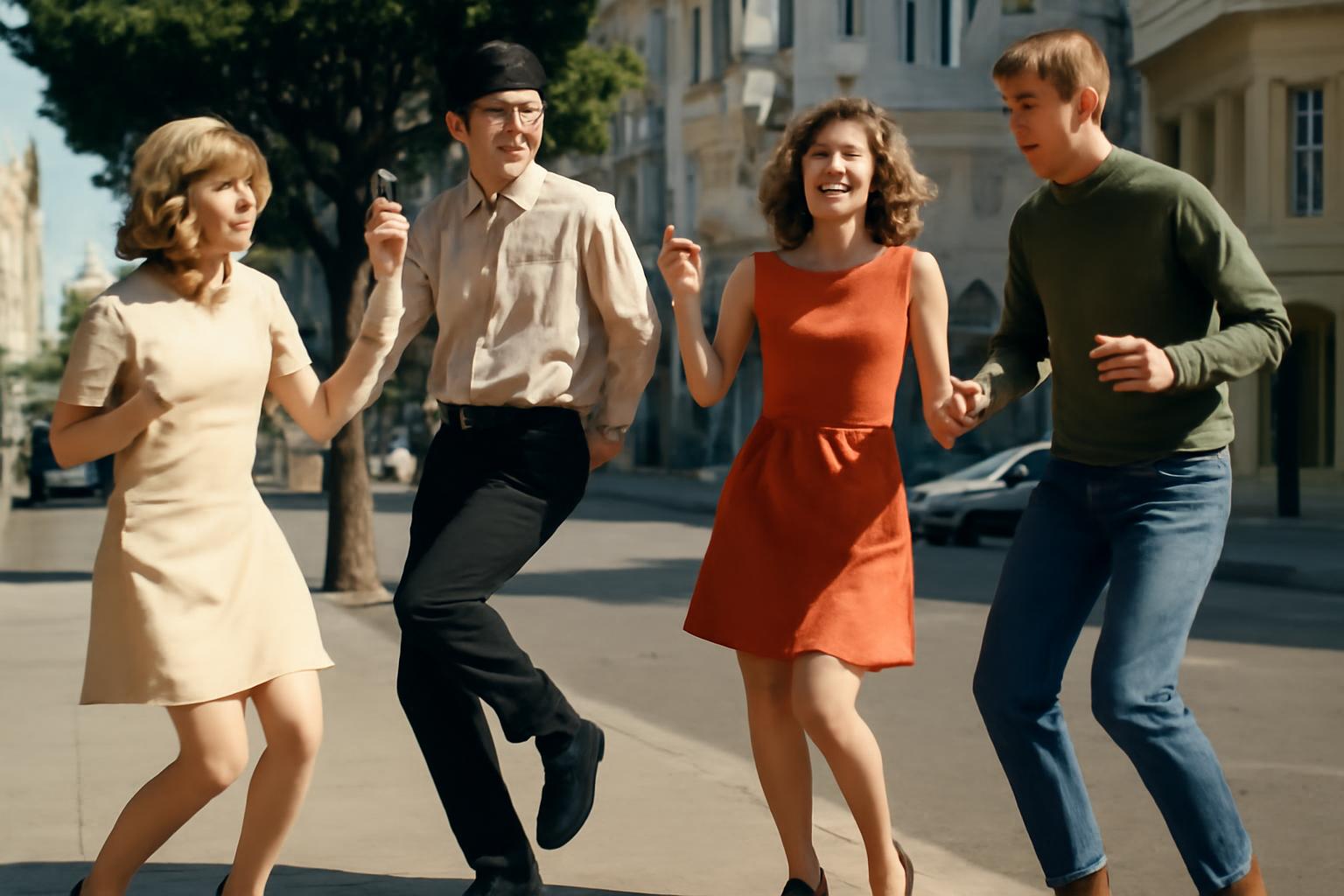
When people talk about the dances of the 1960’s, they usually mean something more specific than “music people danced to.” They mean the named crazes: the Twist, the Mashed Potato, the Pony, the Watusi, the Swim, the Frug, the Jerk, the Hitch Hike, the Loco-Motion, the Madison, the Monster Mash, and, later, the Boogaloo. They were social dances built to spread fast: easy to recognize, easy to imitate, and easy to adapt.
That simplicity was the secret. A dance craze worked when it had just enough identity to be copied from a song title, a TV performance, or a crowded party floor, but not so much technical detail that beginners felt excluded. You needed a beat, a few signature motions, and the confidence to join in.
The decade’s craze culture also matters historically. Much of the movement vocabulary, style, and musical energy behind these dances came out of African American musical and social-dance traditions, then reached broader pop audiences through records, television, clubs, and touring performers.
The Rise of 1960s Dance Crazes
What changed at the start of the 1960s was not just the soundtrack but the social arrangement of dancing. Rock ’n’ roll had already loosened older partner conventions, and by the early 1960s non-contact dances and solo-friendly styles were becoming more common. Sixties City describes the arrival of rock ’n’ roll as a major shift toward less formal, more frantic dancing, with solo and non-contact styles becoming especially popular and the Twist emerging as the biggest and most enduring craze of the new pattern (Sixties City).
That mattered because it made the dance floor more democratic. Instead of mastering a partnered routine, dancers could face each other, keep some distance, and perform their own version of the same general move. A craze did not need technical precision to spread. It needed a memorable name, a beat people wanted to move to, and a motion simple enough to be recognized across rooms, schools, clubs, and television studios.
The craze boom also rode on a feedback loop between music and movement. A song named the dance, radio delivered the record, TV supplied a visual model, and local dancers filled in the details.
Broad dance-craze summaries in the evidence pack also note that many 1950s and 1960s fads were popularized or commercialized versions of steps associated with African American dancers and scenes in major U.S. cities. That point should be stated carefully, because the surviving summaries are broad rather than definitive, but it helps explain why R&B, soul, early Motown, and related pop records sat so close to the center of the craze years (Dance crazes overview).
A title like the Swim, the Monkey, the Pony, or the Hitch Hike gave dancers an image before they knew a step. That made the dances portable. You could hear about one at school or on the radio and arrive at the next party with a usable guess.
The named-craze period was also relatively concentrated. The decade did not spend all ten years inventing one dance after another at the same pace. The strongest burst came in the early and middle years, when records, TV shows, teen clubs, and touring acts kept feeding one another. Later in the decade, broader soul, funk, and countercultural styles increasingly mattered more than an endless parade of new one-name novelty steps.
Top 12 Iconic Dances of the 1960s
Any “top” list of 1960s dances has fuzzy edges. Some dances were stronger in certain regions, some were tied closely to one hit song, and some overlapped with older or longer-lasting social forms. Still, the same core names recur in retrospective roundups, especially when writers try to capture the feel of the craze years (Sixty and Me).
- The Twist — the defining early-1960s solo craze, built on swiveling hips and legs with partners dancing apart.
- The Mashed Potato — a compact, heel-to-toe shuffle associated above all with Dee Dee Sharp’s “Mashed Potato Time.”
- The Watusi — a loose, highly visible social dance often linked in retrospectives to Ray Barretto’s “El Watusi.”
- The Pony — a bouncing, riding-like groove tied to Chubby Checker’s “Pony Time.”
- The Hully Gully — a group-friendly dance with a communal party-floor character.
- The Jerk — a sharper mid-1960s dance associated with the Larks.
- The Swim — a novelty-action dance whose upper-body motions mimic swimming.
- The Frug — a bent-knee, side-pulsing dance that could look stylish without much travel.
- The Hitch Hike — a gesture-based dance strongly associated with Marvin Gaye.
- The Loco-Motion — one of the clearest examples of a dance being propelled by a breakout pop hit.
- The Madison — a line dance that overlapped with craze culture and remained party-friendly long after its peak.
- The Monster Mash — a novelty favorite that added character acting and comic mood to the dance floor.
What unites these dances is not technical similarity so much as social function. Some were basically solo dances. Some worked in loose pairs. Some slipped toward line dancing. Some were strongly attached to one record, while others became clusters of related motions. The name suggested an image, and the image helped people remember the move.
That is why so many of the decade’s dance names sound like actions, characters, or creatures. Even before someone had learned the full pattern, the title gave them a mood. The Pony suggested bounce. The Swim suggested arms. The Hitch Hike suggested a thumb gesture. The Monster Mash suggested theatrical fun. In a world before video tutorials on demand, those hints were powerful.
The list also shows how broad the craze ecosystem was. It included dances tied to R&B and soul records, novelty hits with comic appeal, line dances that worked at mixed-age parties, and highly visual TV-friendly moves. The dances of the 1960s were not one uniform style. They were a fast-moving family of social habits that made participation easier than perfection.
The Twist: The Dance That Started It All
If one dance stands for the craze era as a whole, it is the Twist. Ice-dance.com’s historical overview traces the song back to Hank Ballard’s 1959 recording and notes that Chubby Checker’s re-recording turned it into a chart-topping pop event in 1960, helping make the dance a national phenomenon rather than a local or scene-based step (Ice-dance.com).
The brilliance of the Twist was its balance of structure and freedom. The motion was recognizable, but it did not demand exact counts or polished partnering. Dancers usually kept their feet apart, knees soft, and lower body swiveling side to side while the upper body countered the motion. Because the dance was based on feel rather than precision, people could make it tiny, bouncy, exaggerated, comic, or cool without losing the identity of the step.
The Twist could be done alone, opposite a partner, or inside a crowded group. It also looked modern. Dancing apart at short distance carried a different social message from older partner holds: you were still dancing together, but you retained your own space and style.
Twist-themed records also helped keep the craze alive well beyond one season. Contemporary and retrospective discussions of the era regularly point to a cluster of Twist-titled hits and follow-ups that kept the word circulating through the early 1960s. That sustained visibility mattered. A named dance had a better chance of lasting when it became more than one song and more than one moment.
The Twist’s larger importance is not that it erased every earlier form of social dance. It did not. Rather, it helped normalize a new mainstream arrangement: low-contact, highly imitable, youth-oriented dancing in which individuality mattered as much as paired coordination.
Mashed Potato: 1962’s Heel-To-Toe Sensation
The Mashed Potato was one of the clearest early-1960s follow-ups to the Twist. In the evidence pack, both the tutorial summary from Adventures in Dance and the broader history on the Mashed Potato describe James Brown as bringing the move into circulation around 1959, with Dee Dee Sharp’s “Mashed Potato Time” turning it into a mainstream craze in 1962 and the Contours’ “Do You Love Me” helping keep the name in public view (Adventures in Dance).
In feel, the Mashed Potato is close enough to the Twist that modern beginners sometimes blur the two together, but the emphasis is different. The Mashed Potato is more compact and more ankle-driven. Descriptions in the evidence pack emphasize shuffling feet, twisting ankles, and shifting weight in a heel-to-toe pattern. One common explanation starts with stepping slightly back with the heel turned inward, then swiveling the heel outward and repeating the action in a pulsing shuffle.
That grounded, repetitive shuffle gave the dance its character. Where the Twist often reads as a broad swivel, the Mashed Potato feels denser and more percussive. It can be danced small and close to the floor, or pushed into a more exaggerated party style, but the charm comes from the repeated heel-and-ankle action.
The dance also had unusually strong song support for a craze so tightly identified with one name. The Mashed Potato entry in the evidence pack lists it as a popular craze of 1962 and associates the dance with Nat Kendrick and the Swans’ “(Do the) Mashed Potatoes,” James Brown’s “Mashed Potatoes U.S.A.,” Dee Dee Sharp’s “Mashed Potato Time,” and Sharp’s follow-up “Gravy (For My Mashed Potatoes)” (Mashed Potato overview).
That cluster of songs helps explain why the Mashed Potato remains so memorable. It sat at the center of the craze formula: a vivid title, a repeatable feel, crossover help from multiple records, and enough lyrical reinforcement that even listeners who never mastered the step knew the name. It was not just a dance people did. It was a dance people kept hearing about.
The Mashed Potato also shows how quickly the craze machine could work. A movement could begin in performance, be amplified by one artist, be turned into a major hit by another, and then be stabilized by lyric mentions in yet more songs.
Watusi, Pony, and Other Mid-1960s Hits
After the Twist opened the floodgates, the named dances came quickly. The Watusi became one of the most visible follow-ons, and its public reach was broad enough that We Make History highlights a well-known 1964 moment in which Luci Johnson danced the Watusi with Steve McQueen at a campaign event. That image matters less as a step guide than as a sign that craze dancing had moved far beyond teen clubs and into highly public mainstream life (We Make History).
The Pony offered a different feel. Instead of swiveling in place like the Twist, it leaned into bounce and a riding-like rhythm. That made it easy to read from across a room. In both cases, the craze succeeded because the central idea was stronger than any fixed technical syllabus.
The Frug and the Swim show how television-friendly these dances could be. Sixties City describes the Frug as a bent-knee pattern with body weight settled over one foot while the other knee bends and releases, accompanied by clipped arm motions. It also describes the Swim as a Frug variation that adds swimming-arm gestures on top of a similar lower-body pulse.
That visual immediacy was crucial. Viewers did not need a dance diagram to understand what they were seeing. They needed a few seconds of posture, rhythm, and attitude. The same was true of dances such as the Monkey, Freddie, Mouse, and Jerk. The signature motion often mattered more than a universally agreed sequence of steps.
This is one reason memories of exact patterns vary so much today. Records, TV shows, clubs, and local communities all shaped how the dance looked in practice.
Boogaloo: The Late-1960s Funk Fusion
Boogaloo belongs to the later phase of the decade, and the term needs careful handling because it refers to more than one history. The evidence pack’s strongest source on the subject describes the 1960s Boogaloo as a social dance that developed in Black communities, spread rapidly as a popular form, and was visible enough by 1964 for James Brown to be filmed dancing it. The same source stresses that this dance is distinct from Latin boogaloo music in New York and distinct again from the later Electric Boogaloo associated with 1970s popping styles (Blues and Jazz Dance Book Club).
What made Boogaloo different from the earlier named crazes is that it behaved less like a single gimmick and more like a synthesis. The source above describes it as absorbing elements from dances such as the Watusi, Swim, Jerk, Frug, Skate, Chicken, and Pony, while adding triple-steps, shimmies, shakes, and rolling body action. In other words, Boogaloo was not merely another label in the craze list. It was a looser vocabulary made from the craze era’s accumulated materials.
That makes Boogaloo especially useful as a marker of transition. Earlier dances often thrived because they could be reduced to one compact image. Boogaloo still had a name, but it pointed toward a broader funky style rather than a single obvious trick. The dance feels like an endpoint to the most rigid craze language and a bridge toward later soul and funk forms.
It also shows how messy pop-dance history can be. A single word may refer to a dance, a music style, a later dance lineage, or all three depending on context. Distinguishing those meanings is not pedantic; it is necessary if you want to understand what people in the mid-1960s actually meant on a dance floor.
How Songs and TV Fueled the Crazes
The craze era was not just a string of dances. It was a media system. Records named the move, radio spread the sound, television demonstrated the attitude, and young dancers turned all of that into social practice.
Ice-dance.com’s overview of postwar social dance explicitly points to American Bandstand as a key mechanism for diffusion, noting that radio determined what songs people heard while television showed viewers how those songs looked when danced. That mattered because a craze spread fastest when audiences could see the posture, distance, arm use, and mood as well as hear the beat (Ice-dance.com).
In Britain, Sixties City identifies Ready Steady Go as another important promoter of new dances.
The songs themselves often worked like instructions, or at least invitations. A title could do half the job before the lyrics even started. And sometimes the lyrics piled craze names together on purpose. The dance-craze overview in the evidence pack notes that “Land of a Thousand Dances,” which became a 1965 hit for Cannibal and the Headhunters after Chris Kenner’s earlier version, referenced many fad dances by name, turning the craze landscape itself into pop-song material (Dance crazes overview).
Women were central to this story, too. Sixty and Me’s roundup highlights Dee Dee Sharp’s role in making “Mashed Potato Time” a defining hit and notes that Little Eva first recorded “The Loco-Motion” as a demo before it became a No. 1 hit. Those details are worth keeping in view because nostalgia writing about dance crazes can drift too easily toward male hosts, bandleaders, and headline performers, even though young female singers helped carry several of the era’s most durable dance records (Sixty and Me).
Stagecraft mattered as well. The Boogaloo research summary in the evidence pack connects Motown choreography and the work associated with Cholly Atkins to the larger visual culture of 1960s dance.
All of this helps explain why the craze era burned so brightly. It was not powered by music alone or dance alone. It depended on the constant exchange between records, screens, live performance, and imitation. The dances spread because people could hear them, see them, name them, and try them almost immediately.
Timeline of 1960s Dance Fads
A practical decade map, based on the evidence pack’s dance-craze overview, looks like this: 1960 brought the Twist and Shimmy; 1961 featured the Pony and Chicken Walk; 1962 included the Loco-Motion, Mashed Potato, Monster Mash, Swim, and Watusi; 1963 saw the Hitch Hike and Monkey; 1964 brought the Frug and Jerk; and 1965 featured the Freddie and the Mouse.
That kind of timeline should be read as a broad map rather than a rigid law. Dances often appeared before their peak, lingered regionally after the national spotlight moved on, or overlapped heavily with one another. Some names described highly specific motions; others described looser families of steps. A year-by-year list is useful because it shows density, not because it captures every local variation.
The timeline also reveals a pattern. As the decade moved forward, social dancing did not disappear, but the culture increasingly favored broader styles over endlessly renewed one-name fads.
That is the lasting significance of the 1960s craze era. Dances like the Twist and the Mashed Potato made social dancing feel accessible to people who might never have learned formal partner steps. Songs increasingly arrived with a movement identity attached. TV taught audiences not just what to hear but what to do. Even after the named crazes thinned out, they left behind a durable expectation: popular music was something you enacted with your body, not just something you listened to.
What was the first major 1960s dance craze?
The first major 1960s dance craze was the Twist, which We Make History describes as the first dance craze of the new decade and an unprecedented national phenomenon in 1960 (We Make History).
How do you do the basic Twist step?
A basic Twist starts with your feet apart and your knees loose, then uses a side-to-side swivel of the hips and legs while the upper body counters the motion. Sixties City preserves the old shorthand of imagining that you are stubbing out a cigarette with both feet while drying your back with a towel.
Which 1960s dance was linked to James Brown?
The dance most directly linked to James Brown in early-1960s craze history is the Mashed Potato. The evidence pack’s tutorial summary says the move originated from James Brown around 1959 before Dee Dee Sharp’s 1962 hit pushed it into broader craze status.
What distinguished Boogaloo from other 1960s dances?
Boogaloo stood out because it functioned more as a fusion style than a one-gimmick novelty dance. The strongest source in the evidence pack describes it as blending elements of earlier dances such as the Watusi, Swim, Jerk, Frug, and Pony, while remaining distinct from Latin boogaloo music and later Electric Boogaloo.
Name songs that popularized Mashed Potato.
The songs most often cited are “(Do the) Mashed Potatoes,” “Mashed Potatoes U.S.A.,” “Mashed Potato Time,” and “Gravy (For My Mashed Potatoes),” with “Do You Love Me” also helping publicize the dance by naming it in the lyrics.