
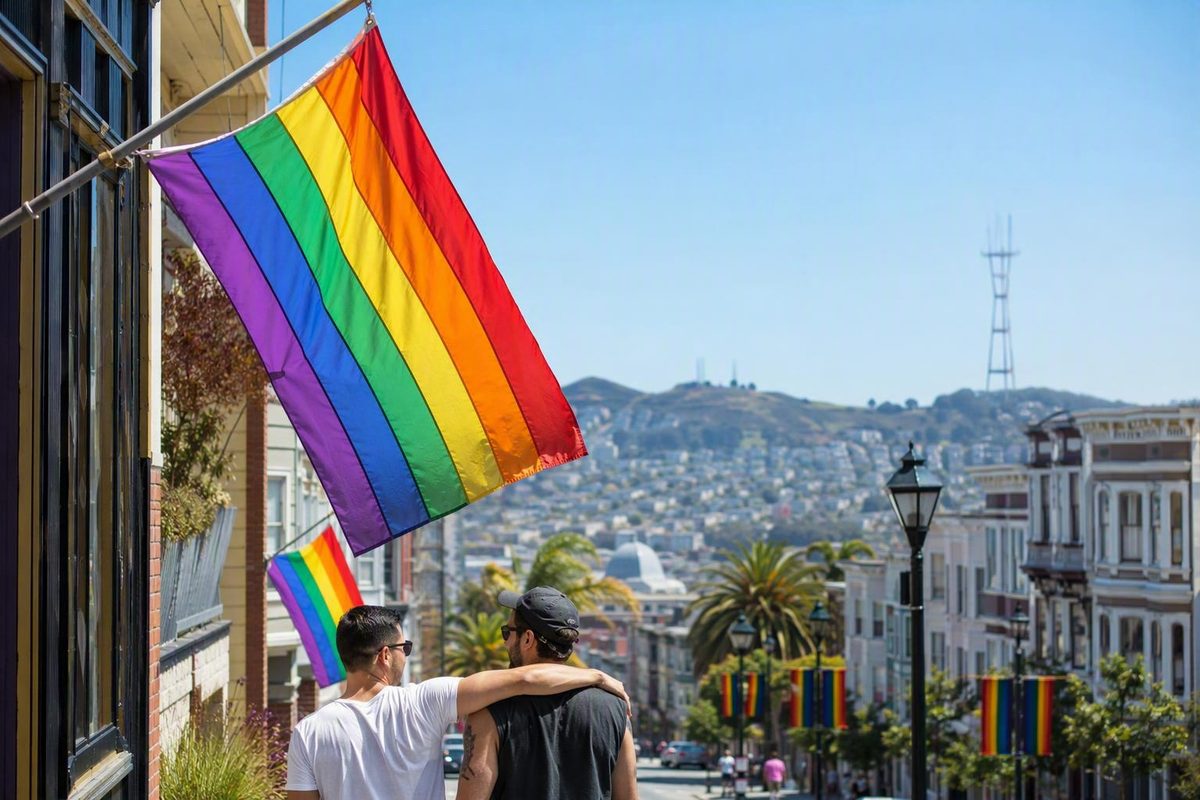
The short answer: start with the Castro, then look beyond it
The Castro is San Francisco’s best-known and most concentrated gay neighborhood. For a first-time visitor seeking LGBTQ+ landmarks, public history, cultural institutions, shops, restaurants, bars, and an immediately recognizable district, it is the clearest place to begin. Its commercial core centers on Castro and 18th streets and broadly follows Castro Street from Market Street to 19th Street (Castro Community Benefit District neighborhood overview).
But the Castro is not the whole story. San Francisco’s LGBTQ+ geography also includes:
- SoMa, especially the Folsom Street corridor, for leather and kink history and specialized nightlife.
- The Mission, where queer and lesbian-oriented gathering places are dispersed around Valencia Street, 16th Street, Mission Street, and Dolores Park.
- Polk Gulch, an important gay enclave before the Castro became the city’s most prominent gay district.
- The Tenderloin and Transgender District, central to transgender history and the Compton’s Cafeteria uprising.
- Duboce Triangle, Dolores Heights, Noe Valley, and Bernal Heights, quieter residential areas with reported LGBTQ+ associations but no equivalent concentration of visitor-facing nightlife.
The phrase “gay neighborhood” can therefore mean several different things. It may describe a compact commercial and nightlife district, a specialized cultural corridor, a historically important enclave, a public gathering place, or a residential area associated with LGBTQ+ residents. Those categories overlap, but they are not interchangeable.
Nightlife listings also do not establish the sexual orientation or gender identity of the people currently living nearby. A block can contain several queer venues without functioning as a predominantly LGBTQ+ residential neighborhood. Conversely, an area can have strong LGBTQ+ residential or historical associations without a visible bar district.
This guide compares the principal areas by historical role, approximate focal corridor, daytime landmarks, nightlife concentration, and likely visitor fit. The aim is not to declare one universal “best” neighborhood, but to help you choose the part of San Francisco that matches what you want to understand or experience.
San Francisco’s LGBTQ+ areas at a glance
San Francisco’s neighborhood identities are informal and often overlap. The corridors below are practical orientation points, not hard borders.
| Area | Useful classification | Approximate focal corridor | Historical or cultural identity | General nightlife concentration | Representative daytime stops | Best visitor fit |
|---|---|---|---|---|---|---|
| The Castro | Primary concentrated gay district | Castro and 18th streets; broadly Castro Street from Market to 19th Street (Castro district overview) | Gay activism, Harvey Milk, public LGBTQ+ history, and community institutions | High relative to the other areas in this guide | Harvey Milk Plaza, Pink Triangle Park and Memorial, Rainbow Honor Walk, GLBT Historical Society Museum, Castro Theatre | First-time visitors seeking the clearest orientation and a compact mix of history, culture, and social life |
| SoMa | Specialized leather, kink, and nightlife area | Folsom Street, approximately between 7th and 12th streets (San Francisco LGBTQ+ neighborhood guide) | Leather bars, bathhouses, kink culture, nightlife, public space, and community events | Concentrated in particular corridors and venues | Eagle Plaza and sites associated with the leather cultural district; confirm access before visiting | Visitors focused on leather and kink heritage or specialized nightlife |
| The Mission and Dolores Park | Dispersed queer area and gathering landscape | Valencia Street, 16th Street, Mission Street, and Dolores Park (San Francisco queer activity guide) | Queer and lesbian-oriented gathering places within a neighborhood known more broadly for Latino cultural history | Scattered rather than concentrated in one gay commercial core | Dolores Park, plus non-LGBTQ-specific neighborhood context such as murals, bookstores, cafes, and food corridors | Visitors who want queer spaces integrated into a broader neighborhood day |
| Polk Gulch | Historic gay enclave | Polk Street between California Street and Broadway, associated by one guide with the gay scene of the 1960s and 1970s (Global Gayborhood’s district overview) | A major chapter of gay life before the Castro’s rise | Lower and less concentrated than historically | Polk Street streetscape and sites connected to earlier gay history | Visitors interested in how the city’s gay geography changed |
| Tenderloin and Transgender District | Transgender historical and cultural district | Parts of the Tenderloin; consult current cultural-district information rather than assuming fixed boundaries | The 1966 Compton’s Cafeteria uprising and transgender community history (San Francisco Travel’s Transgender District overview) | Individual LGBTQ+ venues rather than a Castro-style cluster | Tenderloin Museum and historical interpretation connected to Compton’s Cafeteria | Visitors prioritizing transgender history |
| Duboce Triangle | Adjacent residential area with LGBTQ+ associations | Immediately north and northeast of the Castro’s commercial core | Sometimes included in a broader interpretation of the Castro | Limited as a dedicated nightlife district | Residential streets and connections toward Market Street | Visitors wanting proximity to the Castro with a more residential setting |
| Dolores Heights | Adjacent residential area with LGBTQ+ associations | Between the Castro and Dolores Park area | Sometimes treated as part of the wider Castro and sometimes as a separate neighborhood | Low | Residential streets and access toward Dolores Park | Visitors combining the Castro and Mission |
| Noe Valley | Quieter LGBTQ+-associated residential area | Neighborhood commercial and residential streets rather than a queer venue corridor | Residential associations reported by travel guides | Low | General neighborhood cafes, shops, and residential streets | Visitors seeking a quieter base rather than dedicated nightlife |
| Bernal Heights | Quieter LGBTQ+-associated residential area | Neighborhood commercial and residential streets | Residential associations reported by travel guides | Low | General neighborhood streets, cafes, and hilltop surroundings | Visitors more interested in neighborhood atmosphere than a gay entertainment district |
| Haight-Ashbury and Hayes Valley | Areas appearing in wider LGBTQ+ travel directories | Their established commercial corridors | Citywide queer presence rather than concentrated gay-district identity | Scattered | General shopping, dining, and cultural stops | Visitors already exploring these neighborhoods for broader reasons |
This classification is more useful than placing every area under a single “gay neighborhood” label. The Castro is the strongest answer to the literal search for a gay district. SoMa and the Transgender District have more specialized cultural identities. Polk Gulch is essential historically. The Mission combines queer gathering places with many other layers of neighborhood culture. The quieter residential areas are relevant to the wider queer city but should not be marketed as nightlife zones.
The “best visitor fit” column is practical editorial guidance, not a demographic finding or quality ranking. Personal experience can vary by venue, event, time, and individual needs.
The Castro: the first stop for landmarks, history, and concentrated gay culture
For practical orientation, begin around Castro and 18th streets. The recognizable commercial spine runs north toward Market Street and south toward 19th Street. The Castro Muni Metro station and F-Market streetcar corridor are useful map references, although service details and schedules should always be checked through current transit information.
The neighborhood is also known as part of Eureka Valley. Its wider boundaries are not universally fixed: some descriptions extend the broader Castro toward Church Street or include nearby Duboce Triangle and Dolores Heights, while others treat those as distinct adjacent neighborhoods. For a visitor, it is simplest to regard Castro Street between Market and 19th streets as the recognizable business core and the surrounding blocks as transitions into nearby residential areas (Castro Community Benefit District neighborhood overview).
The Castro’s prominence is inseparable from LGBTQ+ activism and Harvey Milk, who lived in the neighborhood and served on the San Francisco Board of Supervisors in 1978.
That history is fundamental, but it should not be used to reduce all of San Francisco’s queer past to one neighborhood. Transgender resistance in the Tenderloin, leather culture in SoMa, earlier gay life around Polk Street, and queer gathering places in the Mission form distinct and necessary parts of the city’s LGBTQ+ map.
A useful first-visit landmark checklist includes:
- Harvey Milk Plaza, at Market and Castro streets.
- Pink Triangle Park and Memorial, near Market and 17th streets.
- The Rainbow Honor Walk, whose plaques commemorate notable LGBTQ+ people.
- The GLBT Historical Society Museum, for historical exhibitions and interpretation.
- The Castro Theatre, a prominent neighborhood landmark whose current event access and operating arrangements should be confirmed before visiting.
Harvey Milk Plaza was renamed for Milk after his assassination in 1978. Pink Triangle Park and Memorial refers to the symbol imposed on gay men during the Holocaust. The sites are close together but serve different purposes: the plaza connects visitors to Milk’s political legacy, while the memorial creates a place for remembrance.
The Rainbow Honor Walk adds another layer of public history at street level. Rather than functioning as a single monument, its plaques invite visitors to notice individual lives while moving through the business district. The museum offers a more concentrated historical experience, while the theater represents the neighborhood’s broader cultural life beyond bars and memorials.
That combination makes the Castro especially effective for a first visit. Within a relatively compact area, visitors can encounter public history, cultural institutions, retail, food, nightlife, a historic theater, Victorian architecture, and residential side streets. You do not have to be planning a late night to understand why the district matters.
A simple visit can follow this sequence:
- Arrive near Market and Castro for basic orientation.
- See Harvey Milk Plaza and Pink Triangle Park and Memorial.
- Walk south on Castro Street and look for Rainbow Honor Walk plaques.
- Turn toward 18th Street for the museum and surrounding businesses.
- Continue into residential streets only as far as your time, mobility, and interest allow.
- Return to the commercial core for food, an event, or nightlife.
Treat this as a framework rather than a timed itinerary. Hills, admission arrangements, theater events, weather, and personal pace can all change the shape of a visit.
The museum, theater, bars, restaurants, and shops named in visitor sources should not be assumed to be open solely because they appear in a guide. Check their official websites or verified first-party accounts before leaving, especially if one stop is central to your plans.
SoMa: leather heritage, nightlife, and the Folsom Street corridor
SoMa means South of Market. It is a large and varied part of San Francisco, not simply an extension of the Castro. The LGBTQ+ area most relevant to this guide is commonly associated with Folsom Street, approximately between 7th and 12th streets. Because SoMa is extensive and cultural-district geography does not necessarily match every visitor map, use that corridor as an orientation aid rather than a precise boundary (misterb&b’s San Francisco neighborhood map).
A local LGBTQ+ history overview describes South of Market as developing a community of leather bars and bathhouses in those decades, before the Castro became the city’s most prominent gay district (SF Gay History’s neighborhood timeline).
Visitor sources describe part of SoMa as the Leather District or Leather & LGBTQ+ Cultural District. That recognition matters because it frames leather culture as community history rather than merely a list of nightlife businesses. Visitors interested in the area can look for cultural interpretation, public space, and community organizations alongside bars and event venues. Because the evidence supplied here does not establish exact current district boundaries, do not treat an informal visitor map as an official perimeter.
Travel sources name SF Eagle, Powerhouse, Oasis, and Eagle Plaza as representative places associated with the area. Their inclusion here explains the character of SoMa’s queer geography; it is not confirmation that every place is currently open, accessible at a particular time, or offering the programming a visitor expects.
SoMa is also associated with the Folsom Street Fair, an event centered on BDSM and leather culture. Dates, admission practices, street closures, age rules, and accessibility arrangements can change. Verify all event details directly with the organizer rather than relying on an undated neighborhood summary.
The practical distinction between SoMa and the Castro is one of emphasis:
- Choose the Castro for a compact introduction combining public memorials, gay political history, a museum, commercial streets, and broadly oriented nightlife.
- Choose SoMa when leather and kink history, cultural-district identity, or specialized nightlife is the main reason for your visit.
Neither district is objectively better, and the available evidence does not support a neighborhood-level safety or comfort ranking. The more useful question is which area matches your interests.
Many SoMa destinations are also venue- or event-specific. Arriving without confirming the program can result in a very different experience from the one described by a travel article. Check official venue, event, and cultural-district pages immediately before visiting.
The Mission and Dolores Park: a more dispersed queer landscape
The Mission does not have a compact gay commercial center comparable to Castro Street. Its queer geography is more dispersed, with gathering places and nightlife associated with 16th Street, Valencia Street, Mission Street, and Dolores Park. These are practical reference points, not the boundaries of a formal queer district.
Visitor sources connect the Mission with lesbian and queer social spaces, but venue listings should not be converted into claims about who currently lives in the neighborhood. A queer bar or event reveals something about social geography, not the sexual orientation or gender identity of nearby households.
Sources identify El Rio, Jolene’s, Mother, and Make Out Room as representative Mission venues. Before treating any of them as a destination, confirm current operating status, programming, intended audience, accessibility, admission conditions, and age restrictions. A venue may host queer events without every night serving the same audience, and its identity or schedule can change.
Dolores Park provides the Mission’s most visible outdoor connection to queer social life. The southwest portion near 20th and Church streets is informally known as “Gay Beach” (GayCities’ Dolores Park itinerary).
It is a social name for a general part of the lawn where LGBTQ+ people have gathered. Searching for it as though it were a conventional marked attraction may therefore be confusing.
Conditions in the park depend on weather, time of day, and whether an organized event is occurring. An ordinary afternoon and a major gathering are fundamentally different experiences, with different crowd levels and planning requirements. Confirm event dates and access information directly with organizers.
The Mission also deserves attention beyond its queer venues. Visitor sources describe it as a historically Latino neighborhood with food corridors, murals, bookstores, cafes, independent businesses, and residential streets. These are broader neighborhood characteristics, not exclusively LGBTQ+ attractions.
A Mission-focused queer visit works best when it combines interests rather than attempting to follow a single “gay street.” For example:
- Start around Valencia or 16th Street for cafes, bookstores, and general neighborhood activity.
- Add murals or a food stop elsewhere in the Mission.
- Continue to Dolores Park if weather and daylight make an outdoor stop appealing.
- Visit a queer-oriented venue only after confirming that the day’s program matches what you want.
This area suits visitors who enjoy finding queer spaces inside a multilayered neighborhood. If you want immediate visual orientation and several LGBTQ+ landmarks close together, the Castro is easier to navigate. If you want a park, dispersed gathering places, and broader Mission culture, the Mission offers a different kind of day.
Polk Gulch: an earlier center of San Francisco gay life
Polk Gulch appears in LGBTQ+ guides because it represents an important stage in San Francisco’s gay history before the Castro became the best-known center. One supplied guide places the historic focal corridor on Polk Street between California Street and Broadway and associates it with the gay scene of the 1960s and 1970s.
Today, the concentration of dedicated LGBTQ+ venues is described as smaller. Polk is therefore better understood as a historic enclave than as a current equivalent of the Castro.
That distinction avoids two common mistakes. The first is assuming that a neighborhood’s historical reputation guarantees a dense contemporary nightlife scene. The second is treating the Castro’s rise as the beginning of queer San Francisco, even though LGBTQ+ gathering places existed elsewhere earlier.
A concise historical progression looks like this:
- Early gay venues appeared in the former Barbary Coast area and the Tenderloin.
- SoMa developed a leather-bar and bathhouse scene during the 1950s and 1960s.
- Polk Street became an important gay social corridor.
- By the late 1960s, gay life was increasingly shifting toward the Castro.
- The Castro became the city’s most recognizable concentrated gay district, while other areas retained distinct histories and communities.
This chronology is supported as a broad neighborhood-level outline, not as a claim that everyone moved in one direction or that one district neatly replaced another (SF Gay History’s neighborhood overview). Communities overlap, businesses close or relocate, and cultural memory can persist after a venue cluster has diminished.
For visitors, Polk Gulch works best as a historical layer added to another neighborhood plan. Walk the corridor with an understanding of what it represented, but do not expect every block to display that history visibly. If present-day nightlife is your priority, research specific businesses through their current first-party channels rather than relying on Polk Street’s former reputation.
The Tenderloin and Transgender District: history that predates the Castro’s prominence
The Tenderloin deserves its own place in a guide to San Francisco’s LGBTQ+ neighborhoods because folding it into a generic nightlife list would obscure its significance to transgender history.
The key documented event is the 1966 Compton’s Cafeteria uprising, which occurred three years before Stonewall. The uprising is central to understanding transgender resistance, community organizing, and the longer LGBTQ+ history of the Tenderloin.
The Tenderloin had LGBTQ+ gathering places before the Castro became San Francisco’s dominant gay district. Its history therefore challenges a Castro-only account of the city. It also demonstrates why an LGBTQ+ neighborhood cannot always be defined by its present-day concentration of bars: political struggle, mutual support, housing, performance, gathering places, and resistance also shape neighborhood identity.
Visitor sources identify the Tenderloin Museum and Aunt Charlie’s Lounge as representative stops. Treat both as possibilities requiring direct confirmation. Check current hours, ticketing or admission arrangements, accessibility, programming, and operating status before organizing a visit around them.
The Tenderloin’s historical and cultural importance should not be converted into a claim about the present-day proportion of transgender or LGBTQ+ residents. The supplied visitor sources do not provide reliable current neighborhood population data. Nor is it necessary to repeat unsupported superlatives about the size of the area’s transgender population or its status as a definitive historical “first.” The documented events are significant without those claims.
The same restraint applies to safety. Conditions can vary by block and time, but the available evidence does not support guarantees, universal comfort ratings, or categorical warnings. Plan around the places you intend to visit and make transportation decisions using current conditions rather than broad neighborhood labels.
For a history-centered visit, begin with a museum, cultural-district resource, or guided interpretation rather than trying to locate the past solely through present-day storefronts. Historical interpretation can explain why an otherwise ordinary-looking site matters.
Duboce Triangle, Dolores Heights, Noe Valley, Bernal Heights, and the wider queer city
Not every LGBTQ+-associated part of San Francisco is a major nightlife district. Some areas appear in queer guides because of residential associations, proximity to better-known districts, historic links, or the presence of individual venues.
Duboce Triangle and Dolores Heights are the clearest examples of overlapping definitions. Both approaches can be useful. A visitor navigating the commercial core will probably experience them as nearby residential areas, while a wider cultural map may connect them to the Castro’s community.
Noe Valley and Bernal Heights are also associated by some travel guides with LGBTQ+ residents or families. Those descriptions help explain why the neighborhoods appear in queer travel coverage, but they do not establish current demographic shares. It is more accurate to describe them as quieter residential areas with reported LGBTQ+ associations than to assign either neighborhood to a particular group.
The same caution applies to Haight-Ashbury and Hayes Valley. LGBTQ+ travel directories include them among neighborhoods with queer venues or community presence, but that does not make either one a concentrated gay district. GayCities, for example, lists the Castro, SoMa, the Mission, Hayes Valley, and Haight-Ashbury while displaying venues across a much wider city map (GayCities’ San Francisco directory).
These areas help clarify four concepts that travel guides often blur:
- Living patterns: where LGBTQ+ people may reside, even without visible dedicated venues.
- Inclusive atmosphere: a subjective reputation that cannot guarantee every visitor’s experience.
- Historic identity: the role an area played in LGBTQ+ life, whether or not that role remains visible.
- Venue concentration: a practical cluster of bars, institutions, shops, or gathering places.
A neighborhood can fit one category without fitting all four. Polk Gulch has a stronger historic claim than present-day venue concentration. Noe Valley may have residential associations without functioning as a nightlife destination. SoMa contains a specialized cultural and entertainment corridor, while the Castro combines several categories in a relatively legible district.
Queer life extends across San Francisco, but that broader presence should not erase distinct histories. The leather communities of SoMa, transgender history of the Tenderloin, lesbian and queer gathering spaces of the Mission, earlier gay life around Polk Street, and political symbolism of the Castro are complementary rather than interchangeable.
Visitors choosing a quieter base can consider Duboce Triangle, Dolores Heights, Noe Valley, or Bernal Heights for their general neighborhood qualities. They should not assume that these areas provide immediate access to a dense cluster of LGBTQ+ venues. Lodging decisions should also account for hills, transit, late-night plans, and which district you expect to revisit.
Choose an area by interest and verify the details before you go
The most useful way to choose among San Francisco’s LGBTQ+-associated neighborhoods is by interest, not by an unsupported ranking.
- Choose the Castro for the clearest first-time orientation, concentrated public landmarks, gay political history, and a mix of daytime and evening activity.
- Choose SoMa for leather and kink heritage, cultural-district context, and specialized nightlife.
- Choose the Mission for dispersed queer and lesbian-oriented spaces, Dolores Park, and a day that also includes food, murals, bookstores, and cafes.
- Choose Polk Gulch to understand an earlier center of gay life and how the city’s queer geography changed.
- Choose the Tenderloin and Transgender District for transgender history, especially the legacy of the Compton’s Cafeteria uprising.
- Choose an adjacent residential area when neighborhood atmosphere or lodging matters more than being inside a concentrated nightlife district.
If your time is limited, select one primary district and one thematic stop rather than attempting to turn every area into a single walking route. The Castro and Mission can fit into the same broader part of a trip, but not every relevant site lies on one compact corridor. SoMa, Polk Gulch, and the Tenderloin introduce different histories and street patterns. Use current transit planning rather than assuming every area in a “gay San Francisco” guide is naturally connected on foot.
Before visiting, verify:
- Whether a venue, museum, theater, or cultural institution is currently operating.
- Opening hours and event schedules.
- Admission, reservation, and identification requirements.
- Age restrictions for nightlife and special events.
- Accessibility details relevant to your needs.
- Current transit routes and service notices.
- Event locations, street closures, and entry policies.
- Whether a venue’s current programming and audience match what you expect.
The named venues, institutions, events, cultural districts, and transit references are representative examples, not first-party confirmation of current operations, schedules, access, or programming. Verify those details directly before visiting.
Neighborhood boundaries remain approximate. A venue’s presence does not establish the demographic makeup of surrounding blocks, and a historic label does not guarantee that a former nightlife scene remains intact.
The concise choice is straightforward: begin with the Castro if you want the most recognizable gay district and the strongest concentration of visitor-facing landmarks. Then widen the map according to your interests—SoMa for leather heritage, the Mission for dispersed queer spaces and Dolores Park, Polk Gulch for earlier gay history, and the Tenderloin for transgender history.
Frequently asked questions
What is the main gay neighborhood in San Francisco?
The Castro is San Francisco’s main and best-known gay neighborhood. Its visitor-facing commercial core is centered near Castro and 18th streets and broadly follows Castro Street from Market Street to 19th Street (misterb&b’s San Francisco neighborhood map).
It combines public LGBTQ+ history, cultural institutions, shops, restaurants, bars, a theater, and residential streets. It is the most useful starting point for a first visit, but it is not San Francisco’s only LGBTQ+-associated area.
Where does the Castro’s gay district begin and end?
There is no universally fixed boundary. For visitor planning, the most recognizable commercial corridor runs along Castro Street from Market Street to 19th Street, with the focal intersection around Castro and 18th (Wikipedia’s Castro district overview).
Broader descriptions may extend toward Church Street or include parts of Duboce Triangle and Dolores Heights. Those wider definitions reflect local and cultural interpretation rather than a single hard border.
What is the difference between the Castro and SoMa?
The Castro is a compact, broadly oriented gay district combining political history, memorials, a museum, shops, restaurants, nightlife, and familiar visitor landmarks. SoMa is a much larger neighborhood whose LGBTQ+ identity is especially associated with the Folsom Street corridor, leather and kink history, and specialized nightlife.
A first-time visitor seeking a general introduction will usually find the Castro easier to understand. Someone specifically interested in leather culture, kink history, or the Folsom Street scene may find SoMa the stronger thematic match (KAYAK’s LGBTQ+ San Francisco guide).
Where is Gay Beach in San Francisco?
“Gay Beach” is the informal name for the southwest portion of Dolores Park near 20th and Church streets. It is an area of lawn, not an official beach, separate park, district, or bounded neighborhood.
Because the name is social rather than official, do not expect beach facilities or a formal entrance marked “Gay Beach.” Crowd levels and atmosphere depend on weather, events, and time of day.
Are Polk Gulch and the Tenderloin still LGBTQ+ neighborhoods?
Both retain important LGBTQ+ identities, but for different reasons.
Polk Gulch is best understood as a historic gay enclave whose former concentration of dedicated venues has diminished. Visitors seeking current nightlife should verify individual businesses instead of assuming that the earlier scene remains intact.
The Tenderloin and Transgender District are central to transgender history, particularly because of the Compton’s Cafeteria uprising. Their significance is cultural and historical and should not be reduced to a current bar count or an unsupported claim about residential demographics.
For the clearest contemporary gay commercial district, start with the Castro. Visit Polk Gulch and the Tenderloin when their distinct historical stories match what you want to learn.