
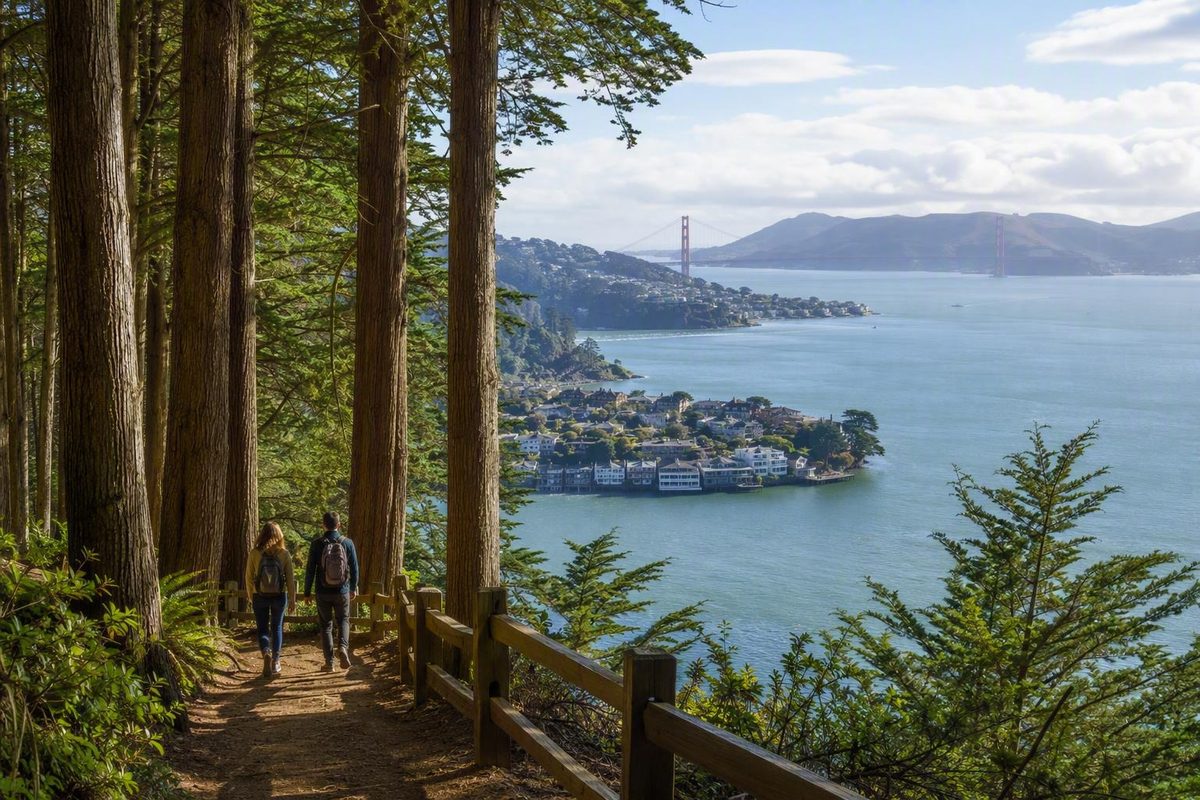
The short answer: choose Muir Woods and Sausalito for variety without an extreme journey
For many first-time visitors, the best day trip from San Francisco is Muir Woods plus Sausalito. This is a qualified editorial recommendation, not an objectively proven winner. The combination delivers two contrasting experiences—coast redwoods and a waterfront town—without the extreme round-trip burden associated with Yosemite, Lake Tahoe, or Big Sur.
Five practical criteria shape that recommendation:
- Travel burden: How much of the outing is consumed by driving, transfers, parking, and waiting?
- Variety: Does the trip provide more than one kind of experience?
- Transportation fit: Is it realistic for your preferred combination of car, ferry, shuttle, or organized tour?
- Physical effort: Can the itinerary accommodate your desired level of walking or hiking?
- Planning complexity: How many reservations, connections, and contingencies must you manage?
Muir Woods supplies the nature component, with coast redwoods and trails of varying lengths and difficulty. Sausalito adds waterfront walking, restaurants, cafes, shops, houseboat areas, cycling possibilities, and Bay views. Together, they provide more contrast than either stop alone.
Commercial listings demonstrate that operators advertise the two destinations as one structured outing, but they do not prove that every independent itinerary will work on every date. One advertised five-hour trip allocates approximately 1.5 hours to Muir Woods and 45 minutes to Sausalito; customer reviews on that specific product include both satisfied travelers and people who wanted more time (see the listed itinerary and product-specific reviews). Treat those durations as examples, not guarantees.
Choose quickly
- Best-balanced first trip: Muir Woods plus Sausalito
- Easiest car-free candidate: Sausalito
- Best concentrated redwood experience: Muir Woods
- Best full nature day: Point Reyes
- Best ferry-oriented hiking and history: Angel Island
- Best manageable coastal drive: Half Moon Bay and Pescadero
- Best for wine: Napa or Sonoma, with sober transportation arranged
Muir Woods plus Sausalito is strongest when you want contrast and accept a structured day. Choose Sausalito alone if you prefer fewer reservations and more unstructured time. Choose Point Reyes if hiking and coastal wilderness matter more than convenience.
Operational-status note — August 30, 2026: The evidence available for this guide does not include current first-party schedules or access notices from park agencies, ferry operators, transit providers, road authorities, or reservation systems. Accordingly, ferry, shuttle, parking, admission, road, and closure information below is presented as planning context—not as confirmation that a service or route currently operates. Verify every operational detail through the relevant official provider immediately before booking and again before departure.
A practical comparison of the leading day trips
Exact door-to-door comparisons are unreliable because published estimates use different starting points, endpoints, traffic assumptions, and transportation modes. The more useful question is what shape of day each destination requires.
| Trip | Day shape | Transport fit | Planning effort | Signature experience | Best for | Physical effort | Variety | Weather sensitivity | Main logistical drawback |
|---|---|---|---|---|---|---|---|---|---|
| Muir Woods + Sausalito | Structured half or full day | Car possible; tour useful; car-free routing may be possible when services align | High independently; moderate by tour | Coast redwoods plus waterfront town | First-time visitors seeking contrast | Low to moderate unless adding longer trails | High | Moderate | Park access and onward or return transportation must align |
| Sausalito alone | Easy half day | Historically served by ferry; verify current service | Low to moderate | Waterfront, food, shops, houseboat areas, Bay views | Visitors prioritizing ease and flexibility | Low unless cycling or extending the walk | Moderate | Moderate | The return remains schedule-dependent if traveling by ferry |
| Point Reyes | Full day | Car preferable | High | Beaches, trails, shoreline, lighthouse, possible wildlife viewing | Hikers and nature-focused travelers | Moderate to high, depending on stops | High | High | Attractions are dispersed and conditions can disrupt plans |
| Angel Island | Structured half or full day | Ferry-oriented; verify current service | Moderate | Hiking, Bay views, and historic sites | Active travelers who also want history | Moderate to high | High | Moderate to high | The visit depends on outbound and return ferry timing |
| Half Moon Bay + Pescadero | Full day | Car preferable | Moderate | Highway 1, beaches, food and farm stops, optional hiking | Coastal-road-trip travelers | Low to moderate | High | High | Fog, traffic, road conditions, and dispersed stops |
| Napa or Sonoma | Full day | Tour or designated sober driver advisable | High | Tastings, dining, towns, markets, and scenery | Wine-focused travelers | Low to moderate | Moderate to high | Moderate | Reservations, distance between stops, and sober transportation |
| Monterey or Carmel | Long full day | Car preferable; tour possible | High | Major attractions or beach-town scenery | Travelers with one overriding destination goal | Low to moderate | High | Moderate to high | A large share of the day can be consumed by travel |
The categories are intentionally bounded:
- Low planning effort means one principal transportation mode and few timed commitments.
- Moderate planning effort means at least one schedule, reservation, or meaningful connection.
- High planning effort means several timed elements, dispersed stops, or a difficult fallback.
- Low physical effort means the core outing can be enjoyed through short walks.
- High weather sensitivity means fog, wind, smoke, road conditions, or closures could materially reduce the value or feasibility of the plan.
“Car-free” does not mean schedule-free. “Car preferable” means a vehicle substantially simplifies movement between spread-out stops, not that public transportation is impossible. “Tour useful” means an organized trip may solve a transportation problem, not that it is necessarily the best value.
Published journey estimates differ substantially. For example, travel sources place Point Reyes anywhere from roughly an hour to about an hour and a half from San Francisco, depending on the assumptions and destination point (compare one local guide’s stated drive estimate). “San Francisco” might mean a downtown hotel, a western neighborhood, or the Golden Gate Bridge; “Point Reyes” might mean a town, visitor center, trailhead, beach, or lighthouse area. Traffic, parking, transfers, and ferry schedules add further variation.
For that reason, this guide does not score current prices or promise exact door-to-door times.
How to read the table
If you have only half a day, begin with Sausalito or a tightly structured Muir Woods–Sausalito tour. If you have a full day and a car, compare Point Reyes for wilderness, Half Moon Bay–Pescadero for a modular coastal drive, and Napa or Sonoma for wine and dining. Consider Angel Island when you want hiking and history and are comfortable planning around a boat schedule.
Monterey and Carmel fit best when you select one principal goal. In Monterey, that might be the aquarium or Cannery Row. In Carmel, it might be the town and beach or nearby Point Lobos. Combining both towns with multiple scenic drives, a major attraction, and a leisurely meal produces a much more rushed day.
Popularity is not proof. The recurrence of Muir Woods, Sausalito, Point Reyes, Napa, Sonoma, Carmel, and Monterey across travel lists shows that they are commonly recommended. It does not establish that any one destination is objectively best for every visitor.
Muir Woods, Sausalito, or Point Reyes: the decisive head-to-head
These three Marin County choices solve different problems:
- Sausalito solves for ease and flexibility.
- Muir Woods solves for redwoods.
- Point Reyes solves for breadth of nature.
Choose Muir Woods for a concentrated redwood experience
Muir Woods is the clearest choice when your priority is walking among coast redwoods without committing to a far-northern California road trip. The available evidence describes trails of varying lengths and difficulty, allowing the forest to function as either a shorter walk or part of a more active day.
The principal constraint is access rather than the distance shown on a map. Travel sources report advance parking arrangements for drivers and reservation-dependent shuttle options for some car-free routes, but those descriptions are not substitutes for current first-party instructions. One local guide specifically describes advance parking and a seasonal ferry-and-shuttle route, while warning that operating dates and arrangements can change (review the source’s Muir Woods access description).
Do not depart merely because an older article says a particular shuttle or ferry connection exists. Confirm the current parking or shuttle reservation, park admission rules, boarding point, operating date, and return plan with the responsible official providers.
Muir Woods is less expansive than Point Reyes, but that concentration is an advantage when your goal is specific: see redwoods, take a meaningful forest walk, and avoid spending the entire day moving among distant sites.
Choose Sausalito for the least commitment
Sausalito is the lowest-friction candidate of the three. Travel guides describe it as a ferry-oriented half-day outing centered on waterfront walking, shops, cafes, parks, houseboat areas, cycling, and Bay views.
That transportation description is date-sensitive. A 2023 AAA Via guide reported ferry access from San Francisco and characterized Sausalito as an easy half-day option, but readers must confirm current terminals, operating dates, ticketing, bicycle rules, and return service with the relevant operator (see the dated car-free overview).
Sausalito gives you more unstructured time than Muir Woods or Point Reyes. Once in town, you can decide how far to walk, when to eat, and how long to linger—subject to a confirmed return plan.
The tradeoff is depth. Sausalito offers atmosphere, waterfront scenery, and town life rather than a major wilderness experience. It is best when leaving the city for a few pleasant hours is sufficient.
Choose Point Reyes for a full nature day
Point Reyes is the more expansive option, with beaches, trails, shoreline, a historic lighthouse, and possible wildlife viewing. One commercial travel guide describes the national seashore as having approximately 80 miles of shoreline (review that Point Reyes overview).
The practical implication matters more than the figure: the attractions are dispersed. A car generally makes it easier to move between them, and the day works better when limited to two or three anchors—for example, one hike, one coastal area, and the lighthouse vicinity.
Fog, wind, road conditions, and trail or facility closures can force changes. Wildlife sightings and clear views remain possibilities, not promises. Because the evidence pack does not contain current first-party park notices, check the national seashore’s official conditions information before departure.
The chooser rules
Choose Sausalito if:
- You want the simplest broadly supported car-free candidate.
- You have only half a day.
- A meal, waterfront walk, and Bay views are enough.
- You value flexibility more than a major natural attraction.
Choose Muir Woods if:
- Seeing coast redwoods is the central goal.
- You are willing to coordinate access in advance.
- You want a contained nature experience.
- You are comfortable choosing between a short walk and longer trail time.
Choose Point Reyes if:
- Hiking and coastal variety matter more than convenience.
- You have a full day.
- You can drive or arrange suitable transportation.
- You are willing to shorten the itinerary if conditions change.
How to combine Muir Woods and Sausalito without wasting the day
Muir Woods and Sausalito can fit into the same outing under a structured transportation plan. Commercial operators advertise that combination, but their products demonstrate feasibility only under their own scheduled arrangements. An independent visit remains dependent on confirmed park access, connections, and return transportation.
A sensible sequence
Use this as a planning framework, not a timetable:
- Leave San Francisco in the morning.
- Visit Muir Woods first, with access already confirmed.
- Allow time for a meaningful redwood walk rather than treating the forest as a quick photo stop.
- Continue to Sausalito for a meal and waterfront time.
- Return by confirmed road transport or ferry, based on the service actually operating that day.
Muir Woods belongs first because it is usually the less flexible part of the plan. Sausalito is easier to shorten or extend and offers food and a comfortable place to spend extra time. Reversing the sequence could leave you rushing from a relaxed town visit toward a fixed park connection.
If you plan it independently
Before committing, verify:
- The current Muir Woods parking or shuttle arrangement
- Any required park admission or timed access
- The exact origin of each shuttle or transit connection
- Connection windows between ferry, bus, shuttle, taxi, or rideshare
- Ferry operating dates and departure points
- The final workable return to San Francisco
- Cancellation or change rules for prepaid bookings
A route can look short on a map but become fragile when it relies on multiple infrequent services. Identify the fallback for each timed leg before leaving.
Independent planning is best for travelers who value control over stop length. It may allow more forest time, a longer lunch, or an evening in Sausalito. In exchange, you assume responsibility for every reservation and transfer.
If you take a guided tour
A guided outing can bundle transportation, reduce parking complexity, and establish a defined half-day structure. This may suit visitors who do not want to drive or coordinate multiple transport providers.
The compromise is limited time at each destination. One operator advertises a five-hour itinerary with about 1.5 hours at Muir Woods and approximately one hour in Sausalito; its listed times are approximate and may change with traffic or unforeseen events. The same operator offers a ferry return only when the corresponding option is selected (check the operator’s itinerary and inclusion terms).
Reviews belong to the specific products on which they appear. They do not prove that all tours are rushed, but they show that a short combined itinerary may not satisfy travelers who want substantial trail time.
A short tour is therefore a poor match for serious hikers. If trail time is the priority, arrange a longer Muir Woods visit. If flexibility is the priority, make Sausalito the only destination.
The best car-free alternatives: Sausalito, Angel Island, and Tiburon
For most visitors, Sausalito is the easiest broadly supported car-free candidate. Angel Island is stronger for an active outing, while Tiburon offers a smaller waterfront alternative and has historically been described as a gateway to the island.
These are not confirmations of current service. Ferry routes, operating days, terminals, ticketing systems, bicycle policies, and final departures must be checked with the operators serving your travel date.
Sausalito: easiest overall
Sausalito works because the reported transportation pattern and destination complement each other: travel by boat, arrive near a walkable waterfront area, and avoid needing another long transfer.
A relaxed outing might include:
- A waterfront walk
- A meal or cafe stop
- Downtown shops
- Bay views
- Parks or marina areas
- Publicly accessible houseboat areas
- Cycling, if current rental and ferry bicycle rules support the plan
Avoid burdening the outing with distant add-ons. Sausalito is most appealing as a low-pressure half day rather than a base for collecting scattered Marin attractions.
Angel Island: best for hiking and history
Angel Island is the stronger ferry-oriented option when you want the destination itself to occupy most of the day. The available travel evidence describes hiking, broad Bay views, and historic sites associated with the island’s former immigration station. One car-free guide reports that the immigration station operated from 1910 to 1940, but ferry and site-access information in that guide may no longer be current (review the dated Angel Island description).
The island format creates a clear day: arrive, select a route, explore, and return. Work backward from the confirmed final ferry, leave enough time to reach the dock, and do not begin a long trail late in the visit.
Tiburon: smaller and quieter
Travel sources describe Tiburon as a smaller waterfront town with dining, a downtown area, waterfront walking, and ferry connections. It suits travelers looking for a quieter town experience or a possible departure point for Angel Island.
Do not assume that a San Francisco–Tiburon–Angel Island sequence operates conveniently on every date. Confirm:
- The departure terminal
- Direct versus connecting service
- Operating days
- Ticketing requirements
- Bicycle policies
- Island admission arrangements
- Final returns from both Angel Island and Tiburon
What about Muir Woods without a car?
Travel sources describe Muir Woods routes involving a ferry followed by a shuttle. Because the supplied evidence does not confirm current service, treat that combination as a planning lead rather than an available route until official providers verify it.
That makes Muir Woods a potential car-free choice for careful planners, not the safest spontaneous option.
Half Moon Bay should not be treated as equally easy by public transportation. One travel guide describes a multi-stage journey taking around 2.5 hours, illustrating how a geographically nearby destination can still be burdensome without a car (compare the guide’s reported car-free routes). Verify any current route through the responsible transit agencies before relying on it.
Best coastal escape: Half Moon Bay and Pescadero, with longer-drive alternatives
For a coastal driving day that balances scenery, food, beaches, and optional hiking, choose Half Moon Bay and Pescadero. The route offers a modular Highway 1 experience without making Big Sur’s much longer journey the principal event.
Half Moon Bay and Pescadero: the balanced choice
This route can combine:
- Coastal viewpoints and beaches
- Time in Half Moon Bay
- Food or farm stops around Pescadero
- A short walk rather than a major hike
- Optional redwood hiking
- Seasonal wildlife-viewing areas when conditions and access are suitable
Choose only a few elements. A sound structure is one principal walk, one town or food stop, and one or two scenic pauses.
A regional travel guide groups Half Moon Bay and Pescadero around Highway 1, beaches, farm and food stops, redwood hiking at Butano State Park, and possible seasonal wildlife viewing near Año Nuevo (review the route outline). Seasonal wildlife, open trails, and accessible facilities are not guaranteed.
Santa Cruz and Capitola: beach-town energy
Choose Santa Cruz and Capitola if you prefer a more developed beach-town day. The supplied evidence associates Santa Cruz with beaches, a boardwalk, coastal walking, and nearby redwoods; one regional guide considers Santa Cruz and Capitola close enough to combine in one day.
This pairing is a better fit than Half Moon Bay–Pescadero for travelers who value town activity and classic seaside attractions. It is less suitable for anyone prioritizing solitude or wilderness.
Carmel: town, beach, and galleries
Carmel-by-the-Sea suits visitors interested in cottages, galleries, shops, a beach, and nearby Point Lobos. Its greater travel burden makes focus important.
Choose one center of gravity:
- Town-focused: streets, galleries, a meal, and the beach
- Nature-focused: Point Lobos plus a shorter town visit
- Scenic-drive-focused: selected viewpoints with limited town time
Adding Monterey, several scenic drives, multiple hikes, and a long meal can turn the day into continuous clock-watching.
Monterey: attraction-led rather than purely scenic
Monterey is strongest when one major attraction justifies the journey. The supplied travel guides identify Monterey Bay Aquarium, Cannery Row, Old Fisherman’s Wharf, whale-watching excursions, and nearby scenic drives as possible anchors.
Build the day around the principal attraction. Do not treat Carmel, Point Lobos, the full 17-Mile Drive, Cannery Row, the wharf, and a boat excursion as automatic additions. Whale sightings cannot be guaranteed, and a boat trip adds another fixed schedule and weather dependency.
Big Sur: ambitious, not the default
Big Sur appears frequently on day-trip lists, but the label conceals a substantial travel burden. One source estimates approximately 2 hours 23 minutes one way, while another gives roughly three hours and warns that landslides or mudslides can close the highway.
Big Sur is also a long coastal corridor rather than one destination entrance. The specific trail, beach, bridge, or viewpoint you choose materially changes the day.
Treat it as an ambitious excursion for travelers willing to spend many hours in transit. For most visitors who want several hikes, leisurely viewpoints, a relaxed meal, and delay margin, an overnight is the better fit.
Fog, traffic, weather, construction, landslides, and closures can change Highway 1 feasibility. The evidence pack does not contain current road-agency information, so consult the relevant official road and destination notices on the day of travel. Do not build the outing around guaranteed clear views, wildlife, waterfalls, or swimming conditions.
Napa or Sonoma: choosing a wine-country day
Neither Napa nor Sonoma is factually “better.” The useful distinction is stylistic: Napa is commonly characterized as more polished and high-end, while Sonoma is often described as more relaxed and rural. These are broad editorial impressions, not rules that apply to every town, winery, or visitor.
Choose Napa for a polished, structured day
Napa suits travelers who want a day organized around tasting appointments, dining, and developed visitor experiences. The supplied evidence also identifies non-wine possibilities such as:
- Oxbow Public Market
- Napa’s riverfront
- Restaurants
- Shopping
- Biking and other outdoor activities
- Downtown stops between reservations
Stops may be separated by meaningful driving, so an overfilled appointment schedule can leave little time to enjoy any one destination.
Choose Sonoma for a more relaxed setting
A Sonoma day can be centered on Sonoma Plaza, restaurants, historic sites, nearby parks, and wineries. Broader Sonoma County itineraries may include redwoods or the coast, but that increases distance and complexity.
With only one day, decide whether the priority is tasting, town life, or scenery. Trying to give equal weight to all three can produce more driving than experience.
Transportation is part of the decision
If tastings are included, arrange a designated driver, hired driver, or organized tour before departure. A regional guide specifically recommends one of those sober-transportation options for wine-tasting days (see the guide’s Napa and Sonoma planning advice).
Do not improvise transportation after drinking. The properties may be dispersed, and the supplied evidence does not establish that last-minute transportation will be available.
Keep the number of planned stops modest. This is practical synthesis rather than a fixed numeric rule: every added reservation creates another drive, check-in, and deadline. Fewer commitments leave room for a meal, traffic, conversation, and an unplanned stop.
Current tasting reservations, fees, opening hours, policies, and transportation availability are outside the evidence available here. Confirm them directly before booking. Wine country may be possible as a day trip, but an overnight is often better if you want a slower meal, broader exploration, or less return-time pressure.
Trips that are technically possible but usually better overnight
Inclusion on a “best day trips” list does not make a destination practical for most visitors. Yosemite, Big Sur, Lake Tahoe, and Redwood National Park illustrate the difference between possible and worthwhile in one day.
Yosemite
One supplied guide estimates approximately 3 hours 15 minutes each way from San Francisco to Yosemite, implying about 6.5 hours of driving before parking, traffic, meals, stops, or sightseeing (see the published estimate).
A same-day visit may suit someone whose principal goal is a scenic overview and who accepts spending much of the day in transit. It is a poor fit for someone expecting meaningful hiking, multiple valley stops, a leisurely meal, and margin for delays.
It exchanges active driving for a long transport day and a fixed itinerary.
Big Sur
Big Sur’s burden extends beyond its estimated drive time. Desired stops are distributed along the coast, while fog, traffic, weather, and road closures can alter the route or make planned attractions inaccessible.
If your ideal day includes several trails, leisurely viewpoints, and dinner without clock pressure, stay overnight.
Lake Tahoe
One supplied travel source estimates approximately 3 hours 15 minutes one way to South Lake Tahoe (see the source’s stated travel estimate). Tahoe is also geographically spread out, so reaching the region does not end the transportation problem.
A same-day car-free visit is particularly difficult because onward movement and seasonal transportation may be complicated. An overnight or weekend is usually a better fit, especially when weather, winter roads, or a specific activity adds uncertainty.
Redwood National Park
Redwood National Park appears in one supplied day-trip list, but the excerpt does not establish that it is practical as a same-day trip from San Francisco. Inclusion alone is insufficient evidence of feasibility.
If your goal is the far-northern redwood parks rather than Muir Woods or a nearer redwood destination, plan a separate multi-day trip.
The narrow exception
A long same-day tour to Yosemite or another distant destination may suit a traveler who:
- Has no realistic opportunity to return
- Values a scenic overview more than depth
- Accepts extensive transportation time
- Does not expect a flexible hiking day
- Is comfortable with an early start and late finish
That makes the outing possible—not easy, routine, or suitable for most visitors.
Final booking checklist and contingency plan
Treat the final planning pass as a dated operational check. Travel articles, including this one, cannot establish that a ferry, shuttle, park facility, road, trail, winery, or attraction will be available when you arrive.
Pre-departure checklist
Write your travel date at the top of the plan, then confirm through the responsible official provider:
- [ ] Ferry, shuttle, train, or bus schedule for that date
- [ ] Exact departure terminal or stop
- [ ] Final workable return—not merely the nominal last service
- [ ] Muir Woods parking or shuttle reservation, if applicable
- [ ] Park admission or timed-entry requirements
- [ ] Road status and Highway 1 conditions
- [ ] Trail, beach, park, or lighthouse-area closures
- [ ] Weather at the destination
- [ ] Wildfire-smoke conditions
- [ ] Attraction, restaurant, winery, or market hours
- [ ] Tasting or tour reservations
- [ ] Cancellation and change terms
- [ ] Sober transportation for a wine-tasting plan
- [ ] A backup return route or fallback outing
Drivers should allow margin for Bay Area traffic, parking, fuel or charging, and movement within dispersed destinations. An approximate regional drive estimate is not an arrival-time promise.
Ferry and shuttle users should build a connection buffer and identify the backup return before leaving. That might be another confirmed ferry, a different terminal, a bus, the tour vehicle, a taxi, or a rideshare—but only where current availability has been verified.
Match the fallback to the problem
If a complex North Bay connection fails: simplify to Sausalito only if a confirmed outbound and return service still makes the outing workable.
If Muir Woods access is not confirmed: do not depart hoping to solve parking or shuttle access on arrival. Choose a simpler verified trip or remain in San Francisco.
If coastal weather is poor: replace a viewpoint-heavy drive with a town- or attraction-led day.
If smoke or closures undermine the regional trip: use an in-city itinerary instead of chasing another distant destination affected by similar uncertainty.
If Point Reyes remains viable but the day is delayed: remove the least important stop. Preserve one hike or coastal area and one secondary site rather than rushing through a long list.
If a wine-country transportation plan fails: remove the tastings. Do not improvise sober transportation after drinking.
That approach reflects San Francisco Know’s stated planning philosophy: favor practical plans that remain understandable after you leave the map. It does not mean the publisher has personally tested or operationally verified every excursion described here.
Frequently asked questions
What is the easiest day trip from San Francisco without a car?
Sausalito is the easiest broadly supported candidate. Travel sources describe it as a ferry-accessible half-day destination with waterfront walking, cafes, shops, parks, Bay views, cycling possibilities, and houseboat areas.
That is not confirmation of current ferry service. Before leaving, verify the operating date, departure terminal, ticketing rules, bicycle policy, and final return with the relevant operator.
Angel Island is stronger if you want hiking and history, but it demands closer attention to ferry timing. Muir Woods may be possible through a ferry-and-shuttle sequence when those services operate, although that plan is more connection-sensitive.
Can you visit Muir Woods and Sausalito on the same day?
Yes, under a structured plan. Commercial operators advertise approximately five-hour trips combining both destinations, with example itineraries allocating about 1–1.5 hours in Muir Woods and 45–60 minutes in Sausalito (compare the advertised itinerary).
Those listings establish that particular operators schedule the pairing; they do not guarantee that every independent itinerary or travel date will work. Plan independently if you want longer trail time or a leisurely meal, but confirm park access, every connection, and the final return first.
Do I need reservations for Muir Woods?
Assume that advance access planning may be necessary, then check the current official requirements for your travel date. Depending on how you arrive, the plan may involve parking, shuttle access, park admission, or a tour booking.
Do not rely on historical prices, routes, or booking windows from travel articles. The evidence supplied for this guide does not verify current reservation rules, and physical proximity to the park does not guarantee parking or shuttle access.
Is Point Reyes better than Muir Woods for hiking and nature?
Point Reyes is generally the stronger choice for a full day of hiking and varied coastal nature. The available evidence describes beaches, shoreline, trails, a lighthouse, and possible wildlife viewing across a broad area. Muir Woods is better for a concentrated coast-redwood experience and can support a shorter visit.
Choose Point Reyes if you have a full day, suitable transportation, and tolerance for weather-sensitive plans. Choose Muir Woods if redwoods are the central goal or you prefer a more contained outing. Neither destination guarantees open trails, clear views, wildlife, or favorable weather.
Is Yosemite a realistic day trip from San Francisco?
It is technically possible, especially through a long organized tour, but it is not a practical default for most visitors. One supplied estimate puts the drive at approximately 3 hours 15 minutes each way, or about 6.5 hours round trip before stops and delays (see the source’s Yosemite estimate).
Choose a same-day trip only if you accept extensive transportation and primarily want an overview. Stay overnight if you want meaningful hiking, multiple stops, relaxed meals, or margin for disruption.
For many first-time visitors, Muir Woods plus Sausalito remains the best-balanced choice: redwoods and a waterfront town in one structured outing. Choose Sausalito for the easiest car-free candidate, Point Reyes for a full wilderness-oriented day, Angel Island for ferry-based hiking and history, Half Moon Bay–Pescadero for a manageable coastal drive, or Napa and Sonoma for wine with sober transportation.
Pick one clear trip shape, minimize backtracking, and verify official access, schedules, weather, road conditions, and the return plan immediately before leaving San Francisco.