
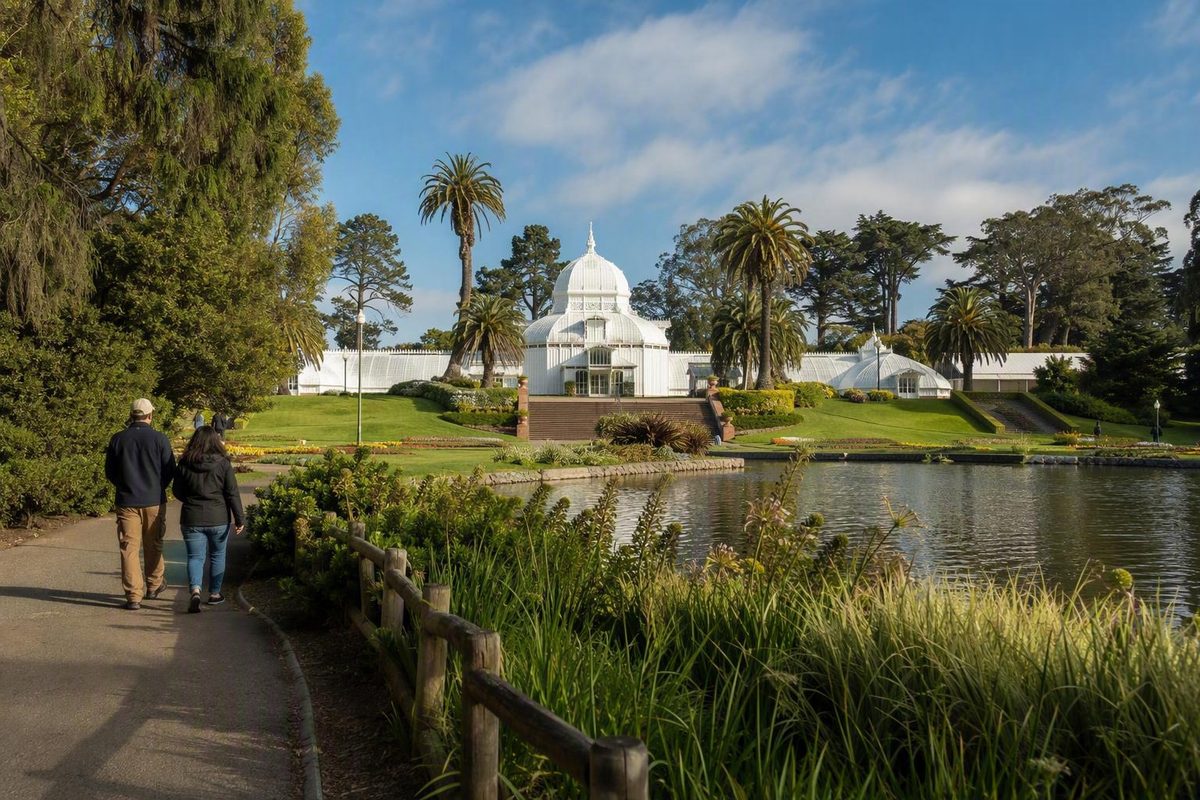
Golden Gate Park is easier to enjoy when you stop treating it as a checklist. Its museums, gardens, lakes, recreation areas, bison, windmills, and coastal edge do not form one compact sightseeing district. They form a series of distinct zones.
For a first visit, choose one major attraction as your anchor, add two or three nearby stops, and decide where you will finish before setting out. That leaves time to experience the park rather than spending most of the day moving between attractions.
Start by choosing a part of the park, not a list of attractions
Golden Gate Park stretches roughly three miles from the Haight-Ashbury area toward Ocean Beach. It is separate from the Golden Gate Bridge and the Presidio, and Ocean Beach is adjacent to its western edge rather than an attraction inside the park itself. Those distinctions matter because a search for “Golden Gate” can lead to very different parts of San Francisco (Golden Gate Park orientation and planning guide).
The simplest planning model divides the park into three zones:
- Eastern museum-and-garden zone: California Academy of Sciences, de Young Museum, Music Concourse, Japanese Tea Garden, San Francisco Botanical Garden, Conservatory of Flowers, and much of JFK Promenade.
- Central lake-and-recreation zone: Blue Heron Lake, Strawberry Hill, Huntington Falls, lawns, paths, picnic areas, and outdoor recreation.
- Western landmark zone: Bison Paddock, the historic windmills, seasonal gardens, and the park edge beside Ocean Beach.
The eastern area has the greatest concentration of headline attractions. Around the Music Concourse, you can move between two major museums, a compact garden, public spaces, and nearby outdoor areas without repeatedly crossing the park. The Botanical Garden is also nearby. The Conservatory of Flowers sits farther east and works better as either the beginning or the end of an eastern route.
The central zone is less structured. Instead of moving through galleries or managing admission, you can walk beside the lake, pause on a lawn, explore island paths, or have a picnic. It is a useful destination in its own right and a natural place to decide whether the group has enough energy to continue west.
The western zone contains memorable landmarks, but they are more dispersed. Expect longer gaps between the bison, windmills, seasonal flowers, and coastal edge than you encounter around the Music Concourse. Going west should therefore be a deliberate extension, not something added casually because it is “still inside the park.”
A first-time visitor will usually have a better day by choosing:
- One anchor: a museum, major garden, or central outdoor area
- Two or three additions: nearby walks, public spaces, viewpoints, or smaller garden experiences
- One stopping point: a place from which leaving the park will be straightforward
For a two- or three-hour visit, stay within one zone. For a half day, combine one substantial attraction with its immediate surroundings. Even with a full day, do not assume you can meaningfully explore every museum, garden, lake, and western landmark.
Throughout this guide, the following labels describe the basic character of each stop:
- Free outdoor area: no general park admission, although a specific activity may charge
- Ticketed venue: admission may apply; check the venue’s current policy
- Indoor: useful during rain, cold, or heavy fog
- Outdoor: affected by wind, rain, and temperature
- Seasonal: blooms, displays, or programming may not be present
- Reservation-sensitive: check current booking requirements rather than assuming walk-up access
- Weather-dependent: conditions can substantially change the experience
Ocean Beach can be a logical finish for an east-to-west day, but it should remain optional. Reaching the ocean is not proof that you completed the park, and turning back before the coast is not a failed itinerary.
Choose one major attraction around the Music Concourse
The California Academy of Sciences and the de Young Museum face each other across the Music Concourse. That makes the area easy to understand geographically, but it does not make either institution quick to experience. Each can serve as the main event of a half day or longer.
California Academy of Sciences — indoor; admission and booking requirements should be checked
The Academy combines an aquarium, planetarium, rainforest, and natural-history experiences in one institution. It is the clearer choice for families, science enthusiasts, animal lovers, and groups whose interests vary. It also provides a substantial indoor anchor when rain, fog, or cold makes an outdoor-heavy day less appealing (San Francisco Travel’s Golden Gate Park visitor guide).
Because the Academy contains several distinct experiences, it can absorb more time than visitors expect. Entering with the intention of “seeing it quickly” may result in rushing through the exhibits or leaving later than planned. If the Academy is your anchor, treat a garden or promenade walk afterward as an optional complement rather than another obligation.
Planetarium access and other program procedures can change. Review current information directly with the Academy shortly before your visit rather than relying on an older description of how entry works.
de Young Museum — indoor; admission may apply
The de Young suits visitors interested in art, design, textiles, costume, photography, and architecture. Its collections include American art and works from Africa, Oceania, and the Americas. Temporary exhibitions may influence whether you want a focused visit or most of a day, so review the current program before deciding.
The building also attracts visitors interested in contemporary architecture. Travel guides frequently describe the Hamon Observation Tower as a possible add-on for people who want an elevated perspective without completing a full gallery visit. Public access and admission arrangements can change, however, so confirm them directly with the museum rather than assuming an older report remains current (overview of the de Young and Hamon Observation Tower).
How to choose between them
Choose the Academy if your priorities include:
- Aquatic life and animals
- Science and natural history
- A family-oriented indoor experience
- Several kinds of exhibits under one roof
- A substantial poor-weather anchor
Choose the de Young if your priorities include:
- Art and photography
- Textiles, costume, and design
- Architecture
- A gallery-oriented visit
- Pairing a museum with the Japanese Tea Garden or nearby outdoor art
For a balanced first visit, choose one. Trying to explore both institutions fully can leave little time for gardens, JFK Promenade, or the lake. If both are important to you, a return visit will usually be more rewarding than reducing each museum to a hurried walk-through.
A sensible Music Concourse sequence is:
- Visit your chosen museum.
- Pause in the Music Concourse.
- Add the Japanese Tea Garden, a nearby sculpture area, or a short section of JFK Promenade.
- Decide whether you still want to continue toward Blue Heron Lake.
The decision after the museum matters more than the original wish list. If you have already spent several satisfying hours indoors, you do not need to compensate by forcing a journey across the park.
Add one garden instead of trying to collect all three
The Japanese Tea Garden, San Francisco Botanical Garden, and Conservatory of Flowers offer different experiences. The useful question is not which one is universally best, but which one fits your available time, the weather, and the kind of visit you want.
Japanese Tea Garden — outdoor; admission may apply
The Japanese Tea Garden is a designed landscape with bridges, pagodas, koi ponds, a Zen garden, architectural features, and a tea house. It suits visitors who want a contained, carefully composed setting rather than an extended plant walk.
Its location near the Music Concourse makes it the easiest garden to pair with the Academy or de Young. It can provide a welcome contrast after a museum: less information to process and more attention to water, structures, planting, and framed views.
Compact does not mean insignificant. Allow enough time to follow the paths, pause at the landscape features, and decide whether the tea house belongs in your visit. Treat the garden as an attraction, not merely as a shortcut between museum stops.
San Francisco Botanical Garden — outdoor and weather-dependent; admission may apply
The Botanical Garden is the broadest plant-focused outing of the three. Its regional and thematic collections include redwoods, cloud-forest plants, succulents, and other landscapes connected by trails. It also lends itself to picnicking and less structured wandering.
Choose it when plants are a central interest and you want meaningful time outdoors. It is a weaker fit when the group is already tired, the weather is deteriorating, or you have a fixed museum entry approaching.
Conservatory of Flowers — indoor, warm, and humid; admission may apply
The Conservatory of Flowers is a historic Victorian greenhouse with tropical and aquatic plant displays. Its warm, humid interior makes it especially useful when the weather outside is cold, damp, or windy. It offers a concentrated greenhouse experience rather than the Botanical Garden’s extended outdoor landscape.
The Conservatory sits east of the Music Concourse cluster. It pairs naturally with JFK Promenade, but it is not directly beside the two major museums in the way the Japanese Tea Garden is. If it is your priority, route to it specifically instead of assuming all the eastern attractions share one doorstep.
A comparative guide to the park’s gardens supports the practical distinction between the compact Tea Garden, the larger plant-focused Botanical Garden, and the Conservatory’s greenhouse experience (overview of Golden Gate Park gardens and attractions).
Use this decision rule:
- Choose the Japanese Tea Garden for a compact, designed setting close to the museums.
- Choose the Botanical Garden for a longer, plant-centered walk.
- Choose the Conservatory of Flowers for an indoor greenhouse experience, especially in poor weather.
Magnolias, tulips, dahlias, roses, and other flowers are seasonal possibilities, not promises. Weather and growing conditions do not follow a fixed tourist calendar. If a particular bloom matters to you, check current conditions shortly before visiting and pair it with a year-round attraction.
Admission policies also require a live check. Resident benefits, eligibility-based discounts, free periods, booking systems, and operating hours can change. Do not build a budget around an old article or social-media post.
Slow the day down around JFK Promenade and Blue Heron Lake
Not every part of a Golden Gate Park day needs an admission ticket. JFK Promenade and Blue Heron Lake are useful precisely because they allow the visit to become less scheduled.
JFK Promenade — free outdoor area and weather-dependent
JFK Promenade provides a car-free environment for walking, running, cycling, skating, sitting, and encountering public art or small outdoor features. It can serve as a destination in its own right, but it is especially valuable as a connector between eastern attractions.
Use it when you want to:
- Add movement after a museum
- Build a free or low-cost visit
- Pause without committing to another venue
- Cycle through part of the park
- Give children or restless adults time outdoors
- Decide whether to continue farther west
Because it requires little commitment, the promenade also creates a graceful stopping option. You can walk only the portion that fits the day and leave without abandoning a formal attraction halfway through.
Blue Heron Lake — free outdoor area and weather-dependent
Blue Heron Lake may still appear as Stow Lake in older articles, maps, and conversations. The names refer to the same place, so knowing both is useful when comparing older guidance with a newer map.
Around the lake, visitors can follow the perimeter, cross bridges, explore island paths, look toward Strawberry Hill, and seek out Huntington Falls. Paddleboats may be available when rentals are operating and conditions permit, but boating should remain optional unless current availability has been confirmed (guide to JFK Promenade, Blue Heron Lake, and Strawberry Hill).
The lake area also suits simple activities that are easy to undervalue while making a sightseeing list:
- Have a picnic
- Sit beside the water
- Walk part rather than all of the perimeter
- Cycle through the central park
- Spend time on a lawn
- Explore a bridge or island path
- Use the area as a quiet reset after a museum
This central zone is where a tightly managed itinerary can loosen. If a museum took longer than expected, the lake can replace a western transfer. If the group wants more activity, it can become the bridge to a longer walk or ride.
Do not assume that every route will be level, quick, or step-free. The available visitor guidance does not establish precise grades, route-level accessibility, or reliable walking times. Anyone with mobility requirements should check the relevant entrances, path surfaces, facilities, and transportation options before choosing an island or hill route.
Go west for bison, windmills, and the edge of the Pacific
The western half of Golden Gate Park is worth the additional travel when its attractions match your interests. It is particularly appealing for wildlife viewing, photography, cycling, and visitors who prefer outdoor landmarks to another museum.
A clear westward sequence is:
- Bison Paddock
- Dutch Windmill and Queen Wilhelmina Tulip Garden
- The park’s western edge
- Ocean Beach, if conditions are favorable
Murphy Windmill is the second historic windmill in the western park. It can be treated as an additional western objective rather than forcing it into the same sequence as the Dutch Windmill. The two windmills were originally associated with pumping water for park irrigation and now function primarily as landmarks (guide to western Golden Gate Park landmarks).
Bison Paddock — free outdoor area; wildlife viewing varies
The bison are viewed within a fenced paddock. Their location inside the enclosure varies, so a close or clear view cannot be guaranteed. On some visits they may be easy to see; on others they may stand farther away or outside the most convenient viewing position.
Treat the paddock as a distinctive stop along a western route, not as a guaranteed close wildlife encounter. It pairs naturally with cycling or a continued journey toward the windmills.
Windmills and seasonal gardens — free outdoor areas; flowers are seasonal
The Dutch Windmill stands near the Queen Wilhelmina Tulip Garden and the coastal side of the park. Murphy Windmill is a separate landmark in the western area. Visitors primarily interested in the Dutch Windmill and tulip garden do not need to collect both structures merely because two exist.
Tulips and other nearby flowers are seasonal bonuses. Their timing varies, and displays can look different from year to year. The architecture, landscape, and proximity to the ocean should be enough to justify the journey; flowers should enhance the stop rather than carry it.
The western zone is a good fit for:
- Cyclists who can cover the gaps more comfortably
- Photographers interested in changing landscapes
- Visitors drawn to wildlife and historic structures
- Repeat visitors who have already seen the major museums
- Travelers comfortable with a one-direction route
- Groups that prefer moving outdoors to entering another venue
Ocean Beach — adjacent outdoor area and weather-dependent
Ocean Beach is an optional finish, not an obligatory final attraction. Continue beyond the park only if daylight, weather, and energy are favorable.
The western edge and adjacent beach can feel cooler and windier than more inland areas. Carry a layer even if the eastern park feels comfortable, and retain an easy exit option. If wind, visibility, or fatigue makes the coast unattractive, finishing near the windmill is entirely reasonable (westward planning and Ocean Beach conditions).
Do not create a difficult return merely to say you reached the Pacific. Before going west, know how you intend to leave the area. An east-to-west route works best when the return is planned separately rather than requiring everyone to retrace the park.
Use one of three realistic first-visit plans
These three frameworks use sequence and stopping rules rather than rigid schedules. Museum visits, meals, crowds, weather, and individual walking pace make minute-by-minute itineraries unreliable.
1. Two-to-three-hour eastern plan
Start with JFK Promenade or the Music Concourse. Take in the setting before choosing one focused attraction:
- Japanese Tea Garden for a compact designed landscape, or
- Conservatory of Flowers for an indoor greenhouse visit
If current access is confirmed, the de Young observation level can be considered as an additional stop. Do not include it automatically if reaching it would require rushing the garden you actually came to see.
Logical stopping point: Finish at the Music Concourse, Japanese Tea Garden, or Conservatory of Flowers. Leave from the eastern side rather than starting toward Blue Heron Lake simply because a small amount of time remains.
Free or low-cost variation: Skip the admission-based venue. Walk part of JFK Promenade, explore the Music Concourse, visit lawns or public outdoor features, and stop before the route becomes a cross-park trek.
This plan works because it accounts for orientation, photographs, and pauses. It also leaves room for a snack or unplanned outdoor stop.
2. Half-day museum plan
Choose either a science version or an art version.
Science version
Make the California Academy of Sciences the anchor. Explore the aquarium, rainforest, planetarium, and natural-history components according to current access and procedures. Then select one addition:
- Japanese Tea Garden
- Botanical Garden, if plants are a priority
- Music Concourse and a section of JFK Promenade
- A relaxed outdoor pause without another admission-based stop
Logical stopping point: End around the Music Concourse or an eastern exit. Do not start west after a substantial Academy visit unless everyone actively wants more travel.
The Academy is large enough to carry the plan. “Museum plus the entire park” is not a realistic half-day structure.
Art version
Begin at the de Young and focus on the collections or current exhibition that interests you most. If public access is confirmed, consider the observation level. Afterward, add one or two nearby experiences:
- Japanese Tea Garden
- Sculpture areas
- Music Concourse
- A short promenade walk
Logical stopping point: Stop after the garden or outdoor walk. Avoid adding the Academy merely because it is across the concourse.
The museums are geographically close but experientially substantial. Proximity does not reduce the time or attention required to enjoy them.
3. Full-day balanced plan
Choose one major museum in the morning. Take a real lunch break rather than treating food as an obstacle between attractions. Then visit one nearby garden.
After the garden, reassess:
- If energy is moderate, continue to Blue Heron Lake.
- If energy is high and conditions are good, choose one western objective: the bison or a windmill.
- If weather is worsening, remain in the eastern area or end the visit.
- If the museum took longer than expected, skip the west rather than trying to recover the schedule.
Logical stopping point: Blue Heron Lake is the natural middle-distance finish. The Bison Paddock or a windmill can serve as a farther endpoint. Ocean Beach is an optional extension beyond the park edge.
Free or low-cost variation
Build the day around public outdoor spaces:
- Walk part of JFK Promenade.
- Explore the Music Concourse.
- Continue toward Blue Heron Lake.
- Explore an appropriate section of the lake or Strawberry Hill area.
- Continue to the Bison Paddock if energy allows.
- Finish at a windmill or the western edge.
Check whether conditional free access is available at a museum or garden, but do not depend on it until the date, eligibility rules, and current policy are confirmed.
For this version, Blue Heron Lake is the best early stopping point. The Bison Paddock is a practical later endpoint, and the windmills are the final western objective. Ocean Beach remains optional.
For every plan, east-to-west movement is a choice rather than a requirement. Abandon the transfer if weather, fatigue, or time inside an attraction makes it unattractive. A shorter route enjoyed calmly is more successful than an itinerary completed through determination alone.
Match the park to your group, budget, and weather
The most useful list of things to do in Golden Gate Park changes according to who is visiting.
For families
Prioritize the California Academy of Sciences for its aquarium, rainforest, planetarium, and natural-history experiences. Follow it with one simple outdoor activity rather than another major institution.
Good additions include:
- A short walk on JFK Promenade
- Lawn time
- Blue Heron Lake
- The carousel area, if currently operating
- Bison viewing if the group is comfortable with the additional travel
Choose the outdoor addition based on the children’s energy after the Academy, not on what was planned before entering.
For art and design lovers
Pair the de Young with the Music Concourse, nearby garden design, sculpture areas, public art, or the architecture of the surrounding institutions. This creates a coherent day without crossing the entire park.
The Japanese Tea Garden works particularly well as a visual counterpoint. Its paths, water, structures, and planting provide a different form of composition without requiring a western transfer.
For plant enthusiasts
Choose one or two of the following:
- Botanical Garden for the broadest plant-focused walk
- Japanese Tea Garden for designed landscape and architecture
- Conservatory of Flowers for tropical and aquatic greenhouse displays
- Seasonal flower areas as optional additions
Trying to visit all three major gardens can make the day feel like a collection exercise. Choose the two that offer the strongest contrast, such as the Botanical Garden and Conservatory or the Tea Garden and Conservatory.
For active visitors
Use JFK Promenade for walking, running, skating, or cycling. Continue around Blue Heron Lake, then go west only if stamina and conditions remain favorable.
Cycling can make the dispersed western stops easier to combine, but rental operations must be confirmed. If walking, establish a firm stopping or exit rule so the route does not turn into an accidental end-to-end endurance day.
For couples or slower-paced visitors
Choose one museum or garden, take a lake walk, and leave space for a meal or unhurried pause. An evening museum program, concert, or lake-area performance can be an appealing addition only after confirming that it is operating on your date.
A visit does not improve simply because it includes more stops. One indoor attraction, one outdoor setting, and a comfortable exit usually create a better rhythm.
For a rainy or cold day
Emphasize:
- California Academy of Sciences
- de Young Museum
- Conservatory of Flowers
These are indoor attractions, but outdoor transfers are still necessary. Avoid building a poor-weather itinerary that depends on crossing large portions of the park between indoor venues. Choose one main institution and one nearby fallback.
For a free or low-cost day
The park’s public outdoor spaces are distinct from separately ticketed museums, gardens, events, and rentals. A no-ticket day can still include JFK Promenade, the Music Concourse, lawns, Blue Heron Lake, Strawberry Hill, bison viewing, and the windmills.
Bring food for a picnic if controlling costs is important. Before relying on free museum or garden access, verify the date, eligibility rules, documentation requirements, and scope of entry.
For seasonal interests
Festivals, museum evenings, concerts, flower installations, races, jazz programs, and temporary exhibitions are date-specific additions. They can make a visit more distinctive, but they can also increase crowds or alter access. Published local guides document a range of park programming, but every schedule should be checked for the specific year and date (overview of Golden Gate Park events and seasonal activities).
Pair every seasonal plan with a year-round fallback:
- Tulips plus the Dutch Windmill
- A concert plus Blue Heron Lake
- A temporary exhibition plus the museum’s permanent collection
- A flower display plus an eastern garden
- An evening program plus a daytime museum visit
That way, a bloom delay, cancellation, sellout, or weather change does not erase the purpose of the trip.
Plan the arrival, return, and live-detail checks before leaving
A mostly car-free visit is practical when the arrival point matches the chosen zone. Walking, cycling, and Muni can all support the day, but there is no single entrance that works equally well for every itinerary.
Route toward:
- The Music Concourse area for the Academy, de Young, Japanese Tea Garden, and Botanical Garden
- The eastern park for the Conservatory of Flowers and the eastern portion of JFK Promenade
- A central access point for Blue Heron Lake and Strawberry Hill
- The western side for bison, windmills, and an optional Ocean Beach finish
Do not arrive at the far eastern edge merely because it looks like the formal beginning of the park if your only priorities are the windmills and ocean. Likewise, do not arrive near the beach and cross the entire park before a scheduled museum entry.
Muni serves areas around Golden Gate Park, but routes, fares, transfers, and service patterns can change. Use SFMTA’s current trip-planning information shortly before departure rather than relying on route numbers or transfer rules from an older article (San Francisco transportation overview directing visitors to current SFMTA planning).
If driving, treat parking as limited and variable. A paid garage serves the Music Concourse area, but rates and availability should be checked rather than assumed. JFK Drive also includes car-free areas, so drivers should not assume that every internal road shown on a map provides through access (Golden Gate Park parking and road overview).
Treat any park shuttle as a conditional service. Confirm current operation, schedule, stops, capacity, and accessibility before making it essential to your route.
For an outdoor-heavy or westward visit, bring:
- A layer
- Comfortable shoes
- Water
- A light bag
- A downloaded or saved map
- A charged phone
- A clear return plan
Accessibility requires more specific preparation than a general statement that the park is accessible. Broad visitor guidance describes portions of the eastern park as usable by wheelchair or adaptive-cycle visitors, but that does not establish the suitability of a particular entrance, path, restroom, bridge, hill, or attraction. Confirm route surfaces, grades, entrances, elevators, restrooms, mobility-equipment policies, and transportation arrangements with the relevant park service or venue.
Shortly before departure, verify only the details that affect your chosen plan:
- Venue hours
- Admission policies
- Booking requirements
- Temporary closures
- Exhibition and program access
- Boat or bicycle rentals
- Shuttle operation
- Transit changes
- Road access
- Parking conditions
- Food service
- Special events
- Weather at both the eastern and western ends
Then make four decisions: choose the zone, choose one anchor, add nearby outdoor stops, and settle the return plan. The successful Golden Gate Park visit is not the one that checks off the most places. It is the one that leaves enough time to enjoy the museum, garden, lake, promenade, bison, or windmills that brought you there.
Is Golden Gate Park free to enter?
Yes. The park itself does not require general admission. Public outdoor areas such as JFK Promenade, the Music Concourse, lawns, Blue Heron Lake, the Bison Paddock, and the windmills can be visited without buying a general park ticket (Golden Gate Park admission overview).
Individual museums, gardens, special events, rentals, performances, and activities may charge separately. Free periods and resident benefits can change, so confirm the current policy of each venue.
Is Golden Gate Park next to the Golden Gate Bridge?
No. Golden Gate Park is separate from the Golden Gate Bridge and the Presidio. The park extends from the Haight area toward Ocean Beach, while the bridge and Presidio should be planned as different destinations.
If the bridge is your priority, do not follow directions to Golden Gate Park expecting to arrive at a bridge viewpoint.
How much time do I need in Golden Gate Park?
Allow two or three hours for one compact zone, such as the Music Concourse and one nearby garden or outdoor walk. A half day works well for one major museum plus a nearby addition. A full day can combine one museum, one garden, and either Blue Heron Lake or one western objective.
Trying to cover both major museums, all three principal gardens, the lake, bison, windmills, and Ocean Beach in one day is likely to produce a rushed visit. Choose fewer stops and establish an endpoint before starting.
Should I visit the California Academy of Sciences or the de Young Museum?
Choose the California Academy of Sciences for an aquarium, rainforest, planetarium, natural history, animals, and a family-oriented science experience. Choose the de Young for art, photography, textiles, costume, design, and architecture.
For most first-time visitors, selecting one creates a better-balanced day. You can then add the Japanese Tea Garden, Music Concourse, JFK Promenade, or another nearby outdoor stop instead of spending almost the entire visit inside two large museums.
Are Blue Heron Lake and Stow Lake the same place?
Yes. Blue Heron Lake is the current name for the place many older maps, articles, and residents call Stow Lake. Both names may appear when researching directions, boating, Strawberry Hill, or Huntington Falls.
At the lake, you can walk beside the water, cross bridges, explore island paths, or look toward Strawberry Hill. Boating should remain optional unless current rental operations and conditions have been confirmed. Choose the lake as a central destination or stopping point—not merely another box between the museums and the western park.