
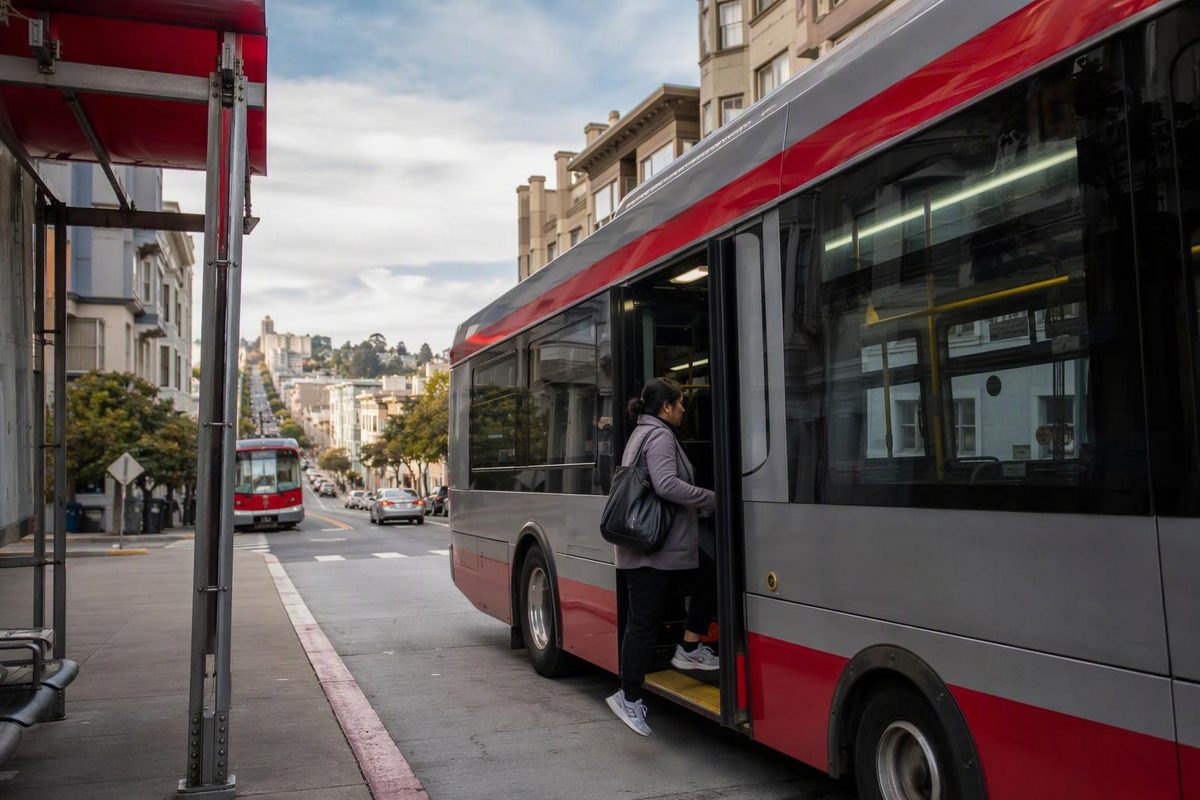
San Francisco’s Proposition H would fund Muni through a 15-year parcel tax; rejecting it would not automatically close 20 bus routes. Without adequate funding, however, SFMTA warns of up to 20 route eliminations, longer waits and reduced evening service beginning in fiscal year 2027–28. The vote concerns one source of funding, not approval of a final route-cut list. SFMTA’s funding and service warning
Choose your travel period and the service you rely on to separate current planning from the potential cut scenario.
Check Your Trip’s Exposure
The 39 Coit is listed as active. The potential cuts are not a reason to reroute an October or November 2026 visit.
Modeled exposure: elimination of the 39 Coit, which could leave a longer or steeper approach to Coit Tower.
Limits Of This Check
The Controller’s September 16, 2026 report evaluates a cut package supplied by SFMTA in 2025. It is not a finalized timetable and does not evaluate RTM, other revenue options or alternative operating changes. SFMTA’s funding warning begins in fiscal year 2027–28; individual route-change dates are not established here.
Sources: Controller’s potential-cut model, pages 4–6 and 16–18; SFMTA’s 39 Coit listing. This check is not live service information.
Prop H Would Establish A Tax, Not A Route-Cut Order
Prop H qualified by signature petition, certified June 12, 2026, for the November 3, 2026 election. It requires a simple majority to pass. A yes vote would establish an annual tax on San Francisco real estate from July 1, 2027, through June 30, 2042, adjusted annually for inflation. Revenue would be restricted to Muni service and administering the tax.
The proposed starting charges depend on the parcel’s use and building area:
| Parcel Type | Building Area | Annual Starting Tax |
|---|---|---|
| Single-family residential | 3,000 sq. ft. or less | $129 |
| Multifamily residential | Up to 5,000 sq. ft. | $249 |
| Non-residential | Up to 5,000 sq. ft. | $799 |
Larger properties would pay more. These figures are selected starting charges, not the full rate schedule. Exemptions or reductions apply to qualifying seniors and certain properties.
For rent-controlled units whose rent was set before June 1, 2027, landlord pass-throughs would be limited to 50% of the attributable tax, capped at $65 per unit annually. That rule does not establish a cap for every rental unit.
The ballot’s fiscal estimate is approximately $177 million annually. The qualification, tax terms, selected rates, pass-through provision and ballot estimate appear in the official voter pamphlet, pages 124–125.
The Controller’s September 16, 2026 economic-impact report uses $184 million instead. These are differing estimates, not guaranteed collections. Controller’s report, page 11
Prop H is separate from Measure RTM, the regional transit sales-tax proposal on the same ballot. Both appear on the city’s qualified ballot measures list. SFMTA’s funding strategy combines local revenue, regional revenue and savings—not Prop H alone. A result on one measure therefore does not, by itself, settle the agency’s service plan.
The Potential Cuts Include Hill Routes And Sightseeing Services
The Controller’s September 16 report models a potential cut package supplied by SFMTA in 2025. It is a scenario for evaluating the tax, not a finalized service-change timetable. It includes frequency reductions of up to 50%, route suspensions and changes to nighttime service.
| Potential Change In The Model | Consequence For A Trip |
|---|---|
| Eliminate neighborhood routes, including the 37 Corbett and 39 Coit | A short bus ride could become a longer or steeper approach. |
| Suspend all three cable car lines and the F streetcar | Those sightseeing services would be unavailable under this scenario. |
| Reduce Metro and busy bus-route frequencies | More waiting and less forgiving transfers, even where service survives. |
| Shorten many routes’ operating spans to 6 a.m.–9 p.m. | A daytime connection might not work for an evening return. |
These are potential cuts, not current closures. The model estimates more than 15,000 additional hours of trip delay per weekday, accumulated across San Francisco residents and workers. That includes less convenient transit and greater traffic congestion; it is not a delay assigned to each rider.
The analysis does not evaluate RTM, other revenue options or alternative operating changes. Its service assumptions and delay estimate should be read within that limit. Controller’s report, pages 4–6 and appendix pages 16–18
For visitors, losing the 39 Coit would be different from simply waiting longer for another bus: the final approach to Coit Tower is a hill. Likewise, a route operating only until 9 p.m. could serve an outbound journey but not the return. Those are reasons to watch the eventual route-level decisions—not reasons to treat this model as today’s schedule.
The Balanced Budget Uses Temporary Financing
SFMTA’s approved two-year budget closes an immediate $307 million shortfall, but its first year includes a $200 million state loan. The agency says its structural deficit had been projected to reach $434 million within five years. Closing the immediate budget gap with temporary financing does not establish permanent service funding. SFMTA’s budget announcement
The voter decision is whether to adopt this particular long-term tax. Supporters emphasize avoiding service cuts. The official opponent, the San Francisco Republican Party, argues that funding should be tied to binding efficiency and performance requirements.
The measure does require an independent annual audit, an annual report and an efficiency review. Those requirements are part of the proposal; the debate is not simply between oversight and no oversight. Official digest and arguments, pages 124–127
Current Trips Do Not Need A Hypothetical-Cut Detour
Do not reroute an October or November 2026 visit because of these hypothetical cuts. The 39 Coit remains listed as active, with live arrival predictions available by stop. That confirms the status of the 39, not every route mentioned in the funding debate.
For a hill-smart outing, use our Coit Tower bus-up, walk-down guide, then verify the bus before setting out. The funding scenario is not a substitute for current arrival information.
For travel in 2027 or later, recheck service after funding and operating decisions are announced. The agency’s warning begins in fiscal year 2027–28, not automatically on election day or at the start of calendar 2027. Neither the vote nor the Controller’s model supplies a finalized closure date for an individual route.
If a future trip depends on a hill route or an evening connection, check that specific service before committing to the itinerary. A surviving daytime route may still have a shorter operating span. In rain or strong wind, a compact indoor outing is a more practical fallback than assuming a longer walk can replace a missing bus.