
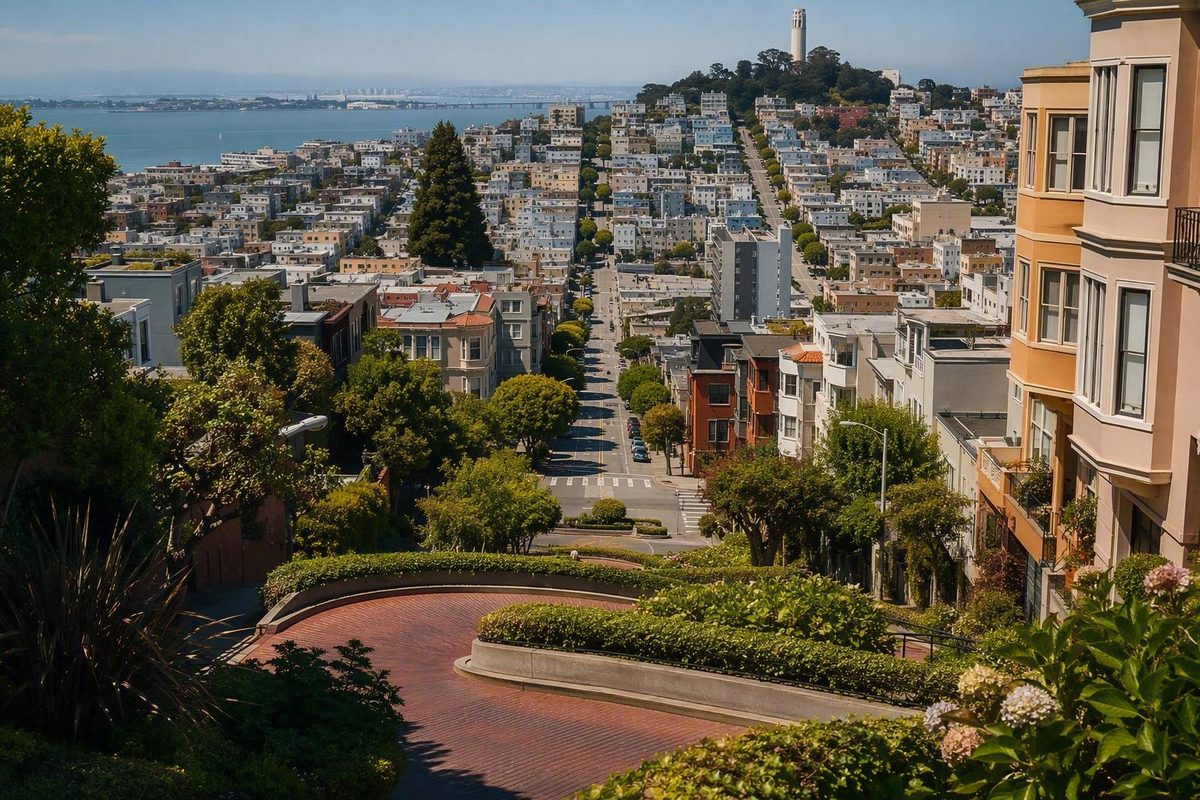
San Francisco’s latest population estimate
Direct answer: The U.S. Census Bureau estimated that 826,079 people lived in San Francisco city, California, on July 1, 2025. This is an annual population estimate—not a real-time headcount, a decennial census count, or an official population figure for 2026. See the Census Bureau’s QuickFacts profile for San Francisco city.
Three qualifiers should accompany the number whenever it is quoted:
- Reference date: July 1, 2025
- Geography: San Francisco city, California
- Measure: Annual population estimate
Population changes continuously as people are born, die, and move. An annual estimate is therefore a statistically produced snapshot for a particular date. It does not mean that exactly 826,079 people live in the city at this moment.
The estimate also differs from a decennial census result. San Francisco’s latest decennial census count remains the April 1, 2020 total discussed below.
The Federal Reserve Bank of St. Louis corroborates the estimate through its Census-derived resident-population series for “San Francisco County/city.” It reports 826.079 thousand people for 2025, equivalent to 826,079 residents. The series was updated on March 27, 2026, but its latest observation still refers to July 1, 2025. A webpage update in 2026 does not turn a 2025 observation into a 2026 population figure. View the Census-derived annual series in FRED.
The clearest way to quote the result is:
The U.S. Census Bureau estimated San Francisco’s population at 826,079 as of July 1, 2025.
That wording identifies the source, population measure, geography, and reference date without suggesting that the figure is a live counter.
Why San Francisco city and county have the same population
San Francisco is organized as a consolidated city-county. For population statistics in this context, San Francisco city and San Francisco County are two presentations of the same jurisdiction—not separate populations that should be added together.
This differs from the usual arrangement in California. San Francisco’s city and county boundaries, by contrast, are consolidated.
The Census Bureau reflects that arrangement in its city and county profiles. Its San Francisco County presentation reports the same July 1, 2025 estimate, 2020 census count, and revised estimates base as the city presentation. Compare the Census Bureau’s San Francisco County QuickFacts profile.
In practical terms:
- Do not add the San Francisco County population to the San Francisco city population.
- Do not treat the city and county figures as two overlapping groups of residents.
- A dataset labeled “San Francisco County/city” covers the consolidated jurisdiction.
- For a question about the population of San Francisco city, the city-county total is the relevant figure.
This article uses San Francisco city when answering the city-population question directly and San Francisco city-county when emphasizing geographic scope. In this context, both terms refer to the same resident population.
San Francisco population by year: 2010, 2020, and 2025
The latest estimate becomes more meaningful when placed beside the two most recent decennial census counts. The revised 2020 estimates base also needs to be shown because the Census Bureau uses it—not the published 2020 census count—to calculate change in the current annual estimates series.
The dates, values, and statistical measures below come from the Census Bureau’s San Francisco city QuickFacts profile.
| Reference date | Population | Statistical measure | Source |
|---|---|---|---|
| April 1, 2010 | 805,235 | Decennial census count | U.S. Census Bureau QuickFacts |
| April 1, 2020 | 873,965 | Decennial census count | U.S. Census Bureau QuickFacts |
| April 1, 2020 | 878,550 | Revised population estimates base, V2025 | U.S. Census Bureau QuickFacts |
| July 1, 2025 | 826,079 | Annual population estimate, V2025 | U.S. Census Bureau QuickFacts |
Several useful comparisons follow from this timeline, provided the measures are described accurately.
The 2020 census counted 68,730 more residents than the 2010 census:
873,965 − 805,235 = 68,730
That comparison establishes growth between the two census dates. It does not imply that San Francisco continued growing after April 2020.
The July 2025 estimate was 47,886 below the April 2020 census count:
873,965 − 826,079 = 47,886
This is valid arithmetic, but it compares two different statistical products: a decennial census count and an annual population estimate. It is not the Census Bureau’s official percentage-change calculation.
The 878,550 figure is not another census count. It is the revised April 1, 2020 population estimates base used as the starting point for the current annual estimates series. The published 2020 decennial census count remains 873,965.
For a concise historical summary:
- 2010 census: 805,235
- 2020 census: 873,965
- 2025 annual estimate: 826,079
The revised 2020 estimates base belongs in a methodological explanation. It should not be inserted into a list labeled simply “census population.”
Has San Francisco’s population been rising or falling?
Both descriptions can be correct, depending on the period.
The recent trend has two distinct parts:
- San Francisco experienced a substantial population decline relative to 2020.
- The annual estimates reached a low in 2022 and then increased in each of the following three displayed years.
The annual figures below are July 1 estimates from the Census Bureau series published through FRED. FRED displays the values in thousands of people; the table converts them to individual residents.
| Year | Estimated population | Change from previous displayed year |
|---|---|---|
| 2021 | 816,169 | — |
| 2022 | 813,266 | −2,903 |
| 2023 | 816,926 | +3,660 |
| 2024 | 820,945 | +4,019 |
| 2025 | 826,079 | +5,134 |
Within the displayed 2021–2025 series, 2022 was the low point, at 813,266. The estimated population then increased by 12,813 residents between 2022 and 2025:
826,079 − 813,266 = 12,813
Relative to the 2022 estimate, that increase was approximately 1.6%:
12,813 ÷ 813,266 × 100 ≈ 1.6%
This was a partial recovery, not a return to San Francisco’s 2020 census population. Even after increases in 2023, 2024, and 2025, the latest estimate remained 47,886 below the 2020 census count.
It would therefore be misleading to say that San Francisco’s population declined every year after 2020. A more precise summary is:
San Francisco’s population fell substantially relative to 2020, reached the lowest point in the displayed annual series in 2022, and then partially recovered through 2025.
“Below the 2020 census count” and “rising in the most recent annual estimates” can both be true. The first statement describes the longer comparison; the second describes the direction since 2022.
Annual population estimates can also be revised. The Census Bureau uses information about births, deaths, and migration to construct the series. Later data vintages may update estimates for earlier years as that information changes or improves.
A revision does not necessarily mean that an earlier estimate was a mistake. Estimates reflect the information available when they are produced and can subsequently be refined. Anyone comparing annual figures from reports published at different times should check whether the reports use the same Census data vintage.
The series does not establish what will happen after 2025. It shows only that the estimated population increased from 2022 through 2025 while remaining below the 2020 census count.
Why the Census Bureau reports a 6.0% decline
The Census Bureau reports a 6.0% decrease between San Francisco’s revised April 1, 2020 estimates base of 878,550 and its July 1, 2025 estimate of 826,079. The separate April 1, 2020 decennial census count was 873,965. See the measures and official percentage change in Census QuickFacts.
Using the estimates base, the calculation is:
(826,079 − 878,550) ÷ 878,550 ≈ −5.97%
Rounded to one decimal place, the result is −6.0%.
Starting instead with the published 2020 census count produces a different result:
(826,079 − 873,965) ÷ 873,965 ≈ −5.48%
That rounds to approximately −5.5%, not −6.0%.
The difference does not arise from conflicting 2025 values. It arises from using different starting measures:
- 873,965: April 1, 2020 decennial census count
- 878,550: Revised April 1, 2020 population estimates base
- 826,079: July 1, 2025 annual population estimate
An estimates base is the starting population for an annual estimates series. It is related to the census but is not interchangeable with the published decennial census count. The evidence here establishes that the two 2020 measures differ, but it does not provide a complete accounting of every adjustment used to produce the revised base.
The accurate wording is:
The Census Bureau reports a 6.0% decline from its revised April 1, 2020 estimates base to the July 1, 2025 estimate.
Avoid saying that San Francisco declined 6.0% from the 2020 census count. That phrasing assigns the official percentage to the wrong starting value.
For general use, keep the two comparisons separate:
- The 2025 estimate was 47,886 below the 2020 census count, based on simple subtraction between different statistical products.
- The Census Bureau reports a 6.0% decline from the revised 2020 estimates base, which is its official measure for the annual estimates series.
Why different websites give different San Francisco population figures
A search for San Francisco’s population may produce several plausible totals for the same year. That does not automatically mean one of the sources is wrong. The values may come from different statistical programs, data vintages, reference dates, or projection methods.
Common categories include:
- Decennial census counts: Nationwide counts conducted every 10 years.
- Annual population estimates: Estimates of the resident population as of July 1 each year.
- American Community Survey estimates: Survey-based estimates used for population and community characteristics.
- Different data vintages: Releases that may revise previously published annual figures.
- Third-party estimates or projections: Values produced or presented outside the Census Bureau, including future-year figures.
Before comparing two totals, determine whether they measure the same geography, date, and statistical concept.
Three different figures for 2024
The differences are visible in published 2024 figures:
- The Census-derived annual population-estimates series reports 820,945 for July 1, 2024. See the annual observations in FRED.
- Census Reporter displays an ACS 2024 one-year population estimate of 827,526. View the San Francisco profile in Census Reporter.
- Data Commons displays 830,235 for 2024, although its summary does not identify which available population facet produced that value.
These figures differ by several thousand people, but they should not be treated as three interchangeable versions of one statistic.
The Census Bureau’s annual population estimates program and the American Community Survey serve different purposes and use different methods. The ACS is a survey that provides population estimates alongside information about age, housing, commuting, income, and other community characteristics.
Because the ACS is survey-based, its figures are normally interpreted with the relevant release and margins of error. An ACS estimate should not be relabeled as a decennial census count or substituted silently for an annual population estimate.
Data aggregators add another consideration: a platform may offer multiple statistical facets for the same place and variable. A displayed summary can depend on which underlying dataset, measurement method, or observation the platform selects. Users should identify that facet before comparing the displayed value with another source.
The same care is needed with open-data collections. A population dataset can contain multiple years, geographic units, demographic segments, and source products. Selecting the dataset is only the first step; the user must still filter it to the intended geography, period, product, and measure.
What about a 2026 population of 812,530?
World Population Review displays 812,530 as San Francisco’s 2026 population. The page does not clearly establish how the future-year figure was calculated or whether readers should interpret it as an estimate or a projection. It is a third-party value, not an official Census Bureau population figure. See the 2026 figure as presented by World Population Review.
A source page updated during 2026 may still contain a latest population observation dated July 1, 2025. Publication date, update date, and population reference date are not the same thing.
The appropriate distinction is:
A third-party website publishes a 2026 figure, but the latest U.S. Census Bureau estimate cited in this article refers to July 1, 2025.
Until the Census Bureau publishes a San Francisco population estimate with a 2026 reference date, a third-party future-year figure should not be described as the city’s official Census Bureau population.
A four-part population verification checklist
Before quoting any San Francisco population figure, check four elements:
- Date: Is the number for Census Day, July 1, January 1, a calendar year, or an unspecified “current” date?
- Geography: Does it cover San Francisco city-county, a metropolitan area, or the nine-county Bay Area?
- Statistical product: Does it come from the decennial census, annual population estimates, the ACS, or a third party?
- Measure: Is it a count, an estimate, or a projection?
If one of those elements is missing, the figure may still be useful, but it should not be compared or quoted without qualification.
San Francisco city population versus the Bay Area
The population of San Francisco city-county is not the population of the wider Bay Area.
San Francisco’s July 1, 2025 city estimate was 826,079. The Metropolitan Transportation Commission, by contrast, reports that the nine-county San Francisco Bay Area had approximately 7.66 million residents in 2025. That regional geography includes numerous cities and unincorporated communities. See the Metropolitan Transportation Commission’s Bay Area population indicator.
The regional total includes San Francisco, but it also covers Alameda, Contra Costa, Marin, Napa, San Mateo, Santa Clara, Solano, and Sonoma counties. San Francisco city-county is only one part of that larger region.
Other geographic definitions can produce still more totals. Search results may refer to a metropolitan area, a combined statistical area, or another regional boundary. Those figures may be appropriate for questions about transportation, housing, employment, or environmental planning, but they do not answer a city-population question unless the city itself is the stated geography.
A reliable interpretation rule is:
If a San Francisco population figure is several million, it almost certainly refers to a larger regional geography rather than San Francisco city itself.
For a city-level answer, use the consolidated city-county figure. For a regional question, name the regional boundary rather than labeling the result simply “San Francisco population.”
The final citation-ready answer is:
According to the U.S. Census Bureau, San Francisco city-county had an estimated 826,079 residents on July 1, 2025. Census QuickFacts
That estimate reflects a partial recovery from the 2022 annual estimate but remains below the 2020 decennial census count. Whenever a different total appears, check its reference date, geography, and statistical product before comparing it with the city estimate.
Frequently asked questions about San Francisco’s population
What is the population of San Francisco city in 2025?
The U.S. Census Bureau estimated San Francisco city’s population at 826,079 as of July 1, 2025. It is an annual population estimate, not a real-time headcount or decennial census result. See the Census-derived annual series.
What was San Francisco’s population in the 2020 census?
The April 1, 2020 decennial census counted 873,965 residents in San Francisco. That count is separate from the revised 2020 population estimates base used for the annual estimates series.
Are San Francisco city and San Francisco County the same for population statistics?
Yes, in this context. San Francisco is a consolidated city-county, so the city and county presentations cover the same jurisdiction. Their populations should not be added together.
Why do sources report different San Francisco populations for 2024?
They may use different statistical products, vintages, or data selections. An annual population estimate, an ACS survey estimate, and a value selected by a data aggregator are not automatically interchangeable, even when all three are labeled 2024. Check the geography, reference date, product, and type of measure before comparing them.
Is 812,530 the official population of San Francisco in 2026?
No. It is a third-party figure whose methodology is not clearly established on the page that publishes it. See the third-party presentation. The Census sources cited here do not establish an official San Francisco population figure with a 2026 reference date.