
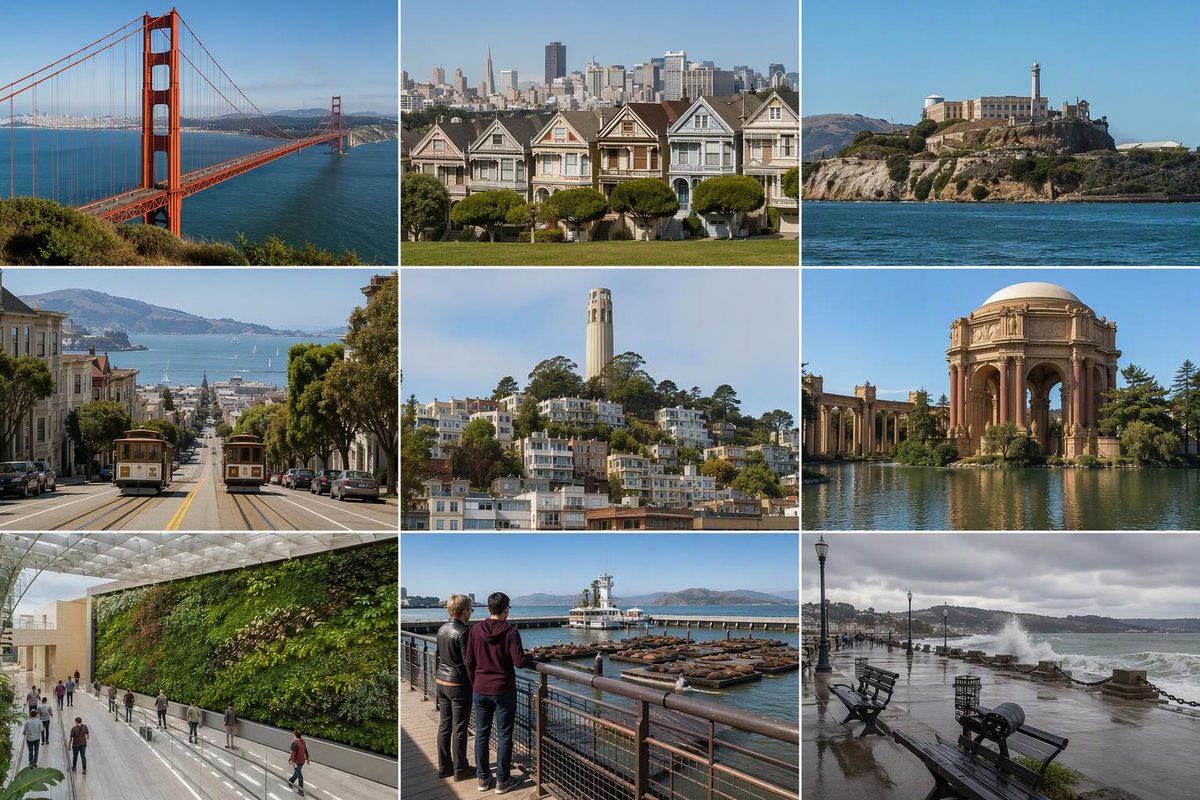
For a first visit, start with the Golden Gate Bridge, then choose between an Alcatraz visit, the northern waterfront sights, or the city’s architectural landmarks. Don’t treat them as one continuous walking route: Lombard Street and Coit Tower each introduce a substantial climb, while the Painted Ladies sit away from the waterfront.
Choose one main experience and add nearby stops—not a cross-city trip for every photograph.
Fall 2026 planning alert: Alcatraz is scheduled to close beginning October 26, with dock repairs expected to be completed by November 18, 2026. That is an expected repair-completion date, not a guaranteed reopening date. Weather or other factors may change the timeline. Check the National Park Service closure notice before arranging an island day.
1. Golden Gate Bridge: choose a view or a crossing
The bridge is the strongest first choice if you want one unmistakable San Francisco sight. Decide whether you want to look at the bridge or walk on it; those are different outings.
For a lower-effort view, choose Crissy Field’s East Beach or West Bluff. The Presidio describes the nearby Golden Gate Promenade/Bay Trail as one of its easiest places to walk or roll. A bridge-sidewalk visit means reaching bridge level rather than staying along the shoreline. Crissy Field visitor information
Pedestrians use the east sidewalk only. Opening hours vary seasonally, and construction can shorten access, so check the bridge operator’s pedestrian rules. You don’t need to cross all the way to Marin to make the visit worthwhile.
2. Alcatraz: book this before filling the day
Choose Alcatraz for an island and cellhouse experience, not a quick waterfront photo stop. Access requires a ferry ticket, and Alcatraz City Cruises is the only NPS-authorized operator permitted to dock and discharge visitors. The Park Service strongly recommends advance reservations; a cruise past the island is not an island visit. NPS ticket guidance
The hill matters here too: the dock-to-cellhouse route gains about 130 feet over a quarter-mile. An accessible tram serves visitors with mobility impairments. NPS accessibility information
Build the day around your ferry departure at Pier 33 on the Embarcadero, and avoid putting a cable-car ride immediately before check-in. The F streetcar runs past the landing. NPS arrival guidance
3. Ferry Building: an easy waterfront starting point
At the foot of Market Street, the Ferry Building combines a recognizable waterfront landmark with food shops and a useful transit arrival point. Embarcadero BART is nearby, and the F historic streetcar stops in front. Individual merchants keep their own hours, so an early arrival does not mean every food counter is open. Ferry Building visitor information
Use it as breakfast or lunch before heading north along the Embarcadero. If you want to save your walking energy for a hilltop sight, take the F instead.
4. Coit Tower: ride up, then choose your descent
Coit Tower offers two reasons to visit: city-and-bay views from its observation deck and 1934 murals depicting Depression-era California inside the base. It stands on Telegraph Hill. The observation-deck elevator can be unavailable; reaching the viewing level may then require 13 flights of steps. Recreation and Parks’ Coit Tower guide
Take the 39 Coit bus uphill from the Wharf or North Beach, then walk down only if stairs suit your group. Our Coit Tower visiting guide separates the bus, stair routes and viewing options.
5. Lombard Street: target the exact crooked block
The famous section is between Hyde and Leavenworth streets, not the whole length of Lombard. Hyde is the top; Leavenworth is the bottom. Looking uphill from the bottom emphasizes the curves, while the top gives you the outward city view. San Francisco Travel’s Lombard guide
For a downhill visit, arrive at Hyde and descend beside the roadway. Stay on the sidewalks and keep residents’ driveways clear. Choose your approach with our Lombard Street guide—especially if you want the photograph without climbing the entire block.
6. Cable cars: use a moving landmark to reach Lombard
Cable cars are themselves a National Historic Landmark. Three lines operate: Powell–Hyde, Powell–Mason and California. They are not equipped with accessible boarding, so they should not be the essential transport link for a visitor who needs step-free access. SFMTA cable-car guidance
Powell–Hyde is the useful pairing here: it stops at Hyde and Lombard, at the top of the crooked block. Ride there, then continue downhill on foot rather than retracing the climb. Powell–Hyde route and stops
7. Palace of Fine Arts: pair architecture with the shoreline
The Palace of Fine Arts brings a different visual character: a Greco-Roman rotunda, columns and a lagoon, originally created for the 1915 Panama-Pacific International Exposition. Its Marina District location makes it a logical stop before Crissy Field. The adjoining exhibition building operates as an event venue; don’t count on it as a walk-in museum or rainy-day shelter. Palace history and venue information
8. Painted Ladies: make Alamo Square a separate outing
The Painted Ladies of Postcard Row stand on Steiner Street between Hayes and Grove, opposite Alamo Square Park. Photograph these occupied homes from the public park and sidewalks rather than approaching private entrances. Painted Ladies visitor guide
Alamo Square is a hilltop park, so the final walk can still involve uphill effort. Its accessible entrance is at Hayes and Scott streets. Treat this as a neighborhood-and-park outing, not a detour between waterfront landmarks. Alamo Square park information
Three practical ways to group the sights
These are suggested outing sizes, not timed tours; leave room for queues, meals and transit.
- Bridge-focused half-day: Palace of Fine Arts → Crissy Field → optional bridge-sidewalk visit. Stop at the shoreline for less climbing. For a separate bridge-level visit without walking up from the shore, use the 28 bus to the toll-plaza area; it also connects the bridge with Fisherman’s Wharf.
- Northern landmarks day: Powell–Hyde cable car → Lombard downhill → North Beach → 39 bus to Coit Tower → bus back down or one stair descent → waterfront. Use the F streetcar for the Ferry Building connection instead of adding more walking.
- Alcatraz day, when open: Ferry Building → Pier 33 → island visit → optional Wharf stop. Keep Coit Tower as an extra only if ferry timing and your energy allow it; don’t make two hill climbs compulsory.
If fog or rain changes the plan
If the bridge is obscured, shorten the view-focused outing rather than committing to a long crossing. In sustained rain, keep the Ferry Building as a sheltered waterfront stop; its marketplace closes on Thanksgiving and Christmas, and merchant hours vary. Ferry Building hours
On a non-holiday weekday, replace the exposed walk with City Hall’s marble interior and grand staircase. City Hall lists hours of 8 a.m.–6 p.m.; check for holiday closures and rotunda restrictions before going. Entry includes security screening. City Hall hours and visitor information
Planning details checked October 11, 2026.