
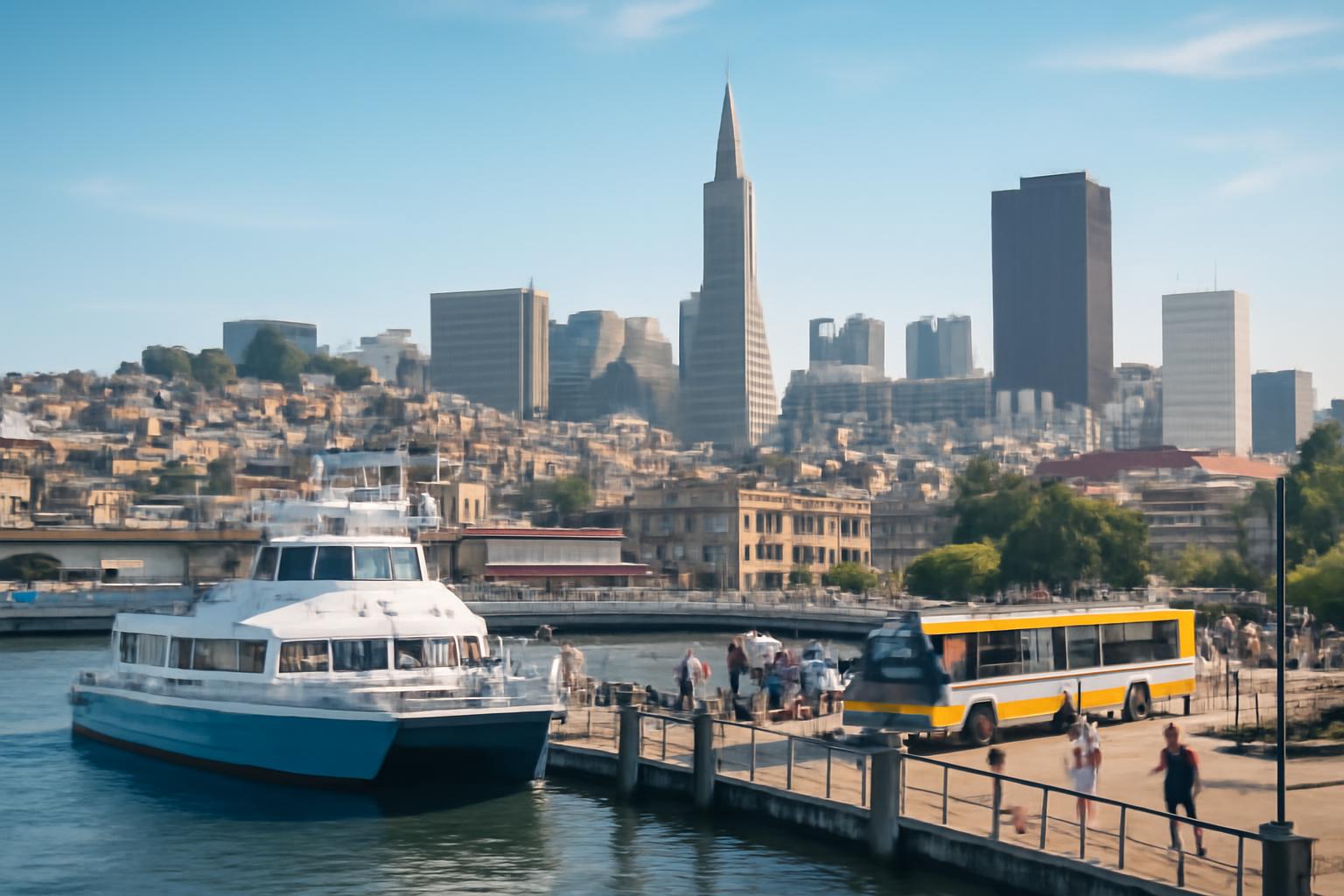
That geography matters more than people expect. The best san francisco day trips without a car are not simply the closest dots on a map. They are the places that line up with the transit network cleanly enough that the trip still feels like a day out rather than a logistics puzzle. That is why ferry towns such as Sausalito and Tiburon work so well, why Oakland and Berkeley are such easy BART swaps, and why Muir Woods is wonderful only if you respect the reservation piece.
The easiest way to choose is to decide what kind of day you want first. If you want low effort and immediate scenery, pick a ferry town. If you want museums, food, and a quick urban change of scene, go East Bay. If you want redwoods, make Muir Woods the main event and plan it in advance. If you want the beach, accept that the coast costs you more time.
A simple way to think about the lineup:
- Fastest, easiest win: Sausalito
- Best nature day: Muir Woods
- Best urban swap: Oakland or Berkeley
- Best longer rail day: San Jose or another Peninsula stop
- Best if the ocean is the point: Half Moon Bay or Stinson Beach
Why Skip the Car for San Francisco Day Trips
For visitors, the appeal is usually practical before it is ideological. You avoid parking stress, bridge traffic, and the constant question of whether a scenic stop is worth the trouble of leaving a car there. You also avoid losing time to the kind of “last ten minutes” friction that quietly ruins short outings: circling for parking, walking back from a distant lot, or cutting a visit short because you do not want to deal with the drive home.
Transit also forces useful discipline. When you plan by ferry, BART, or train corridor, you naturally end up choosing destinations that are close enough to enjoy properly. That usually leads to better day trips than trying to stretch the idea of “near San Francisco” to somewhere that is technically reachable but exhausting in practice.
Advance planning matters most when the destination has a choke point. Muir Woods is the obvious example, because shuttle space can require reservations well ahead of time and the Sausalito connection is seasonal in the source set. Even for easier days, weekend and weekday service can feel very different, so the smart habit is simple: choose the route family first, then check the exact timetable the night before and again before you leave.
Sausalito: Quick Ferry Ride to Waterfront Charm
Sausalito is the easiest no-car day trip to recommend to a first-time visitor because the route is so readable. In the source set, ferries to Sausalito run from the San Francisco Ferry Building on Golden Gate Ferry or from Pier 41 on Blue & Gold, with the ride taking about 30 minutes and one-way fares coming in under $15 (Extranomical).
That simplicity is the whole point. You board in San Francisco, sit through one scenic crossing, and step into a town that feels distinctly separate from the city without requiring a second transfer. For a half day, that matters. Sausalito gives you a shoreline walk, marinas, cafés, galleries, and that bay-facing small-town mood almost immediately after arrival.
It also works for a wide range of energy levels. You can do very little and still feel like the day succeeded: coffee by the water, a wander past the boats, lunch with a view, ferry back. If you want more structure, houseboats and the waterfront promenade give the place enough shape that you can turn a casual stroll into a proper afternoon without needing a checklist.
The other reason Sausalito is such a strong starter trip is flexibility. It can be the whole day, but it can also be the easy front half of a more ambitious one. Some visitors use it as the staging point for Muir Woods in summer when the Sausalito shuttle connection is running. Others make it the reward at the end of a bridge-crossing bike ride.
If you like the idea of connecting the city to the day trip physically rather than just by ferry, pairing Sausalito with a bridge crossing is one of the cleanest versions of that idea. The ride from San Francisco to Sausalito is described in AAA Via as a little over 8 miles, and if you want a calmer way to think through the waterfront approach before committing to the bridge, our self-guided Golden Gate waterfront walk is useful planning context.
The main caution is not about difficulty but drift. Because Sausalito is so easy, people sometimes stop planning altogether and assume any return will do. A quick look at the last ferry options keeps the day pleasant. That is especially true if you visit on a cooler, windier afternoon and decide you are ready to head back earlier than expected.
If you are unsure where to begin, this is still the best answer. Sausalito asks the least, pays off fastest, and leaves the most room for weather changes, slow starts, or simply lingering longer than planned.
Muir Woods: Redwoods via Ferry + Shuttle
Muir Woods is the no-car day trip that requires the clearest planning. In the source set, the classic public-transit route is ferry to Larkspur, then the official shuttle. Snap Happy Travel describes that as a roughly 35-minute ferry ride followed by a shuttle that costs $3.75 round-trip for adults, with kids riding free; the same source also notes a $15 adult entrance fee and says reservations may be needed as much as three months ahead (Snap Happy Travel).
That reservation window is why Muir Woods feels so different from Sausalito. The redwoods themselves are the easy part. The hard part is treating the trip as something you book, not something you improvise at breakfast. If you want the lowest-friction version, decide early, reserve early, and build the day around it.
There is also a Sausalito-based version in the source set. Extranomical describes Route 66 from Sausalito as the shuttle link on weekdays from June through August, while the Larkspur departure handles weekends and holidays year-round in its summary. The same guide keeps ferry pricing to Sausalito in the under-$15-each-way range and treats the ferry-plus-shuttle pattern as the standard car-free structure (Extranomical).
Once you actually arrive, the smartest move for most visitors is restraint. Muir Woods does not need to become an athletic achievement to feel worthwhile. If your goal is to stand among the redwoods, walk under the canopy, and let the place slow you down, the easier valley-floor experience is enough. One of the most useful warnings in the source set is practical, not scenic: there is no cell service inside Muir Woods, so you should screenshot your schedules, reservation confirmations, and return details before you go (Perfect Port Day).
That no-service reality changes how you should plan the day. Do not assume you will look up the next bus from inside the monument. Do not assume you can clean up a loose plan on the fly. Know your departure point, know your return slot, and have the relevant confirmation already saved.
For visitors worried about mobility more than mileage, the nuance is that the source set gives encouraging but still anecdotal signals. In the Rick Steves forum discussion, travelers talking specifically about an older parent with mobility limitations describe Muir Woods as accessible enough for benches, pauses, and easier movement on the main paths, while also emphasizing that reservations and transport logistics are the bigger challenge.
If the official shuttle is sold out, there is a legitimate fallback for people who actively want a hike: ferry to Sausalito, then the direct bus to the Panoramic Highway trailhead near Mountain Home Inn, which Perfect Port Day puts at about 50 minutes, followed by roughly an hour of hiking into the woods. The same guide describes the walk back out via Dipsea Trail as about 40 minutes (Perfect Port Day).
That fallback is real, but it is a different trip. It is not the easy-redwoods version. It is the “transport plus trail” version. For fit travelers, that can be great. For most visitors, especially if Muir Woods is on the wish list because they want a calm forest day, the official shuttle remains the better target.
The best mental model is simple: Muir Woods is rewarding, but it is not casual. If you book it early, keep the route simple, and prepare for spotty connectivity, it can be one of the best car-free outings from San Francisco. If you treat it like a spontaneous add-on, it becomes the easiest day trip in this list to fumble.
Tiburon and Angel Island: Ferry Hop to Parks and Views
Tiburon sits in a sweet spot between “easy ferry town” and “quieter alternative to Sausalito.” In the source set, Blue & Gold ferries reach Tiburon from either Pier 41 or the Ferry Building in about 30 minutes, with adult one-way fares around $14, while Angel Island is also described as about a 30-minute ferry ride from San Francisco (Snap Happy Travel).
The reason to choose Tiburon is mood. It is a waterfront town day without Sausalito’s level of name recognition or visitor flow. That can make it feel calmer if what you want is lunch by the bay, a shoreline walk, and views back toward San Francisco rather than a bigger checklist.
Angel Island changes the shape of the day. It is still ferry-based, but the destination is a park rather than a town center. That means the outing becomes less about browsing and more about committing to the island itself: hiking, open views, more exposure to weather, and a return that depends much more on catching the right boat.
You can think of Tiburon and Angel Island as two branches of the same ferry logic. Choose Tiburon when you want wandering, food, and a softer pace. Choose Angel Island when you want the day to revolve around one scenic destination.
The key here is return discipline. These are not hard outings, but they are less forgiving if you miss an important sailing. On the island especially, that is the difference between a satisfying long afternoon and a surprisingly annoying wait.
If Sausalito is the default answer and Muir Woods is the carefully booked nature answer, Tiburon and Angel Island are the “slightly quieter, slightly more deliberate” alternatives. They reward visitors who already know they like ferry travel and want the destination to feel a little more distinct.
East Bay: Oakland and Berkeley by BART
For a quick change of scene without a full-day commitment to transit, the East Bay is the strongest category in this article. Oakland is the most practical anchor because the station-to-sights relationship is unusually good. AAA Via puts the ride from downtown San Francisco to Lake Merritt at about 30 to 40 minutes and then maps the payoff cleanly: about three blocks to the Oakland Museum of California, two more blocks to Lake Merritt itself, roughly a mile to Jack London Square, and kayak rentals around $30 per hour (AAA Via).
That makes Oakland less of a “get there somehow, figure it out later” trip and more of a modular day. You can build a museum afternoon, a lake walk, a food stop, or a Jack London Square wander without burning energy on transfers. For visitors, that is a major advantage. The city feels big enough to feel like a real outing, but the actual mechanics can stay simple.
It is also one of the best weather-flex days in the region. Ferry towns are gorgeous when the bay is behaving; beaches are only worth the trouble if you really want the coast. Oakland is useful even on a mixed or cooler day because the structure is urban: indoor stops, short walks, flexible timing.
Berkeley offers a different version of the East Bay.
Berkeley is often the better pick if you want atmosphere more than a tight attraction cluster. Oakland gives you more obvious stop-to-stop variety. Berkeley gives you a strong walkable character. Both are good when you want a day trip that still feels urban, fast, and forgiving.
This is also where San Francisco visitors often discover the advantage of choosing by transit family rather than by fame. An East Bay day does not sound as dramatic as redwoods or a beach, but for ease-to-reward ratio, Oakland and Berkeley are among the smartest trips on the board.
Peninsula Spots: San Jose and Beyond via Caltrain
Caltrain is the right tool when you want a longer, cleaner rail run south. San Jose is the fullest version of that idea in the source set. AAA Via describes the trip from San Francisco to Diridon Station as under two hours, with Plaza de César Chávez less than a mile away and San Pedro Square Market about a 10-minute walk from the station.
That is the key to making San Jose work well: do not treat it like a city you need to conquer. Treat it like a station-centered downtown day. Walk to one or two main targets, eat well, maybe add a museum or public square, and let the train frame the outing rather than dominate it.
The broader Peninsula follows the same pattern. Traveler discussions in the source set repeatedly point to Palo Alto, Stanford, and Mountain View as reasonable no-car stops from San Francisco by Caltrain, with Mountain View specifically paired in that discussion with short onward links such as VTA bus service or the Google shuttle (Tripadvisor forum).
What makes these stops different from Oakland or Berkeley is that the reward is usually calmer and more local. You are not chasing the quickest dramatic payoff. You are choosing a campus environment, a walkable downtown strip, a market, or an afternoon with a little more breathing room.
Burlingame is useful as a reminder that not every Peninsula outing has to be a long haul. In older local advice in the source set, Caltrain is specifically mentioned as a practical way to reach walkable Peninsula stops including Burlingame and San Jose, with Burlingame paired to a free DASH shuttle for short local circulation (Tripadvisor forum).
The tradeoff versus a ferry town is obvious: more rail time, less instant spectacle. The upside is range. The Peninsula gives you markets, campus settings, downtown wandering, and museum-style days without needing a car once you arrive.
The biggest mistake here is overstacking. Because the towns all sit on the same line, it is tempting to bounce between them. That usually weakens the day. Pick one primary stop and maybe one nearby add-on if you have a strong reason. Caltrain days work best when they feel intentional rather than opportunistic.
Coastal Outposts: Half Moon Bay and Stinson Beach by Bus
That does not make them poor choices. It just means they work best when the coast itself is the goal, not when you are casually trying to fill an afternoon.
Half Moon Bay is the clearest example. In the source set, one route sequence runs by Caltrain to San Mateo, then onward to Hillsdale, then the 294 bus to Half Moon Bay, with the total trip described at about 2.5 hours.
That already tells you how to think about it. Half Moon Bay is not the quick beach fix. It is the “start early, commit to the coast, and give the day over to it” version. If that sounds appealing, the trip can still make sense. If what you want is merely a change of scenery, there are easier wins elsewhere.
Older local advice in the source set also points to SamTrans service from Daly City or Millbrae BART as another no-car path toward Half Moon Bay, which is helpful mainly as a reminder that the coast usually requires a Peninsula-style transfer rather than one simple ride from central San Francisco (Tripadvisor forum).
Stinson Beach has a similar payoff profile but a more scenic framing. Travel Lemming describes a car-free approach of ferry to Sausalito and then Marin Transit Route 61, with the bus portion taking about an hour (Travel Lemming).
That route has an emotional advantage over Half Moon Bay for some travelers: part of the journey already feels like the outing. You are not just grinding through transfers for the sake of arrival. The ferry and Marin leg help the day feel scenic before your feet even hit the sand.
The tradeoff is still schedule dependence. Beaches are where you most need to know your return before you relax into the place. Weather shifts, long waits, and fewer forgiving backup options can make a late, loose departure feel much worse here than on a BART day.
If you want maximum reward per minute, these are not the leaders. If you badly want ocean air and are willing to spend more of the day getting it, they are still valid and often memorable choices.
Planning Tips: Reservations, Costs and Backups
The easiest way to keep these trips organized is to stop thinking of them as one big list and start thinking of them as transit families. Ferry days need return-boat awareness. BART days need one clear station area and a loose walking plan. Caltrain days need a little more time discipline because the ride is longer and the temptation to overstack stops is higher.
In the source set, Clipper is specifically recommended for ferry and bus payments and noted as cheaper than cash in the Muir Woods guide that walks through the Sausalito ferry-and-bus approach. Even when cost differences are modest, using one payment method across operators simplifies transfers, which matters more than people expect on a multi-leg day.
Cost-wise, the sweet spot is usually “transport plus optional admission,” not “big all-inclusive outing.” Sausalito, Tiburon, Oakland, Berkeley, and many Peninsula stops can be relatively modest if you keep the day to transit, food, and walking. Muir Woods is the main exception because it adds both transport complexity and a park entry fee.
Backups are worth deciding in advance. If Muir Woods shuttle space is gone, do not spend half your morning trying to rescue the plan through improvisation. Switch the day to Sausalito, turn toward Oakland or Berkeley, or decide that convenience is worth paying for.
That is where tours become relevant.
Accessibility and effort level matter just as much as budget. The lowest-friction yes for most travelers remains Sausalito. Oakland and Berkeley are close behind because the station-to-destination relationship is strong. Muir Woods becomes excellent only when the reservation piece is handled. The beaches are the most schedule-sensitive and the least forgiving if energy or weather turns mid-day.
Above all, choose the trip that matches the day you actually want. The Bay Area offers enough no-car options that you do not need to force a beach mood onto a museum day or a redwood ambition onto a low-energy afternoon. The best plan is usually the one that leaves the most time for being there.
How far in advance do I need to reserve Muir Woods shuttle?
As early as you reasonably can. In the source set, the strongest practical warning is that shuttle reservations may need to be made as much as three months ahead, which is a good sign that Muir Woods should be treated as an advance-booking day rather than a same-morning decision.
If you miss that window, the trip is not impossible, but it does get more complicated fast. At that point, you are usually choosing between a more adventurous transit-and-hike version, paying for a tour, or swapping to an easier day trip altogether.
What’s the cheapest way to Sausalito and back?
If you mean “best low-cost, low-hassle option,” the ferry is still the default answer in the newer sources, with one-way pricing described as under $15 in Extranomical’s rundown of the route.
The bigger point is that Sausalito is one of the few trips where simplicity is part of the value. Trying to outsmart the route for a small saving usually matters less than keeping the outing clean and relaxed.
Are these day trips accessible for families or elderly?
The easiest broad answer is that some are much better than others. In the Rick Steves forum discussion, travelers focusing specifically on an older parent with mobility issues describe Sausalito’s core as flat and easy to wander, while also reporting benches and manageable main paths at Muir Woods once you are there.
That still leaves an important distinction: destination accessibility and trip accessibility are not the same thing. Sausalito is easy both to reach and to enjoy. Muir Woods can be pleasant on the main paths, but the reservation, transfer, and return planning make it a heavier lift.
BART to Oakland: safe and how long?
For route planning, Oakland is one of the quicker regional outings from San Francisco, and the article’s Oakland section above is why it works so well: the main advantage is not just the ride but how little extra transit you need once you reach Lake Merritt.
On safety, the evidence in this source set is mostly anecdotal rather than systemwide. Traveler comments in the forum material mix ordinary recommendations with personal comfort levels, so the sensible takeaway is to treat BART like any urban rail system and plan according to your own comfort rather than expecting a universal yes-or-no answer (Tripadvisor forum).
Tours vs public transit: when to choose each?
Choose public transit when the route itself is straightforward and the freedom matters more than compression. Sausalito, Oakland, Berkeley, Tiburon, and many Peninsula stops are better DIY because you can move at your own pace, linger where you want, and keep the cost down.
Choose a tour when logistics would otherwise dominate the day. Muir Woods is the clearest case. In the source set, organized options starting around $97 are expensive compared with ferry or rail days, but they can still make sense if the shuttle is sold out, if you want bundled transport from central San Francisco, or if you would rather buy back time than solve transfers yourself (Hellotickets).
The cleanest conclusion is also the simplest one: start with the trip that fits the network best. For most visitors, that means Sausalito first, Oakland or Berkeley next, and Muir Woods when you are ready to plan around it. Done that way, San Francisco’s transit advantage extends well beyond the city itself.