
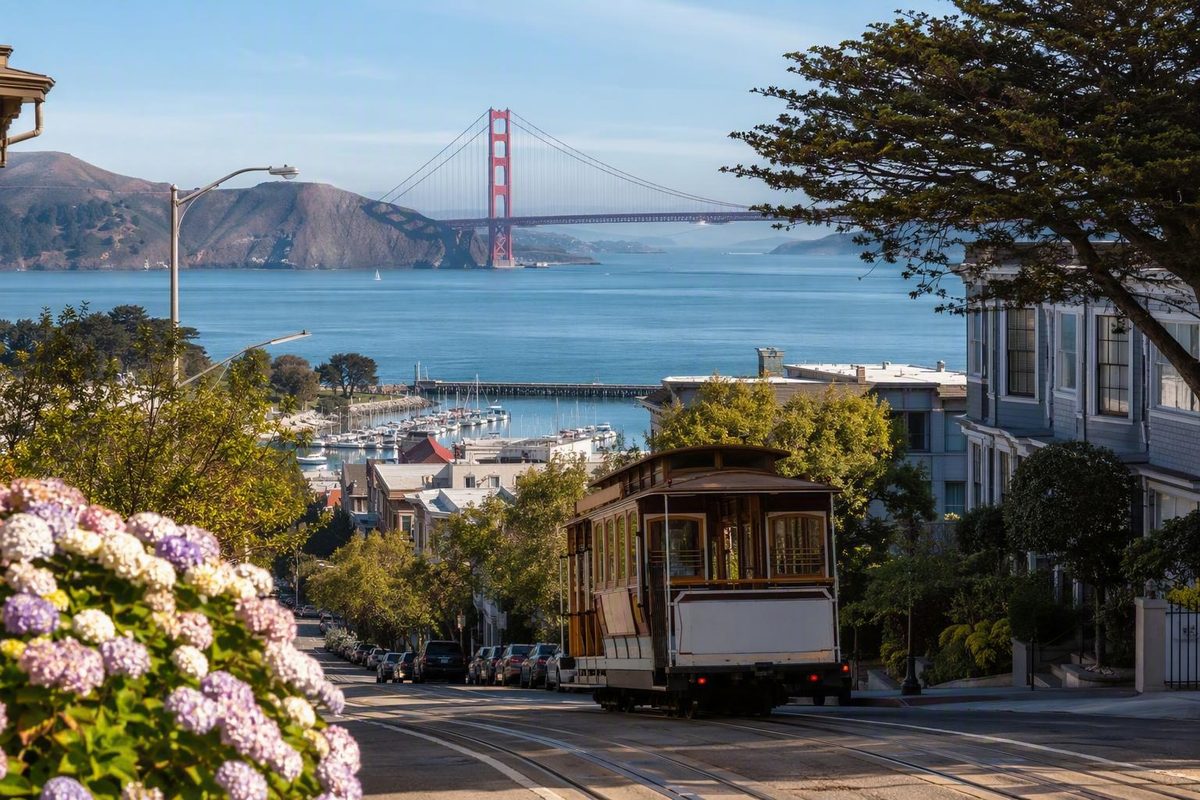
See the city’s essential sights without racing across the map.
A successful San Francisco one day itinerary is not a contest to collect the most map pins. It is a route through three manageable geographic clusters:
- The Golden Gate waterfront: Crissy Field or a bridge viewpoint, with the Palace of Fine Arts if time allows.
- The northern waterfront: Fisherman’s Wharf, Pier 39, Aquatic Park, Musée Mécanique, or a short Embarcadero segment.
- Chinatown and North Beach: one substantial neighborhood experience, followed by a shorter introduction to the other.
Walk within each cluster. Use Muni, a taxi, or rideshare for the longer transfer between the bridge and Fisherman’s Wharf. Treat the cable car, Lombard Street, Coit Tower, and the Ferry Building as choices rather than obligations.
Here is a practical default sequence for a full day without Alcatraz:
| Planning window | Recommended focus |
|---|---|
| 8:00–10:15 a.m. | Crissy Field, a bridge viewpoint, or a longer bridge walk |
| 10:15–10:45 a.m. | Palace of Fine Arts if the morning is on schedule |
| 10:45–11:30 a.m. | Transfer to Fisherman’s Wharf, including a service or pickup buffer |
| 11:30 a.m.–2:00 p.m. | Two or three waterfront priorities and lunch |
| 2:00–3:00 p.m. | Cable car or Lombard Street, not necessarily both |
| 3:00–5:30 p.m. | North Beach and Chinatown |
| After 5:30 p.m. | Dinner in the neighborhood receiving more time |
These are editorial planning ranges, not guaranteed travel or visit times. Weather, queues, transit service, walking speed, meals, and your starting point will change what fits.
If you have reserved Alcatraz, use the separate Plan B below. The island should shape the day rather than being inserted into an already full highlights route.
What Can You Realistically See in One Day?
One full day is enough for a memorable introduction to San Francisco. It is not enough for comprehensive city coverage.
For a first visit without Alcatraz, the recommended core is:
- A Golden Gate Bridge viewpoint or short Crissy Field walk
- The Palace of Fine Arts if your pace allows
- A selective visit to Fisherman’s Wharf and Pier 39
- One cable-car experience if the line is reasonable
- Time in Chinatown and North Beach
That list is deliberately selective. Published itineraries often combine many more attractions, but their inclusion demonstrates that the sights are commonly recommended—not that every stop can be experienced comfortably in one day. A route containing the bridge, Golden Gate Park, Haight-Ashbury, Lombard Street, Fisherman’s Wharf, a cable car, and Chinatown must also absorb transfers, hills, meals, queues, and time at each destination.
Protect three essential experiences
If the day begins to contract, retain:
- A bridge experience: a practical viewpoint, a short waterfront walk, or part of the bridge
- A focused waterfront experience: Pier 39, Aquatic Park, Musée Mécanique, or a waterfront meal
- One meaningful neighborhood walk: Chinatown or North Beach
Everything else is adjustable.
The Palace of Fine Arts is a convenient addition near the bridge area. Pier 39 works if sea lions or family activities matter to you. Lombard Street works if the group accepts an uphill detour. A cable-car ride works if it is a personal priority and the queue is manageable. None of these should force you to rush through all three clusters.
What does not belong in the core route?
Golden Gate Park, Haight-Ashbury, Lands End, Sutro Baths, Alamo Square, and the Mission are worthwhile. They are also geographically costly additions to this bridge-to-wharf-to-neighborhood route.
Use them as substitutions:
- Replace the wharf and cable car with Lands End and Sutro Baths for a coastal day.
- Replace the bridge area with Golden Gate Park and Haight-Ashbury for a western-neighborhood day.
- Replace North Beach with the Mission if food and neighborhood culture matter more than the classic northern-waterfront sequence.
- Replace Lombard Street with the Ferry Building if markets and waterfront architecture are a higher priority.
The objective is not to prove that every famous attraction can fit. It is to protect enough time to enjoy the ones you keep.
Before You Start: Make Three Decisions About the Day
Your exact route depends less on a generic “best order” than on three decisions made before departure.
Decision one: Is Alcatraz reserved?
If yes, skip the standard sequence and follow Plan B: A One-Day Itinerary With Alcatraz later in this guide.
Do not add the island to the complete bridge, wharf, cable-car, Lombard Street, Chinatown, and North Beach circuit. Alcatraz involves a fixed departure process, ferry travel, the island visit, and a return journey. Those commitments make it fundamentally different from a quick viewpoint or photo stop.
If Alcatraz is not reserved, continue with the bridge-first route. If tickets are unavailable, keep the main city itinerary rather than automatically substituting an unplanned bay cruise. A cruise may be worthwhile, but only if being on the water is itself a priority.
Decision two: Where does the usable day actually begin?
A downtown hotel, the Ferry Building, Pier 33, and a cruise terminal do not produce the same efficient route.
- Starting near downtown: Travel directly to the Golden Gate waterfront, then work back toward Fisherman’s Wharf and Chinatown.
- Starting at the Ferry Building: Take a short look before moving west, or save it for another visit. Do not spend the whole morning walking the Embarcadero if the bridge is your main priority.
- Starting near Pier 33 or a cruise terminal: The northern waterfront is close, but it can still make sense to visit the bridge first and return later—unless you have a fixed ferry reservation.
- Starting after midmorning: Reduce the route immediately. Preserve the bridge, one waterfront priority, and one neighborhood.
Define the sightseeing window honestly. Breakfast, checkout, luggage arrangements, and transportation to the first attraction all consume time even though they do not appear as sightseeing stops.
Decision three: How much walking and climbing can the group enjoy?
Walking tolerance and hill tolerance are not the same.
Someone may be comfortable walking for several hours on level ground but dislike the climb toward Lombard Street or Coit Tower. Families, slower travelers, and groups needing frequent breaks should remove uphill detours before shortening the bridge or neighborhood experience.
Rank your priorities before leaving:
- Bridge views
- Neighborhood character
- Food
- Waterfront sights
- Transportation history
- Photography
- Family activities
That ranking will resolve most late-day decisions.
Check weather and bridge visibility shortly before departure. Fog can obscure the bridge, while wind near the water can make conditions less comfortable. Bring a layer and keep the bridge stop flexible rather than building the entire day around a promised clear view.
Finally, decide whether the cable car is essential. Cable cars operate on a limited set of routes and are better treated as a sightseeing experience than as the transportation backbone of the day. Use a live planner and ordinary Muni service as the fallback.
Morning decision box
- Reserved Alcatraz: Follow Plan B.
- Limited walking or hill tolerance: Use the low-walking adaptation and skip Lombard Street and Coit Tower.
- Poor bridge visibility: Keep the viewpoint flexible and begin elsewhere if the revised route remains efficient.
- Long cable-car line: Use ordinary transit, a taxi, or rideshare.
- Late start: Preserve the bridge, one waterfront priority, and one neighborhood.
Morning: Golden Gate Waterfront and Palace of Fine Arts
Use the Golden Gate waterfront as the morning anchor, but do not assume that every possible bridge experience is quick.
For the default route, begin along the Crissy Field waterfront and walk west toward the bridge. Arrange the return or onward transfer separately rather than committing to a loop. For a fuller version of that approach, see this self-guided Golden Gate waterfront walk.
Choose one primary bridge experience:
- Viewpoint visit: Best when photographs matter and you need to conserve time or energy.
- Short waterfront walk: Best when you want to experience the setting without committing to a bridge crossing.
- Longer bridge walk: Best when being on the bridge is one of the day’s highest priorities.
Do not automatically combine a long Crissy Field walk, multiple viewpoints, and a full bridge out-and-back.
Default morning schedule
A workable planning framework is:
- 8:00–8:20 a.m.: Arrive, orient yourself, and absorb a modest delay buffer.
- 8:20–9:45 a.m.: Complete your chosen viewpoint or waterfront walk.
- 9:45–10:15 a.m.: Allow extra time for photographs, rest, or a partial bridge walk.
- 10:15 a.m.: Decide whether to add the Palace of Fine Arts.
These ranges are intentionally generous. If you begin later, do not compress the same route into less time; remove an optional stop.
Decide whether to walk on the bridge
A supplied route source describes the bridge walking path as 1.7 miles one way, which makes a complete out-and-back a substantial commitment rather than a quick photo stop. That distance does not include reaching the path, stopping for views, or returning to onward transportation (Inked with Wanderlust).
If neighborhood food and atmosphere matter more than physically crossing the bridge, enjoy a viewpoint and continue. If walking on the bridge is a bucket-list experience, make it the morning’s main event and remove something else immediately.
Carry water and a light layer. The waterfront can feel cooler and windier than sheltered neighborhoods, and conditions can change during the walk.
Add the Palace of Fine Arts only if the morning is on track
The Palace of Fine Arts is close enough to pair with the Golden Gate waterfront as a short architectural stop. It was originally associated with the 1915 Panama-Pacific International Exposition, and the structure was later rebuilt using more durable materials (Trips With Tykes).
Treat it as a pause rather than a separate major attraction. Walk around part of the lagoon, view the rotunda, and continue. A planning allowance of roughly 20–30 minutes is reasonable for a brief exterior visit, but it is an editorial estimate rather than a guaranteed visit length.
Morning cut rules
Make the decision before the schedule slips:
- If the bridge walk runs long: Skip the Palace of Fine Arts.
- If neighborhoods matter more than bridge walking: Choose a viewpoint or short waterfront segment instead of a full crossing.
- If the weather becomes unpleasant: Shorten the exposed walk rather than waiting indefinitely for improvement.
- If you are tempted by western attractions: Do not add Lands End or Golden Gate Park to this route.
Afterward, transfer to Fisherman’s Wharf by Muni, taxi, or rideshare. Use a live route planner to select the current service from your exact finish point. Allow approximately 30–45 minutes in the itinerary for waiting, pickup, and travel, but treat that as a planning buffer rather than a promised transfer time.
The bridge and wharf are separate clusters. Walking every mile between them uses energy that will be more valuable in Chinatown or North Beach.
Midday: Fisherman’s Wharf, Pier 39, and a Waterfront Lunch
Think of Fisherman’s Wharf, Pier 39, Ghirardelli Square, Aquatic Park, and the Embarcadero as one waterfront cluster—not five major attractions requiring completion.
Plan approximately two to two and a half hours for the cluster, including lunch. Before arriving, choose two or three priorities:
- Look for the Pier 39 sea lions
- Eat a quick waterfront lunch
- Visit Musée Mécanique
- Pause at Aquatic Park
- Browse a limited number of shops
- Walk a short Embarcadero segment
- See Ghirardelli Square
- Continue promptly toward North Beach
This decision prevents the waterfront from absorbing the remainder of the day.
A practical midday sequence
For the default route:
- Arrive near Aquatic Park, Ghirardelli Square, or the western side of Fisherman’s Wharf.
- Complete one short western-waterfront priority.
- Walk east through the wharf toward Pier 39.
- Look for the sea lions if they matter to you.
- Eat either along the waterfront or in the neighborhood you plan to visit next.
- Leave as soon as your selected priorities are complete.
Pier 39 and the sea lions
Pier 39 is associated with its sea-lion colony, but wildlife presence and colony size vary. Treat sightings as a possibility rather than a guaranteed attraction. A local walking itinerary likewise describes sea lions as something that may be present (That Travelista).
If sea lions are important, look for them first. If they are absent or difficult to see, do not wait indefinitely. Enjoy the bay setting and proceed to the next priority.
Families may decide that the carousel, views, and activity at Pier 39 deserve more of the available time. If so, remove shopping elsewhere or shorten the later neighborhood walk.
Choose lunch for efficiency and preference
There is no universally best lunch for this route. Choose the meal style that supports the rest of the day:
- Classic waterfront option: Sourdough, chowder, or another quick wharf meal
- Market-style option: Casual food without a long table-service stop
- Chinatown option: Save lunch for dim sum, baked goods, or another quick meal
- North Beach option: Continue inland for Italian food or a café stop
A long lunch is reasonable if food is a top priority. It simply replaces sightseeing time. The mistake is treating a prolonged meal as though it has no effect on Chinatown, North Beach, or the cable car later.
Where the Ferry Building fits
The Ferry Building is a logical extension along the Embarcadero, particularly if you started there or prefer food markets to Lombard Street. It is not essential to this bridge-first route.
Include it when:
- Your day began there
- You have extra time
- The building and food vendors are a specific priority
- You are willing to skip Lombard Street, the cable car, or part of the wharf
Do not add it merely because the waterfront looks continuous on a map. Every extra segment consumes time and energy.
Published itineraries have used the F historic streetcar to connect the Embarcadero and Fisherman’s Wharf, but current service must be checked before you rely on it (A Lady in London).
The first firm behind-schedule rule
Once you have completed your selected waterfront priorities, leave.
A practical target is to begin moving toward North Beach, Lombard Street, or your cable-car boarding area by about 2:00 p.m. on the sample schedule. If lunch or shopping has pushed you later, skip Lombard Street or the cable car instead of rushing both neighborhoods.
Fisherman’s Wharf has no natural completion point. There will always be another pier, shop, or viewpoint a few minutes away.
Afternoon and Evening: Cable Car, Lombard Street, North Beach, and Chinatown
The final portion combines an optional transportation experience with two adjoining neighborhoods. The goal is not to explore both neighborhoods exhaustively.
Choose one for the main meal or extended walk. Give the other a shorter introduction.
Decide whether to ride the cable car
A cable car can be one of the day’s most distinctive experiences, but it does not provide comprehensive city transportation. The system serves only a limited number of routes, so a live planner is necessary before you commit to a particular boarding point or direction (California Crossroads).
One possible sightseeing segment begins near Hyde and Beach and heads toward the central city. Treat that as an example rather than a guaranteed operating recommendation. Verify the current route, boarding conditions, fare, and service before relying on it.
Use this rule:
- Manageable line and high personal priority: Ride one useful segment.
- Long or uncertain wait: Use ordinary Muni service, a taxi, or rideshare.
- Already behind schedule: Go directly to North Beach or Chinatown.
The cable car should add pleasure to the route, not hold the rest of the day hostage.
Lombard Street: quick stop or easy cut
The frequently photographed block near Lombard and Hyde has eight sharp curves, but reaching it can require meaningful climbing. A supplied one-day itinerary places the block along a cable-car route while treating the stop as optional (A Lady in London).
Use a simple choice:
- Want the iconic street? Stop near Lombard and Hyde, look briefly, and continue.
- Prefer food and neighborhood time? Remain on your chosen transportation or bypass the detour.
Allow roughly 15–25 minutes for a brief look, excluding any extra wait or climb. Do not descend and then climb back merely to preserve a line on the itinerary. If the group is tired, Lombard Street is one of the cleanest cuts.
North Beach and Chinatown belong together—but not in equal depth
These adjoining neighborhoods form the final cluster.
In North Beach, focus on Italian heritage, cafés, Columbus Avenue, and Beat-era associations. A short route can include the area around City Lights Books and nearby streets before dinner.
In Chinatown, enter through the Grant Avenue gateway if it suits your direction, then explore bakeries, dim sum, shops, and side streets. Grant Avenue offers an immediate visual introduction, while nearby commercial streets provide a different neighborhood rhythm.
Choose one for the main meal:
- Select North Beach for an Italian meal, café stop, or Beat-era focus.
- Select Chinatown for dim sum, baked goods, shops, or a Chinese dinner.
Then give the other a shorter walk. On the sample schedule, allow approximately 45–60 minutes for the shorter neighborhood and at least 90 minutes for the neighborhood receiving dinner and deeper exploration.
Coit Tower is a substitution, not an addition
Coit Tower may appeal to visitors interested in views, architecture, or public art. Its first-floor murals were created by local artists in the 1930s and depict California life during the Great Depression (Inked with Wanderlust).
However, the hill, approach, possible wait, and current operating conditions can consume a meaningful part of the afternoon. Substitute Coit Tower for Lombard Street, a cable-car ride, or deeper neighborhood exploration. Do not automatically add it to all three.
Where to finish
End with dinner in Chinatown or North Beach. Continue toward Union Square only if that helps you reach your lodging or onward transportation. Union Square is not required to complete the route.
If the day is running late, cut in this order:
- Coit Tower
- Lombard Street
- The cable-car ride if the line is excessive
- Extra shopping
- A second substantial neighborhood meal
Retain the bridge experience and at least one meaningful neighborhood stop. If Alcatraz was reserved, protect that reservation above every optional attraction.
Plan B: A One-Day Itinerary With Alcatraz
Alcatraz and a Golden Gate Bridge viewpoint may fit into one long day. The complete no-Alcatraz itinerary will not remain intact.
The island must anchor the schedule. Your reserved ferry, operator instructions, return, group pace, weather, and onward transfer determine what remains possible.
A practical Alcatraz-centered sequence
When an early reserved departure is available, use this structure:
- Arrive at the Pier 33 departure area at the time specified in your booking instructions.
- Visit Alcatraz and return to the waterfront.
- Choose one compact waterfront priority: Pier 39, a short Fisherman’s Wharf walk, or a quick meal.
- Continue to North Beach or Chinatown for lunch and a neighborhood walk.
- Transfer later to a Golden Gate Bridge viewpoint if time, visibility, and energy allow.
- Finish near your lodging rather than adding another cross-city attraction.
Pier 33 places you near the Embarcadero, Pier 39, Fisherman’s Wharf, and North Beach after your return. Travelers discussing similarly constrained days have suggested an early ferry followed by nearby waterfront sights and North Beach, although that remains individual planning advice rather than a guaranteed schedule (Tripadvisor forum discussion).
Do not assign fixed return times unless they appear in your current reservation. Instead, build the remaining route only after confirming the day’s ferry instructions.
Remove these stops
Compared with the standard itinerary, cut:
- A full bridge crossing
- An extended Palace of Fine Arts visit
- Lombard Street if it creates a detour
- Coit Tower
- The Ferry Building extension
- Prolonged shopping
- A long cable-car wait
A cable-car ride remains optional, but it should not jeopardize the bridge viewpoint. If the queue is long, use ordinary transit, a taxi, or rideshare.
If Alcatraz returns later than expected
Choose between:
- A bridge viewpoint, followed by a simple dinner near your lodging; or
- Chinatown and North Beach, with the bridge saved for another visit
Do not attempt both at full length. A brief neighborhood pass and a brief viewpoint may still be possible, but neither should be represented as a complete experience.
Reserve Alcatraz in advance because availability may be limited. Before leaving, verify ferry times, departure instructions, accessibility information, ticket rules, and any identification requirements through the current official operator. Do not rely on an old booking window or an assumed return time.
If tickets are sold out, retain the main city-highlights route. Substitute a bay cruise only if the cruise itself is something you want.
Getting Around Without Wasting the Day
A mixed-mode strategy is generally practical for this route:
- Walk within each geographic cluster
- Use Muni, a taxi, or rideshare between separated clusters
- Treat the cable car as a sightseeing experience
- Avoid making a rental car the transportation backbone of a dense city day
No mode is always fastest or cheapest. Transit depends on routes, service, and waits. Rideshare depends on traffic, pickup conditions, and party size. Driving depends on traffic, parking, reparking, and vehicle retrieval.
Know the terminology
San Francisco’s transportation names are easy to blur together:
- Cable cars operate on a small number of routes and are an attraction in their own right.
- Historic streetcars operate along corridors including the Embarcadero.
- Muni buses and light rail cover many ordinary city trips.
- BART primarily serves regional and airport connections rather than every sightseeing leg within the city.
Use a live route planner rather than assuming that a famous vehicle serves the next destination.
A practical transfer plan
For the default itinerary:
- Downtown to Crissy Field or the bridge area: Use current Muni directions, a taxi, or rideshare from your exact starting point.
- Bridge area to Fisherman’s Wharf: Use Muni or rideshare rather than walking the entire distance.
- Wharf to North Beach: Walk if the group is comfortable, or use a short vehicle or transit transfer.
- North Beach to Chinatown: Walk through the adjoining neighborhood cluster when conditions and mobility permit.
- Final neighborhood to hotel: Recheck the live route rather than retracing the sightseeing path automatically.
Allow buffers around every transfer. A 30-minute planning allowance does not mean the trip will take exactly 30 minutes.
When rideshare may be useful
Rideshare can be practical:
- Between the Golden Gate area and Fisherman’s Wharf
- When a group wants to avoid a steep transfer
- When a missed connection would consume a substantial part of the day
- When several travelers can share one vehicle
It is not automatically faster or cheaper. Traffic and pickup delays may erase the apparent advantage.
Families traveling with young children should confirm in advance whether their planned vehicle arrangement can accommodate the child restraint they use. Do not assume that an unplanned rideshare will meet the group’s needs; family-oriented itinerary guidance specifically flags car-seat constraints as a planning concern.
Why a city-only rental car can create friction
A car may appear convenient because it reduces some walking, but it also creates repeated tasks:
- Finding parking
- Checking restrictions
- Returning to the vehicle
- Reparking in another cluster
- Paying applicable charges
- Retrieving the vehicle at the end of the day
If you drive, do not leave luggage or visible belongings in the vehicle. Treat this as a basic travel precaution rather than a quantified claim about any particular neighborhood; visitor guidance commonly recommends keeping belongings secured and out of sight.
A car can still make sense for travelers continuing beyond the city or groups with particular mobility needs. It is usually less compelling for moving among several dense sightseeing clusters.
Expect substantial walking even with transit
There is no honest universal walking total for this itinerary. A viewpoint-only bridge visit differs greatly from a bridge crossing. Lombard Street adds climbing. Coit Tower changes the route again. Shopping and neighborhood wandering add distance that a simple point-to-point map may not capture.
Even with transit, expect substantial standing and walking. Wear comfortable shoes and cut uphill detours before fatigue turns the final neighborhood into an obligation.
Low-walking adaptation
For a lower-walking version:
- Use transit, a taxi, or rideshare between all three clusters.
- Choose a bridge viewpoint that does not require a full crossing.
- Keep the Palace of Fine Arts brief or skip it.
- Select one wharf attraction close to your arrival point.
- Skip Lombard Street and Coit Tower.
- Ride the cable car only if boarding is straightforward.
- Choose either Chinatown or North Beach as the primary neighborhood.
- Arrange the final meal near your onward transportation.
This is a lower-walking framework, not a validated accessible route. Before traveling, verify vehicle boarding, grades, pathways, elevators, attraction access, fares, and service alerts through current official transportation and attraction tools.
Cut Points, Weather Changes, and Final Checks
The itinerary should contract as soon as the available day contracts. Do not preserve the full plan and simply move faster.
Six-hour version
This is an editorial reduction rather than a universally validated schedule:
| Planning window | Stop |
|---|---|
| First 90 minutes | One Golden Gate viewpoint or short waterfront anchor |
| Next 30–45 minutes | Transfer to Fisherman’s Wharf |
| Next 90 minutes | Pier 39 or one other wharf priority, plus a quick meal |
| Remaining time | Chinatown or North Beach, not both in depth |
Skip the Palace of Fine Arts unless it fits naturally into the bridge stop. Remove Lombard Street, Coit Tower, the Ferry Building, and the cable car unless one replaces another component.
Eight-hour version
Use this planning structure:
| Planning window | Stop |
|---|---|
| First 2 hours | Bridge viewpoint or waterfront walk |
| Next 30 minutes | Palace of Fine Arts |
| Next 30–45 minutes | Transfer to Fisherman’s Wharf |
| Next 2 hours | Two waterfront priorities and lunch |
| Next 30–45 minutes | Cable car or Lombard Street |
| Final 2 hours | Chinatown or North Beach, with a shorter look at the other if practical |
Do not add every optional stop. Keep the wharf selective and choose one neighborhood for the main meal.
Full-day version
Follow the complete no-Alcatraz sequence:
- Golden Gate viewpoint or waterfront walk
- Palace of Fine Arts if on schedule
- Transfer to Fisherman’s Wharf
- Two or three waterfront priorities
- Optional cable car or Lombard Street
- North Beach and Chinatown, with one receiving more time
- Dinner in the final neighborhood
The route remains dependent on your pace, starting point, weather, queues, and actual transit conditions.
Universal cut order
When the day is shorter than expected, remove:
- Coit Tower
- Any contemplated Alamo Square addition
- Any unnecessary Union Square detour
- Extended shopping
- The Ferry Building extension
- Lombard Street
- The cable car if its line is excessive
These should normally disappear before the bridge anchor or a reserved Alcatraz visit.
Heavy fog
Do not build the day around a guaranteed clear bridge view or sunset. Keep the viewpoint flexible.
If visibility is poor, consider:
- The Palace of Fine Arts
- More time in Chinatown or North Beach
- A waterfront meal
- A sheltered or indoor attraction with verified current hours
- Returning to the bridge later only if the route still works
Fog may shift, but waiting indefinitely can cost the remainder of the itinerary.
Rain or strong wind
Shorten exposed waterfront walking. Move more of the day toward food, neighborhood businesses, cafés, or an indoor attraction whose current hours and admission conditions you have checked.
Do not complete a long bridge walk merely because it appeared in the original plan. The itinerary is a framework, not a commitment.
Families
Possible family priorities include Presidio-area open space and playgrounds, the Pier 39 sea lions, and the carousel. A family-focused itinerary may reasonably spend more time in those places and less time walking through both Chinatown and North Beach.
Reduce neighborhood mileage, schedule food before the group becomes tired, and arrange suitable transportation in advance rather than relying on a last-minute vehicle that may not meet the group’s child-restraint needs.
Slower and limited-mobility visitors
Retain:
- One practical bridge viewpoint
- One waterfront stop
- One neighborhood
Move between them using suitable transportation and verify current route-level accessibility. Skip the Lombard Street hill and Coit Tower unless you have confirmed an approach that meets the group’s needs.
Do not characterize the complete itinerary as accessible without checking the specific stops, pathways, grades, vehicles, boarding conditions, and current elevator status.
Morning verification checklist
Before leaving, check:
- Alcatraz reservation, departure point, and instructions
- Current Muni routes and service alerts
- Cable-car operations and boarding conditions
- Attraction hours and temporary closures
- Weather and bridge visibility
- Sunset time if it affects your plan
- Accessibility details relevant to your group
- Your final transportation route after dinner
Bring comfortable shoes, water, a light bag, and removable layers. Conditions can change during the day, and the waterfront may feel cooler than sheltered neighborhoods.
Can you see the Golden Gate Bridge and Alcatraz in one day?
Yes, conditionally. Reserve Alcatraz, follow the operator’s departure instructions, and reduce the rest of the route. After returning to Pier 33, choose one brief waterfront priority and either a neighborhood visit or a bridge viewpoint.
A full bridge crossing, Coit Tower, Lombard Street, the Ferry Building, and extended shopping generally do not belong in the same plan. If the ferry return or group pace pushes the day behind schedule, choose between the bridge and deeper time in Chinatown or North Beach.
Do I need a car for one day in San Francisco?
Usually not for this route. Walk within the Golden Gate waterfront, northern waterfront, and Chinatown–North Beach clusters, then use Muni, a taxi, or rideshare between them.
A car may help travelers with particular mobility requirements or those continuing outside San Francisco, but a city-only rental adds parking, reparking, and retrieval tasks. Choose transportation based on the group, live conditions, and exact route.
How much walking should I expect on a one-day San Francisco itinerary?
Expect substantial walking and standing, even when using transit. There is no single accurate distance because a bridge viewpoint, full crossing, Lombard Street detour, and Coit Tower approach create very different days.
To reduce walking, transfer between all three clusters, skip Lombard Street and Coit Tower, keep the neighborhood walk short, and choose a bridge viewpoint rather than a full crossing.
Which stops should I skip if I am running behind?
Cut Coit Tower first, followed by any Alamo Square or Union Square addition, extended shopping, the Ferry Building extension, and Lombard Street. Skip the cable car if its queue is excessive.
Protect a reserved Alcatraz visit, your Golden Gate experience, one focused waterfront stop, and meaningful time in either Chinatown or North Beach.
What should I wear for a day of sightseeing in San Francisco?
Wear comfortable walking shoes and layers that are easy to remove or carry. Bring a light outer layer for wind and cooler waterfront conditions, plus water and a small bag.
Do not dress only for the warmest forecast temperature. Conditions near the bridge or bay may feel different from those in sheltered neighborhoods, and the day can involve more walking and standing than expected.
The best San Francisco one day itinerary is not the version with the most attractions. It is the one that protects three strong memories: a Golden Gate view, a focused waterfront experience, and time in Chinatown or North Beach. Verify current operations, begin with your highest priority, and cut optional stops early enough to enjoy everything that remains.