
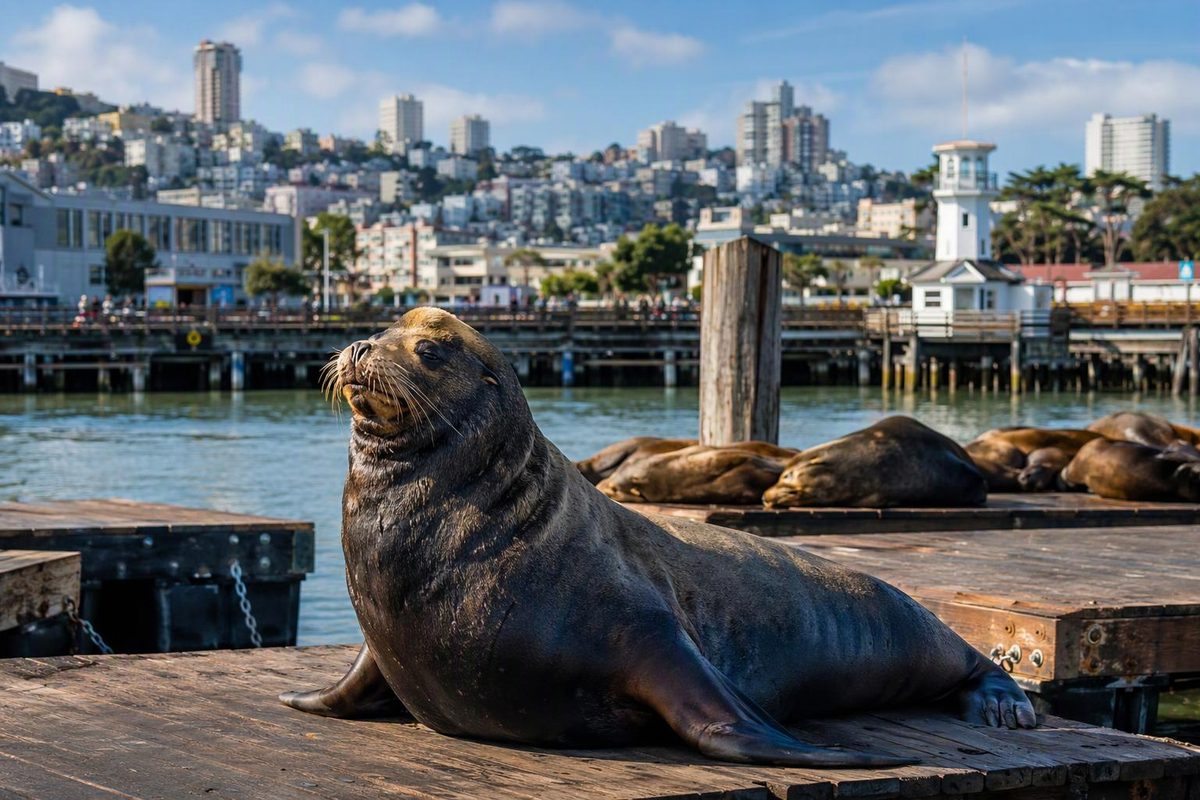
Look for Chonkers at Pier 39’s K-Dock in Fisherman’s Wharf, but check the live camera before making a special trip. Pier 39’s Chonkers guide identifies those docks as his resting spot when he visits. He is a wild Steller sea lion, not a scheduled attraction. The September 2026 sightings were identified as other animals, so they do not establish that the original Chonkers is there now. Add the stop if you also want the waterfront and regular sea lions; do not count on seeing him specifically.
Choose what would make the trip worthwhile and what you see on the camera; use the result to decide whether to go.
Is a Pier 39 Detour Worth It?
Go for the Wharf, not a promised Chonkers sighting.
K-Dock can be one stop in your waterfront outing. Check the live camera before leaving, but keep the trip worthwhile without a giant visitor.
Current sighting: unknown. A camera view cannot confirm the original Chonkers’ identity.
What This Recommendation Can Establish
Pier 39 identifies K-Dock as Chonkers’ visiting spot. September 2026 reports identified the large visitors as other animals. Before 10 a.m. is Pier 39’s viewing advice when Chonkers is visiting, not a daily appearance schedule.
This tool uses your observations; it does not read the webcam or verify sightings. An unclear view is unknown, not proof of absence. Even a visible animal can leave before you arrive.
Sources: Pier 39’s Chonkers guide and sea-lion webcam instructions; ABC7’s September 2026 reporting. No sighting probability is available.
K-Dock Is the Place to Look, Not a Guaranteed Sighting
The destination is the sea-lion viewing area overlooking K-Dock at Pier 39. That is the place to check when a report says Chonkers is visiting San Francisco. It is not a reservation-based encounter, and there is no appointment or performance time to plan around.
Two different questions matter here: whether a large Steller sea lion is on the docks, and whether that animal is the original Chonkers. A camera view can help with the first. It generally cannot settle the second, especially if you are identifying the animal only by its size next to the other sea lions.
That distinction changes how to plan the outing. If any unusually large sea lion would make your day, a current camera view showing one is useful evidence. If you are traveling specifically to see Chonkers, look for an identification from Pier 39 or the specialists quoted in reporting, rather than treating a social-media caption as confirmation.
Even a confirmed sighting is evidence of where an animal was at that moment, not a promise about where he will be when you reach the viewing area. Keep the rest of the waterfront visit worthwhile on its own.
September’s Giant Visitors Were Identified as Other Animals
Chonkers first appeared on March 13, 2026, according to Pier 39, and became a spring social-media sensation. More large Steller sea lions have visited since then. That makes a new photograph of a giant on the floats easy to mistake for news that the same animal has returned.
The September reports show why the identification matters:
| Visit | Reported Identification | Planning Meaning |
|---|---|---|
| September 3, 2026 | Another animal, according to ABC7’s account of Pier 39 officials | Not confirmation of Chonkers’ return |
| September 23, 2026 | Not Chonkers, based on visible scarring | Another Steller visit, not an original-Chonkers sighting |
For the September 3 visitor, harbormaster Sheila Chandor told The San Francisco Standard that staff thought the animal looked smaller than Chonkers, though she did not definitively rule him out. ABC7’s September 3 report said Pier 39 officials identified it as a different animal. Those accounts should not be flattened into a confident “Chonkers is back.”
For the September 23 visitor, the harbormaster and California Academy of Sciences identified the animal as not Chonkers, using visible scarring. The harbormaster also said the earlier September visitor had stayed only about a day. ABC7 reported both findings.
These visits establish that other large Stellers can turn up at K-Dock. They do not provide a return schedule for Chonkers, and the brief stay of one visitor is not a timetable for the next. Treat reports of “a giant sea lion” and reports identifying “Chonkers” as different levels of evidence.
Check the Live Camera Immediately Before Leaving
Open Pier 39’s sea-lion page and live webcam and press “GO LIVE.” The operator says “Control” lets you choose a camera position. Use that current view rather than relying on a saved clip embedded in a news story or shared on social media.
Look across the floats for an animal noticeably larger than its neighbors. That can help you notice a possible Steller visitor. It does not confirm the animal’s identity, and a distant view should not be treated as a substitute for the identification described in the September reporting.
Keep the camera check separate from the news check. Reporting can tell you what officials identified during a particular visit; the camera can help you decide whether there is something worth heading over to see now. Neither removes the possibility that the animal will leave before you arrive.
| What You Find | What It Supports | What It Does Not Prove |
|---|---|---|
| A giant in the live view | A large animal is visible now | That it is Chonkers |
| A recent identified sighting | The identity at that sighting | That he is still present |
| An older clip | A past visit | A current sighting |
| An unclear camera view | No usable confirmation | That he is definitely absent |
If the camera is unavailable or the view is too unclear to judge, leave the sighting status as unknown. Do not turn a technical problem into either a positive sighting or a definite absence.
Check again just before departure, particularly if there is a gap between planning and leaving. A sighting earlier that morning is not enough to make the later visit certain. If you are already nearby, the uncertainty may be acceptable; if the stop would displace something else you wanted to do, it deserves more weight.
Before 10 A.M. Is Viewing Advice, Not a Return Schedule
Pier 39 recommends arriving before 10 a.m. for the best chance of seeing Chonkers when he is visiting. The qualification matters: that advice assumes a visit is happening. It does not mean Chonkers appears every morning, or that an early arrival makes an otherwise unconfirmed trip reliable.
California Academy of Sciences specialist Sue Pemberton told ABC7 in its September 23 reporting that there is no way to predict when Stellers will be there; they follow the food. The available reporting provides no dependable October timetable and no numerical probability of seeing the original Chonkers.
Use the early-morning recommendation after checking for a current visit, not instead of checking. If you choose an early stop, also decide what you will do if the docks do not contain the animal you came for. An early viewing plan and an early indoor fallback are separate arrangements: the pier’s shops and restaurants do not all share the same opening time.
Waiting longer is not a way to turn an unknown arrival time into a scheduled one. There is no published wait length in the supplied sources that improves your odds by a known amount. Give the stop a place in your waterfront outing rather than leaving the rest of the day dependent on an arrival nobody can predict.
Reach Pier 39 Without Routing Over the Hills
Head to Pier 39 at Beach Street and the Embarcadero, then find the sea-lion viewing area overlooking K-Dock. Use the official pier map to orient yourself. The pier is the destination, but the dock-viewing area is the part you need; reaching the entrance is not the same as reaching the view of the floats.
There is no admission charge to enter Pier 39, according to its visitor FAQ. That makes a brief check easier to fold into a Wharf visit without committing to an admission purchase. It does not establish the cost of transport, food, parking, or other attractions; those are separate from entering the pier.
From Market Street or the Ferry Building, the F Market & Wharves streetcar keeps the approach along the waterfront rather than routing you over city hills. Its Wharf-bound stop is The Embarcadero & Stockton Street (Pier 39). Check SFMTA’s route page for arrivals and service status before boarding.
Use the waterfront destination to choose your route, not a distant photograph of the animal. The useful sequence is to check the camera, check transit, travel to Pier 39, and use the pier map for the final approach. If the streetcar service is disrupted, the route page is the place to resolve that before building the outing around it.
The supplied sources do not give a journey time from your starting point. Do not assume the animal will remain there for the length of your trip simply because the route itself is straightforward.
A Wharf Outing Is More Reliable Than a Chonkers-Only Detour
The strongest reason to go is that you would enjoy the waterfront and the regular sea lions even without Chonkers. In that case, checking K-Dock adds a specific target to an outing you already want. A possible giant visitor is a bonus rather than the only condition under which the trip succeeds.
Use the Fisherman’s Wharf walking route to connect the viewing stop with the rest of your plans. Keep the dock visit as one stop on that route, rather than repeatedly returning to the same view while other plans slip away.
If you are elsewhere in the city and only the original Chonkers would justify the journey, the threshold should be higher. A large animal visible on the webcam is still not an individual identification. An old confirmed photograph is still not a current sighting. Without both useful current evidence and an acceptable fallback, a special detour remains a gamble.
If you are already in Fisherman’s Wharf, the decision is different. You can make a brief dock check without treating it as the purpose of crossing the city. Decide what counts as a satisfying stop before you arrive: watching the regular sea lions, seeing any large Steller, or seeing the original Chonkers. Those are not interchangeable outcomes.
The planner above separates those preferences. Its recommendation is about whether the outing fits your expectations, not a forecast of animal behavior or a claim that the camera has verified Chonkers.
Keep an Early or Windy Stop Easy to Shorten
Bring a wind-resistant layer for the outdoor viewing stop. If rain or cold makes watching unpleasant, shorten it and move to a meal or indoor browsing rather than staying solely because you hoped an animal might arrive.
Check venue hours before relying on that fallback. Most shops and eateries are listed as opening at 10 a.m. or later, though some restaurants serve breakfast earlier. The recommendation to look before 10 a.m. therefore does not mean every nearby business will be ready to receive you afterward.
Choose the fallback by its actual opening hours, especially for an early visit. A closed shop is not an indoor alternative, and the absence of Chonkers does not make waiting outside more productive. If your only acceptable outcome is seeing him, postponing a special trip can be more sensible than filling time at the docks without current evidence.
Watch From the Visitor Area Without Disturbing the Animals
Stay in the visitor viewing area. Do not feed, handle, or harass the sea lions. Pier 39’s sea-lion guide notes that they may bite if provoked and describes their legal protections.
A closer encounter is not part of this viewing plan. Use the designated view of the floats, accept that identification may remain uncertain, and leave the animals undisturbed. The practical plan is a current camera check, a waterfront approach to K-Dock, and another worthwhile Wharf stop—not a promise that Chonkers will be waiting.