
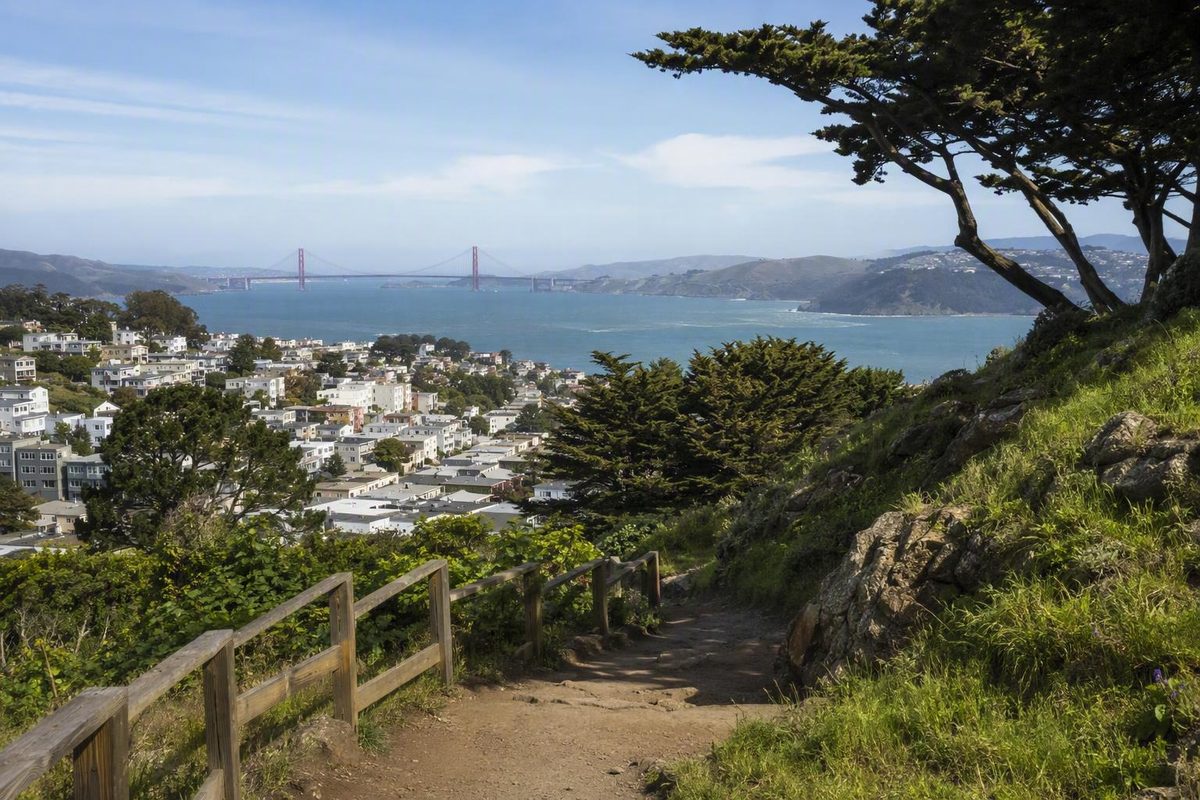
Golden Gate Heights Park works best as a short neighborhood stop, not a standalone hiking destination. Arrive near 12th Avenue and Rockridge Drive, expect stairs and uneven surfaces, and treat any Pacific view as a weather- and foliage-dependent bonus. To build a longer outing, combine the park with nearby mosaic stairways, Grandview Park, or the Crosstown Trail—but only if your group is ready for more climbing.
Golden Gate Heights Park at a glance
This compact park sits in the residential Golden Gate Heights neighborhood on San Francisco’s west side. The clearest arrival reference is the corner of 12th Avenue and Rockridge Drive. Some listings use 2002 12th Avenue, which appears to refer to the same general park area rather than a separate destination.
The park contains Larsen Peak, but it is not the place to plan a long summit hike. Think of it as a brief local walk, a play stop, or a pause within a wider route through the surrounding hills.
| Detail | What to expect |
|---|---|
| Location | 12th Avenue and Rockridge Drive; some listings use 2002 12th Avenue |
| Best visit style | Short park visit or one stop in a longer hill walk |
| Terrain | Steps, slopes, sand, and paved and unpaved paths |
| Reported amenities | Playground, two tennis courts, green space, benches, and disputed picnic seating |
| Views | Possible western views across the Sunset District toward the Pacific |
| Listed hours | Daily, 5:00 AM–11:45 PM |
| Confirm before visiting | Hours, closures, restrooms, water, picnic tables, dog rules, court access, and path conditions |
The listed hours come from an Apple Maps listing for Golden Gate Heights Park, which also gives the phone number as 415-242-5647. Both details can change, so confirm them with San Francisco Recreation and Parks if your plans depend on an early or late visit.
What you can see and do inside the park
The park’s small scale is part of its appeal. You can look around without committing the rest of your day, but its internal paths do not amount to a substantial hike.
Visitor accounts and park guides report a children’s playground, tennis courts, open green areas, benches, and a mixture of paved and unpaved paths. Near Rockridge Drive, an open meadow and stone steps leading toward the courts provide useful orientation points. Because these details come largely from third-party guides and older visitor reports, the condition or availability of individual amenities may differ when you arrive.
Larsen Peak lies within the park. The practical approach is to explore the established internal paths rather than improvise a direct climb through vegetation or sandy ground.
One detailed park guide says several repetitions of the internal paths would be needed to reach a mile, reinforcing that this is a short walk rather than a mileage-driven hike. The same guide to Golden Gate Heights Park describes the meadow, stone steps, playground, courts, benches, and mixed trail surfaces.
The park is therefore a natural fit for:
- a short walk between other neighborhood stops;
- a playground or green-space break;
- a quick look at the wooded and sandy terrain;
- or a pause during a longer stairway or Crosstown Trail outing.
If your priority is a long nature walk, choose a larger park. Golden Gate Heights Park makes more sense when you want a quiet hilltop interlude that can remain brief or expand into a neighborhood walk.
Terrain and views: expect hills, trees, and changing visibility
A park guide describes broader, marked paths on the eastern side and narrower, sandy paths and offshoots on the western side. The western dune area is erosion-prone, so stay on established trails instead of treating every visible track as a route. The terrain and erosion guidance also notes stone steps and sandy ground.
The walk inside the park may be short, but getting there and moving through it can still take effort. Steep neighborhood approaches, stairs, slopes, sand, and transitions between paved and unpaved surfaces may be difficult for visitors with limited mobility. Do not plan around a wheelchair- or stroller-accessible route without current confirmation from the city.
Views vary with fog, foliage, and your position. Openings on the western side may reveal the Sunset District and Pacific Ocean, while Monterey pines and other vegetation can narrow or block the sightline. Larsen Peak is reported at 774 feet, but elevation does not guarantee an unobstructed panorama.
The trees also contribute to the park’s habitat value. A local guide to Golden Gate Heights identifies the park as part of the Green Hairstreak Corridor, a network of neighborhood open spaces associated with birds and the coastal green hairstreak butterfly.
Come for the wooded hilltop setting and the possibility of an ocean glimpse, not a guaranteed postcard view. If broad panoramas are your priority, keep Grandview Park as a separate destination rather than assuming its outlook belongs to Golden Gate Heights Park.
Getting there without underestimating the climb
Use 12th Avenue and Rockridge Drive as the most useful arrival reference. The alternative listing, 2002 12th Avenue, appears to identify the same general park area, but it should not be treated as proof of a particular entrance.
Third-party neighborhood coverage associates Muni routes 52 and 66 with Golden Gate Heights. Other bus and light-rail lines connect with the broader central Crosstown Trail area, but that does not mean every stop is close to the park or avoids climbing. The neighborhood transit overview is useful for orientation, but current service should be checked with SFMTA.
Before leaving, review current schedules, service notices, stop locations, and the walking route from your chosen stop. Do not choose an approach solely because it appears short on a map: a brief distance in Golden Gate Heights can still include stairs or a sharp grade. There is no supported basis for naming one transit approach as the easiest or least steep.
Street parking has been reported in the surrounding residential neighborhood, but availability and restrictions can vary by block and time. Read every posted sign rather than assuming parking is unrestricted. If you drive, leave no bags, electronics, luggage, or other belongings visible in the vehicle.
If you are planning an early-morning or late-evening stop, confirm the listed park hours first rather than treating the map listing as a permanent schedule.
Choose the visit that fits your energy and schedule
The best plan depends less on the park’s size than on how much climbing you want before and after it.
| Visit choice | What to include | Best for |
|---|---|---|
| Compact park visit | Meadow, courts, established paths, and western view openings | A brief neighborhood stop |
| Neighborhood hills and stairs | Park, Hidden Garden Steps, 16th Avenue Tiled Steps, and Grandview Park | Visitors comfortable with substantial climbing |
| Crosstown Trail Section 3 | Park as one feature within the broader trail route | Strong walkers wanting a longer urban outing |
For the compact visit, begin near 12th Avenue and Rockridge Drive. Look for the meadow and courts, follow the established internal paths, and check the western openings for a possible Pacific view. The park’s short distances mean there is little benefit in pursuing every sandy offshoot.
For a neighborhood hills-and-stairs outing, consider pairing the park with the Hidden Garden Steps, 16th Avenue Tiled Steps, and Grandview Park. These are separate sights spread across a steep residential area, not one flat attraction complex. Build the day around your group’s hill tolerance rather than trying to include every staircase that appears nearby.
Grandview Park needs a clear distinction. The broad panoramic views highlighted in coverage of this area are often associated specifically with Grandview Park. Photographs taken there should not be treated as a promise of what you will see inside the more wooded Golden Gate Heights Park.
For the Crosstown Trail option, Golden Gate Heights Park is included in Section 3. The broader route uses streets, sidewalks, paths, steep stairways, and mixed surfaces, with repeated elevation changes. Use the trail organization’s current maps and turn-by-turn directions rather than relying on a simplified neighborhood description. On this terrain, a missed turn can add an unwanted descent followed by another climb.
A flexible plan works best: visit the park first, then decide whether to continue. If the approach has already used more energy than expected, stopping there is a sensible choice—not a failed itinerary.
What to verify before you go
Check these details close to your visit:
- Current opening hours and temporary closures
- Restroom availability
- Drinking-water availability
- Whether picnic tables are currently present
- Current dog and leash rules
- Tennis-court access or restrictions
- Playground and path conditions
- Parking signs on the block where you leave your vehicle
Restroom information conflicts. One guide refers to park descriptions mentioning toilets but says they could not be found during a visit. Another neighborhood source reports no public restroom or drinking fountain. Unless the city confirms otherwise, plan as though neither facility will be available.
Picnic-table reports also disagree. A park guide describes picnic seating near the meadow, while an older visitor review reported no tables. Bring a plan that does not depend on finding a table.
That older review also described leashed dogs, but a past visitor’s observation is not current policy. Confirm present dog and leash rules through San Francisco Recreation and Parks and follow signs at the park.
Compact does not mean accessible. The documented setting includes stairs, steep grades, sand, and mixed surfaces, so visitors with mobility concerns should not assume there is a suitable step-free route.
Golden Gate Heights Park is most rewarding as a small local hilltop stop for visitors comfortable with uneven terrain. Arrive near 12th Avenue and Rockridge Drive, keep ocean-view expectations flexible, and extend the outing toward the tiled steps, Grandview Park, or the Crosstown Trail only if your group has energy for more climbing. In the erosion-sensitive western area, remain on established paths and follow all posted safety, wildlife, and parking signs.