
Overview
The best parks in San Francisco are Golden Gate Park for an all-round day, Presidio Tunnel Tops and Crissy Field for Golden Gate Bridge views, Lands End for coastal walking, Alamo Square and Mission Dolores Park for picnics with classic city views, and McLaren Park for quieter trails. The deciding factor is what you want to do, not a fixed ranking.
One clarification before you compare: this shortlist mixes different kinds of public space, and knowing which is which changes how you plan. Golden Gate Park, Alamo Square, Mission Dolores Park, and McLaren Park are city parks. Presidio Tunnel Tops, Crissy Field, Lands End, and Baker Beach sit on the northern and western waterfront, and IHG’s local-area guide places the Tunnel Tops within the wider Golden Gate National Recreation Area, but alert and condition sources differ by site, so check with the relevant managing agency for each place you plan to visit. Lands End is best understood as a coastal trail rather than a lawn-style park, and places like Koret Children’s Quarter are playgrounds inside a much larger park. Some paid attractions, such as the de Young Museum and the California Academy of Sciences, sit inside Golden Gate Park but run on their own hours and admission.
The matrix below compares the shortlist by best-supported use, setting, and the main caveat that should shape your decision. Logistics that vary day to day, such as event schedules and facility status, are flagged rather than promised.
| Place | What it is | Best for | Typical visit shape | Main caveat |
|---|---|---|---|---|
| Golden Gate Park | Large city park | All-round day: gardens, museums, playgrounds, lawns | Half day or more, built around one or two chosen stops | Too large to visit without a plan; weekend events affect parking (San Francisco Moms) |
| Presidio Tunnel Tops | National parkland overlooking the bay | Bridge and city views, family play, picnics | 1–3 hours, pairs naturally with Crissy Field | Nearby lots are paid parking (Presidio Trust) |
| Crissy Field | Waterfront parkland with beach and promenade | Flat walking, jogging, cycling by the bay | 1–2 hours, often combined with Tunnel Tops | Windswept shoreline; check the status of individual facilities like Crissy Field Center |
| Lands End | Coastal trail on the city’s northwest edge | Cliffside hiking with ocean and bridge views | 1–3 hours on foot | Trail terrain, not a lawn park; not a picnic-blanket destination |
| Alamo Square Park | Small city park | Painted Ladies photos, skyline picnics | Under an hour to a lazy afternoon | Sloped lawns; a popular photo stop rather than an activity park |
| Mission Dolores Park | City park on a slope | Relaxing on the grass, casual sports, people-watching | 1–3 hours | Busy scene; weekdays are less crowded than weekends (510 Families) |
| McLaren Park | Large city park in the southeast | Wilder urban hiking and bird-watching | 1–3 hours on trails | Vehicle break-ins in the parking area are commonplace (Apple Maps guide) |
| Mountain Lake Park | Neighborhood park with playground | Toddler-focused play in an enclosed area | Around an hour | A play stop, not a sightseeing destination |
Use the table to narrow to one or two candidates, then read the matching section below for the comparison detail, the family fit, and the practical checks that should happen before you leave.
Choose a park by what you want to do
Pick your park by the experience you want, because the famous names serve very different outings. The recurring shortlist across local guides, from Apple Maps’ curated San Francisco parks guide to IHG’s parks overview, differentiates parks by scenery and activity rather than by any objective rank, and that is the honest way to choose.
Three questions sort most decisions quickly. First, do you want a specific view, such as the Golden Gate Bridge, the Pacific, the Painted Ladies, or the downtown skyline? Second, do you want to move, whether that means cliffside hiking, flat waterfront cycling, or garden strolling, or do you want to sit on grass with food? Third, are you heading to Golden Gate Park, which is less a single decision than a container for many smaller ones?
The next three sections handle those cases in order: iconic views, activity-led outings, and how to plan a specific stop inside Golden Gate Park.
Iconic views and classic San Francisco scenery
For the single most recognizable San Francisco photo, choose Alamo Square Park. IHG’s parks guide describes its celebrated row of Painted Ladies with the downtown skyline behind them, and its sloped lawns work for a picnic while you take in the view. The slope is part of the experience, so treat it as a sit-and-look park rather than a flat play space.
Mission Dolores Park offers a different version of the classic city view. The Apple Maps parks guide describes grassy slopes dedicated to lolling while the lowlands host soccer, frisbee, and other local sports, and Tripadvisor reviewers point to the relaxed atmosphere with the city spread out below. Choose Dolores when you want the view plus a social scene, and Alamo Square when you want the postcard composition specifically.
For ocean and bridge scenery earned on foot, Lands End is the strongest choice. IHG describes the Lands End Trail winding through windswept cypress groves and along craggy cliffs with panoramic views of the Pacific Ocean and the Golden Gate Bridge. This is trail scenery, which means changing elevation and dirt paths rather than lawns.
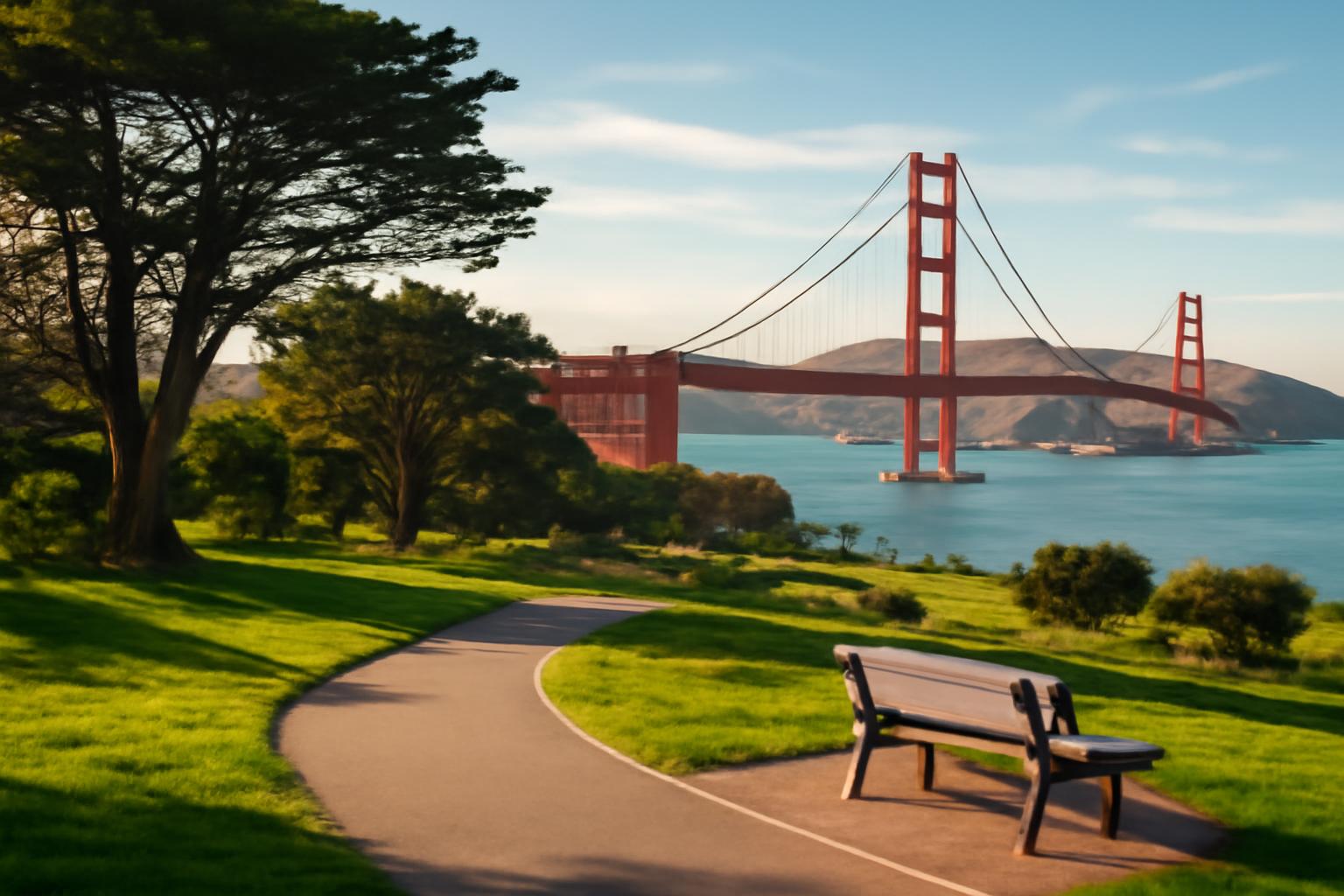
If you want the bridge at water level without the climb, Crissy Field is the flat alternative. Tripadvisor reviewers describe Golden Gate Bridge views with the bay right beside you along a wide, open stretch, and IHG notes the flat promenade and windswept beach. Directly above it, Presidio Tunnel Tops adds scenic overlooks, trails, and picnic areas with city views, planted with 180 varieties of native plants according to IHG’s guide.
The practical split: Alamo Square and Dolores for city-facing views you sit with, Lands End for coastal views you walk to, and Crissy Field with Tunnel Tops for bridge views on flat ground. If anyone in your group struggles with hills, that last distinction matters most.
Walking, hiking, cycling, gardens, and picnics
Match the terrain to the activity, because these parks reward very different kinds of movement.
For a real hike inside the city, Lands End and McLaren Park are the two serious options. Lands End delivers the dramatic coastal version, with the trail carving through cypress groves along cliffs above the Pacific, per IHG’s description. McLaren Park is the inland, wilder version: the Apple Maps guide puts it at 312 acres, the second largest park in San Francisco proper, with some 7 miles of trails including the Philosopher’s Way spreading over forests, fields, and hillside city views. The same guide calls it great for urban hiking, bird-watching, and spotting the occasional coyote. Choose Lands End for scenery-first walking with more visitors around; choose McLaren when you want space and fewer people on the trail.
For cycling, jogging, or a long flat walk, Crissy Field is the clear pick. IHG describes its wide, flat promenade as ideal for jogging, cycling, and walking, with the beach drawing sunbathers and kiteboarders. Flat waterfront ground is rare in this city, so Crissy Field is also the default when strollers or tired legs are part of the equation.
For gardens, Golden Gate Park has no real competitor on this list. IHG names the Japanese Tea Garden and the Conservatory of Flowers among its serene spaces, alongside the park’s museums. Garden visits inside the park may involve admission and their own hours, so confirm those on the venues’ official pages before you go.
For a picnic, the choice is between atmosphere types. Alamo Square gives you sloped lawns and the skyline. Dolores gives you the social scene, with the lowlands hosting pickup sports and, as the Apple Maps guide notes, everything from frisbee to political protests. Tunnel Tops adds picnic areas with overlooks and, per IHG, a daily lineup of mobile food vendors at the Presidio Pop Up, which solves the food question without packing anything.
Plan a specific stop inside Golden Gate Park
Golden Gate Park is the strongest all-round destination on this list, and that is exactly why you should not drive toward it without choosing a stop first. The Apple Maps guide captures the range: from bonsai, buffalo, and redwoods to frisbees, free music, and free spirits, the park contains a large share of what the city does outdoors. That breadth means “go to Golden Gate Park” is not yet a plan.
Decide the anchor stop before you leave. IHG’s guide identifies the main categories: world-class institutions such as the de Young Museum and the California Academy of Sciences, and quieter spaces such as the Japanese Tea Garden and the Conservatory of Flowers. Families usually anchor on Koret Children’s Quarter, the park’s large destination playground covered in the family section below. Each anchor sits in a different part of a very large park, so the anchor determines where you enter, where you park, and how much walking the rest of the day involves.
Treat admission and operating details as items to verify, not assumptions. The museums and gardens are separate venues with their own hours, ticketing, and closure days, and none of that is stable enough to state here; check each venue’s official page the day before you go.
One parking note from a local source: San Francisco Moms reports that you can almost always find parking not too far from Koret Children’s Quarter, but recommends avoiding the area entirely when weekend events are happening in the park. Checking the park’s event calendar is the single highest-value step in planning a Golden Gate Park visit by car.
Best parks and playgrounds for families
Family park selection is a separate decision from scenic park selection, because the right answer depends on your children’s ages, the play equipment, whether the play area is enclosed, and how much supervision the layout demands of you. A park that suits a seven-year-old who wants monkey bars can be a stressful outing with a toddler who bolts, and the reverse is also true.
The evidence supports two distinct family strategies. The first is the destination playground: a large play area worth a trip on its own, ideally next to sights the adults want to see. The second is the contained neighborhood playground: smaller, enclosed, and built for younger children who need boundaries more than variety.
The next two sections compare the two strongest destination playgrounds, then explain the enclosure and supervision tradeoff that should drive the choice for parents of toddlers.
Destination playgrounds for mixed-age families
For a family outing that satisfies both children and adults, the Outpost at Presidio Tunnel Tops is the strongest choice in the city. IHG’s guide describes a two-acre nature play area for children, educational activities at the Field Station, and daily mobile food vendors at the Presidio Pop Up. Destination Daydreamer, a family travel site, adds the detail that matters most to parents: the playground itself is imaginative, and it has views of the Golden Gate Bridge, which makes the supervision time genuinely pleasant. The same source confirms toilets on site and lists the address as 210 Lincoln Blvd, with the Golden Gate Bridge, Crissy Field, the Palace of Fine Arts, and Fort Point among the nearby attractions. The playground sits right along the Golden Gate Bridge bike path, so cycling families can build it into a ride.
Koret Children’s Quarter in Golden Gate Park is the strongest choice when you want maximum play variety across ages. Destination Daydreamer describes a huge play area with two large play structures with stairs, slides, firepoles, and monkey bars, one geared toward older kids and the other toward younger kids. That deliberate age split is the feature to notice: siblings several years apart can both find equipment at their level, which is not true of most single-structure playgrounds. Because Koret sits inside Golden Gate Park, it also pairs naturally with a museum or garden stop for the adults, as covered in the clusters section below.
The honest tradeoff between the two: Tunnel Tops offers the better adult experience and the stronger sightseeing pairing, while Koret offers more equipment variety and a full park around it. Both are large, open destinations, which raises the supervision question addressed next.
Toddler fit and the supervision tradeoff
Enclosure and scale determine how hard a playground visit is on the supervising adult, and the local evidence makes the tradeoff concrete. San Francisco Moms names Mountain Lake Park as its favorite playground for toddlers specifically because the toddler section is enclosed and offers sensory equipment designed for small children. At the other end of the scale, a parent writing for 510 Families warns about one of the city’s large destination playgrounds: it is huge and not gated, and watching two children there is “doable as long as I never sit down.”
That contrast turns into a simple set of selection criteria for parents:
- Enclosure: a fenced or enclosed area lets a toddler roam while you stay in one place; an ungated destination playground requires constant movement.
- Scale and sightlines: bigger playgrounds mean longer distances between structures and more moments when a child is out of view.
- Age-split equipment: separate structures for older and younger kids, as at Koret, reduce collisions between fast big kids and slow small ones.
- Adult-to-child ratio: one adult with two mobile kids should weight enclosure heavily; two adults can handle an open destination playground comfortably.
The practical rule: with a toddler and one adult, Mountain Lake Park is the documented enclosed option; before choosing another playground, check its enclosure, scale, and sightlines to judge how demanding supervision will be. With school-age kids or a second adult, the size and variety of Koret or the Tunnel Tops Outpost pay off.
Quieter and less-obvious alternatives
If the famous parks do not fit your outing, four alternatives serve specific purposes, though the evidence supports each at a different level of detail.
McLaren Park is the strongest documented alternative and the best choice for hiking without crowds. The Apple Maps parks guide calls it arguably the most underrated park in the city at 312 acres, with roughly 7 miles of trails including the Philosopher’s Way crossing forests, fields, and hillside viewpoints. It is explicitly wilder than Golden Gate Park, suited to urban hiking and bird-watching, with the occasional coyote sighting. The same guide states one caveat plainly: vehicle break-ins in the parking area are commonplace, so follow the car-security guidance in the planning section below or arrive without valuables at all.
Mountain Lake Park is the alternative for parents of toddlers rather than a general destination. As covered above, San Francisco Moms highlights its enclosed toddler section with sensory equipment, which makes it a lower-stress choice than any of the large open playgrounds. Treat it as a purpose-built play stop, not a sightseeing park.
Salesforce Park is the transit-first option. 510 Families lists it, along with the Dolores and Sue Bierman playgrounds, as accessible by BART, which makes it a practical choice if you are downtown without a car or arriving from the East Bay and want a park stop without a parking search.
Ina Coolbrith Park appears on the Apple Maps best-parks shortlist alongside the larger names, but the available evidence documents little beyond its inclusion. Treat it as a smaller stop worth considering if you are already nearby, not as a primary destination you plan a day around, and check current details before making the trip.
One honest caution about this whole category: “less obvious” does not automatically mean quiet or empty. McLaren’s scale supports the low-crowd expectation, but for the others, plan around purpose fit rather than an assumption of solitude.
Park clusters that work well in one outing
Choosing parks that sit near each other turns a single stop into a full outing without cross-city travel, and the evidence supports several specific groupings. Travel times between stops depend on your mode and pace, so treat these as adjacency plans rather than timed itineraries.
Three clusters have direct source support or clear geographic logic:
- Presidio waterfront cluster: Presidio Tunnel Tops sits directly above Crissy Field, and Destination Daydreamer lists the Golden Gate Bridge, Crissy Field, the Palace of Fine Arts, and Fort Point as attractions near the Tunnel Tops playground, and Tunnel Tops itself sits right along the Golden Gate Bridge Bike Path. This is the strongest mixed-interest cluster in the city: kids get the two-acre Outpost play area, adults get bridge views and flat waterfront walking, and IHG notes daily food vendors at the Presidio Pop Up so nobody has to leave to eat.
- Golden Gate Park internal cluster: the park contains its own cluster, with the de Young Museum, the California Academy of Sciences, the Japanese Tea Garden, and the Conservatory of Flowers named by IHG, plus Koret Children’s Quarter for families. Pick two stops that sit near each other rather than trying to cover the whole park, since walking distances inside it are substantial.
- Dolores and the Mission: Mission Dolores Park sits inside a dense neighborhood grid, and 510 Families lists the Dolores playground as BART-accessible, so a park afternoon pairs naturally with food and a neighborhood walk before or after without any driving.
The pairing principle behind all three clusters is worth applying anywhere: put the playground or lawn stop next to the thing the adults want, so a mixed-age group satisfies two interests in one location. Tunnel Tops next to the bridge views is the cleanest example, and Koret inside a museum-and-garden park is the second. On the coastal side, Lands End and Baker Beach both sit on the city’s northwest edge, so a trail walk and a beach stop can share one trip, though you should verify Baker Beach conditions first, as covered in the accessibility section.
Plan the practical details before you go
Once you have chosen a park, three categories of practical detail can still make or break the visit, and each behaves differently. Parking and crowds vary by location, weekday, and event schedule, so the useful guidance is about patterns and precautions rather than guarantees. Accessibility details are verifiable for some places and undocumented for others, so this article states only what official sources confirm. Hours, fees, closures, and the status of individual facilities change over time and must be checked against official pages close to your visit date.
None of this should push you back toward indecision. The recommended parks are established public destinations, and for most visits the practical check takes a few minutes: look at the event calendar or alerts page for your chosen park, confirm any paid venue’s hours, and follow the car-security basics below. The next three sections cover each category in the order you will encounter it: getting there and parking, moving around once you arrive, and confirming that what you came for is actually open.
Parking, crowds, and car security
Parking difficulty in San Francisco parks is location-specific, so plan by park rather than by a citywide rule. The evidence shows the spread: San Francisco Moms reports that parking near Koret Children’s Quarter in Golden Gate Park is usually findable, except when weekend events are on, in which case the source recommends avoiding the area entirely. A 510 Families contributor describes the opposite experience at a busier destination, calling parking “a drag” and advising an early arrival to find a space. The same source offers the most reliable crowd pattern in the evidence: weekdays are less crowded than weekends. Near Presidio Tunnel Tops, the Presidio Trust notes that the nearby lots are paid parking, so budget for that rather than circling for street spots.
Car security deserves separate attention from finding a space. The Apple Maps guide states that vehicle break-ins are commonplace in the McLaren Park parking area, and the National Park Service posted an auto-theft warning for Golden Gate National Recreation Area lots and scenic overlooks on May 23, 2025. The NPS alerts page gives three steps to take before leaving your car for even a short period:
- Remove all valuables from the vehicle.
- Lock your doors.
- Take your cell phones and electronics with you.
The simplest version of this advice: arrive with nothing in the car worth taking, and the parking decision becomes purely about convenience. If you can use transit instead, 510 Families’ note that the Dolores, Salesforce Park, and Sue Bierman playgrounds are BART-accessible removes the problem entirely for those destinations.
Accessibility and stroller planning
Verified accessibility detail exists for two places on this shortlist, and both are useful benchmarks; for the rest, you will need to check with the managing agency before relying on step-free access.
Presidio Tunnel Tops has the strongest documented accessibility on the list. According to the Presidio Trust’s accessibility page, most pathways at the site are flat, and two wheelchair-accessible paths connect the northern waterfront section near Crissy Field to the southern section near the Presidio Visitor Center. Several nearby paid lots include accessible parking spaces, and visitors with a properly displayed disabled person placard are not required to pay for parking. Two passenger loading zones accommodate people with impaired mobility, all-gender wheelchair-accessible restrooms are located inside the Presidio Transit Center and near the Outpost playground and Field Station, and all-gender wheelchair-accessible restrooms are located inside the Presidio Transit Center and near the Outpost playground and Field Station. For families, flat wheelchair-accessible paths also mean straightforward stroller terrain.
Baker Beach has specific but partly dated information. The NPS Baker Beach accessibility page lists six accessible parking spaces with van access in the North lot and three in the South lot, an accessible restroom adjacent to the North lot, an accessible portable toilet at the South lot, accessible picnic sites with tables and grills, and beach wheelchairs stored on site that can be reserved. The same page states that the permanent accessible ramp to the beach was damaged in a storm and that the park is seeking funding to repair it. That page was last updated September 7, 2023, so confirm the ramp’s current status with the park before planning a beach-level visit around it.
Do not extrapolate from these two examples to the rest of the shortlist. Comparable official detail is not available in the evidence for Lands End, McLaren, Alamo Square, or Dolores, so contact the managing agency or check its accessibility pages if step-free access, grades, or accessible restrooms will determine whether the visit works.
Verify hours, fees, closures, and facility status
Hours, fees, closures, reservations, and restroom availability are dynamic, and no article can honestly state them for a full shortlist, so the final planning step is always a check against the relevant official page. For the waterfront sites, the Golden Gate National Recreation Area alerts and conditions page is the right source, and its recent history shows why the check matters: posted alerts have included road and parking area closures at upper Fort Mason planned from fall 2025 through fall 2026 and temporary trail closures for maintenance. For Presidio sites, the Presidio Trust’s pages serve the same role, and for city parks and paid venues inside Golden Gate Park, check each venue’s own official page.
One example from this article’s evidence shows the most common verification mistake: confusing the status of a single facility with the status of the park around it. The Apple Maps guide lists “Crissy Field Center” among the best parks, while IHG’s guide describes Crissy Field itself as an open waterfront destination, and the Presidio Trust’s accessibility page references the Crissy Field Center only as a parking address at 603 Mason Street. The available evidence does not establish the center’s current operating status, and it does not need to for most visits: the shoreline, promenade, and beach at Crissy Field are the destination for the walking and cycling outings recommended here. The general rule follows directly: verify the specific building, museum, garden, or program you are counting on, and verify the parkland separately, because either can be open while the other is not.
Do that one check the day before you go, apply the parking and security basics above, and any park on this shortlist becomes a low-friction outing rather than a gamble.