
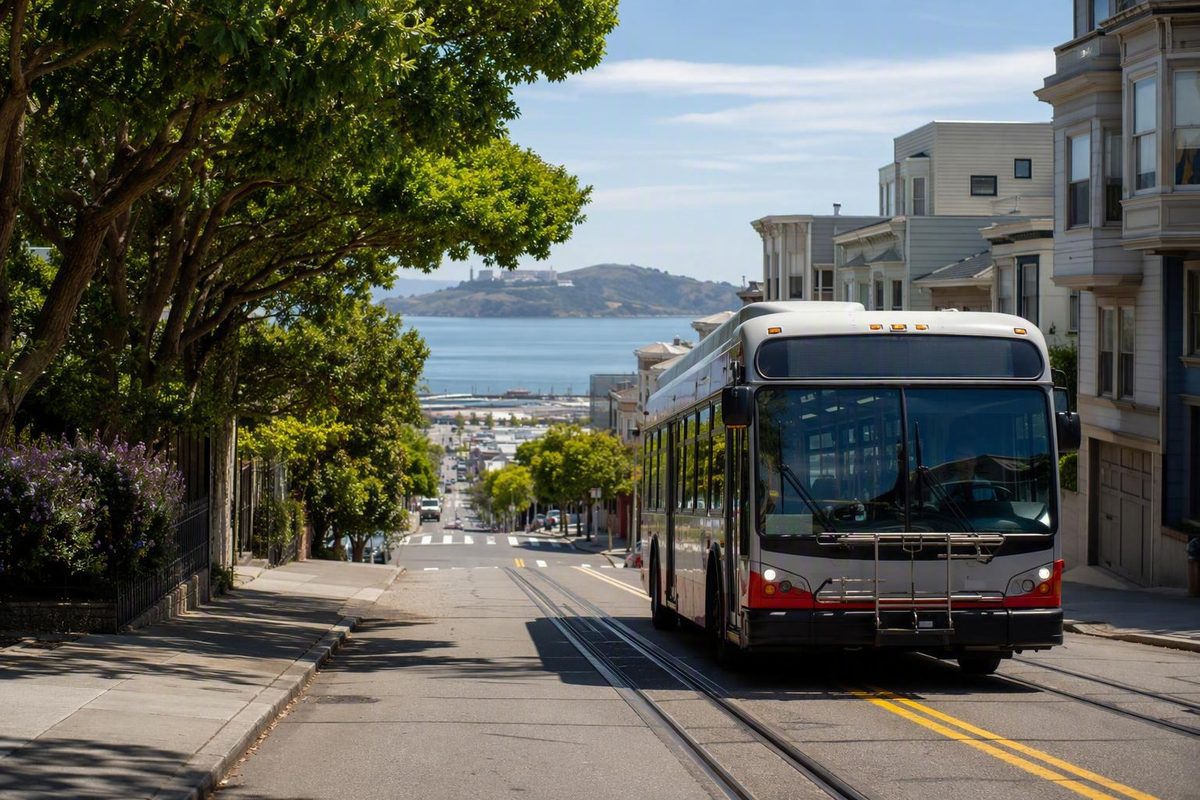
SFMTA scheduled a targeted Muni service package for Saturday, August 29, 2026. The plan called for slightly more frequent service on the 1 California and N Judah, 60-foot buses on the 5R Fulton Rapid, added morning capacity on four other busy routes, and school-access changes involving the 8AX and 28R.
This is a record of the announced plan, not a verified account of current service. The available notices do not establish that every detail took effect as described or remains active. Before planning a trip now, confirm the route in current SFMTA timetables, maps and service alerts.
The short answer: what was scheduled for August 29
The package separated into three types of changes:
- More frequent service: 1 California and N Judah
- More carrying capacity: larger buses on the 5R, plus added morning capacity on the 22 Fillmore, 29 Sunset, 38R Geary Rapid and 49 Van Ness/Mission
- School access: a one-seat 8AX connection to Francisco Middle School and a new 28R stop near Lowell High School
The frequency changes were modest rather than transformative. The 5R was supposed to retain its existing scheduled interval while using larger buses. For the other four capacity routes, SFMTA did not announce shorter headways.
Status note: Treat the details below as the August 29 announcement. For a trip today, use the current route timetable and check service alerts shortly before leaving.
Route-by-route table: frequency versus added capacity
Frequency describes how often a trip is scheduled. Capacity describes how many riders the available trips can carry. A route can gain capacity through larger vehicles or targeted assignments without buses arriving more frequently.
The following figures and route changes come from SFMTA’s official August 29 service update.
| Route | Previous service | Announced August 29 plan | Affected period and verification note |
|---|---|---|---|
| 1 California | Every 10 minutes | Every nine minutes; approximately every four to five minutes for combined downtown service | The notice does not define the complete operating window. Check the current timetable. |
| N Judah | Every 10 minutes | Every nine minutes | Peak periods; confirm the present peak schedule. |
| 5R Fulton Rapid | Every 10 minutes | Keep 10-minute frequency while using 60-foot buses on all scheduled trips | A capacity change, not a shorter headway. Vehicle assignments can change operationally. |
| 22 Fillmore | No previous interval specified | Added capacity | Morning peak; the amount and method were not specified. Do not assume shorter waits. |
| 29 Sunset | No previous interval specified | Added capacity | Morning peak; exact trips and the size of the increase were not specified. |
| 38R Geary Rapid | No previous interval specified | Added capacity | Morning peak; no shorter headway was confirmed. |
| 49 Van Ness/Mission | No previous interval specified | Added capacity | Morning peak; exact trip-level changes were not published. |
The clearest distinction is between a frequency improvement and a capacity improvement. The 1 and N received stated reductions in scheduled headway. The 5R kept a 10-minute interval but was assigned larger buses. The 22, 29, 38R and 49 were promised more morning capacity, which could affect crowding without necessarily changing the time between buses.
Exact peak windows and affected trips were not included in the notices. SFMTA also did not specify how much capacity would be added to the 22, 29, 38R and 49 or whether it would come from larger vehicles, different trip assignments or another operational change.
Evening and overnight details that need an extra check
Local news reporting supplied two details beyond those fully documented in the official route summary. SFist reported that the 29 Sunset would receive additional evening service and that 22-Owl buses would be scheduled every 30 minutes as part of the broader adjustments (SFist’s account of the Muni changes).
Those details are useful for understanding the announcement, but they are not complete trip-planning instructions. The report does not identify the additional 29 service’s evening hours. It also does not establish whether the 30-minute 22-Owl interval covered every night, the entire overnight service span or the full route.
That uncertainty matters most when planning a late hotel return or an early-morning connection, when missing one trip can create a much longer delay. Check the current 29 or 22 timetable rather than assuming the reported evening and Owl arrangements remain active.
School trips: the 8AX connection and new 28R stop
SFMTA announced a one-seat 8AX ride from Visitacion Valley to Francisco Middle School. SFist described the change differently, reporting that students using the 8AX-Bayshore Express would no longer need a transfer pass (SFist’s school-service description).
Both descriptions point to a simpler school journey, but neither provides the complete operating arrangement. Families should confirm the specific school-day trip they intend to use.
The package also called for a new 28R 19th Avenue Rapid stop at 19th Avenue and Eucalyptus Drive near Lowell High School. The announcement identifies the intersection but does not establish the current stop status or exact boarding point for each direction. Consult the present route map before walking to 19th Avenue.
What the changes meant for trip planning
Moving from a 10-minute to a nine-minute scheduled headway is a modest frequency improvement. A 10-minute interval represents six scheduled vehicles per hour; a nine-minute interval represents about 6.7. That calculation follows directly from the intervals in SFMTA’s published service plan.
A nine-minute headway is not a guaranteed maximum wait. It describes the schedule. The actual wait at a stop can differ when vehicles become unevenly spaced or service is disrupted.
For riders, the practical meaning of each change was:
- 1 California rider: Slightly more frequent scheduled service, with approximately four- to five-minute combined service downtown. The complete operating window was not stated.
- Peak-period N Judah rider: A modest frequency increase from every 10 minutes to every nine minutes.
- 5R Fulton Rapid rider: The same 10-minute scheduled interval, but with 60-foot buses intended for every scheduled trip.
- 22, 29, 38R or 49 rider: More morning peak capacity, but not necessarily a shorter wait.
- Student using the 8AX or 28R: A planned simpler connection to Francisco Middle School or an additional rapid stop near Lowell High School, subject to the current school-day schedule and route map.
For visitors, the simplest decision rule is to use the current timetable to choose a departure and real-time service information to catch disruptions. The announcement can explain the intended service pattern, but it should not override a newer timetable, route map or alert.
Why SFMTA made the announcement—and what it did not prove
SFMTA characterized the package as “cost-neutral” and intended to improve frequency and reliability. In the same explanation, the agency warned that without new funding it might eventually have to eliminate about one-quarter of Muni service (SFMTA’s August 5 explanation).
“Cost-neutral” was the agency’s description, not an independently demonstrated conclusion in the available material. SFMTA did not detail how it would achieve cost neutrality or identify any changes in service hours, vehicles, trips or operator assignments that might offset the improvements. The notice therefore does not support an assumption that no resources were shifted.
Reduced crowding and better reliability were goals of the package, not documented post-launch results. More capacity could make busy trips easier to board, but the announcements do not show whether crowding, pass-ups or on-time performance subsequently improved.
The warning about potentially eliminating approximately one-quarter of Muni service was also conditional. It described a broader risk if new funding did not materialize; it was not a confirmed cut and was not part of the August 29 route package.
What to verify before riding now
Before relying on the August 29 announcement, check:
- Current route timetable: Confirm the scheduled interval and full service span for the route and day you plan to travel.
- Current stops and route map: Verify boarding locations, especially for the 28R near Lowell High School and any direction-specific stop.
- Exact operating window: Determine when a stated peak, morning-peak or evening service period begins and ends.
- Live service alerts: Check for delays, reroutes, substitutions, stop closures or temporary schedule changes.
- Later service updates: Look for revisions issued after August 29 that may have replaced part of the announced package.
Details left unresolved by the original notices include the exact peak periods, individual affected trips, capacity amounts on the 22, 29, 38R and 49, the additional evening hours on the 29, the full coverage of the reported 30-minute 22-Owl interval, and the detailed 8AX school-service arrangement.
The August 29 plan concentrated on slightly more frequent 1 California and N Judah service, greater carrying capacity on several busy routes, and targeted school connections. It is useful as a record of what SFMTA announced, not as proof of today’s schedule. Make one final timetable and alert check before leaving.