
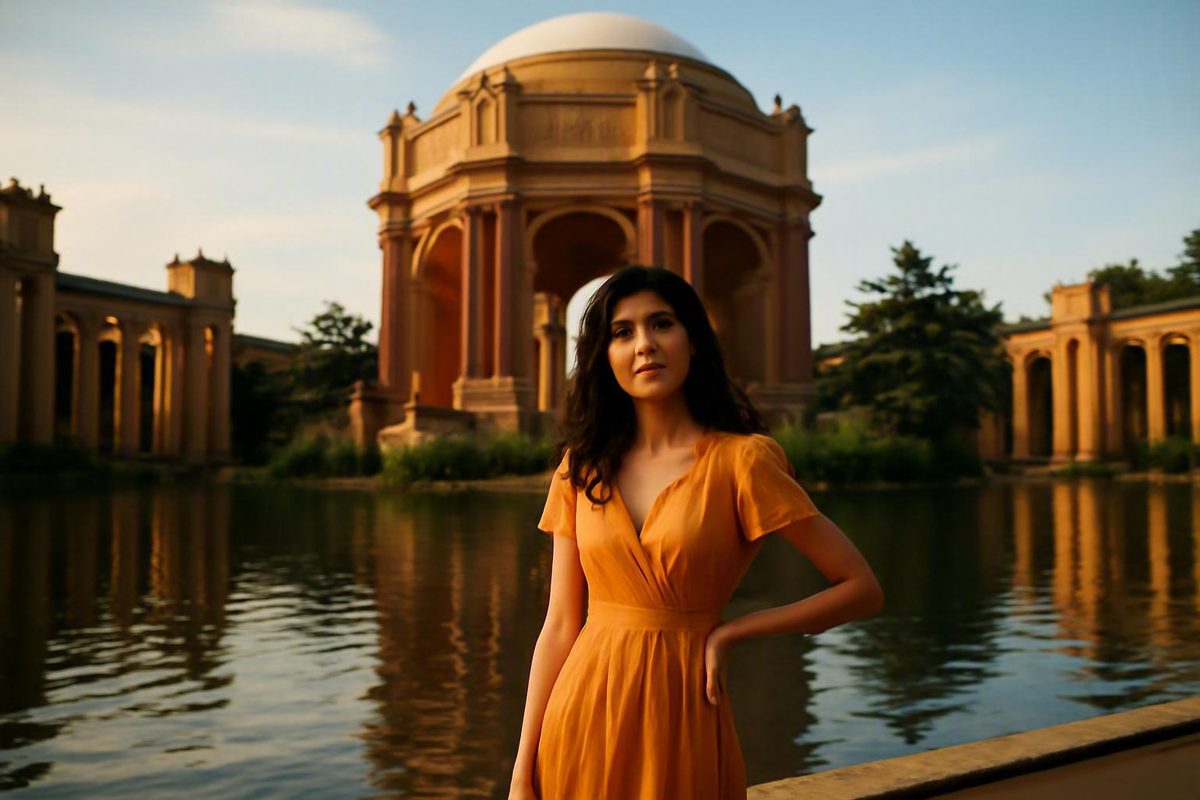
A Palace of Fine Arts photoshoot works best when you choose a visual priority, match it to the light, and follow a short route instead of trying to collect every possible angle. Monumental architecture, repeating columns, shaded passages, landscaped edges, a lagoon, and water reflections are concentrated within the same general setting.
That variety creates a planning trap: the session can become rushed if every backdrop is treated as essential. Decide which two or three photographs would make the shoot feel complete, capture those first, and leave room to adapt to visitors, weather, on-site activity, and the comfort of the people being photographed.
This is a visual and preliminary session-planning guide. Current permit thresholds, equipment rules, closures, facilities, accessibility conditions, and reservation terms are not established by the available first-party evidence. Confirm those operational details with the responsible city or venue authority before relying on a plan.
Decide What You Want the Palace to Do for Your Photos
The Palace can support very different galleries. Engagement and wedding examples are common, while photography services and specialist guides also present it as a setting for family, maternity, anniversary, and graduation portraits. These examples demonstrate visual range, not identical rules for every use.
Start by choosing one of three broad directions.
Architecture-first images use the Rotunda, dome, arches, and columns to communicate scale. The people may occupy a relatively small part of the frame, with symmetry and structural detail doing much of the visual work. This approach suits formal wedding attire, dramatic graduation images, editorial portraits, and photographs meant to be unmistakably tied to the Palace.
People-first portraits use the architecture as a frame rather than the principal subject. Shaded passages, columns, arches, and tighter camera positions can give expressions and interactions more prominence. This can be effective for families, maternity sessions, proposals, anniversaries, and couples who do not want to appear tiny beneath the Rotunda.
Environmental portraits balance people with the lagoon, vegetation, paths, stonework, and reflections. They can feel softer than a strictly architectural set, especially when water and landscaping occupy a meaningful part of the composition. They also give visual relief to a gallery dominated by columns and masonry.
Before choosing a route, name the primary result:
- A prominent Rotunda portrait
- Flattering close portraits in open shade
- Several distinct architectural backgrounds
- A warm sunset-and-lagoon atmosphere
- A golden-hour-to-dusk sequence
- A set that emphasizes the person or occasion more than the landmark
The same framework can be adapted for a graduate with a cap and stole, a family that needs space for group arrangements, a couple in formal clothing, or an architecture photographer working without portrait subjects. A Palace-focused graduation guide, for example, highlights the Rotunda, colonnades, lagoon, and side walkways as different compositional tools rather than treating the site as a couples-only location.
Use portfolios to study posing, lens choice, framing, and the balance between people and architecture. The Palace of Fine Arts venue gallery includes exterior, interior, daytime, nighttime, and event imagery. Those photographs are useful references, but they do not grant permission to copy the work or establish that a proposed session, ceremony, equipment setup, or publication use is permitted.
Build a Shot List Around Five Distinct Backdrops
An effective shot list should follow the space rather than read like an unranked collection of ideas. Organize the session around five backdrop types, then assign a purpose to each one.
1. The Rotunda exterior
Use the exterior for the establishing image—the photograph that immediately identifies the Palace and communicates its scale. Stand far enough away to preserve the relationship among the subject, dome, and columns, but do not assume the widest possible view will be the strongest. Excess pavement, visitors, signs, or distracting edges may weaken the composition.
Try a centered frame for formality, then move off-axis if the background is busy or the light favors one side. A wedding party or extended family may need a broad arrangement, while one graduate or couple can be positioned more selectively against an arch or column group.
Capture this view early if the Rotunda is the reason you chose the location. Saving it for the end creates avoidable risk from changing light, fatigue, crowds, or an unexpected obstruction.
2. Beneath and near the Rotunda
Looking upward introduces the underside of the dome, overhead ornament, curved lines, and a more immersive architectural perspective. These angles can work with a subject standing still, walking beneath the structure, or looking away while the building becomes part of the narrative.
Structural shade can also make some midday portrait work possible. Shade does not automatically create flattering light: faces can remain unevenly illuminated, the background may be much brighter, and reflected color can change near stone and pavement. It nevertheless gives the photographer more options than a completely exposed setting when sunrise or sunset is impractical.
Use this area for mid-length and close portraits as well as wide frames. It is a good place to photograph hands, rings, graduation details, fabric movement, bouquets, diplomas, or interactions while keeping recognizable architecture in the background.
3. The colonnades and arches
The colonnades are among the most flexible compositional elements at the Palace. Repeating columns create rhythm, arches form natural frames, and converging lines direct attention toward the subject. A centered pose can feel formal and symmetrical; an off-center position can create depth and a more editorial result.
Tighter framing is especially useful when visitors occupy the wider scene. Instead of waiting indefinitely for a clear corridor, move closer, use one or two columns as a frame, change camera height, or photograph along the line of arches. A wider aperture may reduce the visual weight of people farther behind the subject, although it will not remove every distraction.
This is also a practical place to alternate posed and moving photographs. Ask subjects to walk, turn toward one another, adjust a jacket or gown, or pause in favorable light. The variation prevents the final gallery from becoming a sequence of stationary portraits against similar stone backgrounds.
4. The lagoon edge
The lagoon changes the visual vocabulary. Water, vegetation, reflections, and open space soften the Palace’s architectural weight. Use it for environmental portraits, silhouettes, broad group arrangements, or a composition in which the Rotunda appears across the water rather than directly behind the subject.
Reflections depend on wind, water movement, light direction, and camera position. Do not make a mirror-like reflection a guaranteed deliverable. Treat clean water reflections as an opportunity and prepare a composition that still works when the surface is textured.
The lagoon can be particularly useful late in the day, when warmer light or illuminated architecture may add color to the water. It can also provide a calmer visual ending after a sequence built around dense columns and arches.
5. Side paths and quieter corners
Side paths, secondary arches, landscaped edges, and less prominent building corners are not merely filler. They are the primary crowd contingency and may be the best locations for close portraits. A quieter background shifts attention toward expressions and relationships without requiring the Palace to dominate every frame.
These areas also help when a subject needs a break from posing in a large public space. Walking between setups can produce natural photographs, while a nearby wall, column, or patch of greenery may provide a cleaner close-up than the famous central viewpoint.
If time remains, add frontage compositions, pond or fountain views, and broader perspectives across the lagoon. Palace wedding-photography examples identify the Rotunda, building frontage, pond, fountain, and less prominent grounds as workable areas, but these are practitioner recommendations rather than an official venue route.
For a consistent editorial workflow, capture each priority backdrop in three versions:
- Wide: the complete setting and architectural scale
- Mid-length: the subjects with enough context to identify the location
- Close: expression, interaction, clothing, rings, flowers, a diploma, or another detail
This is an editorial method, not a Palace recommendation. Public galleries may demonstrate daytime, nighttime, architectural, pond-side, tourist, and reflection compositions, but they do not establish access rights, photography rules, or permission to reuse the displayed work.
Choose the Time by Look, Not by a Universal ‘Best Hour’
There is no single best hour for every Palace of Fine Arts photoshoot. The right time depends on whether you care most about detailed architecture, flattering portraits, warm water color, lighter visitor pressure, or illuminated dusk scenes.
Sunrise and early morning
Sunrise is a practical option for soft, low-angle light and a chance of encountering fewer visitors. Palace photographers commonly recommend early morning for crowd management, but that is practitioner experience—not a promise of empty grounds, easy parking, or unobstructed compositions.
Morning can be especially useful when the building frontage is a priority. A Palace-focused wedding photographer reports that morning light falls more directly on the front of the structure, revealing stronger architectural color, texture, and detail, with the potential for a bluer-looking sky in suitable conditions. The effect changes with the date, clouds, fog, and camera direction.
The advantage of morning is that essential photographs happen before the day fills with other plans. The tradeoffs are an early call time, potentially cool conditions, and less daylight for scouting before the preferred light begins.
Midday
Midday is a compromise, not an automatic failure. Exposed areas can create dark eye sockets, squinting, bright highlights, and strong facial shadows. The difference between a sunlit background and a shaded subject may also be difficult to balance.
The Rotunda and colonnades provide shade, however, so a photographer can search for even light beneath or beside the architecture. A Palace graduation guide specifically notes that overhead and colonnade shade can support some midday work, although it still recommends lower-angle light when scheduling permits.
A constrained midday route should emphasize shaded portraits, tighter compositions, and short transitions rather than relying on open-lagoon scenes in hard overhead light. Pay attention to reflected light from stone, pavement, water, and nearby surfaces; open shade can be attractive when the subject faces the brighter part of the sky.
Late afternoon and the hour before sunset
Late afternoon is useful for warmer portraits and a progression toward dusk. According to one Palace wedding photographer’s experience, the sun can sit behind the structure for many camera angles, creating backlight and golden tones over the water while revealing less color and texture on parts of the architecture.
The hour before sunset is a practical starting point when the desired result is warmth rather than maximum frontage detail. It leaves time for portraits before the session shifts toward reflections and illuminated architecture.
“Golden hour” is not a fixed product. Fog can diffuse or erase direct warmth, clouds near the horizon can block the sun, and seasonal sun direction may favor one background while working against another. Sunrise and sunset also illuminate surfaces from opposite directions, changing where highlights and shadows fall.
Check the date-specific sunrise, sunset, and sun direction shortly before the session. Compare more than one weather forecast as well; a citywide symbol cannot describe every local pocket of fog, wind, or cloud.
Blue hour and night
Blue hour and nighttime are better treated as architecture-and-reflection options than as the default portrait plan. Faces may require deliberate lighting or slower shutter speeds, while the illuminated Palace and water become more visually prominent.
In one documented landscape shoot, photographer Belinda Shi arrived approximately 30 minutes before sunset to scout, then used a tripod, shutter release, low ISO, a small aperture, and progressively longer exposures as the scene darkened. Her selected image was made 23 minutes after sunset using a 210-second exposure, but those settings reflected one evening’s light, wind, water, and equipment—not a universal recipe. Her Palace long-exposure account is best read as a planning example.
Exposure choices must respond to current conditions and the intended photograph. A moving portrait subject cannot be treated like a stationary building, wind can move clothing and vegetation, and lagoon movement changes reflections. Verify current rules before bringing a tripod, lighting support, or other production equipment.
The practical choice is:
- Morning: stronger frontage detail and a chance of lighter visitor pressure
- Sunset: warm backlight, softer portraits, and lagoon color
- Dusk: illuminated architecture and reflection-oriented images
- Midday: shaded architectural portraits when the schedule cannot move
Use a 30-, 60-, or 90-Minute Route
Photographer Zoe Larkin recommends approximately 45–60 minutes for portraits associated with a Palace ceremony, or 90 minutes when schedule and budget permit. These figures are practitioner guidance, not official venue timings; the routes below are editorial planning models rather than measured itineraries. See her Palace ceremony and portrait guide for the context behind that recommendation.
Actual progress depends on the meeting point, walking pace, crowds, comfort, weather, equipment, and access on the day.
The 30-minute priority route
This editorial 30-minute model needs one objective and a disciplined sequence:
- Rotunda exterior: Capture the non-negotiable wide and mid-length images.
- One colonnade setup: Make a symmetrical portrait, a walking frame, and one close image.
- Lagoon or reflection view: Finish with an environmental composition that changes the gallery’s visual mood.
The format has little tolerance for a delayed arrival, full outfit change, prolonged posing adjustment, or extended wait for a clear background. If the primary viewpoint is occupied, switch quickly to tighter framing or a nearby side angle. Do not spend half the appointment trying to reproduce one reference image exactly.
This route suits subjects who arrive fully ready, can move comfortably, and have agreed on the essential images. It is less suitable for a large group requiring repeated arrangements or anyone expecting several outfits and a transition from daylight into dusk.
The 60-minute balanced route
This editorial 60-minute model allows more variety without requiring an exhaustive loop:
- Rotunda exterior
- Shaded angles beneath or near the Rotunda
- Repeating-column and arch portraits
- Lagoon edge
- One side path or quieter architectural corner
Reserve part of the hour for walking, close portraits, and a short wait if another group occupies a composition. Alternate wide architectural scenes with close photographs so the final gallery does not feel repetitive.
An hour may support a simple accessory or removable-layer change, but a complete wardrobe change can consume too much of the session unless a legal, private option has been confirmed nearby. Discuss where any change will happen and how long the subjects ordinarily need.
The 90-minute complete route
This editorial 90-minute model can extend beyond the central views:
- Begin with the most important Rotunda composition.
- Work beneath the dome and through the colonnades.
- Photograph the frontage, pond, or fountain area.
- Continue along more of the lagoon.
- Use quieter corners for close portraits.
- Add a controlled outfit variation.
- If timing and conditions permit, transition from golden hour toward dusk.
The advantage is resilience, not merely more photographs. Additional time lets a group wait briefly, recover from wind or cold, adjust clothing, and change direction if a preferred background is busy. It may also produce two lighting moods without requiring a second location.
Every route needs a buffer because the Palace is shared with visitors, other photographers, and possible activity not visible in a portfolio. Begin with the image that cannot be replaced instead of saving it for a finale.
If you book a mini-session, study the provider’s meeting instructions and late-arrival policy. Shoott states that clients arriving 10 or more minutes late receive only the remainder of their allotted time Palace of Fine Arts Photoshoot in SF Bay | Shoott. Those conditions belong to Shoott and may change; they are not venue-wide rules.
Plan for Crowds, Wind, Fog, and Shared Space
Weekdays and sunrise are repeatedly recommended by Palace photographers as lower-crowd options. Neither guarantees an empty Rotunda, unobstructed lagoon edge, or uninterrupted access to a particular camera position.
One Palace wedding photographer reports that Saturdays—and sometimes Fridays—can slow a session because tourists and other photographers occupy favored spots. Treat that as scheduling experience rather than a measured attendance forecast. A quiet portfolio frame may have been captured during a brief opening in an active scene.
Waiting for a completely empty Rotunda can waste a short session. Use a contingency ladder:
- Tighten the frame around the subjects and one architectural feature.
- Photograph down a row of columns rather than across the busiest space.
- Use a wider aperture to reduce background emphasis.
- Move to a side path or secondary arch.
- Capture close portraits and return later only if time remains.
The aim is not to pretend other people are absent. It is to create a composition in which they carry less visual weight.
San Francisco weather can vary between nearby locations. In one documented engagement session, heavy fog and wind disrupted plans at Sutro Baths, the Palace was sunny, and fog later obscured the Golden Gate Bridge at Crissy Field. That photographer’s account illustrates local variability; it does not prove that the Palace is a reliable sun pocket or weather backup.
Use a simple weather decision tree:
- Manageable wind or light precipitation: Emphasize protected architectural portraits and shorten exposed lagoon stops.
- Cold or wind affecting comfort: Simplify the route, prioritize close photographs, and avoid repeated long walks.
- Conditions beyond the subjects’ tolerance: Use a predetermined alternate date or location.
- Fast-changing conditions: Finish the essential Palace images first and treat every additional backdrop as optional.
A rain-or-shine statement belongs to the provider that issued it. It is not a venue rule and does not mean subjects must accept conditions they find uncomfortable or unsafe.
Prepare with layers, walkable shoes between setups, a hairstyle that can tolerate wind, minimal loose accessories, and a light bag. These are practical precautions, not a forecast. Check available information about events, construction, or closures before departure, then arrive early enough to reassess the route. Because no current official activity feed is established here, do not build the entire session around assumed access to one exact spot.
Verify Permission Before Treating Public Access as Shoot Approval
The available evidence does not establish the current permit threshold for engagement, family, graduation, wedding, editorial, or commercial photography at the Palace of Fine Arts. General public access—or a third party’s report that there is no entrance fee—does not prove that every professional session, production, ceremony, prop, or equipment setup is permit-free.
When requesting current guidance, describe the proposed use accurately. Separate these four categories:
- Casual personal photographs: Visitors taking their own informal pictures
- Professional portrait session: A paid photographer creating engagement, family, graduation, maternity, anniversary, or wedding portraits
- Commercial or editorial production: Images intended for advertising, publication, licensing, stock, campaigns, or another business use
- Ceremony or vow exchange: An activity functioning as a wedding, elopement, or organized ceremony, whether large or small
Do not assume that rules for one category apply to another.
A photographer-authored guide distinguishes using the grounds for portraits from formally reserving the Rotunda for a wedding ceremony. It says official ceremonies are managed through San Francisco Recreation and Parks and reports that a Rotunda reservation covers the area beneath the structure while the surrounding grounds remain open to the public. Because the guide is not a current government policy page, verify the responsible authority, reservation process, and exact scope of control before relying on those statements.
A commercial photography article published in 2021 also mentions a photography application, but it does not identify the current permit trigger, fee, processing time, or restrictions. It should not be treated as proof of today’s process—or as evidence that an application is unnecessary for uses it does not discuss.
Before booking vendors, conducting a ceremony, or bringing production equipment, ask the responsible current authority about:
- Intended date and time
- Number of subjects, photographers, assistants, and other crew
- Personal, paid, editorial, or commercial purpose
- Ceremony, officiant, or vow-exchange activity
- Props and furniture
- Tripods, light stands, flashes, reflectors, or other supports
- Intended publication, advertising, stock, or licensing
- Insurance or indemnification requirements
- Applicable fees
- Processing time and application deadlines
- Conflicting events, closures, or reserved activity
- The exact area covered by any approval or reservation
Do not republish third-party ceremony prices, deposits, reservation minimums, guest limits, or equipment restrictions as current policy. Such terms may change, and a Rotunda reservation does not necessarily create private control over surrounding backgrounds.
Until current official guidance is obtained, treat any route in this article as a preliminary visual plan rather than confirmation that a particular activity or setup is authorized.
Handle Meeting, Facilities, Wardrobe, and Equipment Realistically
A workable session begins with a precise meeting plan. “Meet at the Palace” leaves too much room for confusion. Choose a written landmark or provider-specified address, share a map pin if appropriate, and confirm how the photographer and subjects will recognize one another.
Shoott says it supplies the exact meeting address after booking. Shoott states that clients arriving 10 or more minutes late receive only the remainder of their allotted time Palace of Fine Arts Photoshoot in SF Bay | Shoott. These are Shoott’s commercial terms, not Palace rules, and should be reconfirmed in the client’s current booking confirmation.
Photographer sources describe parking as public and limited, but the evidence does not establish current restrictions, availability, legal spaces, transit directions, or rideshare points. Allow time to read posted signs and walk to the meeting place. Do not promise that parking will be available beside the first setup.
Restroom information is inconsistent. Shoott says there are no restrooms at its stated session location; one graduation photographer describes nearby facilities as limited; and Zoe Larkin’s guide points to facilities across the street at Little Marina Green. These accounts may reflect different dates, definitions, or operating conditions. Verify the current location, hours, and accessibility of any facility instead of treating one third-party statement as definitive.
Nearby changing options are also described as limited. Arrive in the primary outfit whenever possible. For variation, use a removable jacket, shawl, stole, tie, veil, jewelry change, or another accessory that does not require undressing in public. If a full wardrobe change is essential, confirm a legal, private option in advance.
Do not assume any suggested route is step-free or accessible. Anyone with mobility needs should verify current surface conditions, curb access, walking distances, resting options, and restroom accessibility through an appropriate authoritative source. The photographer should also ask what pace and standing duration are comfortable instead of designing the route solely around visual variety.
A compact packing list is usually enough:
- Warm layer
- Comfortable shoes for walking between setups
- Water
- Weather protection appropriate to the forecast
- Charged phone
- Minimal valuables
- Only the photography equipment required by the shot plan
- Small grooming or wardrobe kit if needed
Avoid leaving valuables or camera equipment visible in a parked vehicle. Keep active gear consolidated instead of spreading cases around a public space.
Safety planning should remain proportionate and current-minded. ABC7 reported that photographers were targeted in two separate armed attacks outside the Palace on November 9, 2022. The report supplied no photographer-specific crime statistics, and those historical incidents do not establish the present risk level. They do support ordinary equipment-security planning; see ABC7’s report on the 2022 incidents.
Keep unused gear out of sight, stay aware of the surrounding area, and agree on a quick relocation or exit option. A photographer working alone should avoid becoming so absorbed in the frame that equipment and surroundings go unmonitored. If anyone feels unsafe, stop the session and leave.
Compare Booking Models and Add a Second Location Carefully
Photography services can look inexpensive or comprehensive for different reasons. Compare the complete product rather than only the booking fee or advertised duration.
Ask each provider about:
- Shooting time
- Meeting process
- Number of proof images
- Number of high-resolution files included or purchased
- Total cost at the image count you realistically want
- Full-gallery price
- Editing scope
- Delivery time
- Weather policy
- Cancellation and rescheduling terms
- Late-arrival terms and fees
- Flexibility to change locations
- Permit responsibilities
- Travel charges or limits
- Backup arrangements when conditions change
Shoott is one transparent example, not a market benchmark. On the Palace page reviewed for this guide in August 2026, it advertised a 30-minute guided session, a gallery of at least 40 lightly edited photographs, payment for selected high-resolution files, and delivery in three to five business days. Displayed prices were $25 per photograph under a labeled limited-time offer, $19.90 per image when purchasing at least 10, or $299 for the full gallery. These are provider-specific promotional terms that may change; consult the current Shoott Palace session page before comparing costs.
Shoott describes its complimentary editing as basic color, crop, and lighting adjustments rather than manipulation of objects, faces, bodies, or clothing. Its displayed cancellation, rescheduling, no-show, and lateness charges are likewise examples of terms to inspect—not permanent market standards.
A short mini-session can work when subjects arrive ready and want three tightly prioritized setups. A custom 60- or 90-minute experience may be more suitable for a large group, extensive walking, crowd delays, relaxed posing, outfit variation, or a transition from warm daylight into dusk. Do not assume that a longer session automatically includes more files, deeper retouching, or broader usage rights.
Photographer portfolios also show the Palace being used after a San Francisco City Hall ceremony. That pairing can create architectural continuity, but it requires realistic travel, parking, walking, and delay buffers. Do not promise that both locations will fit into a particular package unless the photographer has assessed the current route and schedule.
Crissy Field can provide a contrasting waterfront setting and potential bridge views. It is not a guaranteed bridge-photo solution: in the documented engagement session described earlier, fog obscured the Golden Gate Bridge after the couple continued there from the Palace.
Treat the Palace as the session anchor and any second location as optional. Finish the primary gallery before leaving. If time, weather, energy, and transportation remain favorable, continue; if wind, fog, fatigue, or delay intervenes, the session should still feel complete.
For broader visitor planning, San Francisco Know’s self-guided Golden Gate waterfront walk offers a flexible framework for connecting the Marina, Crissy Field, and the bridge area. It is general visitor guidance, not evidence of photoshoot permission or a guaranteed travel time.
Frequently Asked Questions
Do you need a permit for a Palace of Fine Arts photoshoot?
Possibly, depending on current rules and the nature of the shoot. The available evidence does not authoritatively establish the permit threshold for personal portraits, paid professional sessions, wedding photographs, informal vows, editorial work, or commercial production.
Confirm the responsible current authority and describe the number of participants, whether the photographer is paid, the intended use of the images, any ceremony activity, props, and equipment. Public access or a reported lack of an entrance fee does not prove that every professional, commercial, or ceremony-related use is permit-free.
What is the best time of day for Palace of Fine Arts photos?
Choose the time by the desired result. Photographer experience suggests that morning may provide stronger color and detail on the building frontage, together with a chance of lighter visitor pressure. Late afternoon and the hour before sunset can produce backlight, warmer portraits, and color over the lagoon. Dusk favors illuminated architecture and reflections.
Midday can still work when the route emphasizes shade beneath the Rotunda and along the colonnades. Fog, clouds, season, sun direction, and subject orientation can change every option, so check date-specific light and several forecasts shortly before the session.
How long should a Palace of Fine Arts portrait session be?
As editorial planning models, 30 minutes can cover the Rotunda exterior, one colonnade setup, and one lagoon composition if everyone arrives ready. A 60-minute model provides more room for close portraits, walking, and a modest crowd buffer. A 90-minute model allows additional grounds, outfit variation, waiting time, and a possible transition into dusk.
Separately, photographer Zoe Larkin recommends approximately 45–60 minutes for portraits connected with a Palace ceremony, or 90 minutes when the schedule and budget allow. That is practitioner guidance rather than a guaranteed venue itinerary.
Does reserving the Rotunda guarantee private or empty backgrounds?
No such guarantee is established. Zoe Larkin’s photographer-authored guide reports that a ceremony reservation covers the area beneath the Rotunda while the surrounding grounds remain open to the public. Visitors, photographers, events, and passersby may therefore continue to affect nearby backgrounds.
Verify the current reservation terms and exact area covered with the responsible authority. Plan tighter compositions and alternate backgrounds even when a formal reservation is in place.
Are restrooms, parking, and changing facilities available nearby?
Third-party accounts conflict. Shoott says there are no restrooms at its stated session location, another photographer describes nearby facilities as limited, and Zoe Larkin’s guide identifies facilities across the street at Little Marina Green. Current location, hours, operating status, and accessibility are not established here.
Photographers also describe parking as public and limited, but current restrictions and availability must be checked on site. Nearby changing options are reported as limited, so arrive in the primary outfit and confirm any legal, private changing facility in advance.
Select the two or three photographs that matter most, then choose morning for stronger frontage detail or late-day light for warmth and atmosphere. Allow enough time for shared-space delays, and verify current permissions, equipment rules, facilities, and access before the shoot. Make the Palace the anchor rather than racing through every backdrop: a short route completed calmly is more dependable than an overloaded plan built on perfect weather, empty grounds, or unverified rules.