
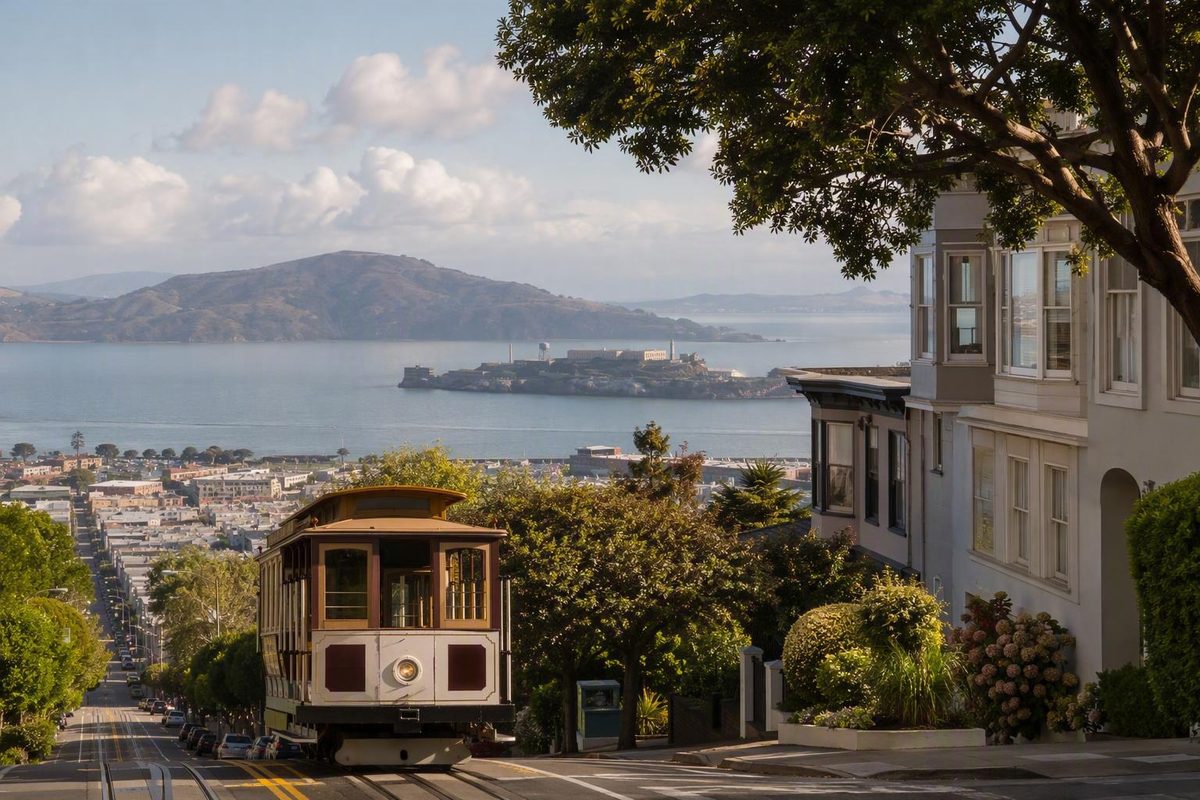
See San Francisco without crossing the city all day.
A practical San Francisco travel itinerary depends less on collecting landmarks than on arranging each day so the geography makes sense. For a first visit, the simplest structure uses three clusters: northeastern neighborhoods and the waterfront; the Presidio and Golden Gate Bridge; then Golden Gate Park with a selective Mission-area block.
Walk when a connection is short and adds to the experience. Use Muni or another suitable ride for cross-city transfers, uphill segments, and difficult final connections. Reserve fixed-time attractions first—especially Alcatraz—while keeping parks, viewpoints, and neighborhood walks flexible for weather and energy.
How many days should you spend in San Francisco?
Three full days is a useful baseline for a first trip. Several supplied itineraries use three days as their core structure, although the amount covered varies considerably. One particularly active three-day plan advises slower travelers to complete only part of each day or spread the same material across five or six days (compare its pacing assumptions).
Two days can still produce a rewarding highlights trip. It simply requires firmer choices: Alcatraz or an extended bridge outing, for example, rather than assuming both will fit comfortably. One day works best as a single northeastern route. Four or five days allow the Mission, museums, or coastal areas to receive their own time.
This itinerary uses three pace levels:
- Relaxed: One main geographic cluster per day, with generous breaks and few extensions.
- Standard: One primary cluster plus a nearby or transit-connected secondary area.
- Ambitious: Most optional stops remain, provided reservations, weather, and energy cooperate.
The core rule is the same at every pace: walk within a compact cluster, use transit or another suitable connection between distant clusters, and avoid repeatedly returning across the city. A destination may look close on a map while still involving a steep grade, stairs, an indirect connection, or significant exposure to wind.
Your ideal trip length depends on:
- Your tolerance for walking and climbing
- Whether museums are brief stops or major priorities
- Fixed reservation times
- Your preference for long meals or unstructured neighborhood time
- Whether regional excursions matter more than additional city days
- How much flexibility you want for weather, queues, and service disruption
This plan does not promise exact completion times. Hills, lines, weather, attraction operations, meals, transit conditions, and individual pace make rigid timing unreliable. Instead, each day has a geographic route, a practical endpoint, and a drop-first list.
The three-day structure is:
- Day 1: Ferry Building, Chinatown, North Beach, and the northeastern waterfront
- Day 2: Presidio, Crissy Field, and the Golden Gate Bridge area
- Day 3: Golden Gate Park, followed selectively by Haight-Ashbury, the Mission, Dolores Park, or the Castro
If you travel slowly, use the drop-first options rather than trying to “finish” the city. Removing a stop is part of the itinerary’s design.
Day 1: Ferry Building, Chinatown, North Beach, and the waterfront
Day 1 combines four areas that recur as one practical sightseeing cluster: the Ferry Building and Embarcadero, Chinatown, North Beach, and the northeastern waterfront. The route can be adjusted around Alcatraz, but it should not expand casually into Nob Hill, Russian Hill, and every pier.
Morning: Ferry Building and Embarcadero
Begin at the Ferry Building. Browse the marketplace if its current hours and operating businesses suit your visit, then step outside to the bay-facing waterfront. This is a gentler orientation than beginning with an inland climb.
Keep the stop deliberate. The Ferry Building can be a short architectural and food break or a longer browsing session, but it should not quietly consume the time intended for Chinatown. If you have an Alcatraz departure, work backward from the required reporting time and leave a generous buffer.
From the Ferry Building, walk through the Financial District toward Chinatown. A practical target is the southern Chinatown area, after which you can continue north on a commercial street such as Grant Avenue or Stockton Street. Select the street according to what interests you and the grade you are comfortable handling.
You do not need to detour through Union Square or climb Nob Hill simply because downtown attractions appear nearby.
Late morning and lunch: a focused Chinatown route
Treat Chinatown as a neighborhood rather than a completion challenge. Follow one primary commercial street and explore one or two side streets that genuinely interest you. Allow time to browse or eat instead of collecting every gate, shop, and alley.
Continue north toward North Beach. Washington Square provides a useful geographic target, but your exact line should reflect current street conditions and your interest in shops, food, or architecture.
If hills are a concern, inspect your walking directions before leaving the waterfront. A slightly longer, gentler route—or a short transit segment—may be more practical than the most direct-looking line.
Afternoon: North Beach, then choose Coit Tower or the piers
North Beach is the natural continuation from Chinatown. Use it for lunch if you have not eaten, or make it the day’s slower neighborhood block.
From here, make one significant choice:
- Coit Tower direction: Choose this if the elevated viewpoint is a priority and additional climbing is manageable.
- Waterfront direction: Follow Columbus Avenue toward the northeastern waterfront if you prefer easier access to Fisherman’s Wharf, the piers, or an Alcatraz departure.
Coit Tower is optional. It adds elevation and can turn a manageable day into a demanding one when combined with Chinatown, the waterfront, and a fixed reservation. Do not include it only because it looks close on the map.
Pier 39 and Fisherman’s Wharf are also optional. Their visitor-oriented, commercial atmosphere appeals to some travelers more than others. Their practical advantage is location: they provide straightforward waterfront access and place several attractions in the same general area.
If you visit, decide whether the wharf is a short pass-through or a principal stop. An open-ended visit can displace dinner, boarding time, or the neighborhood experience you valued more.
If Alcatraz is booked
Treat the confirmed departure as the center of the day. Check the authorized operator or National Park Service for the departure point, reporting requirements, accessibility information, and current operating details.
Alcatraz can sell out, so it is sensible to arrange it well ahead when it is a priority; availability varies by date (review the advance-planning guidance). Do not rely on a general itinerary for current tickets or boarding rules.
Remove at least one optional stop—usually Coit Tower, Lombard Street, or an extended wharf visit. A full Chinatown route, tower climb, long lunch, every pier, and Alcatraz should not be treated as a comfortable default merely because they are on the same side of the city.
For an early departure, keep the Ferry Building brief or move it to another morning. For a later departure, continue from the Ferry Building through Chinatown and North Beach, then descend toward the departure area without adding a distant detour.
Evening without Alcatraz
Eat in North Beach, Chinatown, or near the waterfront according to where your afternoon ends. Choosing dinner near the endpoint is more efficient than crossing the city for a restaurant on an unrelated list.
Afterward, make a simple return to your lodging. Do not add Nob Hill, the Castro, or a western-neighborhood excursion merely because daylight remains.
Drop first: Coit Tower, an extended Pier 39 visit, Lombard Street, or a second waterfront detour.
Hill-smart note: Nob Hill and Russian Hill look close to Chinatown and North Beach on a flat map, but the elevation can materially change the day. Use transit for a specific priority there or save those neighborhoods for another route.
Day 2: Presidio, Crissy Field, and the Golden Gate Bridge
The second day follows a one-direction line from the Marina or Presidio toward Crissy Field and the Golden Gate Bridge. The goal is not to complete every coastal path or force the outing into a large loop. Plan the scenic route and the return journey as separate decisions.
Choose the right starting point
Depending on your lodging and current service, begin near:
- The Palace of Fine Arts
- The Marina waterfront
- A convenient Presidio entrance
- A selected Presidio stop reached by transit
From Union Square, North Beach, or Fisherman’s Wharf, using transit to the starting area can prevent the day from beginning with an unnecessary approach walk. From a Marina base, the Palace of Fine Arts or waterfront may be the natural starting point.
A simple sequence is:
- Palace of Fine Arts or Marina waterfront
- Crissy Field
- Golden Gate Bridge approach or selected viewpoint
- Separate transit, taxi, or ride-hailing return
Our publisher’s own waterfront guide uses the Marina–Crissy Field–bridge sequence as a one-direction organizing line and recommends solving the return separately rather than treating the walk as a mandatory loop (see the waterfront route framework).
Marina and Presidio toward Crissy Field
Start with only the Marina or Presidio features you genuinely value. The Palace of Fine Arts can serve as the opening landmark, but it need not become a long stop if the bridge is the priority.
Continue toward Crissy Field along the currently suitable waterfront or Presidio route. Keep the bridge area as the clear destination and avoid turning every side path into another viewpoint detour.
Conditions can feel cooler or windier here than near your lodging. Carry a layer and preserve the option to shorten the exposed portion.
Experiencing the bridge without crossing all of it
A full bridge crossing is optional. You can experience the Golden Gate Bridge from waterfront paths, approaches, and selected viewpoints without committing to the complete crossing and return.
Choose among three versions:
- Lower walking: Take transportation to a selected Presidio or bridge viewpoint, spend time nearby, and leave by transit or another ride.
- Standard: Walk one direction from the Marina or Presidio through Crissy Field to the bridge area, then arrange transportation back.
- Ambitious: Add part or all of a bridge crossing if access, visibility, weather, and energy support it.
Before leaving, use a current trip planner to check Muni, PresidiGo, taxi, or ride-hailing options from the endpoint you expect to reach. San Francisco Travel describes PresidiGo as free, accessible transportation to and within the Presidio seven days a week, but its current routes, stops, and hours should be confirmed before you rely on it (check the transportation guidance).
Accessible transportation does not establish that every path between a stop and viewpoint is level or step-free. Verify grades, trail surfaces, entrances, elevator needs, and the distance from the stop separately.
Optional coastal extension
Baker Beach or Lands End can extend this day, but neither belongs in the standard plan. Add one only if:
- You have sufficient daylight and energy
- Exposed conditions are comfortable
- Current access suits your mobility
- You have already solved the return journey
- You are willing to sacrifice another viewpoint or neighborhood stop
The broader Presidio-to-Lands End corridor is a substantial outdoor outing, not a routine extra. If coastal hiking is the priority, make it the day’s main activity.
Weather backup
If fog, wind, rain, or limited visibility makes the exposed route unappealing, shorten the outdoor block. Keep one waterfront or bridge viewpoint if conditions permit, then consider a nearby indoor option.
The Walt Disney Family Museum is one possible Presidio-area substitute, subject to its current opening day, admission arrangements, and accessibility. The important point is proximity: staying in or near the Presidio or Marina preserves the day’s geographic logic.
Drop first: A full bridge crossing, a distant beach extension, an extra viewpoint, or a prolonged Marina detour.
Day 3: Golden Gate Park, Haight-Ashbury, and the Mission
Golden Gate Park and the Mission can fit into one day only if you treat them as separate clusters connected by transit. They are not one continuous sightseeing walk.
The standard plan gives the morning and early afternoon to Golden Gate Park, then uses a cross-city connection for a focused Mission block. Haight-Ashbury is conditional.
Morning: choose one Golden Gate Park approach
Begin on the eastern side of Golden Gate Park if you intend to add Haight-Ashbury or the Mission later. An entrance near Stanyan Street provides a practical starting area for the John F. Kennedy Promenade.
Choose one of two structures.
Outdoor-focused park morning
Walk a selected portion of the John F. Kennedy Promenade and add a small number of garden or landscape stops. A locally curated itinerary identifies the promenade as permanently closed to cars, although visitors should still confirm current access, construction, events, and attraction operations (review the described park route).
This version works best when the weather is comfortable and your group prefers movement to museum time.
Museum-focused park morning
Choose one major museum—such as the de Young or California Academy of Sciences—then pair it with a shorter park walk. Verify the opening day, admission requirements, entrance location, and accessibility before crossing the city.
Do not assume a second museum will fit merely because it is nearby. A substantial indoor visit can easily become the main event. If it runs long, remove Haight-Ashbury first.
Early afternoon: Haight-Ashbury only if it matters
Haight-Ashbury is a logical companion to the eastern end of Golden Gate Park, but it is not mandatory. Add it only if it is a genuine priority and the park morning has remained manageable.
Keep the visit focused: walk one selected stretch, browse, or stop for a meal. Do not combine it with unrelated, distant photo stops.
If Haight-Ashbury is not a priority—or the morning has run long—go directly toward the Mission. Use the current SFMTA trip planner from your actual park exit rather than assuming one saved route will suit every starting point.
For practical planning, treat the transfer as eastern Golden Gate Park or Haight-Ashbury to Mission Dolores Park or the central Mission, then complete the rest on foot. The precise route depends on service conditions and where you leave the park.
Late afternoon: Mission streets and Dolores Park
Choose a compact Mission block rather than building a checklist of widely scattered food and mural stops.
A workable structure is:
- Arrive near Mission Dolores Park or another chosen neighborhood starting point
- Walk a limited set of nearby streets
- Choose one food or café stop based on current availability
- Spend time in Mission Dolores Park if conditions suit
- Finish with dinner nearby
The point is to experience the neighborhood, not to cross it repeatedly in pursuit of individual businesses. Restaurant hours, queues, and reservation policies change, so the route should not depend on one venue.
Evening: Mission or Castro
Continue to the Castro only if energy, daylight, and current transit conditions make it appealing. Mission–Dolores Park–Castro is a useful internal sequence, but the Castro remains an extension.
If the day already included a museum, a park walk, and Haight-Ashbury, stay in the Mission for dinner. A relaxed ending is more valuable than adding another neighborhood under time pressure.
Relaxed and poor-weather versions
For a relaxed third day, devote the whole day to Golden Gate Park and nearby western neighborhoods. Move the Mission, Dolores Park, and Castro to Day 4. This is particularly suitable for museum enthusiasts, families, and travelers who prefer scheduled breaks.
In poor weather, make one park museum the day’s anchor and reduce exposed park time. The de Young and California Academy of Sciences are geographically convenient possibilities, but check current opening days, tickets, entrances, and accessibility before traveling.
Drop first: Haight-Ashbury, a second park attraction, the Castro extension, or any stop requiring a lengthy detour.
How to adapt the itinerary for 1, 2, 5, or 7 days
The three-day plan is modular. Short trips require subtraction; longer trips should add depth before adding distant excursions.
One day
Choose the Ferry Building–Chinatown–North Beach–waterfront route. It offers neighborhood contrast, food options, and bay access within one broad area.
Use transit for a steep or tiring segment and omit western neighborhoods. Do not add Golden Gate Park or the Mission unless one matters more to you than the northeastern route.
Include Alcatraz only if it is your highest priority and you already have a suitable ticket. Build the entire day around its confirmed departure and accept a shorter neighborhood route.
Two days
Use this structure:
- Day 1: Chinatown, North Beach, Ferry Building, and northeastern waterfront
- Day 2: Either Alcatraz or the Presidio–Crissy Field–Golden Gate Bridge cluster
Alcatraz and the bridge area can be combined by some travelers, but doing so reduces flexibility. A fixed departure, boarding requirements, variable waterfront weather, and the transfer between the two areas leave less room for meals, pauses, or disruption.
If both are non-negotiable, remove Coit Tower, prolonged wharf time, an extended Marina walk, and a full bridge crossing. Treat the result as ambitious.
Four days
Keep the first two core days, then separate the western and southern clusters:
- Day 3: Golden Gate Park, with optional Haight-Ashbury
- Day 4: Mission, Mission Dolores Park, and optional Castro
This is one of the most useful upgrades. It turns a compressed cross-city day into two calmer neighborhood experiences and creates room for a museum, meal, or additional nearby priority.
Five days
Retain the four-day structure and use Day 5 in one of three ways:
- Coastal day: Lands End plus one selected beach or viewpoint
- Culture day: A museum or indoor attraction omitted earlier
- Neighborhood day: Food, shopping, architecture, or a return to a favorite district
Do not automatically make the extra day another long walk. After four active days, a museum-and-meal day may add more value than a coastal extension.
Six days
Use five days for the city, then choose one moderate regional outing—or keep the sixth day in San Francisco as weather insurance.
A ferry-oriented trip to Sausalito can provide a change of setting without automatically committing the day to a long road journey. Alternatively, use Day 6 for a museum, neighborhood, or waterfront block displaced by poor weather earlier in the trip.
Seven days
A balanced week can prioritize five city days and then add one or two regional excursions. Published weeklong plans include Sausalito, Muir Woods, Napa, Sonoma, and Yosemite, but they also illustrate how quickly organized excursions can consume a trip (compare one excursion-heavy seven-day plan).
These destinations are not interchangeable:
- Sausalito: Suitable for travelers seeking a ferry-oriented outing and a different waterfront setting.
- Muir Woods: Requires transportation planning and may involve advance arrangements.
- Napa or Sonoma: Better treated as dedicated regional days with responsible transportation plans.
- Yosemite: A particularly demanding same-day excursion because of the distance and overall travel burden. It is not an easy addition to a short city visit.
Before adding an excursion, compare:
- Total door-to-door travel
- Required reservations
- Transportation options
- Cost
- Physical demand
- City time surrendered
- Likely fatigue the following day
Useful modular swaps include a museum instead of a coastal walk, a ferry outing instead of another long neighborhood day, or a food-focused city day instead of a regional tour.
Getting around: when to walk, take Muni, or choose another ride
A car-free version of this itinerary is feasible for many visitors when neighborhood walking is combined with public transit and occasional taxis or ride-hailing. Whether it suits you depends on mobility, luggage, pace, transfer tolerance, and service conditions.
Use this rule of thumb:
- Walk for short, meaningful connections within one neighborhood cluster.
- Take Muni for cross-city transfers and uphill segments.
- Ride a cable car when the journey itself is part of the experience.
- Use a taxi or ride-hailing selectively when it prevents major backtracking or solves a difficult final connection.
- Use PresidiGo only after checking that its current stops and service fit your plan.
SFMTA’s transportation portal covers Muni, walking, biking, driving and parking, taxis, visitor information, accessibility, and connections with regional systems including BART and Caltrain. Use its trip planner and review current alerts shortly before departure, particularly for elevators, cable cars, and time-sensitive transfers (check SFMTA transportation resources).
Cable cars and the F historic streetcar
San Francisco’s three cable-car lines are Powell-Hyde, Powell-Mason, and California Street. The F historic streetcar connects Market Street with the Fisherman’s Wharf area, subject to current service (verify current transportation details).
Do not assume a specific wait or operating schedule. If the cable car is primarily transportation, compare it with ordinary Muni. If it is part of the experience, leave additional flexibility and identify a backup route.
Paying for transit
Clipper, MuniMobile, and contactless payment appear in the supplied visitor transportation guidance, but eligibility, transfer rules, accepted devices, and fare products can change. Confirm the current rules with the relevant operator before purchasing or relying on a particular method.
Do not assume a pass is the cheapest option. Make a simple worksheet:
| Planned ride | Operator or mode | Current single-ride cost | Included in candidate pass? |
|---|---|---|---|
| Airport to lodging | |||
| Lodging to Day 1 start | |||
| Day 1 return | |||
| Day 2 outbound | |||
| Day 2 return | |||
| Day 3 cross-city transfer | |||
| Optional cable-car ride |
Add the current pay-as-you-go total and compare it with the current pass price and inclusions. Count rides you realistically expect to take, not every ride you might take.
Airport connections
BART connects San Francisco International Airport with San Francisco. Taxis, ride-hailing, and other ground-transportation options also exist. Choose according to arrival time, luggage, group size, destination, accessibility needs, and current service rather than an old fare comparison.
Accessibility checks
A route labeled “walking” or “walkable” is not necessarily flat, short, step-free, or suitable for every traveler. Verify:
- Street grades
- Station and platform access
- Elevator status
- Trail surfaces
- Curb and entrance conditions
- Vehicle accessibility
- Distance between the stop and attraction entrance
Check both transportation-agency information and attraction-specific accessibility pages. An accessible vehicle or station does not establish that the full route is accessible.
Where to stay for an easier itinerary
There is no universally best San Francisco lodging neighborhood. Compare properties by route compatibility, transit access, hill burden, atmosphere, and the areas you expect to revisit.
Our publisher’s base-selection framework emphasizes hills, transit, and the neighborhood you will return to during the trip. That is more useful than relying only on a booking platform’s district label (see the lodging-base framework).
Union Square
Union Square offers a central location, extensive transit connections, and a large concentration of hotels. It can work well for travelers who value broad lodging choice and expect to travel in several directions.
It is not adjacent to every major sight. The Presidio, bridge area, Golden Gate Park, and Mission still require transportation. Examine the exact route from the property to the stops you expect to use.
Nob Hill
Nob Hill is central to several northeastern neighborhoods and can suit travelers prioritizing Chinatown, North Beach, downtown, and cable-car access.
The tradeoff is elevation. Properties sharing the same neighborhood label may involve very different climbs. Inspect the precise address and the grade between the entrance and likely transit stops.
Fisherman’s Wharf
Fisherman’s Wharf is convenient for waterfront attractions, Pier 33, and family-oriented activities. It can be especially practical when Alcatraz or the northeastern waterfront dominates the trip.
The atmosphere is more commercial and visitor-focused than in many residential neighborhoods. That is a preference question, not an automatic drawback. The practical tradeoff is longer travel to the Mission and western neighborhoods.
North Beach
North Beach suits travelers who prioritize food, Chinatown, the northeastern waterfront, and evenings that finish nearby.
Hotel availability, noise, transit access, and hill exposure vary by exact location. Do not assume every North Beach property functions equally well as a base.
Marina
The Marina is useful for the Palace of Fine Arts, Presidio, Crissy Field, and bridge-focused outings. It may suit travelers who want to stay near the northern waterfront.
The tradeoff is longer travel to downtown, the Mission, and some western-neighborhood sights. It works best when Day 2 activities and nearby areas form a substantial part of the trip.
Whatever district you choose, inspect the property on a detailed map. A longtime local lodging guide likewise advises checking the precise location rather than trusting only the booking platform’s neighborhood label (review the exact-location advice).
Do not treat an entire lodging district as categorically safe or unsafe. Consult current, location-specific information, assess recent property feedback critically, and use ordinary urban travel precautions.
Reservations, weather, hills, and other planning checks
Put Alcatraz at the top of the reservation checklist. When it is a priority, arrange it well ahead and use the authorized operator or National Park Service for current availability, departures, boarding rules, accessibility information, and visit guidance.
Treat the confirmed departure as fixed. Build the surrounding day around it rather than inserting it into an already full itinerary.
Other live checks include:
- Museum opening days and timed-entry requirements
- Attraction hours and entrance locations
- Ferry schedules
- Special events and street closures
- Restaurant hours and reservation policies
- Organized-excursion pickup rules
- Park, trail, beach, and viewpoint access
- Transit disruptions and elevator outages
Bring layers and comfortable footwear. Hills, fog, wind, and changing conditions recur across the supplied local and visitor itineraries. Waterfront and bridge conditions can differ from those near your lodging, and no season guarantees clear views.
Keep exposed scenic blocks movable whenever fixed reservations allow. If conditions deteriorate, choose an indoor substitute in the same general area rather than making an emergency cross-city trip.
A car is generally unnecessary for this city-focused itinerary and creates parking constraints. If you drive, check posted restrictions and remove valuables from the vehicle; San Francisco Travel includes both precautions in its visitor transportation guidance.
Nightly reset checklist
Before bed, review:
- Tomorrow’s weather by neighborhood
- Transit alerts and elevator status
- Ticket and boarding times
- Attraction opening days and reservations
- The group’s actual walking tolerance after the current day
- The first optional stop to remove if the schedule slips
- The return route from the expected endpoint
Publication note: That date is not a blanket assurance that changing schedules, fares, routes, payment rules, tickets, or attraction operations were live-verified that day. Current information from official operators, parks, attractions, and transportation agencies takes precedence.
Make the route work for your pace and mobility
“Walkable” does not mean flat, short, step-free, or appropriate for every visitor. San Francisco’s compact appearance can obscure grades, stairs, long approaches, exposed waterfront conditions, and the effort required to reach transit.
Use this low-walking template each day:
- Select one main attraction cluster.
- Use transit for uphill and cross-city legs.
- Limit scenic extensions.
- Schedule meals and seated breaks.
- Arrange a separate return instead of completing a loop.
- Remove the first optional stop as soon as the day feels rushed.
Low-walking Day 1
Prioritize the Ferry Building plus one of these:
- Chinatown and North Beach
- The northeastern waterfront
Do not attempt every area, Coit Tower, Lombard Street, and Alcatraz in the same low-walking day. Use transit for an uphill segment and choose an endpoint that does not require climbing back through the route.
Low-walking Day 2
Use transportation to selected Presidio or bridge viewpoints. Omit:
- A full bridge crossing
- Beach extensions
- Long coastal trails
- A complete waterfront approach and return
A short viewpoint visit can still make the bridge area the day’s principal experience. Confirm grades, surfaces, accessible entrances, stop locations, and vehicle access before leaving.
Low-walking Day 3
Choose one Golden Gate Park attraction and either Haight-Ashbury or the Mission—not both. Use transit between the park and the second area, even if a map suggests they can be linked by a long walk.
If the park attraction is substantial, make it the full-day priority and add only a nearby meal or short outdoor stop.
Schedule meal and seating breaks rather than waiting until someone is exhausted. Do not depend on a specific business, restroom, water station, or visitor facility without checking current availability.
Travelers using wheelchairs, mobility devices, or strollers should consult SFMTA accessibility resources and attraction-specific pages for elevators, entrances, grades, vehicle access, and surface conditions. No complete route here should be assumed wheelchair-accessible or stroller-friendly without route-level verification.
Removing a stop is not a failure to complete the itinerary. It is the intended adjustment mechanism.
San Francisco itinerary FAQ
Are three days enough for a first trip to San Francisco?
Yes. Three full days are enough for a focused first visit built around major geographic clusters: the northeastern neighborhoods and waterfront, the Presidio and Golden Gate Bridge area, and Golden Gate Park with a selective Mission block.
Three days will not cover everything, nor should that be the goal. Museum enthusiasts, coastal hikers, families, and slower travelers may prefer four or five days. With two days, retain the same geographic logic but make firmer choices.
Can I follow this San Francisco itinerary without renting a car?
Yes, many visitors can follow it by walking within compact neighborhoods, using Muni for cross-city and uphill segments, and choosing an occasional taxi or ride-hailing trip when it prevents significant backtracking.
The precise plan should reflect mobility needs, luggage, service conditions, and lodging location. Check official trip-planning tools shortly before each travel day instead of relying on a route saved weeks earlier.
Can Alcatraz and the Golden Gate Bridge fit into the same day?
They can fit for some travelers, but the combination is ambitious and reduces flexibility. Alcatraz is a fixed-time anchor, while the bridge area requires a separate connection and is exposed to changing conditions.
If you combine them, remove optional Marina wandering, a full bridge crossing, Coit Tower, and prolonged pier stops. Verify Alcatraz reporting requirements first, then plan one focused bridge-viewpoint block around the remaining time. Travelers who prefer a relaxed pace should separate them.
Where should a first-time visitor stay in San Francisco?
Choose by route fit rather than a universal ranking:
- Union Square for central transit connections and broad hotel choice
- Nob Hill for northeastern access if hills are manageable
- Fisherman’s Wharf for waterfront attractions and Alcatraz convenience
- North Beach for food, Chinatown, and northeastern evenings
- Marina for the Presidio, Crissy Field, and bridge area
Inspect the property’s exact address, nearby grades, and walking route to transit. The best base is the one that reduces friction for the neighborhoods you expect to revisit.
How should I change the itinerary for fog, rain, or limited walking ability?
Keep fixed reservations when practical, but shorten exposed scenic blocks and choose a nearby indoor alternative. Do not preserve every viewpoint or transfer simply because it appeared in the original plan.
For limited walking, select one main cluster each day, use transit for hills and cross-city legs, omit bridge crossings and coastal extensions, and arrange a separate ride back. Verify route-level accessibility rather than assuming that a walkable district or accessible vehicle makes the entire journey suitable.
Above all, keep the trip geographically disciplined. Three well-clustered days usually create a more manageable first visit than a longer checklist that repeatedly crosses San Francisco. Reserve fixed-time attractions first, keep bridge and waterfront plans flexible, use transit for uphill and cross-city legs, and remove optional stops whenever the day begins to feel rushed.