
Overview
For a first visit, plan around a balanced mix rather than a long list: one or two icons (the Golden Gate Bridge, and Alcatraz if you reserve early), one adjacent neighborhood pair such as Chinatown and North Beach, one outdoor coastal walk, and food built into the route. The right mix depends on your trip length, interests, and how much walking and hill-climbing you can handle.
That framing matters because San Francisco punishes scattered itineraries. The city’s attractions cluster in distinct areas separated by steep terrain, and guides written for one-day visitors, 48-hour visitors, and locals disagree sharply about what fits into a short stay. This article treats each recommendation as a choice with a tradeoff, not a mandatory stop. It covers the essential first-time experiences, outdoor options, neighborhood pairings, free stops, a short-stay planning method, and the specific details you need to verify before you go, including the one booking that consistently sells out: the Alcatraz ferry.
Start with San Francisco’s essential first-time experiences
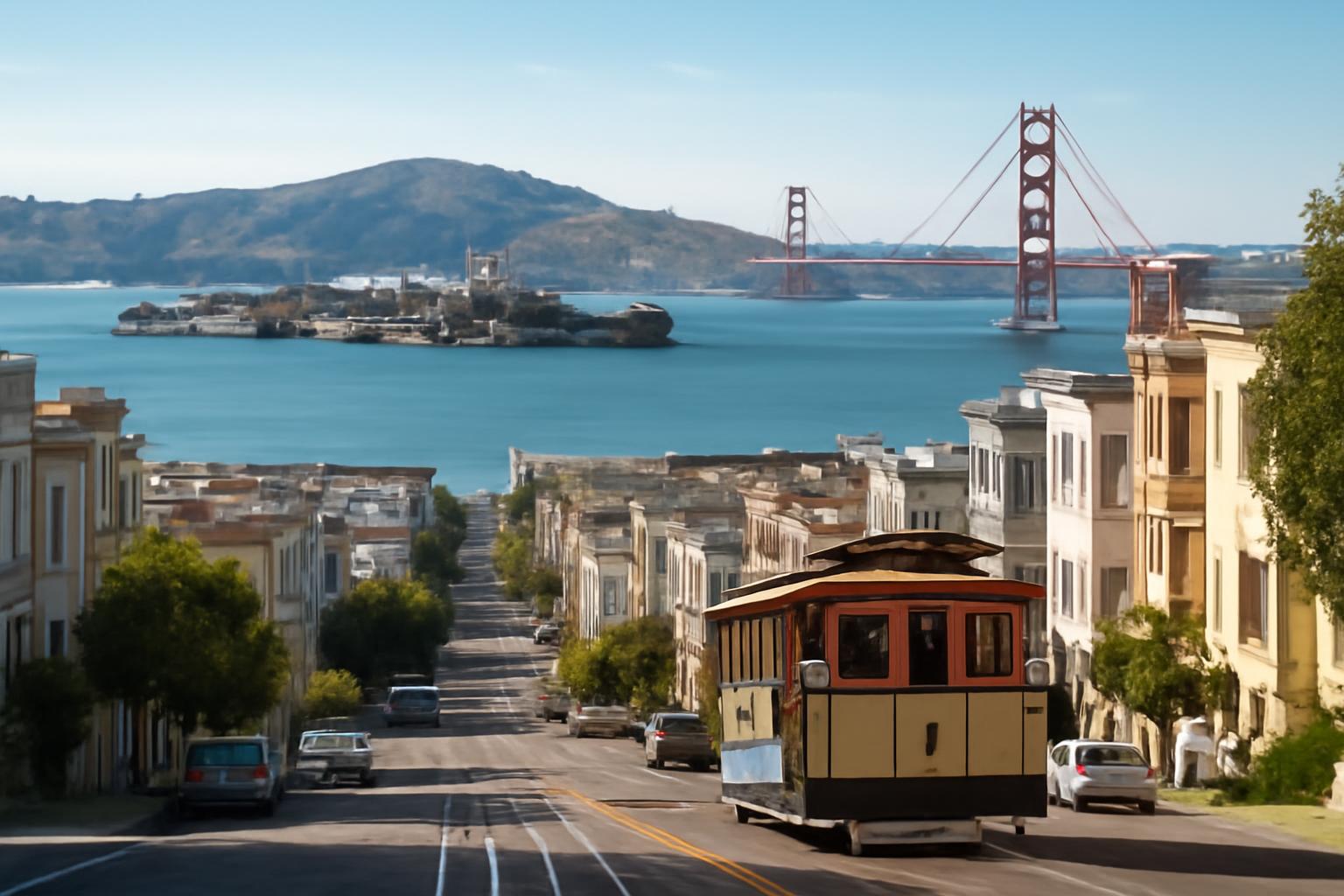
Two experiences anchor most credible first-visit advice: the Golden Gate Bridge and Alcatraz. The one-day guide at Inked with Wanderlust calls the Golden Gate Bridge “non-negotiable for a first-time visit,” and the first-timer guide at Like Where You’re Going opens with the bridge as the most famous and quintessentially San Francisco landmark. Alcatraz carries similar weight for a different reason: Tripadvisor notes the island was once the most secure federal prison in the U.S. and held inmates like Al Capone. The bridge is free and flexible; Alcatraz requires a ferry reservation and advance planning, which is covered in the booking section near the end of this guide.
Beyond those two, a handful of experiences recur across first-visit guides, each serving a different purpose:
- Golden Gate Bridge: free, outdoors, viewable from multiple angles and effort levels.
- Alcatraz: ticketed, half-day commitment including the ferry, reservation required.
- A cable car ride: Inked with Wanderlust groups it with the sea lions and Lombard Street as quintessential San Francisco; it is transport and attraction in one.
- Golden Gate Park: Tripadvisor identifies it as the third most visited park in the United States, with gardens, wildlife, museums, and art.
- Lombard Street’s crooked block: a quick photo stop, most useful when it sits on a route you are already taking.
- The waterfront and Embarcadero: piers, the Ferry Building, and bay views, best treated as a corridor you move through rather than a single destination.
Do not treat this as a checklist to complete. The bridge and Alcatraz reward the time they demand; the rest are modular. A cable car ride can double as transport between Union Square and the northern waterfront. Golden Gate Park can absorb a half day or a single museum visit. Lombard Street takes minutes. Pick based on what your route already passes, not on a sense of obligation. The sections that follow show how to assemble these pieces by area so you spend your time at attractions rather than between them.
Use Pier 39 for a focused waterfront stop
Pier 39 is worth a short, targeted stop for the sea lions, and that framing resolves the conflicting advice you will find about it. Sources that are openly skeptical of tourist districts still endorse this one specific reason to go. The writer at Meet Me Off Grid says she usually avoids packed tourist piers in most cities but still swung by Pier 39 to see the sea lions. Like Where You’re Going reaches the same conclusion from the other direction: the sea lions, usually sunbathing and making noise at the end of the pier, are “worth the walk through to go find them for a few minutes.”
The practical takeaway is to separate Pier 39 from the broader Fisherman’s Wharf area in your planning. Pier 39 is a specific stop with a specific payoff: walk to the end, watch the sea lions, and move on. Fisherman’s Wharf and the surrounding blocks are a larger commercial district that some visitors enjoy browsing and others find crowded and generic. Neither judgment needs to control your plan. If you are already moving along the northern waterfront, between the Ferry Building and the Aquatic Park end of the Embarcadero, the sea lion stop costs you little. If it would require a dedicated trip across the city, it is one of the easier cuts to make on a short stay.
Choose an outdoor San Francisco experience
At least one outdoor block belongs in every San Francisco plan, because the city’s coastline and parks deliver as much as its ticketed attractions and usually cost nothing. The useful decision is not “which park is best” but “which kind of outdoor experience fits my day”: a large urban park, a rugged coastal walk, a hilltop viewpoint, or bridge scenery.
The main supported options break down this way:
- Golden Gate Park for a full urban-park day: Tripadvisor describes gardens, wildlife, museums, and art within the third most visited park in the United States.
- Lands End and the Sutro Baths for coastline: Like Where You’re Going calls Lands End a great spot for rugged coastline views, with the Sutro Baths ruins as an interesting landmark, and Inked with Wanderlust notes the Lands End trail connects directly to the ruins, making them an easy combined visit.
- A hilltop park viewpoint: Meet Me Off Grid highlights a park with 360-degree views over the city as a free outing; San Francisco’s hilltop parks generally reward the climb when visibility is good.
- The Crissy Field to Fort Point shoreline walk for bridge scenery, covered in detail below.
The Lands End and Sutro Baths pairing deserves particular attention if you want the city’s wilder side. Because the trail and the ruins connect, you get a coastal hike and a historic site in one outing at the city’s western edge, far from the downtown attraction cluster. That distance is the tradeoff: it is a deliberate half-day trip, not something you tack onto a downtown afternoon.
Weather and visibility change the value of every option here. Fog can erase a viewpoint or make a coastal walk atmospheric, depending on your taste. Rather than fixing an outdoor block to a specific day in advance, keep it flexible and slot it in when conditions look right. Whichever option you choose, treat it as a genuine block of time with walking involved, not a drive-by photo opportunity.
See the Golden Gate Bridge your way
You do not have to walk across the Golden Gate Bridge to experience it well, and one local source argues you should not. The local guide at Coveteur recommends the shoreline walk from Crissy Field to Fort Point, a National Park Service historic site at the bridge’s south anchorage, and argues it is a better way to see the bridge than walking across it alongside the traffic. The walk keeps the full span in view the whole way and ends directly beneath the towers.
Crossing the bridge on foot is the other main option, and it delivers a different payoff: the experience of being on the structure, with the bay below and the city behind you. It is longer, windier, and louder than the shoreline walk. Choose based on what you want the memory to be: seeing the bridge (Crissy Field to Fort Point) or being on it (the deck crossing).
If you end at Fort Point, know its schedule before you build a plan around going inside. The National Park Service lists the fort as open Thursday through Monday, 10:00 a.m. to 5:00 p.m., with the exterior accessible seven days a week. Inked with Wanderlust notes Fort Point is free to enter, though parking nearby may carry a fee depending on where you leave the car.
Biking is a bounded third option. Bridge and Presidio routes involve real climbs, so if you rent, compare a conventional bike against an e-bike honestly based on your fitness, and check current route rules and conditions before committing. None of these approaches is the single correct one; they suit different energy levels and time budgets.
Explore San Francisco through its neighborhoods
Neighborhoods are where San Francisco stops being a set of landmarks and becomes a city, and they should get real time in your plan, not leftover minutes. Coveteur’s local guide states the principle directly: the best way to see San Francisco is to pick a neighborhood and explore it thoroughly. That advice runs against the instinct to maximize landmark count, and for most visitors it produces a better trip.
Each of the frequently recommended neighborhoods offers a distinct character. Chinatown delivers dense streets, markets, and one of the oldest Chinese communities in North America. North Beach, the city’s Little Italy, offers cafes, bakeries, and a slower street rhythm. The Mission brings murals, taquerias, and a livelier, younger energy. Haight-Ashbury carries its counterculture history in its storefronts and Victorians. The Castro is a center of LGBTQ history and community life. The 48-hour guide at About Time Magazine suggests that visitors pressed for time do well with a quick tour through favorite neighborhoods including the Mission, North Beach, and the Haight.
Treat these five as a menu, not a route. Visiting all of them in a short stay means spending your trip in transit between areas that sit on different sides of the city, with hills in between. One or two neighborhoods explored on foot, with time to stop, eat, and detour, will tell you more about San Francisco than five neighborhoods glimpsed from a rideshare window. Like Where You’re Going makes a related observation: each neighborhood has its own pockets of architecture, parks, viewpoints, and food, which means a single well-chosen neighborhood already contains most categories of thing you came to see. Choose by interest: food and murals point to the Mission, history and density point to Chinatown, music history points to the Haight.
Pair neighborhoods that fit naturally together
The single most efficient neighborhood move in San Francisco is pairing Chinatown with North Beach, because they share a border. Coveteur describes the geography precisely: the neighborhoods are so closely bordered that you can walk a block from the side streets of North Beach’s Little Italy and find yourself in the heart of historic Chinatown. That adjacency means one afternoon covers two of the city’s most distinctive areas with no transit leg in the middle.
A few pairings work on the same logic of shared borders or shared corridors:
- Chinatown + North Beach: directly adjacent, fully walkable as one loop, the strongest supported pairing.
- Golden Gate Park + Haight-Ashbury: the Haight sits by the park’s eastern end, so a park visit can begin or end with the neighborhood; treat this as a planning suggestion and check your specific route, since the park is large and your museum or garden stops may sit well west of the Haight.
- Ferry Building + the Embarcadero waterfront: the marketplace anchors one end of the flat waterfront corridor that continues toward Pier 39.
The general method matters more than any specific pair: before adding a stop to your day, ask what it borders. A stop adjacent to something already on your list is nearly free in time terms. A stop across the city costs a transit leg each way, plus the friction of hills and connections. Build days around one anchor area, then add only what touches it. This is how you convert a list of ten attractions into two or three coherent days instead of a week of backtracking.
Build food stops into the route
Food in San Francisco works best as part of the route rather than as separate restaurant destinations, and two supported anchors make that easy. The first is the Ferry Building. About Time Magazine describes the marketplace as home to food markets with artisan producers, one-off stores, pop-up restaurants, food stalls, and juice bars. Coveteur adds that between the weekly farmers market and the indoor dining options around the Embarcadero, the Ferry Building is a food destination for tourists and locals alike. Because it sits on the flat waterfront corridor, it slots naturally into any Embarcadero or Pier 39 plan as the meal stop.
The second anchor is the Chinatown and North Beach pairing, where eating and sightseeing are the same activity. Walking that loop hungry, with stops at bakeries, dim sum counters, and North Beach cafes, turns a neighborhood visit into a meal spread across an afternoon. No restaurant reservations required, no detour from the route.
If you want structure and context, a guided food tour is a supported option. Like Where You’re Going recommends taking one on the first day of a multi-day trip, or fitting it in even on a single-day visit, describing it as a mix of learning the history and culture while sampling food and drinks from many different spots. A first-day tour also front-loads recommendations you can use for the rest of the stay. Either way, the principle holds: plan where you will be at mealtimes, and let the neighborhood feed you there.
Make free and budget-friendly stops count
Free activities are not the consolation tier in San Francisco; several of the city’s strongest experiences cost nothing to enter. That matters because, as Meet Me Off Grid notes, San Francisco is known as one of the most expensive cities in the United States, so balancing ticketed attractions with free ones protects the trip budget without diluting the itinerary.
The supported free and low-cost options cover most categories of the visit:
- The Golden Gate Bridge, viewed or crossed on foot, is free.
- The Crissy Field to Fort Point walk is free, and Inked with Wanderlust confirms Fort Point itself is free to enter, though parking may carry a fee depending on where you park.
- The Lands End trail and Sutro Baths ruins combine a free coastal hike with a free historic site.
- The sea lions at Pier 39 cost nothing to see.
- Hilltop park viewpoints, including the park Meet Me Off Grid credits with the best 360-degree views of the city, are free.
- Golden Gate Park’s open spaces and gardens can fill a day without a ticket, even though some museums and attractions inside the park charge admission.
- A free museum tower viewpoint: Coveteur notes that at one museum you can skip the exhibition ticket and still take a free trip up the tower for a panoramic city view; confirm the current policy on the museum’s official page before relying on it.
Two cautions keep this list honest. First, “free admission” is not the same as “free visit”: parking fees, transit fares, and food along the way still add up, so a free stop reached by car may cost more than a cheap ticket reached on foot. Second, fees and access policies change. Before anchoring a day to a free stop, check its official page for current conditions, hours, and any fees that have been introduced. Used carefully, this list lets you reserve your spending for the one or two ticketed experiences you actually care about.
Plan a realistic short stay by area
The core planning method is simple: choose a small number of priorities, group everything else around them geographically, and leave slack in the schedule. Guides disagree about how much fits into a day or a weekend, and that disagreement itself is the lesson. Inked with Wanderlust states the reality plainly: things happen, feet get sore, kids get tired, attractions close unexpectedly, you get stuck in traffic, or you spend too much time somewhere you love. A plan with no buffer breaks on the first delay.
Geographic grouping is what makes a short stay work. San Francisco’s attractions form rough clusters: the downtown and waterfront corridor (Ferry Building, Embarcadero, Pier 39, Chinatown, North Beach), the bridge and Presidio area (Crissy Field, Fort Point, the bridge itself), the western edge (Golden Gate Park, the Haight, Lands End, Sutro Baths), and the central neighborhoods (the Mission, the Castro). Build each day inside one or two adjacent clusters. Coveteur’s neighborhood-first advice and the Chinatown-to-North-Beach adjacency show how much a single cluster can hold; About Time’s whistle-stop framing shows what happens when you try to touch every cluster in 48 hours.
When you select within a cluster, weigh each stop qualitatively: is it free or ticketed, indoor or outdoor, a quick stop or a half-day commitment, flat or uphill? Reliable per-attraction durations do not exist in any consistent form, so use those categories instead of a minute-by-minute schedule.
Use this checklist to turn the method into a plan:
- Pick two or three true priorities for the whole trip, not per day; everything else is optional.
- Reserve Alcatraz first if it is a priority, through the authorized provider Alcatraz City Cruises, since day and night tours are flagged as likely to sell out, then build that day around the ferry time.
- Assign each priority to its geographic cluster and fill the day only with adjacent stops.
- Mark each stop as flexible or fixed: viewpoints and walks can move with the weather, timed tickets cannot.
- Leave one open block per day as the buffer Inked with Wanderlust argues for, absorbing delays or extending whatever you are enjoying.
- Check the official visitor calendar and a local listing site like DoTheBay for events on your exact dates before finalizing.
A plan built this way survives contact with the actual city. You will likely do fewer things than an ambitious list promised, and the things you do will be done properly, on foot, without a day lost to crisscrossing town.
Choose transport by route, not by a universal rule
There is no single correct way to get around San Francisco; the right mode depends on the specific leg you are covering, which is why published advice conflicts. Some guides assume a car, others insist you never need one. Both are half right, because they are describing different routes.
Match the mode to the leg. Walking wins inside a cluster: Chinatown to North Beach, or along the flat Embarcadero, needs no vehicle at all. But walking between clusters is a different matter; About Time Magazine warns that while walking is a great way to explore the neighborhoods, you should be prepared for seriously steep hills and pack proper shoes. For cluster-to-cluster moves, Inked with Wanderlust notes that public transportation is readily available, as are ride-sharing options, so a car is not a requirement for the standard first-visit route. A cable car ride can serve as both transport and attraction on the corridors it covers, which makes it one of the rare cases where the slower option is the better one.
Driving earns its place mainly for the western and coastal stops. Lands End, the Sutro Baths, and outer parts of Golden Gate Park sit far from the downtown core, and a car simplifies a day built around them, with the caveat that parking near popular sites is a real constraint; the National Park Service notes parking at Fort Point is limited. Biking suits the bridge and shoreline routes for riders comfortable with the climbs.
Fares, schedules, and parking rules change, and the sources here do not establish current figures, so check official transit and venue pages for live details before you rely on a specific connection. The durable rule is the method: decide mode leg by leg, not trip by trip.
Account for hills, walking, and access needs
San Francisco’s terrain is a planning input, not a footnote, and ignoring it is the most common way short itineraries fail. About Time Magazine’s warning about seriously steep hills applies to exactly the neighborhoods visitors most want to walk, and grades that look trivial on a flat map can turn a fifteen-minute connection into a genuine climb. When you sketch a walking route, check the elevation between points, not just the distance, and route around the steepest blocks when someone in your group would struggle with them.
Fatigue compounds across days. Inked with Wanderlust’s list of things that go wrong, sore feet, tired kids, unexpected closures, is really an argument for pacing: schedule the most walking-intensive cluster early in the trip and keep later days lighter. Alternate a hill-heavy neighborhood day with a flat one; the Embarcadero corridor and the Crissy Field shoreline walk are the natural low-grade options.
For wheelchair users, stroller pushers, and anyone with limited mobility, do not rely on general guides, including this one, for suitability judgments. Check the official access page for each specific venue on your list, because access varies by site and changes over time. Fort Point illustrates what official sources can tell you: the National Park Service states the fort’s ground floor, including the theater, is wheelchair accessible, and that ADA service animals are allowed. That level of site-specific, official detail is what you want for every stop where access matters, and only official pages reliably provide it.
Check bookings, hours, and live details before you go
Everything in this guide about what to see is stable; almost everything about hours, prices, and entry rules is not, and the two kinds of information need different handling. Attraction recommendations from a year-old article remain useful. A year-old price or schedule can quietly wreck a day.
The evidence for this guide shows the problem concretely. Like Where You’re Going reported paying $56 per person for Alcatraz tickets, while the official Alcatraz City Cruises page currently lists the standard day tour at $47.95; neither figure should be trusted for your travel dates without checking the live page. Similarly, Fort Point’s published schedule, open Thursday through Monday, 10:00 a.m. to 5:00 p.m., closed on Thanksgiving, Christmas, and New Year’s Day according to the National Park Service, is exactly the kind of detail that determines whether the end of your bridge walk includes the fort’s interior or just its exterior, which is accessible seven days a week.
The reliable habit is simple: for each priority on your final list, open the venue’s own official page in the week before travel and confirm four things: current hours, current prices, any reservation or timed-entry requirement, and any closure notice. Tripadvisor notes that pre-purchased, timed tickets are required for Alcatraz entry, and other attractions may impose similar rules that third-party articles have not caught up with. Current booking requirements for most attractions beyond Alcatraz are not reliably established in general guides, so treat the official page as the only source that counts for these details.
Book Alcatraz through the authorized seller
Book Alcatraz tickets directly through Alcatraz City Cruises, which states that, in partnership with the National Park Service, it is the only authorized official provider with exclusive ferry service to Alcatraz Island. Buying from the authorized seller matters here more than for most attractions, because the ferry is the only way onto the island and demand routinely exceeds capacity.
The official page currently lists several products. The standard Alcatraz Day Tour is listed at $47.95 with fees and taxes included, and the Alcatraz Night Tour at $59.65, Check the official booking page for any additional products and current prices.
Both the day and night tours are flagged on the official page as likely to sell out, which is why reserving Alcatraz should be the first fixed point in your itinerary, with the rest of that day built around the ferry time. Groups larger than 14 people need to submit a separate groups form per the provider. Check the live page for current prices and availability on your dates rather than relying on the figures above.
Check event calendars for your travel dates
Before you lock in your plan, spend ten minutes checking what is happening in the city on your exact dates, because events can add options no evergreen guide can list. The official visitor site, San Francisco Travel, maintains seasonal event roundups; a recent example highlighted the Fillmore Jazz Fest, the SF Marathon, and neighborhood street events in a single month. For day-by-day listings, DoTheBay organizes Bay Area happenings by specific date, which makes it easy to scan only the days you will be in town.
Treat these calendars as a supplement to the plan you have already built, not a replacement for it. A festival that overlaps your neighborhood cluster is a bonus worth folding in; a marathon closing the Embarcadero on your waterfront day is something you want to know about in advance. Either way, the evergreen structure of priorities, clusters, and buffers stays the same.