
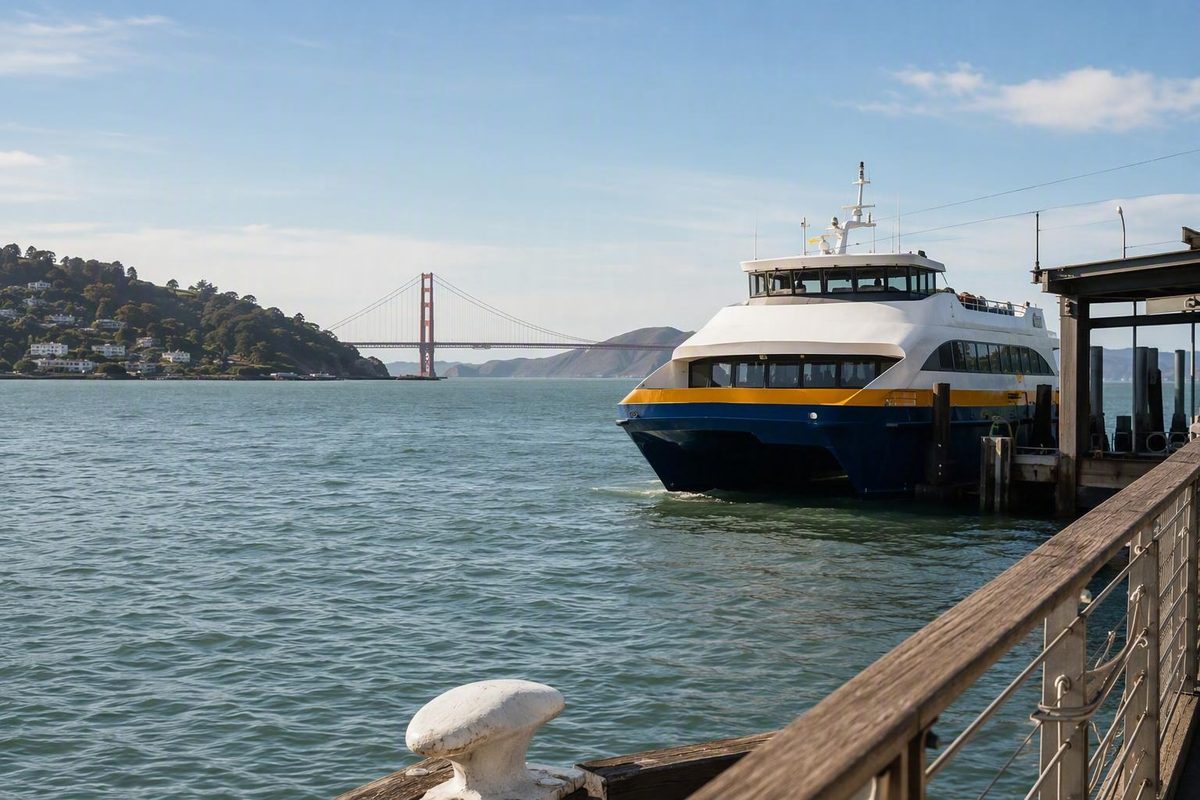
If you are starting at Fisherman’s Wharf, use Pier 41 only when Blue & Gold Fleet explicitly confirms that its Sausalito ferry is operating on your travel date and identifies Pier 41 as the departure point. Without that confirmation, continue southeast to the San Francisco Ferry Building and take Golden Gate Ferry to Sausalito. The terminals are separate, so checking before you leave prevents a needless waterfront backtrack.
The short answer: verify Pier 41 or use the Ferry Building
Which terminal should you use?
- Blue & Gold confirms Sausalito service for your date and names Pier 41: Go to Pier 41.
- No clear, date-specific confirmation: Go to the San Francisco Ferry Building and use Golden Gate Ferry.
Blue & Gold announced on March 9, 2026, that its vessels would temporarily leave Pier 41 and that Sausalito service would be suspended beginning May 3. The operator connected the interruption to PG&E’s Beach Street sediment-remediation project, the installation of new Pier 41 docks, gangways and piles, and an engine upgrade for the Bay Monarch ferry. It directed Sausalito passengers to Golden Gate Ferry at the Ferry Building during the interruption. Read Blue & Gold Fleet’s March 2026 service-adjustment announcement.
That announcement did not provide a reopening date. It establishes what Blue & Gold planned to suspend, but it does not by itself prove whether the Pier 41 route is operating on a later travel date. Older tourism pages and timetables may still describe Pier 41 as a Sausalito departure point without settling its current status.
The safest approach is to look for a current Blue & Gold notice or schedule that clearly covers the date you intend to travel. Check the operator, route, terminal and date together. If any of those details remain unclear, use the documented Golden Gate Ferry route between the San Francisco Ferry Building and Sausalito Ferry Landing instead.
This distinction matters most when you are already at Fisherman’s Wharf. Pier 41 may appear to be the natural place to begin, but walking there first and only then discovering that you need the Ferry Building adds an avoidable transfer. Make the terminal decision before setting out from your hotel, restaurant or waterfront attraction.
Pier 41 and the Ferry Building are not the same terminal
Pier 41 is in the Fisherman’s Wharf area near Pier 39. The Ferry Building is farther southeast along the Embarcadero. Both are on San Francisco’s waterfront, but they are separate boarding locations used by different operators.
| Terminal | Associated operator | Verified route status | What to do |
|---|---|---|---|
| Pier 41, Fisherman’s Wharf | Blue & Gold Fleet | Traditional Sausalito terminal; operation for a future date requires direct confirmation | Use only when Blue & Gold confirms the date and terminal |
| San Francisco Ferry Building | Golden Gate Ferry | Officially documented endpoint of the Sausalito route | Use when Pier 41 service is not explicitly confirmed |
Golden Gate Ferry’s official route information identifies the two endpoints as the San Francisco Ferry Building and Sausalito Ferry Landing. Check the official Sausalito route page.
The Fisherman’s Wharf Association also associates Pier 41 with Blue & Gold’s traditional Sausalito service and the Ferry Building with Golden Gate Ferry. Its visitor page is useful for understanding the geographic split, but it does not display a publication or update date. It should not be treated as proof that Blue & Gold is operating on the day you want to travel.
Do not confuse either operator with San Francisco Bay Ferry. The Fisherman’s Wharf Association identifies San Francisco Bay Ferry as serving East Bay routes through the Ferry Building, rather than operating the San Francisco–Sausalito crossing. The fact that several ferry companies use the same broader waterfront does not make their routes or tickets interchangeable.
Likewise, the presence of an old or revised Blue & Gold timetable online is not enough to establish that Pier 41 service has resumed. A useful confirmation should clearly identify all three of these details:
- Sausalito as the destination;
- the San Francisco departure terminal;
- the date or schedule period covering your trip.
If the information is promotional, undated or internally inconsistent, do not use it to choose a terminal. Going directly to the Ferry Building is the cleaner plan when the Pier 41 option remains uncertain.
How to transfer from Fisherman’s Wharf to the Ferry Building
If you need Golden Gate Ferry, the practical transfer choices are the Muni F line or a southeast walk along the Embarcadero. Choose according to your ferry departure time, luggage and energy—not simply by which route appears shortest on a map.
| Choose | Best when | Main tradeoff |
|---|---|---|
| Muni F line | You have luggage, want to conserve energy or need to protect a ferry connection | Waiting and service conditions can lengthen the transfer |
| Embarcadero walk | You have ample time and want a one-direction waterfront walk | More tiring with bags, crowds or a tight departure |
The F line connects the Fisherman’s Wharf and Ferry Building areas. The Fisherman’s Wharf Association estimates the streetcar journey at about 15 minutes, but that is a ride estimate rather than a guaranteed terminal-to-terminal connection. See the association’s ferry and F-line guidance.
Allow additional time to reach the stop, wait for a streetcar, get off near the Ferry Building and locate the correct ferry gate. A 15-minute estimate should not become a 15-minute transfer plan. If missing the sailing would disrupt the rest of your day, build in a generous buffer rather than relying on a best-case ride.
Walking works better when the transfer is part of the outing rather than an obstacle between two timed activities. Independent local guidance estimates the waterfront route at about 1.4 miles and roughly 30 minutes. Those figures can change with your exact starting point, pace, crossings and waterfront crowds. Compare the walking and F-line transfer guidance.
The walk is straightforward in concept: keep moving southeast along the waterfront toward the Ferry Building instead of creating an out-and-back excursion around Fisherman’s Wharf. It is most sensible when you have enough time to pause without worrying about the next sailing. With suitcases, young children or limited walking tolerance, the streetcar is usually the lower-friction choice.
Whichever option you choose, leave time for:
- reaching the F-line stop or navigating waterfront crossings;
- waiting for transit and absorbing an ordinary service delay;
- finding the correct Ferry Building gate;
- buying a paper ticket if you are not using Clipper or contactless payment;
- checking the departure display and current service alert;
- joining the appropriate boarding line, particularly with a bicycle.
Work backward from the ferry departure rather than forward from the moment you leave Fisherman’s Wharf. First decide when you want to be at the gate, then add the transfer and waiting buffer. This keeps the ferry—the fixed part of the plan—from being squeezed by an optional waterfront stop.
If you have no tight sailing to catch, the walk can turn a necessary transfer into a useful one-direction sightseeing segment. If the ferry is time-sensitive, take the F line and preserve your margin.
Plan the crossing and the return before leaving San Francisco
Golden Gate Ferry’s captured timetable was labeled effective April 13, 2026 and scheduled the displayed San Francisco–Sausalito crossings at approximately 30 minutes. The source capture did not establish whether the visible table represented weekday or weekend and holiday service, and the page displayed one alert without revealing its contents. Open the live Golden Gate Ferry schedule and alert before departing.
Treat the 30-minute figure as scheduled crossing time, not the total time needed for the trip. Your plan must also account for the transfer from Fisherman’s Wharf, finding the gate, waiting to board and leaving the dock after arrival. Weather, alerts and operating conditions can also affect the day.
Do not rely on the captured departure times as today’s schedule or assume that every sailing uses the same Ferry Building gate. The route page can display different weekday and weekend or holiday selections, and its captured timetable showed more than one gate assignment.
Before leaving Fisherman’s Wharf, confirm:
- the timetable for your actual travel date and direction;
- whether you are viewing weekday or weekend and holiday service;
- the current route alert and whether it affects your sailing;
- the Ferry Building departure gate;
- the return departures from Sausalito;
- the fare and payment method for each traveler;
- any bicycle rules or capacity restrictions relevant to your trip.
The return deserves the same attention as the outbound crossing. A departure that works well in the morning does not guarantee that the remaining return options will suit an evening meal, a long walk or a bicycle outing. Choose a preferred return and identify an earlier fallback before leaving San Francisco.
Cyclists should be especially cautious about building a day around the final practical sailing. The supplied evidence supports checking bicycle rules and capacity rather than assuming space will be available. A bicycle can also affect how early you want to reach the boarding area.
The same planning principle applies to visitors staying outside the waterfront area. Consider the time needed after the ferry returns to San Francisco, not merely the time at which it leaves Sausalito. A workable return is one that still connects sensibly with the rest of your evening.
2026 Sausalito fares and the easiest way to pay
Effective July 1, 2026, the Golden Gate Ferry adult one-way fare for Sausalito is $8.50 with Clipper or an eligible contactless bank card or mobile wallet, compared with $14 for a paper ticket. The one-way discounted fares are $7 for youth ages 5–18, seniors 65 and older, disabled riders and Medicare riders, and $4.25 with Clipper START. Up to two children age four or younger may ride free with each full-fare adult. See the official fares effective July 1, 2026.
These are one-way prices. A round trip requires payment in both directions.
For most adults visiting San Francisco, contactless payment is the simplest way to receive the lower fare. Golden Gate Ferry accepts eligible contactless credit and debit cards and mobile wallets for adult fares, and contactless payment automatically receives the adult Clipper price. An adult therefore does not need to buy a Clipper card solely to obtain the $8.50 Sausalito fare.
Every passenger must have a separate paper ticket, Clipper card or account, or contactless card or device. One person cannot repeatedly tap the same bank card or mobile wallet to pay for an entire group. Youth, senior, disabled, Medicare and Clipper START discounts require the appropriate discounted ticket or Clipper credential; an ordinary contactless bank card charges the full adult contactless fare. Check Golden Gate Ferry’s payment instructions.
For two adults, that means preparing two eligible contactless payment methods before boarding. Those could be separate physical cards, separate mobile devices or another supported combination, provided each traveler has an individual payment method.
Golden Gate Ferry uses a single-tap collection pattern rather than requiring passengers to tap both on and off. Travelers departing San Francisco tap when boarding. For trips departing Sausalito, payment is collected when passengers disembark in San Francisco.
The fare difference is substantial enough to settle the payment choice before you reach the gate:
- One adult saves $5.50 each way by paying $8.50 with Clipper or contactless payment instead of buying a $14 paper ticket.
- One adult’s round trip costs $17 with Clipper or contactless payment, compared with $28 using paper tickets.
- Two adults making a round trip pay $34 collectively with separate eligible contactless methods, compared with $56 in paper fares.
- The combined saving for those two adults is $22.
Do not confuse payment flexibility with group payment. Contactless makes it unnecessary for many adult visitors to obtain Clipper cards, but it does not remove the one-payment-method-per-rider rule. Organize cards or devices before entering the boarding area so the group does not have to solve payment at the gate.
Discounted travelers should also settle eligibility before the trip. The ease of tapping an ordinary bank card does not make that card a youth, senior, disabled, Medicare or Clipper START credential.
How Tiburon and Angel Island compare
Tiburon and Angel Island are separate destinations with their own schedules and operating rules. A ferry serving one does not establish a useful connection to either of the others.
| Destination | Adult Clipper or contactless | Adult paper ticket | Important distinction |
|---|---|---|---|
| Sausalito | $8.50 | $14 | Ferry Building–Sausalito route |
| Tiburon | $8.50 | $14 | Separate destination and schedule |
| Angel Island | $10 | $15.50 | Fare includes state-park admission |
The official Golden Gate Ferry fare schedule lists those one-way adult prices for Sausalito, Tiburon and Angel Island. Review the operator’s complete fare table.
Angel Island requires additional planning because tickets cannot be purchased on the island. Travelers should obtain the required return ticket before going there. Golden Gate Ferry also says it no longer accepts Blue & Gold tickets for Angel Island. Bicycles, including electric bicycles, are accepted on a first-come, first-served basis, while dogs are prohibited on the island except for service animals. Bicycles, including electric bikes, are welcome aboard all Golden Gate Ferry vessels Angel Island Ferry | Golden Gate.
Do not assume Sausalito, Tiburon and Angel Island form a convenient same-day loop simply because all three appear on ferry information pages. Check every direction separately, including the final return to San Francisco, before treating a connection as workable.
For a straightforward Sausalito day, keep the terminal decision simple: confirm Blue & Gold’s date and departure point before walking to Pier 41. If that confirmation is unavailable, head to the Ferry Building, check Golden Gate Ferry’s live alert and return schedule, and give each adult a separate contactless card or device to receive the lower $8.50 fare.