
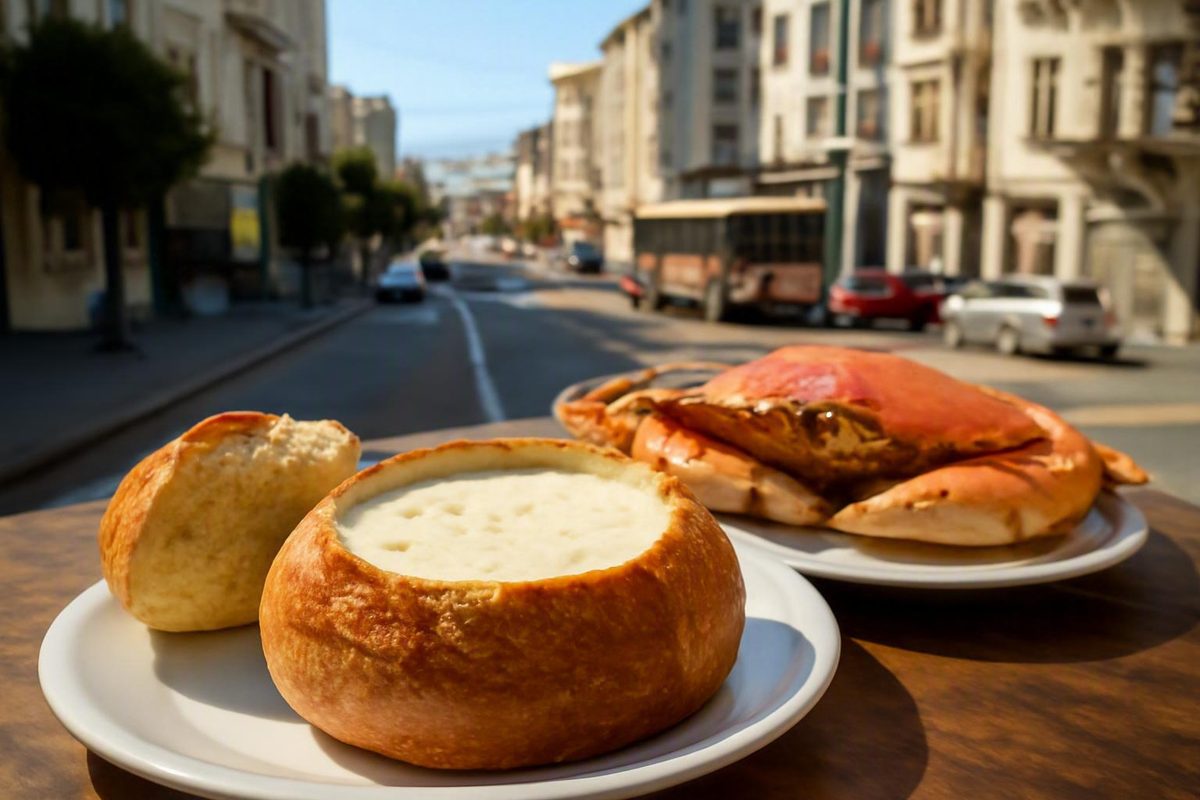
The short answer: five foods that define San Francisco
What food is San Francisco known for? For a first visit, begin with five defining associations:
- Sourdough bread — the crusty, naturally fermented bread most closely associated with the city’s bakery culture.
- Cioppino — a tomato-based Italian-American stew made with a changing combination of fish and shellfish.
- Dungeness crab — a regional Pacific catch with a prominent place in San Francisco’s waterfront dining tradition.
- Mission-style burritos — substantial flour-tortilla burritos packed with generous fillings.
- Chinese specialties such as dim sum — part of a much broader food culture that includes dumplings, barbecue, bakeries, egg tarts, noodles, and regional Chinese cooking.
These are practical starting points, not an objective ranking or proof that every item originated within city limits. Editorial guides repeatedly feature sourdough, cioppino, Mission burritos, dim sum, chowder, Dutch crunch, and other dishes as city-defining San Francisco foods.
For a fuller introduction, add seven secondary specialties:
- Dutch crunch sandwiches
- North Beach focaccia
- Irish coffee
- Clam chowder in a sourdough bowl
- Fortune cookies
- It’s-It ice cream sandwiches
- Egg tarts
That creates a selective list of 12 essential foods and drinks without pretending the city can be reduced to 12 objects. The first five are the strongest broad associations; the remaining seven add bakery, sandwich-shop, dessert, drink, Chinatown, and visitor-facing waterfront traditions.
No single dish captures San Francisco. The city’s culinary identity is inseparable from its neighborhoods and immigrant communities. The Mission, Chinatown, North Beach, the Richmond, and the waterfront each tell a different part of the story. Bakeries, seafood counters, markets, taquerías, cafés, delicatessens, and contemporary restaurants all belong in the answer.
Treat the 12 foods as an introduction, not a completion checklist. The most revealing way to eat through San Francisco is to connect a few of them with neighborhoods already on your itinerary.
Sourdough, cioppino, crab, burritos, and dim sum explained
The five defining foods provide very different experiences. Knowing what to expect helps you choose according to your route, appetite, and preferred dining style.
Some loaves are distinctly sour; others are mild, wheaty, or deeply caramelized.
Its importance lies in its longstanding local association and continuing role in the city’s bakeries. Sourdough appears as a loaf in its own right, alongside soup, as sandwich bread, and in the familiar waterfront bread bowl. That association does not require a claim that San Francisco invented all sourdough or that the bread depends on microorganisms found nowhere else.
A loaf is also one of the easiest signature foods to incorporate into a trip. It can become breakfast, a picnic component, or a hotel-room snack. Visitors interested in the current bakery scene can look beyond one legacy style to country loaves, baguettes, seeded breads, rolls, and laminated pastries. San Francisco Know’s guide to sourdough in San Francisco offers additional bakery-oriented planning.
Cioppino is a tomato-based Italian-American seafood stew closely associated with San Francisco and North Beach. It does not have one fixed seafood formula. Dungeness crab, mussels, calamari, fish, clams, shrimp, and other seafood may appear according to the kitchen and availability. One prominent version described by Eater combines Dungeness crab, mussels, calamari, other seafood, and crusty bread in its guide to iconic San Francisco dishes.
Expect a sauce-forward, potentially hands-on meal. Some seafood may remain in the shell, and bread is useful for soaking up the broth. Ask about the serving size if the menu does not make it clear.
Dungeness crab represents the regional Pacific seafood connection more directly.
Whole steamed crab is only one option. That flexibility is useful for visitors who want to try the regional catch without managing a complete shell-on crab. Because seafood availability and menus change, confirm the preparation currently being served.
A Mission-style burrito is generally a large flour-tortilla burrito with generous fillings. Meat, beans, salsa, and often rice are common. The burrito is usually wrapped tightly, often in foil, making it portable despite its size.
There is no universal recipe. Some notable versions omit rice, while tortilla treatment, fillings, proportions, and menu terminology vary among taquerías. “Mission-style” describes a recognizable format that is locally rooted and strongly associated with the Mission, not a mandatory ingredient list. One burrito can readily serve as a complete meal.
The service format can vary, but the appeal is shared variety: a group can sample several fillings, textures, and cooking methods in one meal.
Dim sum is only one part of San Francisco’s Chinese food culture. Chinatown and Chinese restaurants elsewhere in the city also offer barbecue meats, noodles, congee, seafood, dumplings, bakeries, egg tarts, and cooking associated with different regional traditions. Treating dim sum as the entire Chinese contribution would miss much of the city’s culinary range.
The practical choice is therefore about experience. Pick sourdough for a flexible snack or picnic; cioppino for a sit-down seafood stew; Dungeness crab when the regional ingredient is the priority; a Mission burrito for a substantial casual meal; or dim sum for shared variety.
Three different ways to experience San Francisco seafood
Cioppino, Dungeness crab, and clam chowder in a sourdough bowl overlap, but they emphasize different parts of the city’s seafood story.
| Choose | What it emphasizes | Best fit |
|---|---|---|
| Cioppino | Mixed seafood, tomato broth, and Italian-American North Beach | A substantial sit-down meal |
| Dungeness crab | The regional Pacific catch itself | Visitors focused on a particular seafood ingredient |
| Chowder in a sourdough bowl | Two familiar waterfront traditions in one serving | A casual meal during waterfront sightseeing |
Cioppino is the most layered of the three as a composed dish. Its broth, aromatics, seafood mixture, and accompanying bread all contribute to the experience. It connects Pacific seafood with the Italian-American food traditions associated with North Beach. Because it is a mixed-seafood stew, ordering cioppino is not the same as ordering a dedicated crab preparation, even when Dungeness crab is included.
Dungeness crab places the ingredient first. A whole crab creates a dramatic, hands-on meal, but it is neither the only nor automatically the most convenient preparation. Crab salad, soup, pasta, crab cakes, or a seafood combination may be easier to share or fit into a day of sightseeing. A restaurant survey of local foods documents several such uses in San Francisco seafood cooking.
It is particularly visible around Fisherman’s Wharf and works for visitors who want a familiar, casual waterfront meal. As the soup soaks into the loaf, the bread becomes part of the dish rather than a separate accompaniment.
The chowder bowl is reasonably described as a San Francisco visitor staple. Its prominence reflects the meeting of sourdough branding, seafood dining, and waterfront tourism; it should not be presented as an uncontested local invention.
Let your route guide the choice. Order cioppino if you are spending an evening around North Beach and want a meal tied to Italian-American food culture. Choose Dungeness crab if the regional catch is the priority. Pick a chowder bowl if it naturally fits a visit to the Wharf.
Do not assume every seafood restaurant serves all three options every day. Crab availability, seafood mixtures, portions, and specials can change. Check the current menu directly if one preparation is important to your plans rather than relying on old prices, fixed season dates, or past menu descriptions.
A neighborhood guide to the city’s defining foods
San Francisco food becomes easier to understand when organized geographically. Neighborhoods are not rigid culinary borders, but they are useful planning tools.
| Area | Foods and experiences commonly associated with it |
|---|---|
| The Mission | Mission-style burritos, tacos, pupusas, taquerías, bakeries, and broader Latino food culture |
| Chinatown | Dim sum, dumplings, Chinese barbecue, noodles, bakeries, egg tarts, and fortune cookies |
| North Beach | Cioppino, focaccia, pasta, Italian-American bakeries, cafés, and delicatessens |
| Fisherman’s Wharf and the waterfront | Dungeness crab, chowder bowls, oysters, and other seafood |
| Ferry Building and market-oriented stops | Produce, bread, cheese, chocolate, specialty goods, and prepared foods |
| The Richmond | Chinese restaurants, dim sum, Russian bakeries, produce markets, and other cuisines |
The Mission is the natural district in which to seek a Mission-style burrito. Its food identity is much broader, however. Taquerías, tacos, Salvadoran pupusas, pan dulce, cafés, and other Latino food traditions all belong in the neighborhood conversation. The burrito should open the door to the district rather than obscure everything else.
Chinatown is central for dim sum, dumplings, Chinese barbecue, egg tarts, noodles, markets, and bakeries. It works especially well for visitors who prefer several small tastes to one large meal. A bakery stop can also fit more easily between sightseeing stops than a full restaurant service.
Important Chinese dining extends well beyond Chinatown. The Richmond, among other areas, has a substantial Chinese restaurant presence. Visitors who treat Chinatown as the city’s only destination for Chinese food will miss much of San Francisco’s geographic and regional variety.
North Beach connects most directly with cioppino and Italian-American food traditions. Focaccia, pasta, cafés, bakeries, delicatessens, and old-style dining rooms complement the seafood stew. North Beach also borders Chinatown, making the two districts a practical pairing rather than separate cross-city trips.
Fisherman’s Wharf and the broader waterfront offer some of the most visible versions of Dungeness crab, chowder in sourdough bowls, and other seafood. Their concentration makes it convenient to compare menus while combining a meal with waterfront attractions.
Convenience is not comprehensiveness. Fisherman’s Wharf represents a heavily visited part of the food story, not the full range of Chinese, Mexican, Salvadoran, Burmese, Vietnamese, Filipino, Japanese, Persian, Turkish, bakery, market, and contemporary California cooking found elsewhere.
The Ferry Building and market-oriented stops offer another approach. Instead of committing to one signature dish, visitors can browse bread, produce, cheese, chocolate, specialty goods, and prepared foods. This works well for mixed groups or anyone assembling a picnic. Vendors and schedules can change, so verify the operating day and hours before building an itinerary around a market visit.
The Richmond is useful for experiencing San Francisco as a multicultural dining city rather than a collection of historic icons. Chinese restaurants and dim sum are prominent, while Russian bakeries, produce markets, and restaurants representing other traditions broaden the options. A food-focused itinerary similarly describes North Beach and Chinatown as neighboring districts and the Richmond as a multicultural dining area in its neighborhood-based San Francisco food plan.
Use these associations as planning aids, not rules. Eat a burrito or pupusas when your sightseeing brings you to the Mission. Combine dumplings or an egg tart with focaccia when walking through Chinatown and North Beach. Save crab or chowder for a day already centered on the waterfront.
Crossing the city solely to complete a food checklist can consume time better spent exploring. The meal that fits your route is often more rewarding than a theoretically ideal version located far away.
Why Chinatown and immigrant food cultures are central, not secondary
A list focused only on sourdough and seafood would give a distorted picture of San Francisco. Its food identity has been shaped by people bringing traditions, techniques, ingredients, and business models from around the world, then sustaining and adapting them through neighborhood restaurants, markets, bakeries, and family businesses.
Chinese, Mexican, Italian-American, Vietnamese, Burmese, Filipino, Japanese, Korean, Salvadoran, Persian, Turkish, and other traditions appear across accounts of the city’s dining landscape. One wide-ranging guide includes Chinese barbecue and dumplings, Vietnamese food, Burmese tea leaf salad, Japanese cooking, seafood, breads, and pastries among its San Francisco food experiences.
Three neighborhoods make the relationship between community and food especially legible.
In Chinatown, dim sum, dumplings, barbecue, egg tarts, noodles, bakeries, and markets reflect the enduring importance of Chinese food to the city. But “Chinese food” is not one uniform cuisine. Restaurants differ in regional emphasis, technique, menu, and service style. Chinese culinary life also extends into the Richmond and other neighborhoods, with its geography continuing to change as communities and businesses move.
In North Beach, bakeries, cafés, delicatessens, pasta, focaccia, and cioppino connect food with Italian-American community history. Cioppino matters not only because it contains Pacific seafood but because it represents adaptation: an Italian-American stew that became closely identified with a West Coast port city.
In the Mission, the Mission burrito sits within a much larger Latino food culture. Tacos, pupusas, baked goods, casual counters, and sit-down restaurants make the neighborhood more than shorthand for one oversized burrito. Mexican and Salvadoran traditions may coexist in the district without becoming interchangeable.
The same principle applies across the city. Vietnamese noodles, Burmese tea leaf salad, Filipino cooking, Japanese food, Korean food, and cuisines connected with the Middle East and Central Asia all contribute to contemporary San Francisco dining. They do not need a claim of local invention to matter.
That distinction is central: a cuisine can be fundamental to San Francisco without having originated in San Francisco. Dim sum does not need a local birth certificate to be part of the city’s identity. Japanese food does not become San Franciscan by losing its Japanese history. The local story lies in the communities, businesses, adaptations, customers, and neighborhood patterns through which these cuisines became part of daily city life.
Multicultural dining should not appear as an appendix after bread and seafood. It is one of the city’s defining culinary characteristics.
This perspective also encourages care with the word “authentic.” It is more useful to describe what a place serves, which culinary tradition it draws from, and how it fits its neighborhood than to declare one version uniquely authentic.
For visitors, the practical takeaway is simple: include at least one meal that reveals a neighborhood food culture rather than only a famous object. A dumpling counter, pupusería, Vietnamese noodle shop, Burmese meal, Japanese restaurant, bakery, or Chinese barbecue stop may communicate as much about San Francisco as a loaf of sourdough.
Beyond the big five: breads, sweets, drinks, and visitor favorites
The seven secondary items complete this guide’s 12-food framework. They add range without displacing the five defining associations.
Dutch crunch sandwiches are among the most locally distinctive options. It is strongly associated with Bay Area sandwich shops, although the supplied evidence does not support a simple San Francisco invention story. Look for it as a bread choice rather than a fixed sandwich recipe; the fillings vary widely.
North Beach focaccia belongs to the Italian-American bakery tradition. It works well as a walking snack or light meal and is easier to fit into a busy day than a full bowl of cioppino.
Focaccia also points toward the breadth of the city’s baking. Country loaves and sourdough receive top billing, but pastry cases may include croissants, kouign-amann, babka, baklava, egg tarts, and many other breads and sweets. That variety reflects both specialist craft baking and immigrant bakery traditions.
That strong city association should not be converted into a claim that the underlying drink was invented in San Francisco.
Clam chowder in a sourdough bowl combines two familiar visitor-facing traditions. It is one of the waterfront’s most recognizable meals, but its popularity does not make it the city’s sole defining dish or establish an uncontested local origin.
Fortune cookies have a notable connection to San Francisco’s food story, including Chinatown production and competing historical accounts. Their precise origin remains disputed. The careful description is “strongly associated with San Francisco, with disputed origins,” not “definitively invented here.”
It’s-It ice cream sandwiches provide a casual local sweet. Contemporary food coverage includes the product alongside sourdough, burritos, cioppino, Dutch crunch, chowder, and Chinatown bakery items in its selection of recognizable San Francisco dishes.
Egg tarts represent the bakery side of Chinese food culture. They are easy to incorporate into a walking route through Chinatown because they require less time and appetite than a full dim sum meal. Including them separately in this 12-item framework also highlights that Chinese food in San Francisco cannot be represented by dim sum alone.
Together, these secondary specialties broaden the experience: Dutch crunch introduces sandwich shops; focaccia and egg tarts emphasize immigrant bakery traditions; Irish coffee adds a drink ritual; It’s-It offers a packaged sweet; the chowder bowl reflects visitor-facing waterfront dining; and fortune cookies demonstrate how complicated food-origin stories can become.
If time is limited, prioritize the five core foods. Add the seven secondary items only when they fit naturally into your route.
What originated here—and what is simply associated with the city
Food history rarely fits the tidy stories printed on menus and tourism signs. A dish can be meaningful to San Francisco even when its creator, date, or exact birthplace remains uncertain.
Three labels help separate cultural significance from unsupported certainty.
Strongly associated with San Francisco
These foods have an enduring city connection, but that connection does not necessarily establish local invention.
Sourdough belongs here. San Francisco has a longstanding sourdough identity expressed through bakeries, loaves, bread bowls, and popular imagery. The available evidence does not establish the simplistic claim that the city invented sourdough or that local bread requires microbes exclusive to the Bay Area.
Dungeness crab also fits this category. It is a regional Pacific specialty rather than a species or dish unique to San Francisco. Its city identity comes from seafood markets, waterfront restaurants, and dining tradition.
Dim sum and broader Chinese food culture are central to San Francisco without being local inventions. Their significance comes from community history, neighborhood life, restaurant culture, and the depth and variety of available cooking.
Irish coffee is a recognizable city tradition, but the association should not be turned into an unsupported origin claim.
Locally rooted, with disputed details
These foods have especially strong local stories, but their precise creation histories remain contested or inadequately documented in the supplied evidence.
Cioppino is closely tied to San Francisco’s Italian-American community and North Beach. Its combination of tomato broth, mixed seafood, and bread fits the city’s port setting and Italian-American food culture. Colorful accounts about fishermen combining their catches are often repeated, but the evidence here does not provide the primary historical documentation needed to treat every detail as settled fact.
The Mission burrito is locally rooted and strongly associated with the Mission. Its large flour tortilla and abundant fillings distinguish the format, but the exact creator and birthplace remain contested. Even its composition is not fixed: rice is common, while some notable versions omit it.
Fortune cookies belong here as well. San Francisco has a prominent connection to their production and popular history, but competing accounts make a definitive invention claim unwise.
Broader regional or international foods
This category covers foods that matter in San Francisco but should not be presented as unique city inventions.
Dungeness crab is regional even though its San Francisco tradition is strong. Banh mi, ceviche, Japanese food, Vietnamese noodles, Burmese tea leaf salad, and many other dishes retain broader cultural identities while contributing to the city’s dining landscape.
Grain bowls, breakfast bowls, and seasonal California cooking may reflect contemporary local habits without constituting uniquely San Franciscan inventions. In-N-Out burgers are associated with California more broadly, while Napa and Sonoma products come from neighboring wine regions even when they appear on San Francisco menus.
The useful language is straightforward:
- Say “strongly associated with San Francisco” when the connection is clear but invention is not established.
- Say “locally rooted, with disputed details” when the city connection is persuasive but the creator, date, or precise birthplace remains unsettled.
- Say “important to San Francisco’s food culture” when a broader regional or international food has a meaningful local presence.
A food does not need an uncontested birth certificate to tell the city’s story.
How to build a first-time San Francisco food plan
The most manageable strategy is to select one defining food in each neighborhood already included in your sightseeing plan. This prevents unnecessary transit, excessive meals, and the feeling that the trip has become a restaurant marathon.
A flexible sequence might look like this:
- In the Mission: Have a Mission-style burrito as a substantial lunch, or choose tacos or pupusas if a whole burrito is more food than you want.
- In Chinatown: Share dim sum or dumplings, or stop at a bakery for an egg tart.
- Around North Beach: Choose cioppino for a full meal or focaccia for something lighter.
- Near the waterfront: Try Dungeness crab in an available preparation, another Pacific seafood dish, or a chowder-filled sourdough bowl.
- At the Ferry Building or another market-oriented stop: Browse bread, produce, cheese, chocolate, and prepared foods.
This is an example sequence rather than a fixed itinerary. Chinatown and North Beach make a practical pairing because they border one another. The Mission usually deserves a separate block of time, especially if you also want to see murals, shops, parks, or other neighborhood attractions. The waterfront works best when paired with sightseeing already planned there.
Use simple choice logic:
- Choose cioppino for a warm, mixed-seafood stew tied to Italian-American North Beach.
- Choose Dungeness crab when the regional seafood ingredient is the focus.
- Choose a Mission burrito for a filling, casual meal.
- Choose dim sum for shared variety and several small dishes.
- Choose sourdough for the most flexible breakfast, snack, or picnic option.
- Choose a chowder bread bowl for the familiar waterfront experience.
Do not try to eat all five defining foods in one day. Cioppino and a large Mission burrito can each serve as a main meal. Dim sum is easiest to explore with companions, while sourdough and bakery items can fill the gaps between larger stops. Crab can be ordered as part of another seafood dish instead of as a separate feast.
A market stop is useful for groups with different preferences. It allows one person to focus on bread, another on cheese or chocolate, and another on prepared food. Verify current schedules and vendor participation before going.
Restaurant details are less durable than neighborhood associations. Before traveling across town, confirm opening hours, reservations, current prices, menu availability, and whether the dish you want is being served. Seafood preparations and specials can change, and an establishment featured in an older guide may have altered its service.
For more detailed planning, San Francisco Know publishes separate guides to breakfast in San Francisco and lunch spots. These are editorial planning resources rather than guarantees that every venue will suit every schedule, budget, or taste.
Travelers choosing a full evening meal can also consult the site’s restaurant guide. For a route organized around public transportation rather than a single neighborhood, use the San Francisco food crawl by Muni line as an optional starting point and confirm current transit and venue details before leaving.
Frequently asked questions
What are the five foods San Francisco is most known for?
For a practical first-visit answer, choose sourdough bread, cioppino, Dungeness crab, Mission-style burritos, and Chinese specialties such as dim sum.
Sourdough represents the bakery tradition; cioppino connects seafood with Italian-American North Beach; Dungeness crab reflects the regional Pacific catch; the Mission burrito is locally rooted and strongly associated with the Mission; and dim sum represents one part of San Francisco’s much broader Chinese food culture.
This is a selective summary, not an objective ranking or proof that all five foods originated in San Francisco.
What makes a Mission-style burrito different from other burritos?
A Mission-style burrito is generally distinguished by its large flour tortilla, generous size, and abundant fillings. Meat, beans, salsa, and often rice are common, while cheese, sour cream, avocado, or guacamole may be included depending on the order.
There is no required recipe. Some notable versions contain no rice, and taquerías differ in tortilla preparation, fillings, proportions, and wrapping. The term describes a recognizable format locally rooted and strongly associated with the Mission.
Is cioppino the signature dish of San Francisco?
Cioppino is one of San Francisco’s defining dishes because it combines Pacific seafood with the city’s Italian-American and North Beach food traditions. It is a tomato-based stew that may include Dungeness crab, mussels, calamari, fish, clams, shrimp, or other seafood.
Calling it the single signature dish is subjective. Sourdough, Mission burritos, Dungeness crab, and Chinese specialties are also central to the city’s culinary identity.
Is clam chowder in a sourdough bowl actually a San Francisco food?
It is a recognizable San Francisco visitor experience, particularly around Fisherman’s Wharf and the waterfront. The pairing combines clam chowder with the bread most closely associated with the city.
The available evidence does not establish that the combination was uniquely invented in San Francisco. It is best understood as a popular waterfront staple rather than an uncontested local creation.
Which neighborhoods should food-focused visitors explore?
Start with the Mission, Chinatown, North Beach, the Richmond, and the waterfront.
- Visit the Mission for Mission-style burritos, tacos, pupusas, and broader Latino food culture.
- Explore Chinatown for dim sum, dumplings, barbecue, bakeries, egg tarts, and noodles.
- Go to North Beach for cioppino, focaccia, pasta, cafés, and Italian-American bakery and deli traditions.
- Use the Richmond to explore Chinese restaurants, dim sum, Russian bakeries, markets, and multicultural dining.
- Choose Fisherman’s Wharf and the waterfront for crab, chowder bowls, and accessible seafood experiences.
- Add the Ferry Building or another market-oriented stop for produce, bread, cheese, chocolate, and prepared foods.
The best choice is usually the neighborhood already connected to your sightseeing plan. Food should help structure the day rather than force you to spend it crossing the city.
The practical takeaway
Begin with sourdough, cioppino, Dungeness crab, a Mission burrito, and dim sum, but do not treat them as a complete checklist. Add Dutch crunch, focaccia, Irish coffee, a chowder bowl, fortune cookies, an It’s-It, or an egg tart when one fits naturally into the day.
The most revealing approach is to eat neighborhood by neighborhood. The Mission, Chinatown, North Beach, the Richmond, the waterfront, and market-oriented stops show how immigrant traditions, Pacific seafood, bakeries, and California ingredients combine.
Choose a few experiences that match the route you already want to follow, and confirm current venue details before going. You will understand more of San Francisco—and spend less time backtracking.