
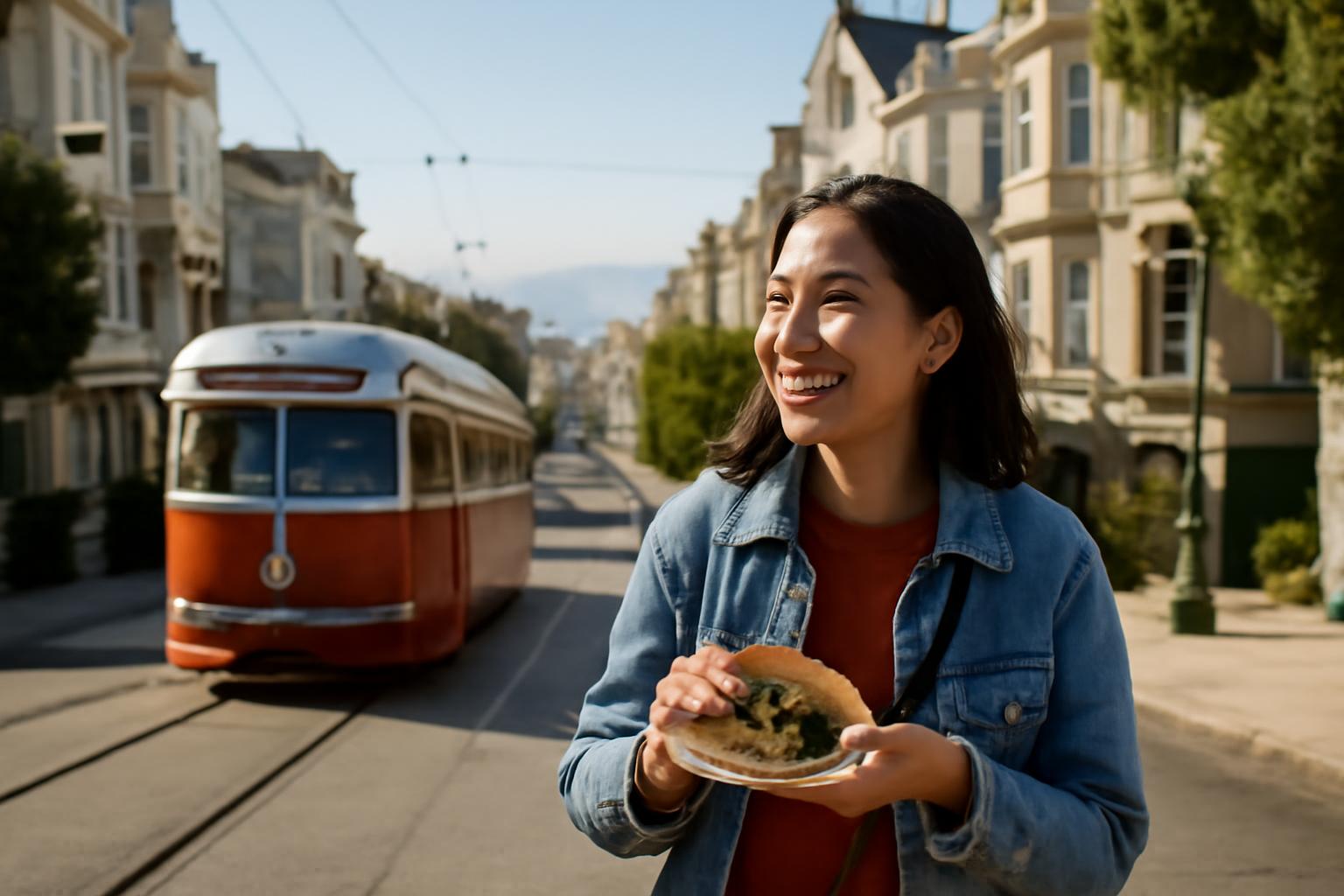
A good San Francisco food day is rarely just about what you eat. It is also about whether you spend the day climbing avoidable hills, doubling back between neighborhoods, or losing time to parking and ride-hail waits. That is why a San Francisco food crawl by Muni line can make real sense for visitors: the transit corridor becomes the structure of the day.
The clearest official proof comes from SFMTA’s 2025 Hop On Muni Beer Crawl, a time-bound event built around four named lines: 7 Haight, 14 Mission, T Third, and 22 Fillmore. It ran during San Francisco Beer Week from February 21 through March 2, 2025. Hop On Muni Beer Crawl | SFMTA
A second official example came from SFMTA’s archived 2024 Tasty Transit Tour, an all-ages bakery crawl that used the L, 22, and 38 on September 28, 2024. 10 Years of Muni Forward Tasty Transit Tour | SFMTA
Those pages do not establish a permanent, year-round official Muni food-crawl program. What they do establish is more practical for trip planning: San Francisco can be explored effectively through Muni corridors, with the line itself doing much of the routing work. The safest way to use the evidence is to treat these as documented SFMTA examples and then adapt their logic for your own day.
What Makes a Muni Line Food Crawl Efficient for SF Visitors
A Muni-based crawl works best when it does three things at once: keeps neighborhood jumps short, reduces unnecessary uphill walking, and gives the day a sequence so you are not improvising every move. That matters in San Francisco because great food areas are often easier to enjoy within themselves than between themselves.
The official SFMTA events support that corridor-first approach. In 2025, SFMTA grouped beer-crawl stops by the 7, 14, T, and 22. In 2024, it grouped bakery stops across the L, 22, and 38. The useful lesson for visitors is not that these exact events are always available. It is that a line can be the organizing principle, not just the transport between unrelated reservations.
That idea also matches the broader, hill-aware visitor mindset behind San Francisco Know: choose a readable structure, let transit cover the awkward connectors, and avoid spending energy on map-perfect but physically annoying detours.
In practice, that usually means picking one corridor for a dense day or two corridors for a longer one, then using transfers only when they solve a real problem. If a transfer saves a steep climb, a messy backtrack, or a long dead zone between neighborhoods, it earns its place. If it saves only two blocks, it usually does not.
It also helps to be picky about what counts as relevant “food transit” advice. Some articles about San Francisco culinary bus routes are really charter- or shuttle-marketing pages, not public-transit planning. They can still suggest neighborhoods worth eating in, but they are not evidence of a true Muni crawl.
The biggest efficiency gain is mental, not just physical. Once you decide that the day is a 14 Mission day or a 22 Fillmore day, you stop chasing the whole city. That usually produces a better meal pattern, better pacing, and fewer frustrating “quick walks” that turn into hidden climbs.
2025 Hop On Muni Beer Crawl: Rules, Routes, and Stops
The strongest official example here is SFMTA’s Hop On Muni Beer Crawl. It ran from February 21 through March 2, 2025, was 21+ only, and started and ended at Standard Deviant Brewing, 280 14th St. SFMTA told participants to RSVP for the kickoff on Eventbrite to get a physical game card and limited merch, then collect six stickers: one Standard Deviant sticker, four route-color stickers for the participating lines, and one final SFCFC sticker. SFMTA also described participating bars as places serving food such as tacos, pizza, burgers, and wings alongside beer. Hop On Muni Beer Crawl | SFMTA
That structure is what makes the event so useful as a planning model. It was not a comprehensive restaurant guide for San Francisco, and it was not proof of an ongoing official program. It was a specific Beer Week promotion centered on Hop on Muni IPA, sticker collection, and prizes. But it still showed a very usable public-transit format: start from one anchor, ride a small set of named lines, and make each stop part of a sequence rather than a random list.
For visitors, the official logic translates well into a self-guided version:
- start from one place you can find easily
- keep the crawl tied to one line or a small group of lines
- decide in advance what “done” means
- let transit handle the ugly connectors
- shorten the crawl before you let it become a scheduling problem
There is one especially practical detail on the 14 Mission leg. SFMTA’s rules made clear that Standard Deviant alone did not complete that corridor; participants had to visit at least one additional stop on the 14 route besides the brewery. That matters because it shows how the official event itself thought about balance: one anchor stop is useful, but a crawl still needs movement.
If you are adapting the 2025 idea for your own trip, resist the urge to “complete” all four lines unless that challenge is the point. The event format was built for a promotion. A visitor day is usually better when it borrows the structure without borrowing the pressure.
Stops on 2025 Beer Crawl Muni Lines: 7 Haight, 14 Mission, T Third, 22 Fillmore
SFMTA’s event page listed the participating venues and addresses below. The official page supports this list as a route framework and confirms that food was available across the crawl, but it does not provide a venue-by-venue menu guide.
- 7 Haight: The Page, 298 Divisadero St; Underdogs Tres, 1224 9th Ave; Pizza Place on Noriega, 3901 Noriega St.
- 14 Mission: Tempest, 431 Natoma St; Standard Deviant, 280 14th St; Teeth, 2323 Mission St; WesBurger, 2240 Mission St; Royal Cuckoo, 3202 Mission St.
- T Third: Red’s Place, 672 Jackson St; Underdogs Cantina, 128 King St; Sea Star, 2289 3rd St.
- 22 Fillmore: The Snug, 2301 Fillmore St; Kilowatt, 3160 16th St; Elixir, 3200 16th St; Connecticut Yankee, 100 Connecticut St.
For actual trip planning, the lines behave differently even though they share the same official event branding.
Its listed stops move from Divisadero out toward the Sunset side of the city. That makes it a good choice if you want the ride itself to feel like part of the outing. It is less ideal if you want a very dense, low-ride, high-snack day.
The listed stops create a readable spine from the Standard Deviant area into the Mission itself. You can build a compact version around Standard Deviant plus one or two Mission stops, or you can keep going farther south if the day still has energy.
The official crawl proves that the route can support a food-and-drink hop, but the feel is different from a neighborhood where you simply wander a few blocks between every stop. It benefits from more generous timing.
The official event proves it is crawl-usable. At the same time, even favorable rider commentary about San Francisco transit often treats the 22 as busy and patience-testing. That does not disqualify it. It just makes it a line where a shorter version often feels smarter than an ambitious one.
For many visitors, the best adaptation is to stop treating “completion” as the goal. A 14 Mission afternoon built around Standard Deviant, Teeth or WesBurger, and one later stop can be more enjoyable than racing through all four official routes. A 22 Fillmore sampler using the 16th Street pair plus one northward stop can work the same way. The official event gives you permission to think in corridors; your trip should give you permission to stop early.
2024 Tasty Transit Tour: All-Ages Bakery Crawl Example
If the 2025 beer crawl shows the adult, promotion-style version of a Muni food crawl, the 2024 Tasty Transit Tour shows the family-friendly version. SFMTA ran it on Saturday, September 28, 2024, from 10:00 a.m. to 1:30 p.m. The event was free, but riders still needed regular Muni fare, and SFMTA specifically told participants to bring a Clipper card, buy tickets in MuniMobile, or bring cash for paper tickets. All ages were welcome. 10 Years of Muni Forward Tasty Transit Tour | SFMTA
The route sequence is worth spelling out because it is one of the clearest official transit-food templates in the evidence. The event kicked off at Rolling Out Café, 1722 Taraval St. Riders then used the L from roughly 10:30 to 11:10 a.m. before continuing to Thorough Bread & Pastry, 248 Church St. From there, the group used the 22 from about 11:40 a.m. to 12:05 p.m. to reach Fillmore Bakeshop, 1890 Fillmore St. The final leg used the 38 from about 12:35 p.m. to 1:05 p.m. and finished at The French Spot, 1042 Larkin St. 10 Years of Muni Forward Tasty Transit Tour | SFMTA
For visitors, that archived page matters for two reasons.
That clarity matters more than whether you copy the exact bakeries.
The page is also a good reminder about evidence boundaries. SFMTA keeps it online as a public record of a past event. That supports the format. It does not prove an annual recurring bakery program. So the most accurate way to use it is as a template: start somewhere destination-worthy, ride to the next stop in a clear order, and let Muni create the transitions.
If you want a ready-made family model, this is the closest thing in the evidence. You could follow the original route logic very closely, or simply borrow the principle: morning bakery, second bakery on another line, final dessert stop that leaves you in an easy place to head elsewhere.
Promising Muni Lines for Food Near Scenic or Reliable Routes
Beyond the two official SFMTA food events, the evidence becomes much softer. That means any broader line suggestions should be treated as scenic or operational ideas, not as verified current food-crawl routes.
A September 2024 opinion piece in Golden Gate Xpress praised the 24-Divisadero as reliable and scenic through areas including the Castro and Alamo Square, praised the 1-California for views through Chinatown, Nob Hill, Pacific Heights, and the Richmond, and liked the 28-19th Avenue as a connector between Golden Gate Park and Fisherman’s Wharf. The same piece criticized the 22-Fillmore as overcrowded and the T-Third Street as traffic-prone. Opinion: The best and worst Muni lines in San Francisco – Golden Gate Xpress
That is useful mainly as a warning about tone, not as a route guide. A line can be scenic or reliable without being a documented food corridor. It can also be officially usable for a crawl, as the 22 and T were in SFMTA’s event materials, while still drawing rider complaints in everyday use.
So how should a visitor use this section?
-
24-Divisadero: a plausible scenic connector if your day already includes neighborhoods along that spine, but not a verified food crawl from the evidence here.
-
28-19th Avenue: potentially useful for linking major areas, but the evidence here supports it only as a connector concept.
- 22-Fillmore and T-Third: confirmed by official event pages as workable crawl lines, but worth padding with extra time if crowding or traffic becomes part of the day.
In other words, the official evidence supports food crawls on the 7, 14, 22, T, L, and 38 in specific event contexts. The opinion evidence supports curiosity about 1, 24, and 28 as rides, not confidence in them as proven current food itineraries.
Transit Tips for Any Muni Food Crawl: Fares, Tracking, and Reliability
The simplest way to reduce friction is to settle payment before your first stop. SFMTA’s 2024 bakery-tour instructions told participants to use a Clipper card, the MuniMobile app, or cash for paper tickets. 10 Years of Muni Forward Tasty Transit Tour | SFMTA
That is basic advice, but it matters more on a food crawl than on a museum day. If boarding is awkward, every later decision gets harder. Your day works better when the only live question is whether to order one more item or catch the next vehicle.
The second big variable is timing. A food crawl is sensitive to small delays because appetite changes faster than sightseeing energy. If a line is running behind, you may arrive too hungry, too full, or too early for the next stop. So the most practical habit is to check live arrival information before leaving each venue, not just when you start the day.
A few rules usually keep things readable:
- avoid transfers that save only a couple of blocks
- check current hours before you board, not after you arrive
- keep one backup stop in mind for each neighborhood cluster
- shorten the crawl as soon as the line stops cooperating
- treat service variability as a reason to simplify, not to panic
The official event examples also point toward a useful pacing principle: Muni is there to remove the wasteful parts. Let it do the long connector, the steep connector, or the boring connector. Save walking for the parts of the neighborhood that are actually fun to browse.
That matters especially in San Francisco, where a route that looks trivial on a map can feel much longer on the ground. The smoother days are usually the ones where transit covers the awkward jump and walking is reserved for the interesting cluster at the other end.
Hill-Smart Adaptations for Muni Food Stops
The best Muni food crawls in San Francisco are not just transit-smart. They are elevation-smart.
A useful rule is to stack stops by effort, not just by distance. In San Francisco, one half-mile can be gentler than one block depending on the hill. So when you adapt a crawl, think about where the climbing happens between stops, not just where the line runs.
You go forward to the next stop, and if the day needs to end early, you can stop without retracing an annoying uphill section. That same logic shows up in a one-direction waterfront walk too: linear plans are usually calmer than elegant-looking loops.
A few practical hill-smart moves carry over well to food planning:
- Use Muni for the steep connector, then walk the flat cluster.
- Do not force a loop just because it looks tidy on a map.
- Save the most flexible, flattest area for later in the day.
- Separate the return trip from the crawl itself.
Haight and Fillmore are good examples of neighborhoods where this mindset pays off. They may be absolutely worth visiting, but they are rarely places where visitors benefit from accidental extra walking. If transit can do the hard part, let it.
The same principle helps if your crawl is only half the day. A linear food route pairs more cleanly with a later waterfront stroll, museum stop, or neighborhood browse than a loop that leaves you stranded on the wrong side of an uphill return.
Food Clusters Near Muni Lines: Neighborhood Inspirations
The strongest way to use the evidence is to let the official SFMTA events tell you which corridors are documented, then use lighter sources only as inspiration, not proof.
A June 2025 charter-bus marketing article, which is not a Muni guide, suggested Mission taco stops such as La Taqueria, El Farolito, and Taqueria Cancun, and Haight plant-based stops such as VeganBurg and Loving Hut. That is useful only at the neighborhood level. It should not be read as evidence of a public-transit Muni crawl. Top Culinary Bus Routes Every Food Lover Must Try in SF
What the official evidence supports more firmly is this:
-
7 Haight: a workable documented corridor, but more spread out. It suits a browse-and-ride rhythm better than a dense cluster.
-
T Third: a documented crawl line with viable anchors, but the evidence does not support a single cuisine identity for it.
That distinction matters. It is fine to say, “I want to ride the 14 because I also want Mission tacos.” It is less accurate to say the evidence here proves a verified, current taco crawl on the 14. The official pages prove the corridor works. They do not replace current menu checking.
A few cautious visitor patterns do emerge:
Mission / 14 line Even if you do not follow the beer-crawl challenge, the official stop list supports a compact corridor day with a clear start, mid-point, and finish.
Haight / 7 line This line makes more sense when the ride is part of the point. The official stop list stretches across neighborhoods, so the experience is less “eat every few blocks” and more “hop, browse, continue.”
Fillmore / 22 line
Third Street / T line Treat it as a measured hop, not a grazing strip.
The safest planning shortcut is simple: choose the line first, then choose the food mood. If you reverse that order, San Francisco can turn into a lot of unnecessary cross-city movement.
FAQ
When is the 2025 Hop On Muni Beer Crawl and how do I join?
It ran during San Francisco Beer Week from February 21 to March 2, 2025, and the official format was 21+ only. It started and ended at Standard Deviant Brewing, 280 14th St. SFMTA told participants to RSVP for the kickoff on Eventbrite to get a physical game card and limited merch, then collect the required stickers across the participating routes before returning to Standard Deviant. Hop On Muni Beer Crawl | SFMTA
What food is available at 2025 beer crawl bars?
SFMTA described the participating venues as offering food such as tacos, pizza, burgers, and wings alongside beer. The official page did not assign those foods to each venue stop by stop. So the reliable takeaway is that the crawl was built to include food, but current menus and hours should still be checked before you go. Hop On Muni Beer Crawl | SFMTA
Are there family-friendly Muni food crawl examples?
Yes. The clearest official example is the 2024 Tasty Transit Tour, an all-ages bakery event run by SFMTA on September 28, 2024. It connected Rolling Out Café, Thorough Bread & Pastry, Fillmore Bakeshop, and The French Spot using the L, 22, and 38. 10 Years of Muni Forward Tasty Transit Tour | SFMTA
Which Muni lines are best for scenic food access?
The evidence here supports only a cautious answer. In a September 2024 opinion piece, the 1-California and 24-Divisadero were praised for scenery, and the 28-19th Avenue was praised as a useful connector. But those are not verified food-crawl routes in the same way the official SFMTA event lines are. The documented food-crawl lines in this article remain the 7, 14, 22, T, L, and 38, with the strongest official examples centered on the 2025 beer crawl and the 2024 bakery tour. Opinion: The best and worst Muni lines in San Francisco | Golden Gate Xpress
How to pay for Muni on a food crawl?
SFMTA’s bakery-tour instructions gave the cleanest answer: use a Clipper card, buy tickets in MuniMobile, or bring cash for paper tickets. Setting that up before your first stop is the easiest way to keep the crawl moving. 10 Years of Muni Forward Tasty Transit Tour | SFMTA