
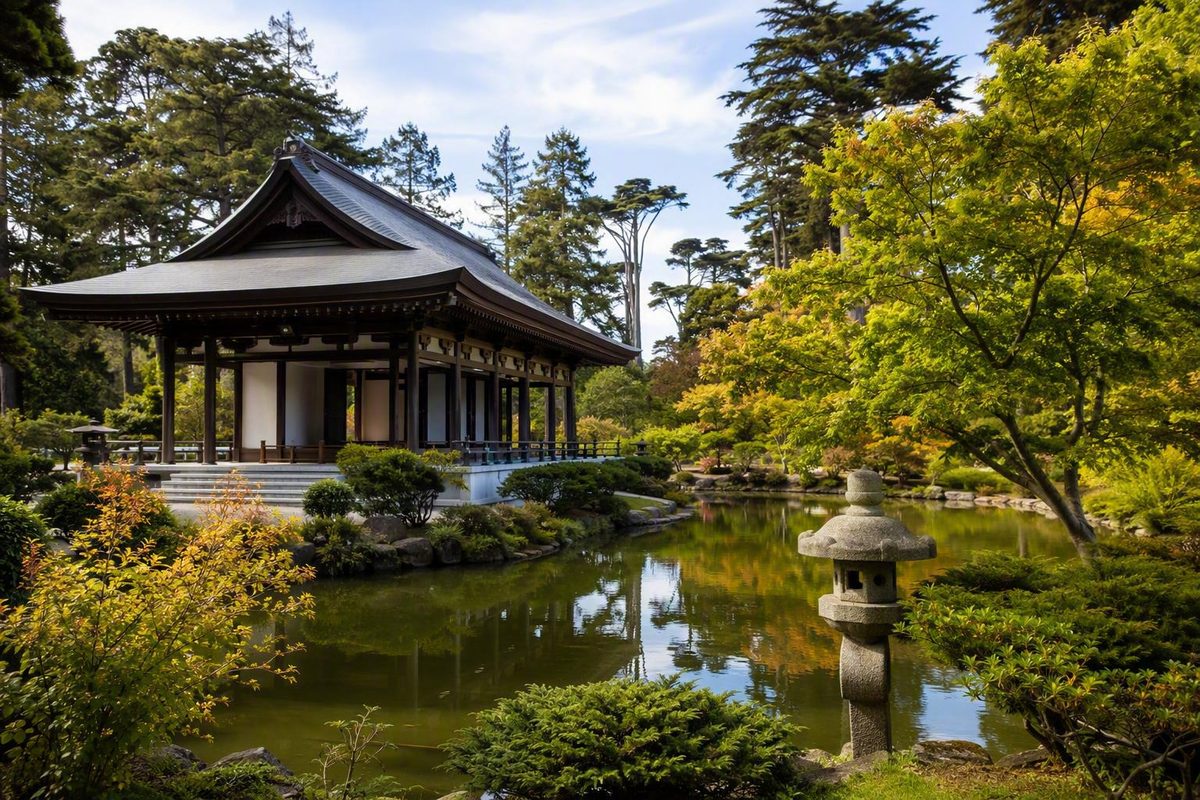
San Francisco’s Japanese Tea Garden works best as a focused stop rather than an all-day park expedition. Use the Music Concourse as your navigation landmark, allow roughly 45 to 90 minutes, and pair the garden with one nearby museum or garden rather than crisscrossing Golden Gate Park.
The main complication is ticketing. Published pages disagree about whether every visitor must reserve a timed entry or whether walk-up tickets may be available, and the supplied information does not establish a current general-admission price. Before leaving, check the live Gardens of Golden Gate Park pages for that day’s admission procedure, seasonal hours, temporary closures, and accessibility arrangements.
Japanese Tea Garden at a Glance: Location, Hours, and Time Needed
The attraction’s official name is the Japanese Tea Garden. It is inside Golden Gate Park—not in San Francisco’s Japantown neighborhood—and it is separate from the larger, more plant-focused San Francisco Botanical Garden.
The address is 75 Hagiwara Tea Garden Drive, San Francisco, CA 94118. More usefully for navigation, the garden is in the Music Concourse area near the de Young Museum and California Academy of Sciences. Search for the exact attraction or address rather than entering only “Golden Gate Park,” which covers a much larger area.
The strongest supplied operating information reports that the garden opens daily at 9:00 a.m. Seasonal final-admission times are 5:30 p.m. from March through October and 4:30 p.m. from November through February. The operator says final admission occurs 30 minutes before closing, which implies expected grounds-closing times of 6:00 and 5:00 p.m. respectively; those closing times are calculated from the stated interval rather than separately published in the source (reported schedule and location).
| Season | Published final admission | Expected closing based on the stated 30-minute interval |
|---|---|---|
| March through October | 5:30 p.m. | 6:00 p.m. |
| November through February | 4:30 p.m. | 5:00 p.m. |
Before-you-go check: Verify seasonal hours, temporary closures, and ticket requirements on the live garden pages immediately before departure. Do not use Tea House hours, a map listing, or an older travel guide to infer the garden’s admission deadline.
For a typical first visit, plan on 45 to 90 minutes. The shorter end suits a purposeful look at the principal landmarks; the longer end leaves room for photographs, smaller landscape details, and an optional Tea House or Gift Shop stop. A guided walk, extensive photography, congestion, mobility needs, or a wait for tea can extend the visit (visit-duration guidance).
Think of the site as a compact designed landscape rather than a large botanical collection. Its appeal comes from the relationships among water, stone, architecture, winding paths, and carefully shaped vegetation.
Tickets, Free Admission, and Rules to Check Before You Go
Do not assume that you can arrive without preparation. The published admission guidance conflicts.
The Gardens of Golden Gate Park attraction page says all visitors must reserve a timed-entry slot in advance. Because Gardens of Golden Gate Park manages admission and general visitor information, its live Japanese Tea Garden page should control your decision.
The independent concessionaire operating the Tea House and Gift Shop says garden tickets may be purchased online or at the door. It also directs admission questions back to Gardens of Golden Gate Park, confirming that the concessionaire does not control the general entry policy (concessionaire ticket statement).
Until those statements are reconciled, use this routine:
- Open the live garden page before traveling.
- Confirm whether timed entry is required for your date and visitor category.
- Reserve online if instructed to do so.
- Save the confirmation or take a screenshot for offline access.
- Recheck the page on the morning of your visit for closures or procedural changes.
This guide does not quote a general-admission price because the supplied evidence does not contain an operator-confirmed current price. Prices in third-party guides may be outdated, limited to nonresidents, or incomplete because of service fees and eligibility distinctions.
A published free-admission period runs from 9:00 to 10:00 a.m. on Monday, Wednesday, and Friday. San Francisco residents and certain additional groups are reported as eligible for free admission as well. Confirm the current categories, documentation requirements, and need for a timed ticket on the official admissions and hours page.
The same published rules prohibit:
- Pets other than service animals
- Outside food and drink
- Tripods
- Strollers
Treat those as the operative rules unless the garden tells you otherwise. The stroller provision deserves particular attention because its published wording appears to include language copied from another attraction and conflicts with a traveler report. Families should ask whether strollers are currently prohibited and whether any storage arrangement exists; no reliable storage provision is established by the supplied information.
The outside-food restriction should not be interpreted as prohibiting refreshments purchased and consumed through the Tea House. The available evidence does not explain exactly how the general rule interacts with concession food or designated seating.
How to Get There Without Wasting Time in Golden Gate Park
Orient your trip around the Music Concourse, not Golden Gate Park as a whole. The Japanese Tea Garden, de Young Museum, and California Academy of Sciences occupy the same general cluster, making it possible to combine attractions without repeatedly crossing the park.
By Muni
The 44 O’Shaughnessy is reported to stop immediately at or very near the Tea Garden and Music Concourse. The N Judah streetcar and the 5 and 7 bus routes are also listed as options, although the walk and any required connection will depend on your starting point and current service.
Transit routes and stops can change. Check SFMTA’s trip planner shortly before leaving and use the Japanese Tea Garden or Music Concourse as the destination rather than relying on a remembered route.
By the free park shuttle
The free Golden Gate Park shuttle is reported to stop at the Music Concourse, close to the garden entrance. It can be useful when arriving from another part of the park or when you want to limit additional walking.
The supplied sources disagree about the shuttle’s weekend start time. Do not plan around an old timetable; verify its current route, operating days, hours, and stop locations on the day of your visit.
By bicycle or car
The Music Concourse Garage is the main nearby garage identified for both car and bicycle parking. It is convenient when your day centers on the Tea Garden, de Young, Academy of Sciences, and Music Concourse, but rates and operating hours are change-sensitive.
Street parking is reported along Martin Luther King Jr. Drive, Nancy Pelosi Drive, and Stow Lake Drive. Availability is unpredictable, and an open space may be farther from the garden than expected. The concessionaire’s transportation overview lists the transit routes, garage, street-parking areas, and nearby shuttle stop.
The practical choices are:
- Transit: useful when you want to avoid searching for parking.
- Music Concourse Garage: convenient for a day concentrated around adjacent attractions.
- Street parking: potentially useful, but too uncertain to anchor a timed-entry plan.
- Park shuttle: helpful for connecting from elsewhere in Golden Gate Park, subject to the current schedule.
Once you reach the Music Concourse, continue on foot to one nearby attraction. Pairing the garden with the de Young or Academy of Sciences is more efficient than driving or shuttling back and forth across the park.
What to See: A 45-Minute or 90-Minute Visit
The garden’s visual vocabulary appears quickly: water, stone, sculpted plants, winding paths, Japanese-style structures, and seasonal foliage. The experience is not primarily about checking off a large collection. It is about noticing how ponds, rocks, buildings, bridges, and vegetation frame one another from changing viewpoints.
A focused 45-minute visit
Prioritize five features:
-
Drum Bridge The steeply arched bridge is one of the garden’s most recognizable forms. Depending on mobility, crowding, or restrictions, viewing it may be more practical than crossing it.
-
Koi ponds Pause long enough to notice the relationships among fish, reflections, rocks, plants, and nearby structures.
-
Pagoda The restored pagoda was originally built for the 1915 Panama-Pacific International Exposition.
-
Buddha The figure is named Amazarashi-No-Hotoke. It was cast in Japan in 1790 and later donated to the garden.
-
Dry Landscape Garden Nagao Sakurai designed it in 1953 to represent hills, mountains, and running water through arranged stone and gravel rather than literal streams. These landmark dates and descriptions are documented in the garden’s feature guide.
This is a priority list, not a guaranteed turn-by-turn route. Photograph or collect the current entrance map and adapt to stairs, one-way circulation, congestion, and temporary closures.
A fuller 90-minute visit
With more time, add:
- Entrance and temple gates
- Stone lanterns
- Stepping-stone paths
- Maples, pines, azaleas, and cherry trees
- The Lantern of Peace
- Smaller framed views around the ponds
- Photographs taken without blocking narrow paths
- A brief Tea House or Gift Shop stop, if practical
The structures and composed landscape remain the backbone of the visit throughout the year. Flowers and foliage can change the atmosphere, but the garden does not depend on a single blooming season.
The official attraction page has reported the Long Bridge under renovation. That status may have changed, and the evidence does not establish whether the bridge is now open or how current work affects circulation. Check posted notices and follow any detours rather than expecting every familiar path to be available.
Tea House, Gift Shop, and Guided Tours
The Tea House and Gift Shop are operated by JTGSF, Inc., an independent concessionaire. Gardens of Golden Gate Park separately manages admission and general visitor information. That division matters because concession hours do not establish when visitors may enter the garden.
In practical terms:
- Tea House and Gift Shop hours may differ from garden-entry hours.
- An open Tea House does not prove that garden admission is still available.
- Garden admission should not be assumed to include tea or food.
- Seating may not be available when you want it.
- The supplied evidence does not establish whether reservations are required, accepted, or unnecessary.
The Tea House serves tea and Japanese refreshments or light food, but its menu can change. It occupies the site of the original teahouse built for the 1894 Mid-Winter Exposition. The Gift Shop is above the Tea House in a structure associated with the 1894 Japanese Village and rebuilt in 1959 (Tea House and Gift Shop history).
Treat tea as an optional pause, not the immovable center of a tightly scheduled itinerary. A third-party guide updated in 2025 reported that traditional tea ceremonies were not being offered at that time, so visitors should expect tea and refreshments rather than assume a formal ceremonial experience (reported Tea House arrangement).
The Gift Shop works best as a final stop if you have extra time. Skip it first if browsing would jeopardize a museum reservation or another timed activity.
Guided walking tours
San Francisco City Guides describes its Japanese Tea Garden walk as approximately 60 minutes. Participants still need valid garden admission, and the tour instructions tell visitors to coordinate timed entry with the scheduled tour. Groups of seven or more are reported to require a private group tour, subject to current policy and availability (City Guides tour details).
A guided walk can add substantial context because much of the garden’s history is not obvious from the scenery alone. Budget beyond the tour’s listed hour for admission, meeting the guide, and any independent viewing afterward.
Accessibility, Strollers, and Realistic Mobility Planning
Most of the historic landscape is reported as not wheelchair accessible, and access to the Tea House and restrooms is described as limited. The published information does not support treating the garden as either fully accessible or wholly inaccessible: some spaces and views may be reachable even when many historic paths and features are not (official accessibility information).
Expect some combination of:
- Stairs
- Slopes
- Stepping stones
- Arched bridges
- Narrow passages
- Irregular paving
- Congested path sections
A compact garden can therefore require more effort than its size suggests. Before arriving, visitors who need step-free travel should request route-specific information:
- Is there a step-free route from the nearest practical arrival point to the entrance?
- Which major landmarks are visible from that route?
- Can the Tea House and any seating be reached without steps?
- What is the current accessible-restroom arrangement?
- Where are benches or other resting places?
- Are closures affecting the most usable path?
- What is the closest workable drop-off point?
For someone who can walk but needs to conserve energy, a shorter priority-based visit may be better than attempting every branch of the path. Consider viewing rather than crossing the Drum Bridge, concentrate on the ponds, pagoda, Buddha, and dry garden, and choose only one nearby companion attraction.
Families should reconfirm the stroller policy. The published rules prohibit strollers, despite conflicting traveler commentary and potentially misplaced wording on the official page. Do not assume that a stroller can enter or that secure storage will be available.
Published rules also prohibit pets while allowing service animals. Those categories should not be blurred: a restriction on pets does not eliminate access for trained service animals.
Best Time to Visit for Blossoms, Foliage, and Lighter Crowds
Cherry blossoms and azaleas generally appear in March and April, while wisteria generally blooms in April and May. Weather can alter the beginning, peak, and duration of each display.
If flowers are central to your decision, look for a recent bloom update shortly before visiting. Also keep a non-bloom-dependent list:
- Drum Bridge
- Pagoda
- Koi ponds
- Buddha
- Dry Landscape Garden
- Gates and stone lanterns
- Lantern of Peace
- Sculpted pines and other evergreen structure
Maples, pines, koi ponds, stonework, architecture, and the dry garden give the landscape interest outside the spring flowering period.
An early arrival or weekday is a reasonable crowd-management strategy, not a promise of quiet. One Trip.com reviewer described a crowded Saturday, but a single visit cannot establish normal weekend conditions. Holidays, school breaks, weather, special events, and peak blossoms can all affect demand.
The free morning period creates a tradeoff: it may reduce admission cost, but it may also attract other visitors seeking free entry. Do not assume that the lowest-cost period will be the least crowded.
Rain or fog does not automatically rule out a visit. If paths are wet, take additional care on steps, bridges, and irregular surfaces. Visitors uncomfortable with those conditions can shorten the outdoor visit or move more of the day to a nearby indoor museum.
The History Behind the Landscape
The Japanese Tea Garden began as the Japanese Village and Tea Garden created for the 1894 California Midwinter International Exposition. The landscape visible today is not simply an intact fair exhibit; it reflects decades of expansion, stewardship, alteration, wartime injustice, and later commemoration.
After the exposition, Makoto Hagiwara became the garden’s manager. He substantially expanded the site, developed its plantings and landscape character, and helped transform a temporary attraction into a lasting public garden. His family’s work and daily life remained closely connected to the landscape after his death.
That stewardship was violently interrupted during World War II. The Hagiwara family was forcibly removed and incarcerated during the U.S. government’s mass incarceration of Japanese Americans. The family lost its role as caretaker and did not return to resume it. During the wartime period, the site was renamed the Oriental Tea Garden; the Japanese Tea Garden name was restored in 1952 (Hagiwara family and wartime chronology).
Two exposition dates are central to the garden and should not be confused:
- 1894: The garden originated with the Japanese Village at the California Midwinter International Exposition.
- 1915: The pagoda and several gates are associated with Japanese exhibits at the Panama-Pacific International Exposition.
Postwar additions introduced explicit messages of recognition and reconciliation. The 9,000-pound Lantern of Peace was presented in 1953 as a symbol of friendship from children in Japan. In 1974, a plaque by artist Ruth Asawa was added to honor Makoto Hagiwara and his family (historical additions and dates).
This history changes how the landscape reads. The garden reflects Japanese participation in two San Francisco expositions, the Hagiwara family’s decades of labor, the rupture caused by incarceration, and later efforts to recognize that legacy.
Age-related superlatives require qualification. Gardens of Golden Gate Park calls the site the “oldest operating public Japanese garden in North America,” while other accounts use different formulations involving the United States, continuous maintenance, or locations outside Japan. Those descriptions depend on differing definitions, so an unqualified superlative is unnecessary.
The frequently repeated claim that the garden originated the modern fortune cookie remains historically disputed. It should not overshadow the much better established story of the Hagiwara family’s stewardship and forced removal.
How to Fit the Garden Into a Golden Gate Park Day
Treat the Japanese Tea Garden as the anchor for part of a morning or afternoon, not as an attraction that must fill an entire day.
Best short half-day combinations
Pair it with either:
Both are nearby in the Music Concourse. The concourse itself provides a useful transition point where you can check the time, regroup, and decide whether everyone has enough energy for the second attraction.
A low-friction sequence is:
- Confirm the garden’s admission procedure and seasonal hours.
- Arrive at the Music Concourse.
- Enter the garden at the reserved or preferred time.
- Stop at the Tea House only if its hours, seating, and your schedule align.
- Continue to one nearby major attraction.
This order prevents an optional food stop from disrupting a timed museum entry.
For a garden-focused outing
Pair the Japanese Tea Garden with the San Francisco Botanical Garden. They offer different experiences:
- Japanese Tea Garden: compact, composed, architecture-rich, and historically layered.
- San Francisco Botanical Garden: larger, more focused on plant collections, and better suited to extended walking.
The two gardens are not interchangeable. Visitors with limited mobility, time, or energy may be better served by choosing one rather than treating both as mandatory.
Third-party sources have reported a multi-garden pass, but its availability, price, validity period, and included admissions can change. Check the current terms and compare them with what you will realistically visit before deciding whether it offers value.
Other possible park stops
Adding it requires more movement than pairing the garden with the de Young or Academy of Sciences. It fits better into a fuller park day with a deliberate transit or shuttle plan.
For limited time or energy, resist trying to collect every major attraction. One garden plus one museum usually produces a more manageable day than rushing among the Tea Garden, Botanical Garden, Conservatory, both Music Concourse museums, and distant park landmarks.
Frequently Asked Questions
Is the Japanese Tea Garden in Golden Gate Park free?
Not for every visitor at every time. The published free period is 9:00 to 10:00 a.m. on Monday, Wednesday, and Friday. San Francisco residents and certain other eligible visitors are also reported to receive free general admission, subject to current terms (admission summary).
Visitors presenting a valid EBT card are reported to qualify for free general admission through Museums for All, although separately charged exhibitions, events, or programs may not be included. Check the live admissions page for current eligibility and ticket instructions.
Do I need advance tickets for the Japanese Tea Garden?
Possibly. The garden-management page says visitors must reserve timed entry, while the independent Tea House and Gift Shop concessionaire says tickets may be purchased online or at the door. Because admission is managed separately from the concessions, follow the current instructions from Gardens of Golden Gate Park and save any confirmation to your phone.
How long does it take to visit the Japanese Tea Garden?
A practical first-visit estimate is 45 to 90 minutes. Use the shorter visit for major landmarks and the longer one for photography, secondary paths, and an optional Tea House or Gift Shop stop.
A guided tour, crowds, mobility needs, or a wait for seating can add time.
When do the cherry blossoms bloom at the Japanese Tea Garden?
Cherry blossoms generally bloom in March and April. Azaleas share that broad period, while wisteria generally appears in April and May.
These are estimated windows, not guarantees. Weather can shift or shorten the display, so keep architecture, ponds, stonework, and the dry landscape garden on your priority list.
Is the Japanese Tea Garden wheelchair and stroller accessible?
Most of the historic landscape is reported as not wheelchair accessible, while Tea House and restroom access is limited. Some areas may remain reachable, but stairs, slopes, stepping stones, bridges, and narrow or irregular paths prevent a simple yes-or-no answer.
Request current route-specific guidance about step-free access, seating, restrooms, visible landmarks, and arrival points. Published rules prohibit strollers, but families should reconfirm the rule and ask whether any storage option exists.
Before leaving, verify the live admission policy and seasonal hours, allow enough time for a focused visit, and use the Music Concourse as your arrival landmark. Adapt the plan to mobility needs, weather, congestion, and temporary closures, then choose one nearby museum or garden as the next stop.
The garden’s value lies not only in its ponds, paths, pagoda, gates, stonework, and plants. It also comes from understanding Makoto Hagiwara’s stewardship, the family’s forced removal, and the history embedded in the landscape.