
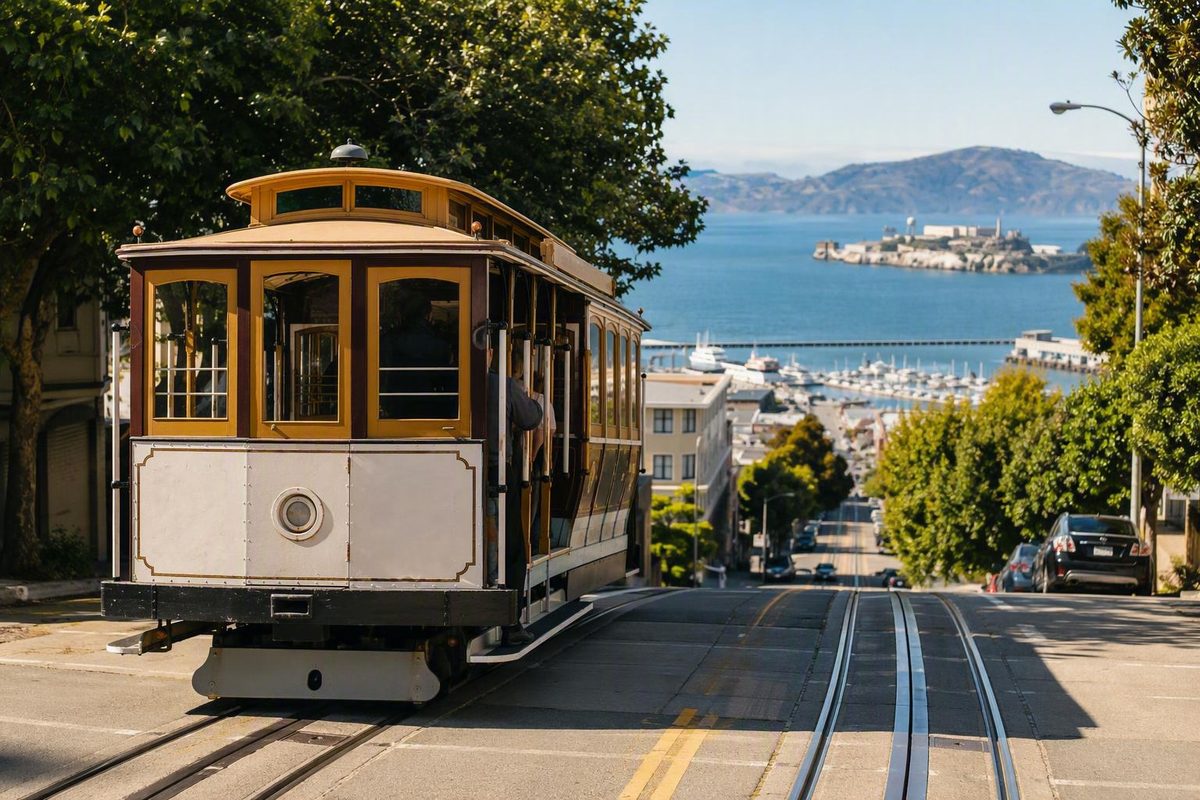
A first cable-car ride is easier to plan when you start with your destination rather than the most familiar route name. Before joining a queue:
- Choose Powell-Hyde, Powell-Mason, or California Street.
- Check current SFMTA maps, schedules, service alerts, and fares.
- Prepare your payment before boarding.
- Decide whether you prefer a terminal queue or the uncertainty of an intermediate stop.
- Confirm the endpoint—not merely “Fisherman’s Wharf.”
Powell-Hyde is the practical choice for Lombard Street and the western waterfront. Powell-Mason works better for North Beach and the closest cable-car access to Pier 39. California Street is the direct choice for Nob Hill.
The essential answer before you join a line
San Francisco operates three cable-car lines: Powell-Hyde, Powell-Mason, and California Street. The two Powell lines connect Powell and Market with different parts of the Fisherman’s Wharf area. The California Street line runs from California and Market to Van Ness Avenue Cable Cars | SFMTA. SFMTA provides current maps, schedules, fares, and operating information on its official cable-car page.
That distinction matters. “Cable car to Fisherman’s Wharf” is not a sufficiently precise plan because Powell-Hyde and Powell-Mason separate after sharing part of their downtown route. One ends near Hyde and Beach; the other ends at Bay and Taylor.
Cable cars are functioning public transit as well as historic attractions. The system dates to 1873 and received National Historic Landmark designation in 1964. More importantly for trip planning, cable cars do not provide accessible boarding. Anyone who requires accessible transportation should consult SFMTA for an appropriate alternative before traveling to a cable-car stop.
Do not build the day around a schedule copied from an undated travel article. Service hours, departures, disruptions, maintenance, and special-event arrangements can change. Check SFMTA on the day you intend to ride and keep another Muni route available as a backup.
Your quickest destination rule is:
- Lombard Street, Russian Hill, Aquatic Park, or Ghirardelli Square: Powell-Hyde
- North Beach, central Fisherman’s Wharf, or the direction of Pier 39: Powell-Mason
- Nob Hill, Huntington Park, or Grace Cathedral: California Street
Choose the line by destination, not by name recognition
All three lines provide the characteristic cable-car experience, but they do not serve interchangeable destinations.
| Line | Endpoints | Useful visitor areas | Main planning tradeoff |
|---|---|---|---|
| Powell-Hyde | Powell and Market to Hyde and Beach | Lombard Street, Russian Hill, Aquatic Park, Ghirardelli Square, western Fisherman’s Wharf | Commonly favored for scenery, which can also make it a popular choice |
| Powell-Mason | Powell and Market to Bay and Taylor | Chinatown access, North Beach, central Fisherman’s Wharf, closest cable-car endpoint to Pier 39 | Better aligned with the eastern waterfront, but Pier 39 still requires a walk |
| California Street | Market/Drumm area to Van Ness Avenue | Financial District, Chinatown access, Nob Hill, Huntington Park, Grace Cathedral | Does not serve Fisherman’s Wharf, but is often suggested as a potentially quieter ride |
The Market Street Railway guide to the three cable-car lines details their different endpoints and the principal neighborhoods served.
Powell-Hyde runs between Powell and Market and Hyde and Beach. It passes through Nob Hill and Russian Hill, provides access near the crooked section of Lombard Street, and continues to Aquatic Park, Ghirardelli Square, and the western end of Fisherman’s Wharf.
It is commonly favored for scenery, but “best” is subjective. Your preferred route depends on whether you value the approach to the western waterfront, proximity to Lombard Street, a particular riding position, or simply reaching your next stop efficiently.
Powell-Mason shares tracks with Powell-Hyde near Powell and Market before heading toward Mason Street, Chinatown access, North Beach, and Bay and Taylor. It is the better-aligned Powell route for North Beach and has the cable-car endpoint closest to Pier 39. It does not deposit you at the Pier 39 entrance, however; expect to continue on foot.
If Chinatown or North Beach is your destination, you may want to leave the car before its endpoint rather than staying aboard merely to complete the route.
California Street runs between the Market/Drumm area and Van Ness Avenue, climbing through Nob Hill. Its stops are useful for the Financial District, Chinatown access, Huntington Park, Grace Cathedral, and Nob Hill hotels.
This line is often suggested as a potentially quieter alternative to the Powell routes, but that is not a promise of a short queue or immediate boarding. Its reliable advantage is geographic: it serves Nob Hill directly and does not travel to Fisherman’s Wharf.
The practical rule is simple: choose California Street when the ride itself or Nob Hill is the goal. Choose one of the Powell lines for the Fisherman’s Wharf corridor—and confirm which waterfront endpoint you actually want.
Fare, payment, and the cost of boarding again
As of publication in August 2026, SFMTA lists the regular cable-car fare as $9 for one one-way trip. A single ticket does not include a transfer to another cable-car line. Two separately boarded cable-car rides therefore cost $18 unless you hold a currently valid pass covering both boardings. Check the official SFMTA cable-car fare page immediately before traveling because fares and payment rules can change.
Officially supported payment methods include:
- MuniMobile
- Clipper card
- Clipper on a compatible phone
- Exact-change cash where payment to the operator is permitted
MuniMobile supports in-app purchases using credit or debit cards, PayPal, Apple Pay, and Google Pay. That does not mean you should assume a contactless bank card can be tapped directly aboard every cable car. Use a payment method SFMTA currently identifies for the service.
When advance purchase is required
At three principal terminals, passengers must purchase the fare before boarding during posted kiosk hours:
- Powell and Market
- Hyde and Beach
- Bay and Taylor
SFMTA’s published pages conflict on when those terminal prepayment hours end: one page says 5 p.m. and another says 8 p.m. Do not rely on either closing time without checking the current posted rule for the day of your ride.
At an eligible nonterminal stop—or outside the applicable terminal kiosk hours—SFMTA permits payment to the operator in exact cash. Bring the correct amount; do not expect the operator to make change.
Should you buy a Visitor Passport?
A Visitor Passport can be worth considering if you plan several cable-car and other Muni rides. It is not automatically the cheapest choice.
Compare the current official pass price with the boardings you realistically expect to make. At the listed $9 single fare:
- One cable-car boarding costs $9.
- Two separately paid boardings cost $18.
- Each additional boarding requires another fare unless a valid pass covers it.
Then account for any other Muni trips included by the current pass. Do not use an old pass price from a blog or screenshot because pass products and prices can change.
Children, youth, and reduced fares
Children age four and under ride free. Free travel for older youth is not a general visitor benefit: SFMTA’s Free Muni for Youth program covers qualifying San Francisco residents age 18 and under who have the appropriate Clipper card.
SFMTA also lists a reduced cable-car fare for eligible senior, disabled, or Medicare riders, but it applies only before 7 a.m. or after 9 p.m. Confirm current eligibility, identification requirements, times, and pricing with SFMTA before traveling.
Where to board—and what the shorter-line tactic can and cannot do
You can board a cable car in either of two ways:
- At a terminal turntable
- At a marked intermediate stop along the route
For the Powell lines, the three principal terminals discussed in SFMTA’s fare rules are Powell and Market, Hyde and Beach, and Bay and Taylor.
At a terminal, join the defined queue for the correct line. At Powell and Market in particular, verify whether you are waiting for Powell-Hyde or Powell-Mason. Do not assume every car serves the same waterfront destination.
At an intermediate stop, wait beside the cable-car signpost where the crew can see you. Signal the approaching car clearly, then wait for crew direction before boarding. A car may pass if it has no available capacity.
Terminal versus intermediate stop
A terminal has an obvious disadvantage: the queue can be long. It also has meaningful advantages:
- You know where the boarding line begins.
- You can confirm the route and destination.
- A family or group has a better chance of boarding together.
- You may have a broader choice of available riding positions.
An intermediate stop removes the known terminal queue but introduces uncertainty. The arriving car may have limited space or no available capacity.
Some travel guides and rider accounts recommend walking beyond a busy turnaround and trying a marked stop. The tactic may reduce waiting under favorable conditions, but it is not a guaranteed shortcut. Even a car that reaches the stop may be unable to accept your entire party.
For a solo traveler or couple, exchanging the terminal queue for uncertain capacity may be reasonable. For a family or larger group, it can be a poor bargain. If only limited room is available, your party may have to decline boarding or risk being separated.
If your goal is simply to experience a cable car—not specifically to reach Fisherman’s Wharf—consider the California Street line. It serves a different corridor and is sometimes suggested as a quieter alternative, but no particular wait time is guaranteed.
The useful rule is:
- Use a terminal when boarding together matters.
- Try an intermediate stop only if you accept that the next car may not have room.
Your first ride, step by step
The process is straightforward once you know what to expect.
-
Confirm the line and endpoint. At Powell and Market, make sure the car serves Powell-Hyde or Powell-Mason according to your destination. Elsewhere, read the route and destination signs before boarding.
-
Check current service information. Review SFMTA’s map, schedule, and alerts. If service conditions do not fit your plans, use your backup route rather than waiting indefinitely.
-
Prepare the fare. Buy or load the correct fare before reaching a terminal platform. If using a mobile ticket, follow the app’s current activation instructions. If an eligible cash payment will be made to the operator, carry exact change.
-
Join the queue or signal at a marked stop. At a terminal, enter the line for the correct route. At an intermediate stop, stand beside the sign and signal visibly as the car approaches.
-
Wait for crew direction. Do not approach or attempt to board a moving car. The crew controls boarding and may need to assign the remaining space.
-
Board carefully. Depending on capacity and crew direction, interior seating, exterior benches, standing space, or outside running-board positions may be available.
-
Show or pay the fare as applicable. Follow the conductor’s instructions. Terminal and nonterminal payment procedures are not always identical.
-
Use only an available, crew-approved position. If standing, establish a secure handhold before the car moves and never lean outward. SFMTA emphasizes secure handholds, following operator instructions, waiting for a complete stop, and watching nearby traffic in its official rider guidance.
-
Request your stop in advance. Clearly tell the crew, “Next stop, please.” Do not wait until the car has already reached the intersection where you want to leave.
-
Wait for a complete stop. Remain aboard until the car has stopped and the crew indicates that it is safe to exit.
-
Check the street before stepping away. A cable car can discharge passengers beside moving traffic. Look for nearby vehicles before leaving the boarding area.
The green X traffic signal used along cable-car routes is intended for cable cars, not pedestrians. It is not permission to cross the street. Full-size and folding bicycles are also prohibited aboard cable cars.
If you are carrying unusual luggage or traveling with a stroller, pet, service animal, or mobility device, consult current SFMTA guidance before going to the stop. Space is limited, and current rules or safe-placement requirements may differ by item.
Three simple ride plans for common visitor goals
A one-way cable-car trip often works better than assuming you must ride back the way you came. Use the cable car as the day’s memorable anchor, then choose the return mode according to the hills, service conditions, and your next destination.
Plan 1: A scenic first ride to Lombard Street and the western waterfront
Take: Powell-Hyde Direction: Toward Hyde and Beach Useful for: Lombard Street, Russian Hill, Aquatic Park, Ghirardelli Square, western Fisherman’s Wharf
This is the classic first-ride plan. Board a Powell-Hyde car and stay alert for your chosen stop. If Lombard Street is the priority, request the stop in advance rather than assuming you will recognize the exact intersection in time.
If you continue to Hyde and Beach, you will finish near Aquatic Park and Ghirardelli Square. That gives you a clear waterfront endpoint and lets you choose the return mode separately.
The right side when traveling toward Fisherman’s Wharf is a recurring visitor tip for views. Treat it as a preference, not a guarantee. The better side depends on your position, direction, obstructions, weather, and what you hope to see. Do not delay boarding or ignore crew instructions while trying to secure a particular place.
Plan 2: North Beach and the Pier 39 direction
Take: Powell-Mason Direction: Toward Bay and Taylor Useful for: Chinatown access, North Beach, central Fisherman’s Wharf, Pier 39 direction
Choose Powell-Mason rather than relying on the generic phrase “Fisherman’s Wharf.” This line continues through North Beach and ends at Bay and Taylor, the cable-car endpoint closest to Pier 39.
A walk is still required to reach Pier 39. The value of this plan is not door-to-door delivery; it is choosing the endpoint that leaves you better positioned for the eastern side of the visitor district.
If North Beach is your actual goal, leave the car there rather than riding to the terminal merely to complete the route. The cable car is transit as well as an attraction, so the most useful trip may end before the endpoint.
Plan 3: A Nob Hill ride without going to Fisherman’s Wharf
Take: California Street Direction: Between Market/Drumm and Van Ness Useful for: Financial District, Chinatown access, Nob Hill, Huntington Park, Grace Cathedral
Use California Street when you want the cable-car experience but your sightseeing day is centered on Nob Hill rather than the waterfront. From the eastern end near Market and Drumm, the line climbs toward Nob Hill and continues to Van Ness Avenue.
This route is often recommended when the Powell terminal scene does not suit the day. That does not mean it will be empty or that a car will arrive immediately. Its principal advantage is that it serves a different corridor and set of destinations.
Keep the return trip separate
At the listed fare, boarding another cable car normally requires another $9 fare unless you hold a valid pass. A one-way ride followed by a bus, Metro, streetcar, walk, or another suitable option can also avoid retracing the outbound cable-car route.
This directional approach makes it easier to plan around elevation. For broader itinerary context, use San Francisco Know’s hill-smart San Francisco day-planning guide to arrange nearby stops and avoid unnecessary climbs.
Add the Cable Car Museum without complicating the route
The Cable Car Museum is at 1201 Mason Street, near Mason and Washington. It fits most naturally into a Powell-line day because both Powell routes pass through the surrounding area.
Instead of treating the museum as a separate cross-city excursion, use it as a stop before or after your ride. For example:
- Ride a Powell car toward the museum area, visit, and continue on foot or by another transit route.
- Visit the museum first, then walk to a suitable Powell-line stop.
- Combine it with Chinatown or Nob Hill rather than returning to the waterfront solely for the museum.
Confirm current admission and opening hours before arrival. The museum includes preserved cable cars, historical materials, mechanical exhibits, and a view into the operating powerhouse, according to Visit California’s museum overview.
Brief history: San Francisco’s cable cars date to 1873 and were designated a National Historic Landmark in 1964. Their defining mechanical feature is the underground moving cable that pulls each car. That differs from a streetcar or trolley powered through overhead electrical wires.
The museum makes that distinction easier to understand because you can connect the ride above the street with the machinery operating beneath it. Keep the visit proportional to your day, however. If your main priority is Lombard Street or the waterfront, the museum should support that route rather than force unnecessary backtracking.
Final checks and common mistakes to avoid
Before leaving your hotel or previous attraction, verify:
- The correct line
- The exact endpoint
- The current one-way fare
- The terminal prepayment rule
- Current kiosk hours
- The day’s schedule
- Active service alerts
- A backup bus, Metro, streetcar, or walking route
- Whether everyone in the group can use non-accessible boarding
Then avoid these common planning errors.
Joining the wrong Powell queue
Powell-Hyde and Powell-Mason share Powell and Market but reach different waterfront endpoints. Powell-Hyde is for Lombard Street and the western waterfront; Powell-Mason is for North Beach and the endpoint closest to Pier 39.
Assuming one ticket includes a return or transfer
A single ticket covers one one-way cable-car trip. At the official $9 fare, boarding a second cable car brings the total to $18 unless a valid pass covers both rides.
Trusting old prices and operating hours
Fares, pass prices, kiosk hours, schedules, and service patterns change. SFMTA’s published pages even differ on the terminal kiosk closing time. Check current information rather than trying to resolve that discrepancy through old travel articles.
Treating an intermediate stop as a guaranteed shortcut
Walking beyond a turnaround replaces a visible queue with uncertain capacity. The next car may pass if full.
Promising that a group will board together
A terminal is generally the better strategy when the party must remain together. At an intermediate stop, the available space may not accommodate everyone.
Bringing only a large cash bill
Where cash payment to the operator is permitted, exact change is required. Prepare it in advance rather than expecting change aboard.
Confusing cable cars with historic streetcars
Cable cars are pulled by moving underground cables. San Francisco’s historic streetcars use overhead electrical wires. They are different vehicles serving different routes, with different boarding considerations.
Overlooking accessibility
Cable cars do not offer accessible boarding. Travelers who need accessible service should identify a current SFMTA alternative before going to the platform.
Concentrating on the view instead of the ride
Exterior positions require attention. Maintain a secure handhold, do not lean outward, follow crew instructions, and wait for a complete stop before stepping down. Check for traffic as you move away from the car.
The final decision rule is compact: choose the route by destination, prepare payment before reaching the platform, and keep another Muni option available if the queue or service conditions do not suit the day.
For Lombard Street and the western waterfront, use Powell-Hyde. For North Beach and the closest cable-car access to Pier 39, use Powell-Mason. For Nob Hill, use California Street. SFMTA lists $9 for one one-way ride with no transfer between cable-car lines, while intermediate-stop boarding always depends on available space. Recheck fares, schedules, kiosk hours, and alerts immediately before departure.
Frequently asked questions
How much does it cost to ride a cable car in San Francisco?
As of August 2026, SFMTA lists the regular fare as $9 for one one-way ride. A single ticket does not include a return journey or a transfer to another cable-car line, so two separately boarded rides cost $18 unless a valid pass applies. Check SFMTA’s official fare information before traveling because prices and payment rules can change.
Which cable-car line is best for Lombard Street, Pier 39, or Nob Hill?
Take Powell-Hyde for Lombard Street, Russian Hill, Aquatic Park, Ghirardelli Square, and the western waterfront. Take Powell-Mason for North Beach and the cable-car endpoint closest to Pier 39, remembering that you must continue on foot. Take California Street for Nob Hill, Huntington Park, and Grace Cathedral.
Powell-Hyde is commonly favored for scenery, but there is no objectively best line. The right choice is the one aligned with your destination.
Can I avoid the Powell and Market line by boarding at another stop?
You can try boarding at a marked intermediate stop. Wait beside the sign, signal the approaching car clearly, and follow crew instructions.
This may avoid the terminal queue, but it does not guarantee faster boarding. A full car may pass without taking passengers, and limited capacity can make the tactic unsuitable for families or larger groups. Use a terminal if boarding together matters more than avoiding the visible queue.
Are San Francisco cable cars wheelchair accessible?
No. Cable cars do not provide accessible boarding. Travelers requiring accessible service should consult SFMTA before departure for a current, suitable alternative serving the intended corridor.
Can children or bicycles ride on San Francisco cable cars?
Children age four and under ride free. Free travel for older youth through the Free Muni for Youth program is limited to qualifying San Francisco residents with the appropriate Clipper card; it is not a universal free-youth fare for visitors.
Full-size and folding bicycles are not permitted aboard cable cars. For strollers, mobility devices, unusual luggage, pets, or service animals, review current SFMTA guidance before traveling.