
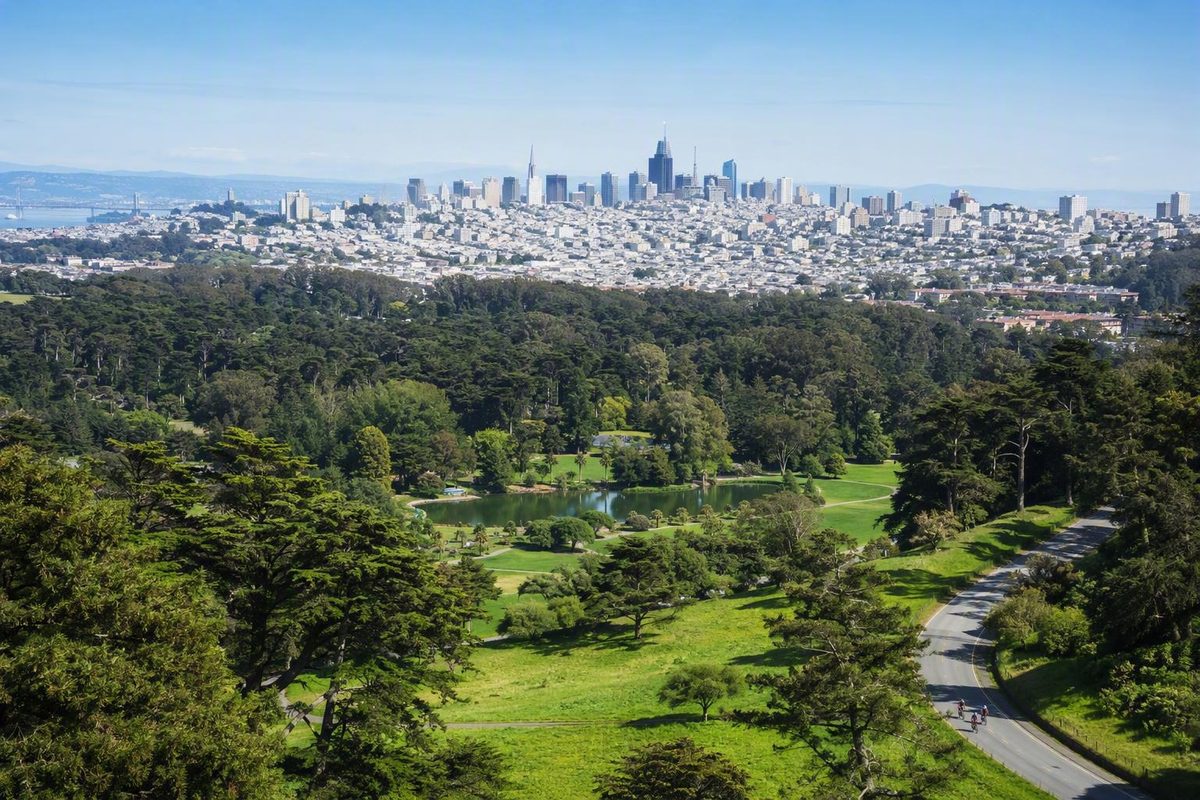
The short answer: Golden Gate Park covers 1,017 acres
Golden Gate Park covers 1,017 acres—approximately 412 hectares, 4.12 square kilometers, or 1.59 square miles. The acreage appears in the California State Parks historic-resource listing for Golden Gate Park and is repeated by a secondary reference, making it the best-supported answer to “How big is Golden Gate Park?”
Golden Gate Park size at a glance
Measurement Park size Area 1,017 acres Metric area About 412 hectares Square kilometers About 4.12 km² Square miles About 1.59 mi² Approximate length Roughly 3 to 3.5 miles Approximate width About 0.5 mile
Descriptions such as “about 1,000 acres” or “over 1,000 acres” are reasonable shorthand, but they are rounded descriptions rather than better exact measurements. For a direct factual answer, use 1,017 acres.
The acreage establishes the park’s total area, but its shape provides more useful context for visitors. Golden Gate Park extends for several miles from east to west while remaining comparatively narrow from north to south. It is therefore better understood as a sequence of landscapes and destinations than as one compact green square.
How long and wide is Golden Gate Park?
The official historic-resource listing gives dimensions of 3.5 miles by 0.5 mile, while a secondary reference says the park extends over three miles east to west and about half a mile north to south. Together, these descriptions support a practical range rather than one exact end-to-end measurement. California State Parks provides the official listing’s dimensions.
The available evidence does not identify the exact points or method used for the length measurement. It does not say whether the distance follows a boundary, a central axis, or another line through the park. “Roughly,” “approximately,” and “about” are therefore appropriate when describing its linear dimensions.
The stated length and width also should not be multiplied as though the park were a perfect rectangle. Rounded dimensions communicate the overall proportions of an irregular footprint; the reported acreage is the better measure of total area.
The distinction is straightforward:
- Area tells you how much land the park encompasses.
- Length shows how far the footprint reaches from east to west.
- Width gives its general north-to-south span.
- Shape explains why those rounded dimensions do not produce an exact rectangular area.
For visitors, the length may be the most useful measurement. Destinations inside the same named park can still occupy different parts of a several-mile-long landscape. Being in Golden Gate Park does not necessarily mean being close to every museum, garden, lake, meadow, or recreation area within it.
Where that footprint sits in San Francisco
Golden Gate Park occupies a long section of western San Francisco between the Richmond and Sunset districts. Its main axis runs east to west toward the Pacific Ocean, creating an elongated band of parkland rather than a compact central square.
For map orientation, the California State Parks historic-resource listing names Fulton Street, Stanyan Street, Fell Street, Baker Street, Oak Street, Lincoln Way, and the Great Highway among the park’s boundaries. These streets are useful reference points, but they should not be reduced to a single pair of exact endpoints.
At a broad level:
This geography explains why the park can feel like several distinct areas. Entering near its eastern side creates a different starting point from arriving near the ocean, even though both locations fall within Golden Gate Park.
The name can also cause confusion: Golden Gate Park is not the Golden Gate Bridge. It is also distinct from the Presidio, Crissy Field, and the Golden Gate waterfront. The shared words “Golden Gate” do not make these places one continuous attraction or walking route.
For itinerary purposes, locate the park by its relationship to the Richmond district, the Sunset district, and the Pacific Ocean. A bridge or waterfront outing should be treated as a separate geographic plan rather than assumed to connect directly through Golden Gate Park.
What 1,017 acres contain
Golden Gate Park’s scale becomes clearer when connected to the range of landscapes inside it. The California State Parks listing describes forests, open meadows, gardens, lakes, curving paths, roads, and active-recreation facilities distributed throughout the park.
Selected destinations illustrate that variety. They include the Dutch Windmill, Bison Paddock, Spreckels Lake, Japanese Tea Garden, botanical garden, de Young Museum, and California Academy of Sciences. A Golden Gate Park attraction overview documents this mix of gardens, cultural institutions, water features, animals, and outdoor landmarks.
These examples are not an exhaustive sightseeing list. Their purpose is to show how the park’s acreage is used. Golden Gate Park is not simply one enormous lawn; vegetation, gardens, lakes, roads, paths, recreation areas, and institutions divide the larger landscape into places with different functions and atmospheres.
Much of the site was formerly windblown sand dunes. That history provides brief but useful context for the scale of the landscape: the park was not merely a surviving tract of woodland. Its forests, meadows, gardens, water features, circulation routes, and recreation facilities form a designed urban park.
For planning, it is reasonable to think in geographic clusters. That is a practical inference from the park’s elongated shape and varied destinations, not an official zoning system. A museum-centered visit, a garden visit, and an outing focused on lakes or open scenery can all take place in Golden Gate Park without covering the same ground.
The acreage supports several different kinds of experience:
- Forests and meadows provide outdoor space without functioning as individual attractions.
- Gardens create more defined destinations within the larger public landscape.
- Lakes and recreation facilities serve purposes different from museums.
- Roads and paths connect areas while also shaping how visitors move between them.
- Major cultural institutions make some itineraries more structured than others.
- The park’s reach toward the Pacific adds another geographic dimension to a visit.
The more useful question is therefore not simply “Should I visit Golden Gate Park?” It is “Which part of Golden Gate Park fits what I want to see or do?”
Is Golden Gate Park bigger than Central Park?
Yes. Under the figures available here, Golden Gate Park is larger than New York’s Central Park.
The strongest supplied figure for Golden Gate Park is 1,017 acres. A third-party comparison rounds the parks to approximately 1,000 acres for Golden Gate Park and 800 acres for Central Park, while another third-party article places Central Park at about 842 acres. Those sources therefore support a qualified Central Park range of approximately 800 to 842 acres, not one exact total. One comparison uses about 800 acres, while the other gives about 842 acres.
Because the Central Park figures are approximate and come from third-party sources, it would be misleading to calculate a supposedly exact acreage difference. The defensible conclusion is simply that Golden Gate Park’s supported area exceeds the Central Park estimates supplied here.
The comparison is useful as a scale cue. Both parks are described as long, relatively narrow urban green spaces surrounded by dense development. Neither is well represented by the mental image of a small square park enclosed by a few blocks.
Acreage alone, however, does not establish which park offers a better experience or a greater concentration of attractions. It measures total reported area, not quality, convenience, landscape character, or the amount of time a visitor should spend there.
For San Francisco visitors, the practical lesson is that Golden Gate Park should not be treated as a minor stop that can automatically be crossed and completed between unrelated attractions. Its larger-than-Central-Park scale is most useful as a reminder to choose priorities.
Why different sources give different numbers
Readers may encounter several descriptions of Golden Gate Park’s size. The supplied sources include 1,017 acres, about 1,000 acres, over 1,000 acres, and an unsupported third-party figure of 1,013 acres.
These figures do not carry equal evidentiary weight:
- 1,017 acres appears in the California State Parks historic-resource listing and is repeated by a secondary encyclopedia.
- About 1,000 acres is an explicitly rounded figure used by a third-party park comparison.
- Over 1,000 acres is a broad description used by a travel overview.
- 1,013 acres appears without a supporting citation in a third-party opinion article.
For a precise answer, 1,017 acres is the figure to use. It is supported by the highest-authority source in the supplied material and corroborated by the secondary reference.
“About 1,000 acres” is not difficult to reconcile with that total. The word “about” makes clear that the number is rounded. Likewise, “over 1,000 acres” communicates the park’s general scale without claiming to be the most precise available measurement.
The 1,013-acre figure deserves more caution because it appears exact but is uncited in the supplied article. A number is not necessarily more reliable simply because it is more specific. Without comparable documentation, it should not replace the better-supported total.
Published descriptions of the length vary as well. One source says the park extends over three miles, while the historic-resource listing gives 3.5 miles. The available evidence does not establish why the wording differs, so it would be speculative to attribute the discrepancy to surveying methods, boundary changes, or selected endpoints.
The careful approach is to treat total area as the more stable figure and the linear dimensions as approximate. Acreage answers how much land the park encompasses; length and width help readers visualize its proportions.
What the park’s size means when planning a visit
Golden Gate Park’s elongated footprint makes advance prioritization more useful than trying to build an itinerary around the park as a whole. Start by deciding what kind of visit you want: museums, gardens, open scenery, lakes, recreation, or a flexible outdoor walk.
Next, consult a current map and group choices that appear near one another. This is planning guidance rather than a claim about exact distances. Two destinations can share a Golden Gate Park location while still belonging to different parts of a practical itinerary.
A focused visit might be organized around:
- A cultural institution and nearby landscaped areas.
- One or two gardens rather than every named garden.
- Lakes, meadows, or wooded scenery.
- Recreation as the main purpose of the outing.
- The park’s western landscapes and Pacific orientation.
- One anchor destination with unstructured outdoor time nearby.
These are not official park divisions. They are ways to make an elongated urban park easier to navigate without assuming every notable place belongs in one visit.
Acreage is less useful for this decision than geography. Total area describes how much land exists inside the park, but the east-to-west reach explains why an itinerary can become scattered. Choosing an anchor area reduces unnecessary backtracking and leaves more flexibility for the landscapes encountered along the way.
Before visiting, check a current park map and verify access information for the specific destinations on your list. Attraction schedules, entry arrangements, temporary closures, transportation conditions, and road access can change. No single estimate can reliably describe how long it takes to “do” Golden Gate Park because the answer depends on route, pace, stops, operating conditions, and transportation choice.
The park’s approximate length also should not be converted into a generic end-to-end travel time. Paths may not follow a direct line, and a real visit can include detours, entrances, pauses, or destinations away from the most direct route.
Finally, do not combine Golden Gate Park automatically with a Golden Gate Bridge or waterfront itinerary merely because the names overlap. The waterfront route involving the Marina, Crissy Field, and the bridge concerns a different part of San Francisco.
The simplest rule is the most useful: choose the portion of Golden Gate Park that matches your priorities instead of assuming the entire park can be experienced as one stop.
Frequently asked questions
How many acres is Golden Gate Park?
Golden Gate Park covers 1,017 acres. Rounded descriptions such as “about 1,000 acres” communicate the same general scale, but 1,017 acres is the better-supported precise figure.
How many square miles is Golden Gate Park?
Golden Gate Park covers approximately 1.59 square miles, equivalent to about 4.12 square kilometers or 412 hectares.
These are measurements of total area, not the dimensions of a perfect rectangle.
How long and wide is Golden Gate Park?
It runs east to west and is much longer than it is wide. Published descriptions should be treated as approximate because the sources use slightly different wording for the length and do not identify the precise measurement endpoints. The reported range and width are summarized in the dimensions section above.
Is Golden Gate Park larger than Central Park?
Yes. Golden Gate Park’s supported acreage exceeds the approximate Central Park figures in the supplied comparisons. The evidence supports the general conclusion that Golden Gate Park is larger, but not an exact acreage difference.
Is Golden Gate Park near the Golden Gate Bridge?
Golden Gate Park and the Golden Gate Bridge are separate destinations and should not be treated as parts of one continuous attraction. Golden Gate Park lies between the Richmond and Sunset districts and extends toward the Pacific; the bridge, Presidio, Crissy Field, and Golden Gate waterfront belong to a different itinerary. Check a current map and transportation information before planning to visit both.